
Antarctica's Air-Eating Microbes
Clip: Episode 3 | 3m 54sVideo has Closed Captions
No sunlight, no soil to eat. In Antarctica, Dr. Ry Holland finds microbes surviving on thin air.
In East Antarctica's frozen interior, Dr. Ry Holland hunts for aerotrophs: microbes that live on thin air by consuming trace gases like hydrogen, methane and carbon monoxide. Suited up like astronauts to avoid contamination, the team collects DNA from the air and tests soil for gas uptake. These microbes may anchor the food chain here and hint at how life might exist on icy moons like Europa.
Problems playing video? | Closed Captioning Feedback
Problems playing video? | Closed Captioning Feedback
Antarctica's Air-Eating Microbes
Clip: Episode 3 | 3m 54sVideo has Closed Captions
In East Antarctica's frozen interior, Dr. Ry Holland hunts for aerotrophs: microbes that live on thin air by consuming trace gases like hydrogen, methane and carbon monoxide. Suited up like astronauts to avoid contamination, the team collects DNA from the air and tests soil for gas uptake. These microbes may anchor the food chain here and hint at how life might exist on icy moons like Europa.
Problems playing video? | Closed Captioning Feedback
Where to Watch Ages of Ice
Ages of Ice is available to stream on pbs.org and the PBS app.
Share Inspiring Moments From The Film
Explore the PBS Giphy collection for Ages of Ice.Providing Support for PBS.org
Learn Moreabout PBS online sponsorship♪ Narrator: Antarctica's interior, new research has uncovered a rich and complex ecosystem.
But, it's at a scale invisible to human eyes, and it doesn't follow the playbook of conventional life.
Once you are in this interior region, it's a microbial dominated world.
They're the only organisms that are adapted to live in a place like this.
I really like microbes because a lot of the time they just don't make any sense.
Like, they just live in the most extreme places that you think nothing can live here.
Feels kind of like being an astronaut when you're in this suit.
So we dress like this to reduce contamination.
There's actually more microbial cells than human cells in your body.
The human cells are just bigger, worse.
We've been wearing these clothes for about ten days in a row.
So there's a lot of potential contamination.
And especially from your mouth as you breathe and speak.
Narrator: This is microbial CSI.
A high precision hunt for life too small to see.
These are essentially the world's most expensive fans.
We stick a filter on the front to capture any bacteria.
And the fans will pull air through for four hours.
They're on a timer, and after that, we'll extract DNA from the filters.
Narrator: But here's where things get weird.
These microbes don't eat soil, or harvest sunlight.
They survive on thin air, literally.
Snacking on molecules in the atmosphere is a strange trick known as aerotrophy, a survival strategy so extraordinary, it's forcing scientists to rewrite the rules of how life works.
So when I'm doing here is measuring how quickly these bacteria in the soils can consume the trace atmospheric gases hydrogen, methane, and carbon monoxide.
So we can see these bacteria in the soils actually consuming those gases, which is really cool that it happens even at the freezing cold Antarctic temperatures.
So we think that aerotrophs are actually forming the base of the food chain here.
I think it's very interesting to see how an ecosystem forms.
They're alive, but they're alive in such a completely different dimension to the way that humans are alive.
Narrator: As we discover more about Antarcticas strange microscopic life forms, the more the cosmos begins to feel alive with possibility.
There's definitely a lot of interesting analogs to extraterrestrial life in Antarctica for like Europa, the moon of Jupiter, which has the ice encrusted surface.
Yeah, Antarctica is very interesting place to study astrobiology.
What life might be like on other planets.
Video has Closed Captions
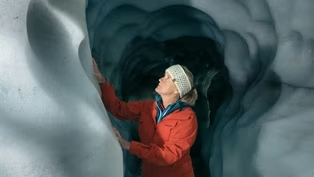
Clip: Ep3 | 3m 39s | Could life beyond Earth hide in ice? Dr. Birgit Sattler finds tardigrades thriving inside a glacier. (3m 39s)
Providing Support for PBS.org
Learn Moreabout PBS online sponsorship New Episode
- Science and Nature

Explore scientific discoveries on television's most acclaimed science documentary series.


 New Episode
 New Episode








Support for PBS provided by: