
After Auschwitz, the Long March to Freedom
Clip | 3m 29sVideo has Closed Captions
Survivors recount a freezing, dangerous trek to freedom after Auschwitz.
In the chaos following Auschwitz’s liberation, a group of children set out on foot under the guidance of Erno “Zvi” Spiegel. Facing extreme cold, hunger, and uncertainty, they relied on one another to survive. Their journey was marked by small acts of kindness, devastating loss, and the determination to find home again.
Problems playing video? | Closed Captioning Feedback
Problems playing video? | Closed Captioning Feedback
Funding for the PBS presentation of THE LAST TWINS provided by The Sylvia A. and Simon B. Poyta Programming Endowment to Fight Antisemitism.
After Auschwitz, the Long March to Freedom
Clip | 3m 29sVideo has Closed Captions
In the chaos following Auschwitz’s liberation, a group of children set out on foot under the guidance of Erno “Zvi” Spiegel. Facing extreme cold, hunger, and uncertainty, they relied on one another to survive. Their journey was marked by small acts of kindness, devastating loss, and the determination to find home again.
Problems playing video? | Closed Captioning Feedback
How to Watch The Last Twins
The Last Twins is available to stream on pbs.org and the free PBS App, available on iPhone, Apple TV, Android TV, Android smartphones, Amazon Fire TV, Amazon Fire Tablet, Roku, Samsung Smart TV, and Vizio.
Providing Support for PBS.org
Learn Moreabout PBS online sponsorship-With the Nazis retreating and the Soviet army in pursuit, Spiegel and the twins found themselves on their own at Auschwitz.
They faced the prospect of a long and dangerous journey back to their homes, uncertain if those homes even still existed.
-I don't think Zvi Spiegel had the idea of assembling the kids and taking them home.
He just wanted to go home himself.
But then we kids approached him and basically begged him to take us with him.
-First of all, he was able to speak quasi-Russian, and quasi a little bit of the Polish.
Says, "Take away because, if by any chance, the Germans turn around and come back, we will not make it."
-Spiegel kept a detailed list of the children in his charge as they set out into one of the coldest European winters of the 20th century, where temperatures regularly dropped well below freezing.
-We had no idea what this whole thing entails.
How're we going to go?
Are we going to take a train, a bus, walk?
No, I had no -- I had no concept of -- of what that meant.
-A day later, we started walking.
Two days and two nights, we walked, bitter cold and just walked.
-On the first night, they found an abandoned schoolroom and huddled in a corner to stay warm.
-Somehow he always found something.
Always was able to find something.
-The second night, a Polish farmer offered Spiegel and the boys shelter in a barn.
They lit a fire to stay warm.
But the straw they were sleeping on caught fire, sending the boys back into the relentless snow.
One day later, a Red Army convoy stopped beside the twins, and the commanders ordered their troops to transfer the children to Krakow.
The soldiers loaded the children into three army trucks.
The third truck had an accident, and one of the twins, Chaim Katz, was thrown from the truck and killed.
♪
Video has Closed Captions
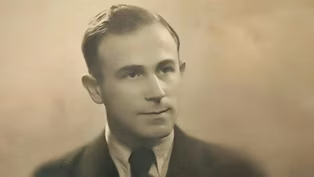
The story of Erno Spiegel, who shielded dozens of twins from experimentation in Auschwitz. (2m 34s)
 New
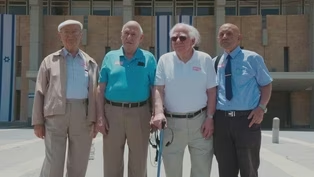
NewThe Last Twins of Auschwitz Reunite After Decades
Video has Closed Captions
An emotional reunion gives Holocaust survivors a chance to reflect. (3m 25s)
 New
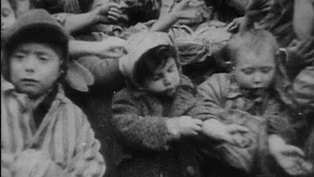
NewThe Hero Who Saved Children in Auschwitz
Video has Closed Captions
Survivors share how one man’s bravery saved children in Auschwitz. (2m 58s)
 Now Playing
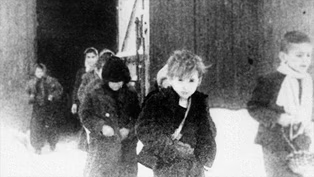
After Auschwitz, the Long March to Freedom
Video has Closed Captions
Survivors recount a freezing, dangerous trek to freedom after Auschwitz. (3m 29s)
Providing Support for PBS.org
Learn Moreabout PBS online sponsorship














Support for PBS provided by:
Funding for the PBS presentation of THE LAST TWINS provided by The Sylvia A. and Simon B. Poyta Programming Endowment to Fight Antisemitism.