
April 10, 2023 - PBS NewsHour full episode
4/10/2023 | 57m 46sVideo has Closed Captions
April 10, 2023 - PBS NewsHour full episode
April 10, 2023 - PBS NewsHour full episode
Problems playing video? | Closed Captioning Feedback
Problems playing video? | Closed Captioning Feedback
Major corporate funding for the PBS News Hour is provided by BDO, BNSF, Consumer Cellular, American Cruise Lines, and Raymond James. Funding for the PBS NewsHour Weekend is provided by...
Support provided by:

April 10, 2023 - PBS NewsHour full episode
4/10/2023 | 57m 46sVideo has Closed Captions
April 10, 2023 - PBS NewsHour full episode
Problems playing video? | Closed Captioning Feedback
How to Watch PBS News Hour
PBS News Hour is available to stream on pbs.org and the free PBS App, available on iPhone, Apple TV, Android TV, Android smartphones, Amazon Fire TV, Amazon Fire Tablet, Roku, Samsung Smart TV, and Vizio.
Providing Support for PBS.org
Learn Moreabout PBS online sponsorshipAMNA NAWAZ: Good evening, and welcome.
I'm Amna Nawaz.
GEOFF BENNETT: And I'm Geoff Bennett.
On the "NewsHour" tonight: A mass shooting at a bank in downtown Louisville, Kentucky, kills multiple people and injures several more.
AMNA NAWAZ: U.S. officials scramble to do damage control after classified documents detailing military intelligence are leaked online.
GEOFF BENNETT: And North Carolina expands Medicaid after a decade-long battle.
We speak with patients who could benefit.
EVITA BASS, Uninsured North Carolina Resident: Better late than never.
You kind of just got to roll with the punches.
Granted, I wish it would have came a little bit earlier.
(BREAK) GEOFF BENNETT: Good evening, and welcome to the "NewsHour."
Yet another American city has joined the seemingly endless list of mass killings at the hands of a gunman.
This time, it's Louisville, Kentucky, where four people were killed today, as well as the shooter.
AMNA NAWAZ: Nine others were injured, including two police officers.
It came two weeks after a school shooting in Nashville, Tennessee, that killed three children and three adults.
Lisa Desjardins begins our coverage.
LISA DESJARDINS: Crime scene tape wraps around the Old National Bank building in Louisville, marking tragedy there and, for a nation on edge, at least the 15th mass killing this year.
Witnesses said the gunman opened fire inside the building, located near Louisville's Slugger Field and Waterfront Park.
Officers arrived within three minutes of dispatch and immediately exchanged gunfire with the shooter.
Interim police Chief Jacquelyn Gwinn-Villaroel: JACQUELYN GWINN-VILLAROEL, Louisville, Kentucky, Metro Police Chief: For my LMPD officers who took it upon themselves to not wait to assess everything, but just went in to stop the threat, so that more lives would not be lost, thank you.
LISA DESJARDINS: Police say the gunman was a 23-year-old man who worked at the bank.
They described his weapon as a rifle.
He left four victims dead on the scene, 63-year-old Tommy Elliot, 64-year-old Jim Tutt, 40-year-old Josh Barrick, 57-year-old Juliana Farmer.
Others were in critical condition, including Nickolas Wilt, a young police officer who was shot in the head.
JACQUELYN GWINN-VILLAROEL: The officer who is in critical condition today, officer Nickolas Wilt, 26 years of age, just graduated from the police academy on March 31.
LISA DESJARDINS: Survivors today grateful to escape a rampage the shooter broadcast on social media.
TROY HASTE, Witness: We have a break room.
And I got in there and shut the door for a second.
And then I was looking around.
I opened the door to see where he was at, and I could see him still shooting.
I didn't see his face.
And then I took off running out the front door.
LISA DESJARDINS: Democratic Governor Andy Beshear spoke as both state leader and a person grieving.
GOV.
ANDY BESHEAR (D-KY): This is awful.
I have a very close friend that didn't make it today and one who's in the hospital that I hope is going to make it through.
Sol, when we talk about praying, I hope people will.
LISA DESJARDINS: Louisville's Mayor Craig Greenberg, also a Democrat, has himself survived gun violence after a shooting in his campaign office last year.
CRAIG GREENBERG, Mayor of Louisville, Kentucky: This was an evil act of targeted violence, and to add to that tragedy, a few blocks away, shortly after this happened, another man lost his life and a woman was shot in completely different act of targeted violence.
The two incidents appear to be entirely unrelated, but they both took lives.
They both leave people scarred, grieving, and angry.
LISA DESJARDINS: As the nation continues a heated debate about gun deaths, Louisville's investigation into today's violence begins, with assistance from the FBI.
For the "PBS NewsHour," I'm Lisa Desjardins.
GEOFF BENNETT: In the day's other headlines: A grand jury in Newport News, Virginia, indicted the mother of a first grader who shot his teacher.
Deja Taylor is charged with felony child neglect and a misdemeanor firearms count.
The teacher, Abigail Zwerner, was shot in her classroom last January.
Nashville, Tennessee's governing Metro Council reappointed Justin Jones to the Statehouse today on an interim basis.
The vote was unanimous.
Majority Republicans had expelled Jones and fellow Democrat Justin Pearson last week after they joined a gun control protest on the House floor.
Pearson may be reappointed to his seat in Memphis on Wednesday.
Both men would still face a special election later this year.
Thousands of Israelis, including at least seven Cabinet members, marched today to an evacuated settlement in the occupied West Bank.
The crowd was led by ultranationalist Jewish settlers.
They support speeding up settlement building at a time when support for Israel's hard-line government is falling.
China's military says its forces are ready to fight after finishing large-scale combat exercises around Taiwan.
State-provided video today showed Chinese warplanes practicing airstrikes and ships simulating a blockade at sea.
Beijing said it shows that China will never give up its claim to Taiwan.
WANG WENBIN, Chinese Foreign Ministry Spokesman (through translator): We hope the international community will fully understand the essence of the issue, firmly abide by the one China principle, and firmly oppose all forms of Taiwan separatist activities.
Taiwan independence is incompatible with peace and stability in the Taiwan Strait.
GEOFF BENNETT: The exercises are retaliation for Taiwan's president meeting with House Speaker Kevin McCarthy last week in California.
In Eastern Ukraine, there's word that Russian forces have turned to scorched-earth tactics in the grinding battle for Bakhmut.
Ukraine's ground commander says buildings there are being systematically leveled by airstrikes and artillery to rob his forces of any cover.
New Russian videos show whole blocks reduced to ruin.
A top pro-Russian official in the region says Moscow's forces now control 75 percent of Bakhmut.
Also today, the State Department formally designated American Evan Gershkovich as wrongfully detained in Russia.
The Wall Street Journal reporter is charged with espionage.
Back in this country, thousands of professors, lecturers, and graduate student workers have gone on strike at Rutgers University in New Jersey.
Some classes went ahead today, even as the strikers began to picket.
They're demanding more money and guaranteed funding for graduate students.
President Biden has indicated again that he will run for reelection.
He told NBC's "Today Show" that he plans on running, but that he's not ready yet for a formal announcement.
Later, the president and first lady hosted the White House Easter egg roll, a tradition for kids and families dating back to 1878.
And, on Wall Street, investors mostly marked time, amid uncertainty over interest rate policy.
The Dow Jones industrial average gained 101 points to close at 33586.
The Nasdaq fell three points.
The S&P 500 added four points.
Still to come on the "NewsHour": conflicting rulings by federal judges leaves the state of a commonly used abortion pill in limbo; Amy Walter and Tamara Keith return with analysis on the latest political news; and the Masters golf tournament shows off the strength of a new Saudi-backed league.
AMNA NAWAZ: It's being described as the most serious intelligence leak in years.
Dozens of pages of classified material are spreading online after being originally posted on a gaming platform.
U.S. officials are investigating the origin of the leaks and the impact of information meant to be secret about the war in Ukraine, Russian forces, and even U.S. spying on American allies.
Nick Schifrin is here now to give us the details.
Nick, good to see you.
NICK SCHIFRIN: Thanks, Amna.
AMNA NAWAZ: Let's start with what we know.
What is in these documents, and how concerned are U.S. officials?
NICK SCHIFRIN: There is serious concern among U.S. officials about the U.S.' relationship with allies that are mentioned in these documents and about the front line in Ukraine.
So let's talk about Ukraine first.
We reviewed 53 of these documents dated from late February and early March mostly.
And we're not going to provide all the details they contain, but slides that seem to be prepared for the chairman of the Joint Chiefs of Staff reveal an extraordinary level of detail about Ukraine's coming counteroffensive, which Ukrainian brigades will be ready for the counteroffensive, when they will be ready, and with which weapons by date.
Many of those brigades going to be trained by the U.S., by the -- by allies on that vehicle there.
That is the Bradley.
And the level of detail is what is concerning U.S. officials.
It could give Russia information about these brigades that are being trained on the Bradley and others that Russia could convert into some kind of battlefield advantage, although there are former generals who actually doubt that that might happen.
The second thing that concerns officials are Ukrainian shortages.
Again, with great detail, these slides reveal exactly when Ukraine will run out of Soviet era air defenses.
That is the S-300 right there.
And that is why U.S. officials are rushing a constellation of Western air defenses you see there, U.S. German and Swedish air defenses.
And so, in response, Ukrainian officials have been largely vague about these leaks, as you would expect, but an adviser to Zelenskyy say: Look, our strategic decisions have already been made.
But we could adjust tactics if we need to.
AMNA NAWAZ: Well, what does the intelligence or what are these documents show about what the U.S. knows about Russian capabilities?
It doesn't exactly paint a great picture there, does it?
NICK SCHIFRIN: Not at all.
And the first thing that reveals is how much information the U.S. has about Russia war plans.
In fact, there's one detail that says that the U.S. shared with Ukraine details of an upcoming Russian offensive before Russia launched that attack.
Intercepted communications reveal especially about Bakhmut.
The private military contractor Wagner that you see there waging a scorched-earth campaign in Bakhmut, the U.S. intercepted communications within Bakhmut that reveal that Wagner was going to NATO ally Turkey to ask them for weapons and also offering Haiti some security assistance.
One last thing about Russia.
One slide reveals that Russian casualties killed and wounded could be 230,000 in this war.
We largely knew that, but some versions of that particular document online have a lower number than that, revealing that somebody, perhaps Russia, was doctoring these documents after they were leaked.
AMNA NAWAZ: You mentioned some information about the U.S. spying on our own allies, our own partners.
What do we see in these documents?
NICK SCHIFRIN: That the U.S. spies on some of its closest partners.
So let's take a look at some of the examples, one, Ukraine.
It definitely surveils Ukraine's leadership.
Two, the U.S. intercepted conversations within South Korea's National Security Council about whether it will send artillery to Ukraine and the U.S. intercepted communications with Mossad -- that is Israel's spy agency -- and that Israel has been asking the U.S. to conduct joint operations against Iran, something that, at least publicly, we did not know until now.
AMNA NAWAZ: Big question, Nick, what about the origin of the leak?
What do we know?
NICK SCHIFRIN: The U.S. officials who we speak to say they don't know much.
Take a listen to John Kirby, the spokesman of the National Security Council, earlier today answering a question to reporter about the leak seriousness.
JOHN KIRBY, NSC Coordinator For Strategic Communications: We don't know what's out there, James.
We don't know who's responsible for this.
And we don't know if they have more than they intend to post.
So we're watching this and monitoring it as best we can.
But the truth and the honest answer to your question is, we don't know.
And is that a matter of concern to us?
You're darn right it is.
NICK SCHIFRIN: But independent investigators believe they know how the leaks spread.
The organization Bellingcat investigates digital footprints, and they found the first leak on a small channel of the gaming platform Discord, says Aric Toler, Bellingcat's director of research and training.
ARIC TOLER, Director of Research and Training, Bellingcat: There's a bunch of mostly some teenagers and some other mostly young men who just like to play "Call of Duty" and "Halo" and stuff together.
The documents that have surfaced are, as a source I talk to said, just the tip of the iceberg.
There's a lot more that's out there.
I don't know exact how many out there, but I have heard the word hundreds put out there, that there are hundreds of other documents that were taken by the leaker and put on this small Discord server.
NICK SCHIFRIN: Investigators will also look at the documents themselves.
Take a look at this one.
They're actually photographs of documents.
On these papers, you can see the top there the level of classification, also an object apparently on the desk behind the document.
Investigators will look at that.
And, already, defense officials are looking at restricting some of the people who have access to this information.
AMNA NAWAZ: A lot more questions left to answer.
Nick Schifrin, thank you.
NICK SCHIFRIN: Thank you.
AMNA NAWAZ: So, how damaging could the release of these secret documents be on the war effort in Ukraine and on U.S. military cooperation with allies around the world?
For that, we turn to retired Lieutenant General Doug Lute.
He served on the National Security Council staff during both the George W. Bush and Obama administrations.
He also had extensive experience on the Joint Staff at the Pentagon, where many of these leaked documents originated.
General Lute, welcome back.
And thanks for joining us.
In your career, you have been in countless briefings where this kind of information has been handled coming from the intelligence arm of the Joint Staff.
Just how tightly held is that information typically?
How easy is it to print it or move it off the premises?
LT. GEN. DOUGLAS LUTE (RET.
), Former U.S.
Ambassador to NATO: Well, typically these sorts of documents would be produced by the intelligence staff inside the Pentagon and briefed to the chairman of the Joint Staff on a very routine basis, typically even five days a week, especially when there's an ongoing conflict, as there is in Ukraine.
It is exceptionally unusual that they would be disseminated officially in official channels beyond that.
So, this is a set of documents which appears to be those that are most tightly kept within the Pentagon itself.
AMNA NAWAZ: Does the fact that it is so tightly kept making it easier in some way to figure out the origin of the leak?
LT. GEN. DOUGLAS LUTE: Perhaps.
But I think it's too early to tell.
AMNA NAWAZ: I want to ask you about some of the contents there.
We heard Nick's reporting on the level of detail when it comes to Ukraine's capability and strategy.
What is your take on that?
Could that give Russian forces an advantage in the war?
LT. GEN. DOUGLAS LUTE: Well, I thought Nick outlined well the tactical impact, the tactical damage that's done by these -- these documents.
And, in particular, I'd be concerned about the level of detail for the units that are being prepared with new equipment, fresh training and so forth, being prepared for the upcoming Ukrainian offensive.
And if the Russians are able to piece together which units with which equipment, and eventually locations inside Ukraine, they might be able to detect, right, and essentially deduce, conclude the main attack, the main effort of the upcoming offensive.
That would be very tactically damaging.
AMNA NAWAZ: You also heard Nick's reporting about the degree to which the U.S. has been spying on its own allies and partners, information President Zelenskyy, conversations between U.S. and South Korean officials, intelligence reports about Israel Could those damage the relationship the U.S. has with those nations and intelligence-sharing efforts with them?
LT. GEN. DOUGLAS LUTE: I think most of our allies and partners understand that we collect on a broad range of intelligence targets, to include, in some cases, them.
I don't think that will come as a big surprise.
I think, however, the damage here is the loss of trust and confidence among allies and partners.
So, will the Ukrainians, for example, be reluctant or less revealing to us because there they fear that such documents could be leaked?
And what about others who are providing support to Ukraine?
Some of them don't wish their support to be made public.
So this is -- this lack of trust and confidence, this erosion among allies and partners, could be the big strategic impact of the leaks.
AMNA NAWAZ: General Lute, how worried are you there could be more sensitive information that U.S. officials have not yet detected published out there somewhere else?
LT. GEN. DOUGLAS LUTE: I think they simply don't know what they don't know at this -- at this point.
These documents were dated, as Nick said, some weeks ago.
So it's difficult to know whether there in the interim period there have been additional leaks.
So I think the investigation will just have to play itself out.
AMNA NAWAZ: What about the possibility of someone inside the Pentagon providing that information?
Is that a concern?
LT. GEN. DOUGLAS LUTE: Well, I think it's a concern because this is where the documents originated, but it's too soon to lay any blame or to point any fingers.
AMNA NAWAZ: That is retired Lieutenant General Doug Lute joining us tonight.
General Lute, always good to see you.
Thank you for your time.
GEOFF BENNETT: It's the latest flash point in the fight over abortion rights, dueling decisions.
In Texas, a federal judge is halting the FDA's more-than-20-year-old approval of the drug mifepristone, one of the main medications used to provide abortions.
But less than an hour later, a conflicting court ruling out of Washington state.
A judge there ordered the federal government to protect access to the drug in 17 Democratic-led states and the District of Columbia.
The two decisions are the most significant abortion ruling since the U.S. Supreme Court overturned Roe v. Wade last summer.
For more on the legal path ahead, are joined by Mary Ziegler.
She's a law professor at the University of California, Davis.
Her most recent book "Roe: The History of a National Obsession."
Thank you for being with us.
And these competing orders signal that this issue is almost certainly bound for the U.S. Supreme Court.
We could be waiting for another potentially seismic ruling on abortion.
Walk us through the next steps.
What's -- what's the timeline?
MARY ZIEGLER, University of California, Davis: Well, we're seeing -- the government has sought a stay of the court's ruling and also tried to buy more time, essentially, before anything happens for the parties to more fully air this out before there is a decision whether the approval of mifepristone will be suspended.
Of course, the FDA is appealing on the merits the conclusions that Judge Kacsmaryk drew in the Texas ruling and is seeking clarification from the Washington court about what exactly the FDA is being asked to do, given Judge Kacsmaryk's ruling.
So there are a lot of filings being fired off here and there.
We think, ultimately, that we're going to need to get clarity both from the Fifth Circuit Court of Appeals and ultimately from the U.S. Supreme Court, given that the FDA is being given these conflicting instructions.
GEOFF BENNETT: Mary, you wrote a piece for "The Atlantic" recently and.
You said this unprecedented ruling by Judge Kacsmaryk of Texas is not just a bid to block access to abortion pills.
You wrote -- quote -- "It's an open invitation to anti-abortion rights groups to use the Comstock Act, a law passed 150 years ago and rarely enforced in the past century."
Tell us more about how this law from the 1870s has to do with access to abortion pills.
MARY ZIEGLER: Yes, this is a strategy we have seen crop up in lots of different parts of the anti-abortion movement recently, but, in this suit, the Alliance Defending Freedom and their client, the Alliance For Hippocratic Medicine, essentially argued that this 1873 law, the Comstock Act, makes it a federal climb to mail mifepristone.
And the language of the act is pretty broad.
It covers not just drugs intended for an abortion, but drugs adopted for abortion, which, as you can imagine, could be extraordinarily broad.
And Judge Kacsmaryk said the text means what it says, it says what it means.
We don't need to worry about the fact that federal courts have not interpreted the Comstock Act this way since the 1920s.
So, going forward, if the language is that broad, we're likely to see challenges to other abortion drugs and devices as well.
GEOFF BENNETT: In the meantime, what does this mean for states where abortion is still legal, or states like Washington, Massachusetts, California, where officials have said that they're now stockpiling mifepristone?
MARY ZIEGLER: Yes, I mean, we're likely to see more legal uncertainty there.
I mean, obviously, in the short term, we have this order from Judge Rice essentially telling the FDA to preserve access to mifepristone in those locations.
But Judge Kacsmaryk's ruling has signaled that there are strategies available to the anti-abortion movement that could block access to mifepristone in blue states, as well as red and purple states.
And so you're seeing preliminary steps by blue states to really to stockpile mifepristone and take other steps.
A lot here is also going to depend on how the FDA ultimately uses its discretion and how much it goes after mifepristone, if that's ultimately the conclusion that the U.S. Supreme Court reaches in terms of whether it was properly approved or whether it's subject to the Comstock Act.
GEOFF BENNETT: Well, let's talk more about that because the FDA doesn't target every unapproved drug on the market.
And there are some Democrats, there's some legal scholars who say that the administration should basically ignore the Texas ruling and that, given the conflicting order from Washington state, the FDA should use its discretion and not go after manufacturers that continue to provide mifepristone.
Is that a viable option?
Is there any precedent for that sort of thing?
MARY ZIEGLER: Yes, I mean, I think the best analogy, often, if you think of prosecutors, for example, we're familiar with the idea of prosecutorial discretion, essentially, the idea being that, if you have a bunch of people violating the law, you only have so much time and so many resources.
And so you allocate those resources toward what you think are the biggest threats.
And I think the FDA would be within its rights to say, look, we don't think mifepristone is a dangerous drug.
We think it's safe and effective.
And so while it's unapproved, we're not going to prioritize violations involving mifepristone in light of that.
And that I think that discretion is used by the FDA somewhat often.
I think ignoring the court is a very different thing.
And I think Democrats advising that are on dangerous territory.
Discretion is different, because the FDA like a lot of other enforcement bodies, uses discretion all the time.
GEOFF BENNETT: This Texas case has drawn scrutiny because of where and how it was filed.
When anti-abortion groups wanted to challenge the FDA's approval, they didn't file the lawsuit in Maryland, where the FDA is based.
They didn't file a lawsuit in any of the states where abortion is still legal.
They filed it in Amarillo, Texas, because they knew that it would end up before this particular judge.
This idea of forum shopping or, I guess, in this case, judge shopping, how common is that?
And is this a tactic that we should expect to see more of?
MARY ZIEGLER: Yes, I mean, forum shopping has been around for a long time and isn't unusual at all.
But I think what makes this judge shopping more unusual is the way Texas has organized its district courts.
For example, if you filed a lawsuit in Dallas, you wouldn't know which judge you were going to get.
So you may think you would have a more favorable outcome in Dallas than in Maryland.
But, beyond that, you couldn't predict exactly who would be hearing your case.
The only district judge presiding in Amarillo is Judge Kacsmaryk.
And so that meant that this suit was filed specifically with him in mind, because there was a belief, probably correctly, that he will be the most sympathetic federal judge in the country at the district level to these arguments.
And I think that's a little worrisome just because you have not only forum shopping, but suits that are resulting in nationwide injunctions being filed before judges who are believed to be political or to have certain biases that will slant them one way or another.
And I don't think that's good for the system.
I also don't think it's good for the perceived legitimacy of the courts, which has also taken a hit in recent months.
GEOFF BENNETT: Mary Ziegler is a law professor at the University of California, Davis.
Mary, thanks so much for your time and for your insights.
MARY ZIEGLER: Thanks for having me.
AMNA NAWAZ: North Carolina is now the 40th state to expand Medicaid under the Affordable Care Act.
The bipartisan expansion signed into law last month comes after a decade of Republican resistance in the state.
As John Yang reports, it will be life-changing for some uninsured North Carolinians and their providers, but not all.
JOHN YANG: Tucked away in a shopping center on Winston-Salem's southwest side, nonprofit United Health Centers is a lifeline for its patients.
DR. VERONICA WILTSHIRE, Chief Medical Officer, United Health Centers: So we have about 10 exam rooms.
JOHN YANG: Pediatrician Veronica Wiltshire, the center's chief medical officer, says, across three locations, it serves 6,000 patients.
Most are Black, Hispanic, or Latino.
The nearly 80 percent of patients who don't have insurance pay on a sliding scale.
In one place, patients can see a doctor, get prescriptions filled, and receive dental care.
They can even enroll in Medicaid, the federal and state health insurance program for those with low incomes.
DR. VERONICA WILTSHIRE: Our patient population, it's all about easy access, so if we can prevent them from going one other place, because a lot of them have to take a bus, you know?
JOHN YANG: Right.
Access to health care has been a challenge for low-income residents of North Carolina, one of 11 states that hadn't expanded Medicaid coverage under the Affordable Care Act, until now.
Last month, Governor Roy Cooper, a Democrat, signed a bill passed by the Republican-controlled legislature expanding Medicaid access in the state.
GOV.
ROY COOPER (D-NC): We have a Medicaid expansion bill.
(CHEERING AND APPLAUSE) JOHN YANG: When it's implemented, the program will be open to families and individuals whose incomes are lower than 138 percent of the federal poverty line.
That's about $20,000 for an individual.
Before expansion, most adults without children or a disability weren't eligible at all, no matter how low their income.
DR. VERONICA WILTSHIRE: Patients are going to be able to come to see their doctors without having to worry about health care costs.
A lot of times, in the population of patients we serve, it's either, should I buy food for my family, should I pay my rent, or should I buy the medication?
JOHN YANG: It's a dilemma UHC patient Twakeena Simmons, a nursing assistant, knows all too well.
Her employer-provided health insurance is inadequate, but she will qualify for Medicaid under the expansion.
TWAKEENA SIMMONS, Patient: The dentist, they're kind of pricey, and then the doctor pricey, medicine definitely pricey.
JOHN YANG: And clinics like UHC will benefit, too.
In all, the expansion and a one-time federal bonus is expected to bring in $8 billion a year for the states health care providers.
The state government's contribution to the cost of expanded coverage will come from hospitals, not taxpayers.
DR. VERONICA WILTSHIRE: Hello, hello, hello.
JOHN YANG: Just days after the bill was signed, Dr. Wiltshire was part of an advocacy day at the state capitol.
DR. VERONICA WILTSHIRE: Can I please give you a hug?
STATE REP. DONNY LAMBETH (R-NC): Sure.
(LAUGHTER) STATE REP. DONNY LAMBETH: I love hugs.
JOHN YANG: The key message to lawmakers?
Thank you.
DR. VERONICA WILTSHIRE: I know you have been working on this for many, many, many years.
JOHN YANG: State Representative Donny Lambeth is a former hospital executive.
Since 2017, he'd been trying to get his fellow Republicans, who controlled both legislative chambers all those years, to pass expansion.
STATE REP. DONNY LAMBETH: Early on, people just did not understand it.
We have also had changes in attitude towards Obamacare and Medicaid expansion.
JOHN YANG: So, it was really an education process to get your fellow Republicans on your side?
STATE REP. DONNY LAMBETH: Exactly.
And I think, when you first talk about expansion, it is like -- and this was what they said to me -- oh, no, we're expanding another government entitlement program.
The neat thing about this program is, it doesn't cost the state any money.
JOHN YANG: And some Republican lawmakers say they were persuaded to vote for expansion because most of those who will gain coverage are employed, like Evita Bass, who works in childcare in Hillsborough and didn't qualify for Medicaid under the old rules.
You're an assistant director here?
EVITA BASS, Uninsured North Carolina Resident: I am.
JOHN YANG: Work full time?
EVITA BASS: I do.
JOHN YANG: But no health insurance?
EVITA BASS: No health insurance.
JOHN YANG: Are you constantly worried about, what happens if I get sick?
What happens if I have an accident?
EVITA BASS: Yes, it is a constant worry.
I know, life for me, when I was growing up, my mom always preached about going to your annual visits, making sure that you get checked out.
And working in day care, you can probably imagine we come across a lot of germs, so it's very hard to keep yourself up there.
But I do what I have to do so I don't have the doctor bill.
JOHN YANG: Last year, Bass, who is 30, had emergency surgery that left her out of work for a month, and stuck with more than $36,000 in debt, an expense Medicaid would have helped pay.
EVITA BASS: One thing I have always live by, better late than never.
You kind of just got to roll with the punches.
Granted, I wish it would have came a little bit earlier.
JOHN YANG: If Bass qualifies under Medicaid's new income requirements, as she believes she will, she says she will enroll as soon as possible.
And then how quickly are you going to make that appointment for a checkup?
EVITA BASS: As soon as they approve me.
(LAUGHTER) EVITA BASS: I already have my primary care doctor that I want to go back to.
And I'm excited.
(LAUGHTER) JOHN YANG: When North Carolinas Medicaid expansion is fully implemented, an estimated 600,000 will gain access to health coverage.
But that doesn't mean there won't still be people in North Carolina without insurance.
KRISTA WOOLLY, Executive Director at Community Care Clinic of Rowan County: There's still going to be a huge need for safety net organizations.
JOHN YANG: Krista Woolly runs the Community Care Clinic of Rowan County in the Piedmont region of Central North Carolina.
KRISTA WOOLLY: A lot of our patients will come in here and go to the dentist, they will go to the doctor, and they will pick up their prescriptions.
JOHN YANG: It's a totally free clinic for county residents who don't have insurance and make less than three times the federal poverty line.
KRISTA WOOLLY: We have 1.1 million uninsured folks in North Carolina.
What we hear is that Medicaid expansion will cover about half of that.
So we will still have 600,000, 700,000 people without insurance and without the ability to afford ACA.
JOHN YANG: Kenneth Small is one of them.
He is the entire staff of the Salisbury, North Carolina, landscaping business he owns.
KENNETH SMALL, Patient: I have been to actual insurance groups that try to find you the best deal that they can.
And you just can't afford to pay the premiums that they want.
JOHN YANG: So he relies on the clinic for health care and for most of his prescriptions, including insulin for his diabetes, and five cholesterol medications.
After quadruple heart bypass surgery in 2017, the clinic also helped him lower a nearly $70,000 hospital bill to $6,000.
KENNETH SMALL: I have never paid out of pocket to come here anything.
So, they're filling a large gap between people that are making too much money to qualify for Medicaid and can't afford insurance.
And that's where I fall in.
JOHN YANG: Because everyone thinks that, well, with Obamacare and with expanded Medicaid, we have taken care of the uninsured problem.
KENNETH SMALL: Yes.
No.
(LAUGHTER) KENNETH SMALL: There's still a bunch of uninsured out.
DR. AMY WILSON, Medical Director, Community Care Clinic of Rowan County: We sent you for the stress test to kind of get a better idea of your heart.
JOHN YANG: Dr. Amy Wilson is the clinic's medical director.
With the expansion of Medicaid, you may lose some patients.
DR. AMY WILSON: Yes.
And that's great.
I would love for there to not be a need for me still, but, unfortunately, I think there is still going to be.
JOHN YANG: Back at UHC in Winston-Salem, Dr. Veronica Wiltshire also knows that not all the clinic's patients will qualify for expanded Medicaid.
DR. VERONICA WILTSHIRE: Did she start school already?
JOHN YANG: But she says the increased revenue from Medicaid will help all the clinic's patients.
DR. VERONICA WILTSHIRE: Just to build up a mental health department or hire more dentists in our clinic.
We can hire a patient navigator who will be able to help our patients fill out their forms, educate our patients.
So those kinds of resources would help.
We will be able to -- because, in health centers, all the revenue that we receive goes back into the health center.
JOHN YANG: North Carolina could start enrolling new patients later this year, a step, supporters say, toward improving the health and well-being of hundreds of thousands of residents.
For the "PBS NewsHour," I'm John Yang in Winston-Salem, North Carolina.
GEOFF BENNETT: Abortion, guns and democracy, three big issues that have reached a fever pitch in recent days, which brings us to Politics Monday.
As many of you in our loyal audience have noted, we hit pause on this segment at the start of the year.
But as the 2024 campaign begins to heat up, we decided it's time to return to it with our friends Amy Walter of The Cook Political Report With Amy Walter and Tamara Keith of NPR.
Got to say, it's great to see you both.
AMY WALTER, The Cook Political Report: Thanks for having us.
TAMARA KEITH, National Public Radio: Good to be here.
GEOFF BENNETT: Absolutely.
And, Amy, let's start with the political impact of abortion restrictions, because Republican Senator Lindsey Graham, he was on one of the Sunday shows yesterday, and he was asked whether the GOP's position abortion is costing the Republican Party after a string of electoral defeats.
SEN. LINDSEY GRAHAM (R-SC): We can win this issue at the ballot box if we show up with reasonable positions.
If we have our head in the sand, we're going to lose.
GEOFF BENNETT: So do Republicans have reason to be concerned about a potential abortion ban backlash?
AMY WALTER: Yes, that's a very good question.
And I reached out to a Republican strategist who does a lot of work in swing states asking the same sort of question: What do you think this means?
And the reply from this person was a big sigh, because, as we learned from 2022, the issue wasn't so much about abortion, about the medical procedure.
One Democrat said to me, abortion wasn't the issue as much as Dobbs was the issue.
In other words, it was the overturning of a right that people thought that was enshrined, right, something that had been around for 50 years.
And even Republicans acknowledge that this is what really turned off voters, the sense that the rug can be pulled out from under them at any moment by unelected judges.
And so the FDA decision, which has been 20 years -- it's been in effect for 20 years - - getting basically pulled out from under women because of the decision of one judge fits into that same narrative.
And so when you do talk to Republicans, they - - Republican strategists, again, who have to do this work in swing states, they acknowledge this is a problem.
But their challenge and the reason for the big sigh was that the legislators and the judges who are doing a lot of this work, well, they don't -- they're not in swing states, and they're not accountable to the kinds of voters that determine who wins and loses in these battleground areas.
GEOFF BENNETT: Well, on that point, Tam, you were just in Wisconsin, and we saw how abortion access, reproductive rights, it was a decisive issue in that key Supreme Court -- Wisconsin with Supreme Court election, where the liberal won.
You were talking to people.
What did you hear?
TAMARA KEITH: Right.
And, admittedly, I was at U.W.
Wisconsin, so -- or U.W.
Madison, so this is a liberal campus where young people were voting, but I was there.
They were early voting.
They were lining up to early vote.
And as I was talking to people coming away from voting, what these young people said, and it wasn't just the girls, it was the young men as well, said that the reason they were driven there to vote -- I asked, what brought you out to vote?
They said, abortion, the issue of abortion.
It is a mobilizing issue for them.
And there in Wisconsin, it was a particularly live issue, because, like many states around the country, there was a trigger law.
And so when Dobbs happened, then a state law that dated back to 1849 banning abortion was triggered.
And so this -- something was taken away, as Amy says, and that is extremely motivating for voters, and not just liberal voters.
And so I think that what you saw there, what you saw in the midterms, what you see from Democrats in swing areas saying, no, we are going to run on this, this is an issue.
And you saw someone like Nancy Mace, who is a Republican from South Carolina, a congresswoman, saying, well, maybe the -- maybe the federal government, the FDA should ignore this ruling in Texas.
She is responding to her voters, which are swing district voters, who overwhelmingly support some abortion access.
GEOFF BENNETT: And, for decades, I mean, Republicans have talked about abortion because it was a rallying cry, a way for them to identify with a culturally conservative base.
Now that it's motivating voters against the GOP, can Republicans change the subject, as some of them want to do?
AMY WALTER: Well, that's what many of them tried to do in 2022, which was to say the economy is the most important issue.
And so, even for voters who care about abortion, it's secondary, because inflation is their top issue.
What we found in the election was, yes, the economy was a very important issue, but abortion was either right behind it, or, in some cases, which we found in post-election polling, that for those voters who were feeling not so great about Biden, not so great about the economy, they said they somewhat disapproved of it, they picked abortion as their top issue.
So you can both be upset about the economy and upset about abortion.
The one thing I will point out, though, is that this issue did not cut one way in every single state.
In a state like Georgia, where the governor passed a six-week ban, signed a six-week ban, he succeeded in winning election, which is Senator Graham's point here.
He won in part because he was talking about other things.
He didn't come across as unreasonable to voters.
And I think another reason why he might not have come across as unreasonable to many swing voters is, he also did something else, which is he did not get endorsed by Donald Trump.
And, in fact, he defeated Donald Trump's handpicked primary opponent.
So, being -- in some ways, it wasn't just that they were anti-abortion and didn't have exceptions.
It's also that many of them had been endorsed by Donald Trump.
And those two together, I think, were really problematic for swing voters.
GEOFF BENNETT: It's interesting.
In the time that remains, let's talk about what's happening in Tennessee, because Tennessee Representative Justin Jones, he has been reinstated by a unanimous vote by the Metro Nashville Council.
Justin Pearson could be reinstated as early as tomorrow.
He represents Memphis.
Tam, the White House has really aligned itself with this story, because there's so many themes and issues, advocating for gun safety, preserving democratic norms, small-D democratic norms.
There was also, of course, a racial element to this, in the two Democrats who were ousted happened to be African American, and the one who was not expelled was a white woman.
Take us behind the White House strategy to go all in on Tennessee.
TAMARA KEITH: It's also a guns issue.
And that is very important to them.
This White House is leaning in a lot on the matter of guns.
There was just another mass shooting today.
And what they saw in Tennessee was a lack of due process for lawmakers who were trying to just get gun control measures a hearing, just trying to get some voice put to what the protesters were shouting from the rafters.
And so the White House doesn't really see a downside in leaning in on this.
Interestingly, the president's statement didn't even mention the racial element, though it became quite apparent as the day went on and as the night went on, that there was also this racial element, which is not something that the White House necessarily would shy away from.
GEOFF BENNETT: Amy, will gun safety issues become a decisive factor in elections, the way abortion has been?
AMY WALTER: I mean, it's interesting.
The vice president went to kind of see, the White House talking about this issue.
This isn't really aimed at just Tennessee.
This is aimed at the kinds of voters... GEOFF BENNETT: No, it's a national issue, yes.
TAMARA KEITH: Yes.
AMY WALTER: It's a national issue aimed at the kinds of voters that Republicans have been bleeding in the era of Trump, those suburban voters in and around fast-growing cities like Nashville or Atlanta, et cetera, except Phoenix.
So I think, with the combination of younger voters, suburban voters, those voters that Republicans are hoping to get back, this is just one more issue that makes it harder for them to bring them back into the -- into the fold.
GEOFF BENNETT: Amy Walter and Tamara Keith, it's great to have you back, and look forward to seeing you more regularly here on Mondays.
AMY WALTER: Thank you, Geoff.
TAMARA KEITH: Thanks.
AMNA NAWAZ: A history-making win for 28-year-old Spanish golfer Jon Rahm at the Masters tournament yesterday.
In securing his second Major career championship, Rahm became the first European ever to win both the Masters and the U.S. Open.
Here he is on the moment he knew he'd won.
JON RAHM, Professional Golfer: When I hit that third shot on the green, and I could tell you it was close by the crowd's reaction, just the wave of emotion of so many things just overtook me.
Never thought I was going to cry about winning a golf tournament, but I got very close on that 18th hole.
AMNA NAWAZ: But the tournament was not without controversy, with several players from the Saudi-funded LIV Golf tour competing and performing well.
For more on this, I'm joined by Christine Brennan.
She's a sportswriter and columnist for USA Today.
Christine, welcome back.
Always good to see you.
Before we get into the politics and the controversy of all this, let's give Rahm his moment just.
Tell us about him and why his win is so significant.
CHRISTINE BRENNAN, USA Today: Amna, he is one of the great young players on the PGA Tour and throughout the world of golf and a very popular player, the latest in a long line of great Spanish male players, Seve Ballesteros, Jose Maria Olazabal, Sergio Garcia, and now John Rahm.
He respects that tradition.
He actually won yesterday, on Sunday, on Seve Ballesteros's 66th birthday.
He noted that.
I mean, who notes that?
What 20-something is talking about the birthday of a man who's now passed away?
But that's the history and the tradition that matters to Jon Rahm.
He's also just one of one of the great players and is now number one in the world.
AMNA NAWAZ: Well, as you well know, among the top six finishers at the Masters, there were three golfers who play on that Saudi-funded LIV Golf tour, Phil Mickelson, Brooks Koepka, and Patrick Reed.
You wrote that the Masters must be saying to Rahm, thank you for saving us from ourselves.
What did you mean by that?
CHRISTINE BRENNAN: The LIV Golf tour has been very, very controversial.
And it is backed by Mohammed bin Salman and his private investment fund.
And, of course, he is the man who has, by all accounts, the CIA and others, is responsible for the murder and dismemberment of Washington Post columnist Jamal Khashoggi in 2018, and, of course, the Saudis and their connection to 9/11, and the Saudi human rights record, which is abysmal, especially regarding women and LGBTQ rights.
So that's what has happened here.
Now, I know people have said to me many times - - I have been -- I have been critical, of course, of the golfers who have left for the LIV tour, Amna.
They have said, well, you pump gas, you put gas in your car.
There are other sports events in Saudi Arabia.
The difference for me is very simple.
These men, Phil Mickelson, Brooks Koepka, Patrick Reed, Sergio Garcia, quite a few others, Dustin Johnson, they're the big names, they had jobs.
They had jobs on the PGA Tour, and they left their jobs, and, by the way, very, very good-paying jobs, left their jobs to go into business with bin Salman and with the Saudis and all of the terrible things that, of course, are alleged or are known about them.
And this is a classic case, in my humble opinion, of sports-washing, i.e., they are using -- the Saudis are using these golfers -- and the golfers know they're being used -- to sports-wash, to whitewash that record and try to make the Saudis look good.
Even Phil Mickelson said that in comments.
He knows they killed Khashoggi.
They -- he knows about the terrible record with LGBTQ people, and yet Mickelson signed up because the money, Amna, is so massive.
They're making hundreds of millions of dollars.
And I think it's obviously something very worthy of conversation, because it is such a remarkable difference from, say, a tennis player playing in Saudi Arabia for one week, or an Olympics being in Beijing.
Very problematic, but not going into business with those people, as these golfers have.
AMNA NAWAZ: Well, Christine, Phil Mickelson was asked about that, asked about representing LIV Golf at the Masters.
Here's part of what he had to say in response.
PHIL MICKELSON, Professional Golfer: I thought it was exciting that this tournament rose above it all to have the best players in the world here and lost all the pettiness.
I thought that was great.
There's always going to be and should always be a place for historical events like this, but it's OK to have a little bit of different and variety in the game of golf.
AMNA NAWAZ: Christine, Mickelson is 52.
He surged in the final round to do much better than many people thought he would.
Do you think this earned him some redemption with the fans who were angry at him and others for leaving for the LIV Golf tour?
CHRISTINE BRENNAN: That's possible, Amna.
When he talks about pettiness, though, he has been the one who has been driving the pettiness.
I mean, he has been one of the chief organizers and the one who has been so critical of the PGA Tour.
So, I like Phil.
I'm doing covering him over the years, obviously one of the greatest players ever.
But he has certainly been a participant and all of the strife and the anger and the rancor between the LIV golfers and their former colleagues at the PGA Tour and their legal battles as well.
So, yes, he had a great day Sunday.
And that's for sure.
And it was remarkable for a 52-year-old, almost 53 to be shooting a 65 and just having the time of his life out there.
So, yes, that was a great moment for Phil on the golf course.
I think his record remains in terms of his decision-making.
And that's something obviously for the sports history books.
AMNA NAWAZ: And something, of course, we will continue to cover, as I know you will as well.
Christine Brennan, sports columnist for USA Today.
Christine, thank you.
CHRISTINE BRENNAN: Amna, thank you very much.
GEOFF BENNETT: Can motorcycles be works of art?
Well, they are at a place called Madhouse Motors.
Jared Bowen of GBH Boston went to see how the mechanics there are creating masterpieces in motion for our arts and culture series, Canvas.
JARED BOWEN: It is a rumbling repository for motorcycles, but also a coffee shop with Middle Eastern flair.
And, to bike aficionados, it's Eden.
How do you describe displays?
NICK TIMNEY, Manager, Madhouse Motors: The coolest place I have ever been.
JARED BOWEN: Nick Timney is the manager of Madhouse Motors in Boston.
It's a place for tuneups and repairs, but also much more than that, a place where antique bikes live, where they take on new personas, and where people like Timney, who grew up riding dirt bikes on West Virginia trails, are drawn to test their mettle.
NICK TIMNEY: I would come at like 8:00 in the morning, and I would work until 5:00, when I had to go to my bar job, and I would work until 4:00 in the morning, something like two years of that.
And I think I kind of proved myself to her, and I became a mechanic at Madhouse.
JARED BOWEN: She is J. Shia, owner of Madhouse Motors, and sculptor of motorcycles.
J. SHIA, Owner, Madhouse Motors: Yes, there's a lot of parts on both these bikes that are abnormal, everything from like where you put your feet on these to the taillights.
The taillight on this is egg slicer.
It functions.
It has a purpose, instead of it just being there for aesthetic appeal.
JARED BOWEN: Picasso did that a lot.
J. SHIA: He did.
But people don't talk as much about his sculpture work.
JARED BOWEN: Shia and her team run the creative arm of Madhouse Motors like an artist's workshop, a place of design, discussion, and experimentation with every bike.
J. SHIA: We want it to be composed properly and be aesthetically beautiful and be able to carry a storyline.
Yes, we view it like making a kinetic sculpture.
And if someone calls it art, I think we're all ecstatic about it.
JARED BOWEN: How much does a bike tell you what it should be?
J. SHIA: Oh, the whole time.
It's like I'm really not in as much control as I would like to be.
JARED BOWEN: Motorcycles are in her blood, interest Shia inherited from her enthusiast father and, before that, her grandmother, seen here in Lebanon.
It's also an interest influenced by her photography studies at the Massachusetts College of Art and Design.
J. SHIA: I hated working on bikes that show up to school dirty and smell like gas and oil.
And I didn't enjoy it.
When I got older, I realized that trained my brain to look at a machine or look at a motorcycle, look at a custom build and say, all right, this color palettes off, or this shape is wrong, or what's the point of this, the same way that, in art class, we would dissect and digest a piece of work.
JARED BOWEN: Thirteen years ago, she named the shop after her family home, a madhouse, as she describes it.
J. SHIA: The community watering hole.
And so people from all over the world, all different walks of life would go there and have meals and decompress and sleep there.
RAMI BISHARA, Madhouse Motors: If the soil is fertile, things will grow.
And this place is very fertile.
JARED BOWEN: Rami al-Bishara is the shop's newest member.
He arrived from Beirut, where both he and his own bike shop fell victim to the Port of Beirut explosion in 2020.
RAMI BISHARA: The roof of my house caved in.
My shop was destroyed.
It was a very testing time.
I have lived in a lot of places where there's war and conflict.
And this probably was one of the worst things that I have experienced.
JARED BOWEN: He rebuilt.
But, with Lebanon's economic collapse and after a chance meeting with Shia, he moved to the U.S.
In his new Madhouse Motors job, he's losing himself in a wonderland of motorcycles he's never encountered, museum pieces, he says, like this 1972 Honda CB500.
RAMI BISHARA: When this hit the market, nothing was going as smooth, as reliable and as fast.
I know it doesn't look like it, but this is just poetry in motion.
JARED BOWEN: Like Shia, al-Bishara also has a formal arts background, designing fonts before bikes beckoned full time.
RAMI BISHARA: A typeface that works is the one thing that you can't notice.
If you're reading a headline on a newspaper, it's the headline that matters, not the typeface.
JARED BOWEN: So, then, how do you apply that to motorcycles?
RAMI BISHARA: They got to run.
They got to work.
And they have a look and feel.
JARED BOWEN: Feeling he says, may be the greatest measure of success.
RAMI BISHARA: A motorcycle is a collection of parts, until you get on it and you start it and the engine becomes alive, and then it comes into experience.
It's now you are ingrained deep into the function of the motorcycle and what feeling it will instill in you.
JARED BOWEN: So it's here in this Madhouse that ideas rev to fruition, where a saxophone can play the exhaust, and where new beginnings are ahead for man and machine.
For the "PBS NewsHour," I'm Jared Bowen in Boston, Massachusetts.
AMNA NAWAZ: What a great story.
And that is the "NewsHour" for tonight.
Join us again here tomorrow night, when we will look at how the end of a pandemic program could cause millions of Americans to be kicked off of Medicaid.
I'm Amna Nawaz.
GEOFF BENNETT: And I'm Geoff Bennett.
Thanks for spending part of your evening with us.

Classified documents on U.S. intelligence leaked online
Video has Closed Captions
U.S. scrambles as classified documents detailing military intelligence are leaked online (9m 59s)

Conflicting rulings leaves state of abortion pill in limbo
Video has Closed Captions
Conflicting rulings by federal judges leaves state of abortion pill in limbo (6m 51s)

Gunman who killed four at Louisville bank worked there
Video has Closed Captions
Gunman who killed four at Louisville bank was an employee there, police say (3m 31s)
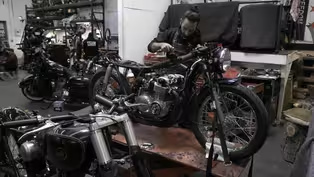
Mechanics at Madhouse Motors create masterpieces in motion
Video has Closed Captions
Mechanics at Madhouse Motors create masterpieces in motion (5m 7s)
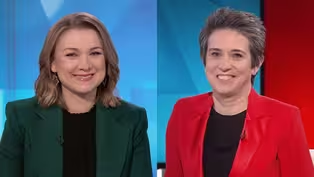
Tamara Keith and Amy Walter on abortion, guns and democracy
Video has Closed Captions
Tamara Keith and Amy Walter on the politics of abortion, guns and democracy (8m 28s)

Uninsured say N.C. Medicaid expansion is life-changing
Video has Closed Captions
Uninsured patients say North Carolina's Medicaid expansion is a life-changing development (8m 36s)

What results from the Masters mean for Liv Golf, PGA
Video has Closed Captions
What results from the Masters mean for the rivalry between Liv Golf and the PGA (5m 59s)
Providing Support for PBS.org
Learn Moreabout PBS online sponsorship
- News and Public Affairs

FRONTLINE is investigative journalism that questions, explains and changes our world.

- News and Public Affairs

Amanpour and Company features conversations with leaders and decision makers.












Support for PBS provided by:
Major corporate funding for the PBS News Hour is provided by BDO, BNSF, Consumer Cellular, American Cruise Lines, and Raymond James. Funding for the PBS NewsHour Weekend is provided by...