
Becoming American: Philadelphia's Story
6/15/2026 | 55m 12sVideo has Closed Captions
“Becoming American” explores the nation’s founding through untold Philadelphian stories.
“Becoming American” explores the founding of the United States through the lens of Philadelphia, America’s first capital. From indigenous people and enslaved Africans to lawmakers and artisans, the film reveals how diverse communities shaped a new nation. Though rooted in Philadelphia, this is a shared American story whose debates, ideals, and consequences still resonate today.
Problems playing video? | Closed Captioning Feedback
Problems playing video? | Closed Captioning Feedback
Becoming American: Philadelphia's Story
6/15/2026 | 55m 12sVideo has Closed Captions
“Becoming American” explores the founding of the United States through the lens of Philadelphia, America’s first capital. From indigenous people and enslaved Africans to lawmakers and artisans, the film reveals how diverse communities shaped a new nation. Though rooted in Philadelphia, this is a shared American story whose debates, ideals, and consequences still resonate today.
Problems playing video? | Closed Captioning Feedback
Where to Watch Becoming American: Philadelphia's Story
Becoming American: Philadelphia's Story is available to stream on pbs.org and the PBS app.
Providing Support for PBS.org
Learn Moreabout PBS online sponsorship(inspirational music) - [Oliver] Philadelphia... a vibrant cultural center, a modern, high-rise, glass metropolis, with two and a half centuries of American stories around every corner.
(inspirational music continues) - Philadelphia created a place where these immigrants of color could come and find home.
(inspirational music continues) - It's a place where if you walked the streets you'd be struck by the vibrancy of its cultural sense.
(inspirational music continues) - Philadelphia demonstrated that ideals could become reality.
(inspirational music continues) - The energy that comes out of Philadelphia, the inventions that come out of Philadelphia, the documents that are written in this city, they create the Nation.
- [Oliver] You might think you know about the Founding Era, how those 56 men gathered in this room, dipped their quills into the Syng inkstand, and put their names to the Declaration of Independence.
You might be proud of the birth of this great Nation, where all men are declared equal, and liberty is the core value.
But it should be acknowledged that a contradiction exists in those words.
This city was at the forefront of an ongoing struggle and meaningful change, where the people who needed it could find genuine refuge from persecution.
(inspirational music continues) (inspirational music continues) (inspirational music ends) (wind whooshing softly) (birds chirp) (ship horn toots) (soft pulsing music) - I'm Oliver St Clair Franklin, and for the last 40 years I've lived in Philadelphia.
My wife and I have raised our family here.
And as someone passionate about history, there's no place I'd rather call home.
(soft pulsing music continues) The story of the city of Philadelphia begins with William Penn, who was gifted more than 75,000 square miles of land west of New Jersey by the King of England.
- William Penn is a Quaker.
And in the 17th century, Quakers are really regarded as quite a radical sect.
In this early part of the century Quakers are stoned to death when they visit parts of New England.
(soft pulsing music continues) - [Oliver] The center of modern Quaker life in Philadelphia is the Arch Street Meeting House.
Built in the early years of the 19th century on land given by Penn as a burial ground.
Jennifer Lee Gray is the Education and Museum Manager here.
- This was the Quaker city, this was the Quaker colony, so you had a little bit more freedom here in Pennsylvania than you did in other colonies if you were a Quaker.
The ideas of freedom of religion, the ideas of everyone should have an equal opportunity, a fair trial by jury.
And it's no coincidence that those rights are protected in our founding documents, because the Founders saw it in practice here in this city, and that's a testament to the Quakers that lived here.
(soft music) - A great believer in democracy and religious freedom, Penn's plan was known as The Holy Experiment, the creation of a utopia where people facing religious persecution could find safety and community.
But did this vision extend to everyone?
Three years after Penn's arrival on the Delaware River, there was another significant landing.
The Independence Seaport Museum holds extensive collections related to Philadelphia's maritime history.
Craig Bruns is chief curator.
- Isabella was the first ship that came here with enslaved Africans.
It's a new thing.
You know, here are these people.
And they're for sale, and you can buy them and you can use them.
- The Isabella was a ship owned by Charles Jones and Company in Bristol, England.
And it was set with the route to go to Philadelphia.
In the process they went to the African coast, they picked up African people, they went to Barbados, they sold, they picked up molasses and rum, and the people and those items were brought up here to Philadelphia.
- The ship arrived in 1684, and it was Quakers who bought these individuals.
- [Oliver] During the next century, the port of Philadelphia became one of the hubs of the Triangular Trade, as is detailed in this book from 1763.
What does this book represent?
- You ask me and I get goose pimples.
It's a temporary ledger, a day book if you would.
(soft poignant music continues) Human beings recorded right next to the various sundry cargoes.
- [Oliver] Yeah.
- [Craig] These pages absorbed the same air that they breathed.
I really consider this a sacred object.
- It is.
Can I touch it?
- Oh, please do.
This book represents those unnamed people in there.
- [Oliver] Mm-hmm.
(soft poignant music continues) - [Craig] "Merchandise to Susannah Badger for two negro men, "for two negro women, a boy" and "a girl for Sally."
(soft poignant music continues) - What would life have been like when they got off of the ship?
- So the first thing a captain would do was go to the London Coffee House to report that he's in.
He would say, "Well, this ship has this to offer."
(soft poignant music continues) - I feel rage that this was done to my people without any sense of humanity.
On the other hand, I feel very grateful that the evidence is here.
- Yes.
(singers vocalizing) (singers continue vocalizing) - It gets mighty hot here in the summertime.
Imagine the smell, announcing the arrival of a slave ship, and those Africans chained in those ships for months, stumbling out in fear, blinded by the sunlight, and marched over to that coffee house to be sold.
(singers continue vocalizing) - They raised the individuals up on two barrels and a board.
These individuals would be scrutinized for their health, you know, undressing to see the body, all of that would be happening right there at the same time.
(somber music continues) You can imagine a woman who has their young child, they're up on the sale block.
There's shouting back and forth.
She doesn't understand what's going on and then someone comes up and takes her baby.
And it's like... - What's going on?
- What's going on?
Am I going to see that baby?
Am I going to see my child in a couple of minutes, or you know... - Or ever... - [Craig] Yeah, or ever.
- Yeah.
- Yeah.
(somber music continues) (somber music continues) (dramatic music) (dramatic music continues) - [Oliver] The population of Philadelphia began to grow through the first part of the 18th century, and the dense forest along the Delaware River began to make way for the foundations of the city.
Penn's grid system of streets had come to fruition, and the inclusive Quaker vision meant that the city's inhabitants were diverse and multicultural.
- It's the leading metropolis of early America in many ways.
But that's important to understand in context because the leading metropolis in early America was a very small town.
If you flew somehow magically above early America in this time period you'd be astounded and you'd notice how much forest there is.
And if you did it at nighttime you'd be struck by the darkness.
(dramatic music continues) - [Oliver] Although the cities of the North, like Philadelphia, did not have the same need for enslaved labor as the plantation owners further South, workers were still required to actually build these places from the ground up.
- They are an integral part of the building of this Nation: The bricklayers, the carpenters, the ones that would cut down the trees.
They would be the ones to then plant the gardens, start the farms.
They were ripped away from their families, yes.
They were kidnapped, they were trafficked across the Atlantic Ocean.
They were stripped, they were sold, but they were resilient and made the best of the situation that they found themselves in.
- [Oliver] Most Quakers, and other citizens, were comfortable owning enslaved people.
But, by the middle of the 18th century, the tide turned.
The Quakers eventually agreed they couldn't own people.
- Quakers in Philadelphia evolved, from being a radical sect to being kind of moderates, but not innately assuming that people of color will be alongside them as fellow members of their own society.
They'll be fellow members of a Philadelphian society, but it wouldn't mean they'd necessarily be co-equals in a kind of political-social sense.
- [Oliver] The Quakers, along with others, turned their attention to the evils of slavery, based on ideas about race.
One of the loudest voices was Anthony Benezet's, who opened a school on Willings Alley.
(dramatic music continues) - One of the ways that Anthony Benezet decided he would make that noise was by saying "I'm going to show people that in fact "these people that we're treating as slaves "are intellectually capable as our own children."
- [Oliver] The children educated in Benezet's school went on to shape the future for African Americans in the city, arguing for equality and recognition.
In 1775, a group of enlightened white Philadelphians went a step further and set up the Pennsylvania Abolition Society.
- The Pennsylvania Abolition Society in addition to presiding over this endeavor is equally, if not more, interested in ensuring that the people of color who have become free in Philadelphia and Pennsylvania will work hard, will have good families, will attend church, will go to school.
This creates a place where free Black life is possible.
(gentle music) - [Oliver] Of course, abolition wasn't the only pressing concern for people in the 13 colonies around this time.
Tensions between some colonists and the British government were reaching boiling point, largely driven by the levels of taxation being imposed by the British crown.
In 1774, the colonies petitioned King George III with their grievances, but their demands were rejected.
Nine months later, delegates from the 13 colonies met again.
And the result of that was revolution.
- The Declaration in 1776 is the end of a story, that we take it as a beginning.
This was the end of a long debate between folks who wanted the end point of the struggle against Great Britain to be independence, versus those who didn't.
And so the Declaration itself says: "Look at all the bad things Great Britain has done, "look how we tried to get redress.
"And so to a candid world we say we're done."
("The Star-Spangled Banner" by J.S.
Smith) - This is arguably the most important building in our Nation's history, housing the room where the Declaration of Independence was debated and signed.
The building itself, and the artifacts in here, are well known to most Americans.
But how they came to exist might not be so familiar.
Everything from the bricks in the walls, to the mahogany Rising Sun Chair, almost certainly harvested by enslaved Africans in the Caribbean, to the ink stand used by the signatories of the Declaration of Independence and the Constitution, the presence of the enslaved echoes through them all.
When the colonial leaders met here to debate a united way forward it could have gone any way.
13 colonies with different opinions; 56 men, some with loyalty to the crown, some wanting complete independence.
To call this difficult is truly an understatement.
(hopeful music continues) (hopeful music continues) (hopeful music fades) (patriotic music) The American Revolution was a lengthy, brutal and bloody conflict.
Yet it also offered people living in the former colonies the opportunity to demonstrate something that we have held dear ever since, the idea of patriotism.
(patriotic music continues) During the American Revolution, there were all kinds of patriots, for and against independence Some Black men signed up to fight for the Revolution, because they believed in the idea of the American Nation.
(patriotic music continues) And one such person was a product of Anthony Benezet's school: James Forten.
Forten was born free in 1766, and grew up during the tumultuous Founding Era.
(calm music) - The Forten family are this amazing family of people of African descent, who are abolitionists and reformers and patriots and just true believers in the ideals of the American Revolution.
- After the Declaration is approved by the committee on July 4th, in the morning newspaper they have an announcement placed that it will be read in the State House Square at noon.
And nine-year-old little James Forten is here in the State House yard to hear the Declaration of Independence, and it has a profound impact on him.
And at 14 years old he becomes a privateer on the Royal Louis during the Revolutionary War.
(calm music continues) - That is sort of his first foray into the ways in which people actively put their lives on the line in order to make the ideals of the Revolution come true.
(calm music continues) - [Oliver] James Forten paid a price for his patriotism.
He was captured and imprisoned by the British, before returning to Philadelphia and, over time, becoming one of the city's most important figures.
(city noise humming softly) But other Black men supported the Revolutionary War without taking up arms, men like Cyrus Bustill.
(dramatic music) - Cyrus Bustill was enslaved and then manumitted and he was a baker here in the city.
(dramatic music continues) - [Oliver] Manumission was normally an act of benevolence, from an enslaved person's owner, setting them free.
Cyrus's father, Samuel, was a prominent Quaker lawyer, and his mother, Parthenia, was an enslaved woman in his household.
White men fathering children with enslaved women they owned was not that unusual.
Cyrus was sold to fellow Quaker, Thomas Prior, with the understanding that he would take the boy as an apprentice, and teach him to be a baker.
And for many years on this street Cyrus owned and operated a bakery shop.
During the Revolutionary War, Cyrus was recruited to supply bread to the troops based at Washington's command post at Valley Forge, 20 miles north west of Philadelphia, work that reportedly saw him rewarded with a gold coin from the future President.
Just like James Forten, Bustill and his descendants became prominent figures in Philadelphia life.
Philly was the focal point for the discussions around the new American Constitution.
And for Cyrus, and others in the Black community, free and enslaved, full equality seemed like a pipe dream.
Many argued it was a necessary starting point for the new Republic.
But as the Constitution was being written, others could not conceive of such a thing.
- That means it's got to be, and it is in this case, a product of debate and discussion and compromise.
It was not a linear process, it was one in which there was lots of debate and discussion and argument, and people leaving in a huff.
- [Oliver] Founded in 1824, The Historical Society of Pennsylvania has an incredible collection, including this early draft of the Constitution.
- The Constitution of the United States was written in Philadelphia in the summer of 1787.
- [Oliver] David Brigham is the Librarian and CEO.
- And we all know how the Constitution starts: "We the people of the United States."
This draft begins "We the people of the States "of New Hampshire, Massachusetts, Rhode Island."
And here in the language they have still not let go of the idea of these 13 small states essentially functioning as independent nations.
The other thing that's very interesting here is paragraph two, "The style of this government "shall be the United People and States of America."
So even the name of the Nation has not yet been fully determined.
- So how did they treat the Southerners and the enslaved people in this draft?
- So it's a really good question, Oliver, and what the states are most concerned about in this early part of the Convention is not yet slavery.
What they're most concerned about is big states and small states.
- [Oliver] States with larger populations carried greater political power by having more seats in the House of Representatives, so slaveholding states wanted to include their enslaved people as part of their overall population.
- They come to a compromise called the Three-Fifths Compromise.
Enslaved people are not going to get the right to vote obviously, but for the purposes of representation they're counted as three-fifths of a person.
- So basically the enslaved people were contributing to the power of their masters.
- Exactly.
- Oh boy.
- That's a really, really-- - That's a thought!
- Great way of putting it.
- [Oliver] Yeah.
My personal relationship as an African American with the U.S.
Constitution is complicated, and it's something I've reflected on my whole life.
When I was 17, I thought our Constitution was the worst document in the world, because it didn't address enslavement.
When I was 30, I was beginning to think of it as an aspirational document and I was getting a little more comfortable.
And when I was 50, I began to realize that the document was purely aspirational and that the saving graces were the amendments.
And I've got to put myself in the position to try and understand the period that this document was written in.
I've got to dwell on the fact that the Constitution is fragile, and that it is still a living document, and also that it became a model for constitutions around the world.
That, I have finally come to understand.
- The preeminent end point was union, was togetherness, was constituting something that was gonna be singular across the polity.
Now, I would argue that one of the most significant interests and significant divergences of interest was that around slave holding.
But I wouldn't argue that the Constitution was innately protecting those interests anymore than it was innately suggesting that the polity would be anti-slavery or that abolition was gonna be part of the polity going forward.
The fundamental design of the Constitution was to contain those divergent interests.
- Southern states are not gonna join this union if you abolish slavery.
(dramatic music) It would have been impossible to get Georgia, South Carolina, North Carolina and Virginia, and this Nation would not exist without Virginia, it could not.
It was just too populous and too powerful.
And so just for practical reasons those men at Independence Hall had to make negotiations to create this Nation.
(wind whooshing softly) - That was how it was then, but even today there's a constant reminder.
Every time I go in my wallet and pull out a dollar bill, I see George Washington, a great man, a Founding Father, the first President, but he was also a slaveholder until he died.
And even in this 21st-century lens, that's something I can't forget.
(poignant music continues) These contradictions are always there in history.
And I've always been proud of the fact that the Founding Fathers included these words in the Declaration of Independence, "All men are created equal, "with certain unalienable rights, "life, liberty and the pursuit of happiness."
- That phrase will likely go down as one of the most powerful, meaningful, impactful phrases in political history.
And while Thomas Jefferson and others never meant it to be that, they could not control or contain the power of what they began in Independence Hall.
(flowing music continues) - [Oliver] These words stoked the fire of emancipation.
In 1780 the Pennsylvania General Assembly passed the country's first major abolition legislation, the Gradual Abolition Act.
And other Northern states followed suit.
(dramatic music) And a few years later, the Free African Society was created.
Its leaders were the clergymen Richard Allen and Absalom Jones.
(dramatic music continues) - In this city you're having powerful white men talk about the abolition of slavery.
And this is a society whose sole purpose was to empower the Black community.
- This Philadelphia, you don't want to overstate it, it's an oasis of sorts, but it's not an uncomplicated place of racial harmony.
(poignant music) (horse hooves clopping) - [Oliver] Although slavery still existed in the colonies, Philadelphia at this time was a progressive, multiracial city, where groups of working people, Black and white, strove to acquire financial independence and autonomy.
Yes, there was a wealthy white elite, but the rest of the population was made up of working people intent on building better lives for themselves and their families.
And in this environment, the free Black community would play a major role at the turn of the century, as Philadelphia faced one of its greatest challenges.
(dramatic music continues) - Philadelphia is in some ways the hub of an international trade.
What you get are people from all over the world coming through.
One group of people who came through in the 1790s brought Philadelphia the gift of the Yellow Fever.
(suspenseful music) - [Oliver] Yellow fever arrived in 1793 and took hold of the city.
It would become a major epidemic, and around 10% of the city's population would perish.
- We believe it arrived from Saint Domingue, so it started around the wharves, and it slowly began to creep into the rest of the city.
Business, life basically shut down.
- [Oliver] It was a city gripped by fear and death.
So, the great and the good turned to the Free African Society for help.
And a marginalized community stepped up.
(suspenseful music continues) - When white Americans were fleeing the city, Richard Allen and Absolom Jones rallied Black people to be nurses to dying white people in this city.
When their neighbors and their family members left them to die, they nursed them as best they could.
(suspenseful music continues) And when those people departed this life, they gave their burials dignity and honor.
To say that those Black people were not Americans is ludicrous.
(suspenseful music continues) - [Kelli] There were so many dead who were left on the streets and in their homes, that they had to have someone to come in, take up those bodies and bury them.
(suspenseful music continues) (suspenseful music continues) - [Oliver] In appalling conditions, the Black community served the white-dominated city, proving themselves through their sacrifice.
(suspenseful music continues) The community was taking matters, and their lives, into their own hands Richard Allen and his congregation moved a blacksmith shop, and founded a place to serve his brethren and God.
(inspirational music continues) This was America's first Black Methodist Society.
(inspirational music continues) (inspirational music continues) - The Black church becomes the scene.
Mother Bethel Church, St Thomas's African Episcopal Church, these become hubs of liberation.
They become hubs of Black empowerment.
(inspirational music continues) - Now you have a foundation of people who are making a living, cutting wood, building houses, making roads, making clothing, who say, "We'll just build our own community "and we'll make it the way we want it."
- This city becomes the place where they open businesses, where they raise their children, where they worship.
And they decide "that I'm going to be Black in America."
(lively gospel music) ♪ I'm a pilgrim and a stranger ♪ - [Oliver] Mother Bethel Church is one of Philadelphia's most important buildings.
♪ I've got a home ♪ ♪ That's beyond the city ♪ ♪ Beyond the city ♪ ♪ Glory, hallelujah ♪ ♪ Glory, hallelujah ♪ - There's nowhere a place on Earth like Mother Bethel.
It sits on the oldest parcel of land continuously owned by African Americans, just not in Philadelphia but in the whole United States of America.
And so, God, whatever our brother and sister needs, God, we believe by faith, God, that You can do it for them.
- [Oliver] Reverend Carolyn Cavaness has been the Pastor of Mother Bethel since 2024, the first woman to hold the role in its long history.
- And this is not the first time.
Turn to somebody and say this ain't the first time.
I mean this is one of the most coveted pulpits in the world.
There were 52 gentlemen before me, and I'm number 53.
It takes work in following Jesus Christ.
I'm just here to serve, and God made me a female.
Don't leave me by myself.
It takes work!
The church was where they could be the leader, where they could exercise power and authority, whereas Monday to Saturday that was not their reality.
Allen was only 27 years old.
He was a master builder, he was a chimney sweeper.
He was a businessman at heart.
He was a preacher, he was a family man.
He could certainly bring people together in ways and galvanize.
And so to create this kingdom, to create this place to show that this is what America with democracy can look like, and should look like and be like.
Because what you all are doing, that's nice, but we could do a little better here.
(chuckles) (bright hopeful music) - [Oliver] As the free Black population grew in the city, so did the influence of its leading figures.
James Forten, who had witnessed the reading of the Declaration of Independence, and had fought the British, had returned.
And was now apprenticed to his father's former employer.
- He comes back, reunites with his family, and then is able to launch on this sort of career of business training and hands-on training working in a sailmaking loft.
- He works for Robert Bridges and helps him build up his company before Bridges decides to retire, and either gives his business or Forten purchases his business.
- Philadelphia was cosmopolitan, Philadelphia was connected to the world, Philadelphia was hugely diverse.
There were people of different political ideologies.
There were people practicing a huge variety of different faiths, and no faith at all.
There were people who were coming from a variety of nationalities, and who were connected to folks all around the world.
Most of the city's population is living within a few square blocks where they are literally like cheek to jowl, between big houses on large beautiful streets and small alleyways where lots of people are crammed together.
Imagine how ideas are shared in that world.
Imagine how information is shared in that world.
James Forten and his family are walking up and down these streets and these alleys, they're hearing the conversations that are spilling out of the taverns and the coffee houses, and they are creating the vibrant electricity of that city just as much as they are absorbing it.
(bright hopeful music continues) - [Oliver] The sailmaking work of Forten, and his integrated labor force, was extremely important in Philadelphia, where trade by sea was the lifeblood of the city.
The French colony of Saint Domingue, now Haiti, was the Caribbean's most productive economy.
It was also a key trading partner to the nascent United States.
- It's absolutely representative of the way a plantation economy works.
And it is an imperial enterprise.
Its sole purpose is to raise funds for France.
(birds chirping) - [Oliver] This is the American Philosophical Society which holds a rich archive on our country's relationship with Saint Domingue.
Michelle Craig McDonald is an expert in Atlantic history.
- Saint Domingue was the jewel of the Antilles.
It was the most profitable colony of any empire in the Caribbean, indeed in the Americas generally.
It was the world's leading producer of both sugar and coffee.
They were importing enslaved people simply to maintain the level of the workforce because the death rate was so high.
(dramatic music continues) - [Oliver] But revolution in Saint Domingue was in the air.
The French found their own revolutionary ideals of 1789 being used against them.
- Insurgent slaves begin to rise up in numbers that the world has never seen before.
(dramatic music continues) - The rest of the Atlantic world, particularly the Americans, watched in just absolute fascination, and at times horror.
- [Oliver] As a new Black leader in the colony emerged on to the world stage.
- Toussaint Louverture who had been enslaved in Saint Domingue, he gained his freedom in the same year that the United States declared its independence from Britain.
(dramatic music continues) - By 1792 he has emerged as one of the pre-eminent leaders of the insurgent forces.
(dramatic music continues) - Toussaint Louverture was unlike any other Black man in the Atlantic world.
What we see over that 15-year period, from 1789 to 1804, is a back and forth where eventually the enslaved population turns the table on who's in charge.
And the enslaved of 1789 became the leaders of a nation by 1804.
(dramatic music continues) - [Oliver] As revolution and violence engulfed Saint Domingue, many chose to leave the island and head to the United States.
Philadelphia was an obvious destination.
- It really begins to change the racial dynamics and racial interactions on the streets of Philadelphia.
When African Americans began to hear about this violence, first they wanted no part of it.
They saw the violence hurting their chances for freedom in the United States.
- Right.
- But what I find so incredible is this shift in American public opinion with the ascension of Toussaint Louverture.
Because what he does is shift Americans to thinking about Black people seeking independence and freedom in a way that was very reminiscent of the Revolution of 1776 right here in this city.
At some level, white supremacy was on the line.
Everyone across the Atlantic world wanted to know, abolitionists, slave holders, non-slave holders in the North, if they can succeed there, then the what if?
(thunder breaking) (suspenseful music continues) (water flowing) (birds chirping) (wheat rustling) - [Oliver] The revolution in Saint Domingue would have an unintended consequence: the Louisiana Purchase of 1803.
(dramatic music) After Napoleon's Army had been defeated trying to reconquer Saint Domingue, the Louisiana Purchase allowed the United States to buy land from France.
- Napoleon acquired Louisiana, really saw Louisiana as a place to provide resources and food for what is going to be the jewel of his economic crown, which was a then re-enslaved Saint Domingue.
(dramatic music continues) When he lost Saint Domingue, he lost interest in Louisiana.
And that's how Jefferson was able to purchase it.
(dramatic music continues) - At the time, it was incredibly controversial.
It was going to double the size of the United States.
And that frightened many of the smartest people in the United States, because they wondered, "How can we govern a nation that is so large?"
(dramatic music continues) - [Oliver] One solution was to dramatically increase the number of enslaved laborers, resulting in an industrial expansion of the Southern slave economy.
As a result, the clamor for abolition also hit new heights.
- After the Louisiana Purchase, what you see is a galvanization of both Black and white abolitionists in this city, that becomes a model for abolitionism across America.
They're able to say with great certainty that a free Black population, a free working population, makes not just Black populations better, but it makes the entire city better.
(city noise humming softly) (birds chirping) - [Oliver] This working Black population was growing.
And in 1811, the first published census to include Black Philadelphians was recorded.
A copy of which is held in the archives of the University of Pennsylvania.
I'm meeting Sean Quimby, the university's Associate Vice Provost and Director, and Emma Lapsansky Werner.
- This small object is a city directory printed in 1811, that is notable because it included a separate section for persons of color, and tells us all sorts of interesting information; where people lived, what their occupation was.
- By 1811 Philadelphia's really a very booming city.
(bright music) People who work on the river live east of 4th Street, people who build ships live south of South Street because that's where the industry is.
This directory tells you not only where the people are, but who they are and what color they are.
(bright music continues) - [Oliver] And the directory contains some familiar names.
- [Sean] James Forten, sailmaker, is listed.
- Well, he was the wealthiest man in the city.
- [Emma] When he died in 1842 he had the city's biggest funeral.
100,000 people, Black and white showed up.
- [Oliver] Showed up for his... That's how much respect.
- Right.
- [Oliver] God, that's great.
(flowing music) I always thought everything was segregated.
I mean, I grew up in a segregated neighborhood.
- [Emma] Why would you need to have a segregated neighborhood if what you need in the morning is somebody to come and put breakfast on your table?
You don't want them to be over there, you want them to be on the back street right behind you.
(flowing music continues) (flowing music continues) - [Oliver] Through the first couple of decades of the 19th century, the Black community was growing, both in number and in influence.
James Forten's daughter, Sarah, was a key figure in the ongoing fight.
- She is an educator in the community.
She is deeply involved in the social, religious, political life of Philadelphia's Black community.
- By 17 years old she was a prolific writer.
She was writing and sending in poems to The Liberator and other newspapers.
- [Oliver] Sarah Forten's poem "The Grave of the Slave" came to the attention of Francis Johnson, one of the most notable musicians in Philadelphia at that time.
- He decided to set it to music.
And it was often played at anti-slavery meetings throughout the 1820s and '30s.
(steady jazz music) (steady jazz music continues) (steady jazz music fades) - "Grave of the Slave" is a piece that I consider the first American protest song.
♪ The cold storms of winter ♪ ♪ Shall chill him no more ♪ - [Oliver] Johnson was one of the most important musicians and composers not just in Black society, but in all society.
♪ The sod ♪ - If I had to sum up Francis Johnson's life I would say innovative, I would say genius.
(bright jazz music continues) - [Oliver] Brent White is a musician and scholar who studies Johnson's life and work.
- He was a risk taker.
He was a musician for all occasions.
(lively jazz music) (fire whooshes) (lively jazz music continues) (lively jazz music continues) When we think about Francis Johnson as a Black American, we have to think about somebody who tore down racial barriers.
We have to think about somebody who would perform to white audiences, for the richest of the rich.
But we also wanna keep in mind that there was a fine line in terms of mixing, and so musicianship was more being like the help.
It did not afford him the full privileges to go sit with the highest of the high.
(lively jazz music continues) - [Oliver] Even in cities like Philadelphia, where people of all races and colors moved freely among each other, anger and discrimination lay beneath the surface.
(flowing music continues) - When you get into the late 1830s, the economic depression then sets people looking around at each other and saying, "That person who's different from me "is doing better than I am.
"So why don't I take my frustrations over there?"
Racial tensions grow when there are other tensions.
It's tempting to drop it into a bucket that says "It's racism," but we have no real definition of what racism is.
- [Oliver] Throughout the decade, these tensions kept boiling over.
The Pennsylvania Anti-Slavery Society's headquarters was targeted.
It was designed as a place for free thinkers, but on the night it opened in 1838, that dream was shattered.
(dramatic music continues) (dramatic music continues) - [Emma] In its first meeting, outsiders, who for whatever reasons were anti-anti-slavery began throwing torches.
And the whole thing went up in flames.
(dramatic music continues) (fire roaring) (dramatic music continues) (birds chirping) (dramatic music continues) - [Oliver] The burned-out shell became a site of pilgrimage for abolitionists, emboldened by this attack on their beliefs.
The concerted push for the end of slavery everywhere grew and grew.
And this city became a place of refuge for those fleeing the South, a haven for Black activism and resistance.
(dramatic music continues) Every Philadelphian worked to build this Nation, whether lawmaker, sailmaker, or dressmaker.
But none of this energy could prevent the onslaught of the Civil War.
(suspenseful music continues) - There's no negotiating with freedom.
It is either freedom, or not.
And this country paid a heavy price for trying to hold on to slavery from 1789 to 1865.
We learned the hard way that the attempts to constrict that freedom and deny that freedom will lead us to near destruction.
(suspenseful music continues) - [Oliver] Equality didn't come easy, even in a liberal, free-thinking city.
It was a long fight, over decades, with many involved.
From the Quakers, to the politicians, the preachers, and the people themselves, abolition of slavery and freedom and equality for everyone was hard.
But the resilient Black leaders, and the communities they represented in Philadelphia, were successful, determined, and ready for a challenge, building themselves up to make all society better.
That same spirit of Africans as Americans determining their place in our history is embodied in our city's culture and fused into its joyful celebrations, including Odunde, the largest African American street festival in the United States.
(bright hopeful music continues) Here we are, 250 years after our great Nation's founding in the city of Philadelphia.
The rollercoaster rides on.
History teaches us that brotherly love will always win over oppression and hatred.
- People such as James Forten, Richard Allen, Absalom Jones, they continued to make claims for their Americanness throughout their lives, but they ran up against other notions of Americanness, that the United States is a republic in which whiteness is what denotes Americanness.
(dramatic music continues) - What could be more American to love a place where you're considered inferior, where you're considered inhuman, and yet you still give your best.
(dramatic music continues) (dramatic music continues) - In many ways the truest expression of American ideological egalitarianism and liberty loving and freedom pursuing, is the ongoing efforts on the part of African Americans.
(dramatic music continues) (dramatic music continues) - I thank the men, the women and the children of the Founding Era for starting this Nation on a system of beliefs that have never been extinguished.
(dramatic music continues) (dramatic music fades) (bright music) ♪ Hey ♪ ♪ Come on ♪ ♪ Hey ♪ ♪ Lift every voice and sing ♪ ♪ Till Earth and Heaven ring ♪ ♪ Ring with the harmonies ♪ ♪ Of Liberty ♪ (commanding music)
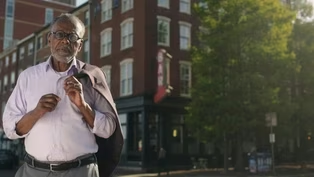
The Beginning of Slavery in Philadelphia
Video has Closed Captions
Explore how slavery impacted people in Philadelphia and its legacy and resonance today. (2m 42s)
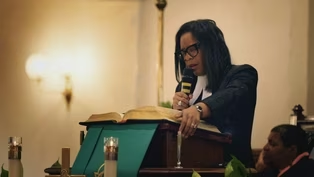
Mother Bethel Church: Founding and Significance
Video has Closed Captions
Join the congregation at Mother Bethel Church and learn its roots and legacy. (2m 18s)
Video has Closed Captions
“Becoming American” explores the nation’s founding through untold Philadelphian stories. (30s)
Providing Support for PBS.org
Learn Moreabout PBS online sponsorship










Support for PBS provided by: