
Celebrating Juneteenth at the Charles H. Wright Museum of African American History
Clip: Season 54 Episode 23 | 11m 39sVideo has Closed Captions
The Charles H. Wright Museum is marking the holiday with a variety of activities.
On June 19, the country will celebrate Juneteenth National Independence Day. Host Stephen Henderson sits down with Neil Barclay, President & CEO of the Charles H. Wright Museum of African American History, to talk about this year's Juneteenth celebration at the museum. Barclay also discusses the history of Juneteenth and how the commemoration has evolved since the federal holiday was established
Problems playing video? | Closed Captioning Feedback
Problems playing video? | Closed Captioning Feedback
American Black Journal is a local public television program presented by Detroit PBS
Celebrating Juneteenth at the Charles H. Wright Museum of African American History
Clip: Season 54 Episode 23 | 11m 39sVideo has Closed Captions
On June 19, the country will celebrate Juneteenth National Independence Day. Host Stephen Henderson sits down with Neil Barclay, President & CEO of the Charles H. Wright Museum of African American History, to talk about this year's Juneteenth celebration at the museum. Barclay also discusses the history of Juneteenth and how the commemoration has evolved since the federal holiday was established
Problems playing video? | Closed Captioning Feedback
How to Watch American Black Journal
American Black Journal is available to stream on pbs.org and the free PBS App, available on iPhone, Apple TV, Android TV, Android smartphones, Amazon Fire TV, Amazon Fire Tablet, Roku, Samsung Smart TV, LG TV, and Vizio.
Providing Support for PBS.org
Learn Moreabout PBS online sponsorship- Welcome to "American Black Journal."
I'm your host, Stephen Henderson.
On June 19th, the country will celebrate Juneteenth National Independence Day.
This is the federal holiday that commemorates the day in 1865 when the last group of enslaved African Americans in Galveston, Texas finally learned that they were free more than two years after the Emancipation Proclamation.
The Charles H. Wright Museum of African American History is marking the holiday with a variety of activities.
This year's theme is a day of freedom, culture, and community.
Here to tell us more is President and CEO Neil Barclay.
Welcome back to "American Black Journal."
- Thank you, Stephen, it's great to be here.
- It's always good to see you.
I think it will be hard to think of Juneteenth this year outside the context of all the things that are going on, in particularly in a national sense that seek to roll back much of the progress, at least from a legislative and judicial standpoint that African Americans have made- - Absolutely.
- Since the 1960s.
But in particular, the recent Supreme Court ruling about the Voting Rights Act and how it's applied, really wiping out much of the infrastructure that we have been using to wipe out centuries of discrimination before that is, to me, just an incredible parallel with the idea of commemorating Juneteenth.
What the court is saying in many ways is, "Look, racism's over, discrimination is in the past.
We don't need these tools anymore to assure that people are treated equally."
The celebration of Juneteenth reminds us that all of that is foundational in this nation, and that there likely won't ever be a day that race doesn't play a role and that discrimination doesn't exist.
- Well, certainly, not as long as we ignore the fact that it does play such an important role in all of our lives, right?
This notion that disparate impact is not something that we should consider, how the law, how our jurisprudence affects people in the real world, is what the Supreme Court now feels is not the way to look at these cases, to just look at them as based on merit, based on any number of other factors, some of which in and of themselves are also discriminatory- - Are soaked in the history of race.
- And so ingrained in the history of race and frankly are reasons why the Voting Rights Act in this case was even put into place, right, where some of the same tactics that we're now seeing today.
So that's certainly, as a historian, it was an institution that really focuses on history.
It's quite a sort of a shocking evolution of the law right now that we see.
- I mean, it's really cutting the legs out from under all the infrastructure that we've built to make the progress that we have.
But nonetheless, this is a celebration, we should talk about that.
- Yes, but it also, it brings up why voting is so important too, right?
And for many people that just don't vote, right, and it just shows you how, even with everything that's happening in other parts of gerrymandering, for example, as onerous as it looks, it doesn't look so bad if you think about people voting.
- Yes, right.
That's right.
- If more people come out to vote.
- If everyone who was eligible voting- - Would come out to vote- - The results would look different without some of those tools.
- Exactly.
So Juneteenth is a celebration.
- Yes, it is a celebration.
Let's talk about what that's gonna look like at the museum.
- Oh, it's so great.
You know, it's interesting because, you know, one of our largest days of the year has always been MLK Day, right.
And now the second holiday has taken on an equal amount of just opportunities for us to celebrate so many aspects of our culture.
It's an all-day celebration.
There's something really, literally for everyone of every age, it's programmed to be intergenerational.
So there are, I'm sitting here looking at the list, there is everything from silent yoga in the Rotunda, you know, to, you know, kids, to Jamal Jordan will be on hand, the official historian for Detroit, to really give us some of the context of the day.
There's book giveaways, there's culinary heritage.
We look at our sort of food culture, you know, obviously in Galveston that was a big deal and big in this celebration, you know, the food that was used to celebrate and the legacy of food and health too that we talk about some of those issues as well.
But it's gonna be a great day.
You know, and I think we're really looking forward to it.
- Yeah, it is a newish holiday.
And compared to MLK Day, which is now what, 40 years old almost.
- 40 years old, yep.
- It's really new.
Is it evolving?
I loved the parallel that you drew to it when you started talking about it and I'm not sure that everyone is thinking of it in those terms, but talk a little about how it has kind of found its own footing in the few years that we've had it.
- Well, it's a great example of traditions and African American culture that people are just not as aware of.
And I think making it a holiday has made it people more aware of it.
But, you know, the year after the Juneteenth occurred in 1865, starting in 1866, celebrations were held in Galveston, Texas for Juneteenth.
And as you know, those celebrations went on, you know, through the '20s and '30s, people coming from the north through the south, south through the north, and bringing those traditions- - The migration.
- The migration.
Through the great migration coming up to the north, they brought these traditions, right.
And so, in many communities, Juneteenth is not a new celebration.
What's new about it is it's now a national holiday and more people outside of the African American community are becoming aware of this incident, how it happened, the history of it, and are celebrating with the African American communities this really extraordinary event.
- Yeah, I mean, one of the things I really like about the holiday and the commemoration of it it's about this delayed, this literal delayed freedom for these enslaved people in Galveston.
But I think it points us to a deeper thought about what freedom is and who controls who's free and who's not.
Certainly we are all subject to governments and other kinds of authorities, but that's not the only freedom that matters.
And the freedom of culture and expression and history and celebration are just as important, and the holiday really makes us think about that.
- Yeah, if not more so in some ways.
Particularly in this moment, our understanding of who we are, our history, where we came from is really the armor that we have in getting through what is a very challenging period I think for African Americans, you know, this notion that we as a people have had these kinds of upfronts, if you will, but that we continue to evolve and to move beyond 'em in a way that remains, that really brings front and center our real desire to be free, to understand what freedom means, to understand what the Constitution promised all people, and to make that real in this world, you know?
So all of those things come up, you know, as a part of this, to think about two years later, you know, so people looking back, "Wow, for the last two years I could have, you know."
- We didn't have to continue to- - But boy, when it happens, they're gonna celebrate that.
And hopefully make that part of who they are, that freedom and that ability to really express their culture, their identity in important ways.
- Yeah, and that's a huge part of course of the museum's overall mission and purpose.
- Overall, absolutely.
- We've got a few minutes left.
Talk just a little about the state of the museum, which I think is, I've said this to you before, much better since you came to town.
- Appreciate that.
- There's a lot more, I think, hope and positive momentum coming out of it.
But give us an update.
- Yeah, the museum is doing quite, is doing well, I think, you know, it's a challenging time obviously for all Black institutions, but I think the museum has really found a kind of rhythm where we're not seeing ourselves as just a museum, but really as a community asset.
And not just for the African American community, but for Southeast Michigan and frankly nationally.
And so, that idea about our work has really led us to do things like the right conversations where we brought in everybody from Nikki Giovanni to Benjamin Crump, you know, folks that really have a lot to say about the present moment or leaning more into performance history has such a, I mean, African Americans have had such a vast contribution in the area of performing arts, right?
Whether it's dance, music, et cetera.
So that, the African World Festival, we continue to evolve into really a celebration of the African diaspora and particularly Detroit's role in it.
So, you know, we are I think really trying to do more and more, I think the coming year will see us also move more into communities.
You know, I think a lot of tourists and things are coming through the museum itself, but now we see ourselves as being able to contribute to work that's happening in neighborhoods, right, and I know that Mayor Sheffield, that's of her great passions and initiatives that she wants to see.
And we are totally on board for that and are looking forward to being able to create things in communities throughout Detroit, actually throughout southeast Michigan.
- Throughout Michigan, yeah.
- So it's gonna be, it's a really exciting time for us, I think, and the next season is pretty extraordinary.
- Yeah, yeah, it gets better and better.
- It does.
- Yeah.
Well, thanks for being here and we look forward to Juneteenth.
- I do too.
- Yeah.
(both laughing) There are several other events taking place in Metro Detroit in celebration of Juneteenth Independence Day.
Here's a look at some of the activities this month.
(upbeat groovy music)
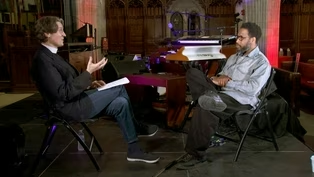 New
NewGRAMMY-winning artist Cory Henry discusses influence of the Black church for Faith in Detroit series
Video has Closed Captions
Clip: S54 Ep23 | 12m 50s | He sat down with the Faith in Detroit director to discuss the influence of the Black church on his l (12m 50s)
Providing Support for PBS.org
Learn Moreabout PBS online sponsorship New Episode
- News and Public Affairs

Top journalists deliver compelling original analysis of the hour's headlines.
 New Episode
- News and Public Affairs

Today's top journalists discuss Washington's current political events and public affairs.
 New Episode
 New Episode
 New Episode
 New Episode
 New Episode

 New Episode
 New Episode
 New Episode
Support for PBS provided by:
American Black Journal is a local public television program presented by Detroit PBS