
Chance
Season 1 Episode 2 | 27m 4sVideo has Closed Captions
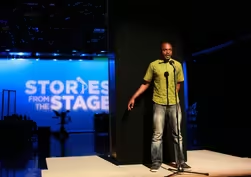
Chance could mean possibilities, risk or opportunity. Hosted by Wes Hazard.
Chance could mean possibilities, risk or opportunity: Rodrigue seeks asylum from the Congo, Korean-American Eson is held at gunpoint in her family’s store and Christine donates a kidney to a stranger. Three storytellers, three interpretations of CHANCE, hosted by Wes Hazard.
Problems playing video? | Closed Captioning Feedback
Problems playing video? | Closed Captioning Feedback
Stories from the Stage is a collaboration of WORLD Channel, WGBH Events, and Massmouth.
Chance
Season 1 Episode 2 | 27m 4sVideo has Closed Captions
Chance could mean possibilities, risk or opportunity: Rodrigue seeks asylum from the Congo, Korean-American Eson is held at gunpoint in her family’s store and Christine donates a kidney to a stranger. Three storytellers, three interpretations of CHANCE, hosted by Wes Hazard.
Problems playing video? | Closed Captioning Feedback
How to Watch Stories from the Stage
Stories from the Stage is available to stream on pbs.org and the free PBS App, available on iPhone, Apple TV, Android TV, Android smartphones, Amazon Fire TV, Amazon Fire Tablet, Roku, Samsung Smart TV, and Vizio.
Providing Support for PBS.org
Learn Moreabout PBS online sponsorship♪ ESON KIM: I think there are so many things that we misunderstand about our parents.
It didn't matter why my father took that chance with my life.
RODRIGUE KALAMBAYI: I heard my mom scream and sing, and rejoicing.
She told me that we're finally going to America.
CHRISTINE GENTRY: I rolled into that operating room the next day having never been more sure of anything in my life.
WES HAZARD: Tonight's stories are all on the theme of chance.
Chance is really odd because it's something that, you know... you can give someone a chance.
You can ask them to take a chance on you.
A chance encounter can lead you to meet the love of your life at a party or a coffee shop, and years later, if that happens, you look back and think, "Wow, what are the chances?"
Right?
At the same time, you might see someone and think, "I'd really like to talk to them, but... ...better not chance it."
That kind of breadth and possibility is exactly what you're going to see on display this evening.
KIM: I grew up in Brooklyn, New York, in a really, really poor neighborhood of East New York.
And my parents were immigrants, like a lot of Americans, and we had very little money, very few resources.
I grew up listening to my father's stories of the Korean War.
He managed to survive some really, really untenable situations.
And so, in many ways, he taught me a little bit of the art of oral storytelling.
So, our theme for this evening is chance.
How do you see your story for tonight in relation to that theme?
I think, as immigrants, the first generation that comes over takes a huge chance, takes a huge risk, but it's not the last risk that they take.
There are series of them as they live their lives, and my story kind of addresses one of them, especially one that I kind of disagreed with with my parents.
And what happens when, within your family, it causes this misunderstanding and a lot of tension.
HAZARD: Please give a huge, Stories from the Stage round of applause for Eson Kim.
(cheers and applause) KIM: It's the '80s.
I'm 12 years old.
And I'm sitting in Korean church parking lot with my friend Andy.
And he is ranting about his parents because he doesn't get along with them.
And suddenly, he blurts out, "You know... "Korean parents don't love their children "as much as American parents do.
Our parents just use us as workers."
I'm completely offended, so I push back and I say, "That's not true."
And he points his finger at me and he says, "You'll see."
And it comes at me like a curse.
A few weeks later, I'm at the family hardware store with my father and two customers walk in.
And in just a matter of seconds, they whip out these guns: one pointed at my father, one pointed at me.
Now my father has endured armed robberies before, but this is my first time.
So, they drag us to the cash register, where they order my father to fill a brown paper bag with all the cash in the register.
But the problem is there isn't enough.
And the robbers are angry.
And so, they keep repeating, "That's it?
Where's the rest?
Where's the rest?"
And my father keeps repeating, "There is no more.
You have all.
There's no more.
No more."
And, every time they go back and forth, I feel the gun dig deeper into the back of my skull so that I have to tip forward.
And finally, the gun moves from the back of my head to the side, as if to give my father a better view.
And the voice behind me says, "I mean it, man.
Get the rest now."
And what follows is a steely silence so tense that I have to close my eyes.
And, in that time, I imagine what it's going to feel like to have a bullet course through my brain.
Because I'm certain that's what's about to happen.
And I'm also certain that my father is bluffing.
Because there is a stash of cash in the back.
And I'm about to lose my life for it.
And I don't know how much time passes, but eventually, the robbers give up, they push us in the back room, and they leave.
But for the days and weeks after, I completely freeze out my father.
I can't forgive him for taking that kind of chance with my life.
And I begin to wonder if maybe Andy was right.
Maybe Korean parents have a lesser capacity for love.
Maybe my classmates were right and that my parents were alien and abnormal.
And my father's not helping here, because he too is distant and silent this whole time, and all he does is jot down these numbers on a notepad, and I keep thinking it's because he's worried about the money we've lost because that's what he really cares about.
And we carry on like this until Thanksgiving.
That's when my father wakes up early, and he gathers us up and takes us to the hardware store on a day where it's usually supposed to be closed.
And he ushers us inside, locks the door behind us, and flips on the lights.
And there, leaning against one of the side walls, are six long countertop slabs wrapped in brown craft paper.
And he goes up to the first one and he rips a corner off, revealing a one-inch-thick piece of glass.
And he taps on it, and he says, "Bullet not go through.
"Each piece, $1,000."
Now the math is not hard here.
And I'm amazed at where my father was able to find $6,000.
And I'm even more amazed about where he was able to find bulletproof glass.
But there's no time to ask him, because he immediately gets to work.
He whips out that notepad with all the figures on it, takes out a circular saw, pulls out a measuring tape, and he measures and cuts and measures and cuts for 36 hours straight.
And, at the end of it, he stretches his stiff back, sweat pouring down his neck, drenching his T-shirt, and we all look at what he's made.
And it is a wonder.
It is a wall, floor to ceiling, and countertop and cabinetry made entirely of bulletproof, clear glass.
And it's so pristine and new that it looks like spring water, compressed.
And he turns to me and he says, "Go inside."
So, I push open this door that he's made and framed, and I step inside and I feel like I'm entering this sci-fi world.
And I close and lock the door behind me and I step back.
And I see my father and the rest of my family, and really the rest of the world behind and beyond the storefront, through this clear, bulletproof glass.
And, honestly, my 12-year-old self kept thinking, "My father has made a piece of Wonder Woman's invisible jet."
(laughter) It is the most cool thing that I have ever imagined that he would ever be able to do.
And as I'm kind of wrapped in the awe of all of this, he finds this little opening that he's made so that we can interact with the customers, and he sneaks his hand through and he tickles me, and I jump back and it's the first time we laugh in weeks.
And he goes in for another, but this time, I'm too far back, and he can't reach, so he's just grasping air.
And he leans into the little opening, so his lips are there, and he says, "See?
Nobody can touch."
And that line is like a spell that makes everything clear.
And I realize it didn't matter what Andy said, didn't matter what my classmates said.
And it didn't matter why my father took that chance with my life.
But what matters is what I know now.
And at this very time, I know what love looks like.
I know what love feels like.
And it's unmistakable.
And so, I step forward, unlatch the locks, and open the door wide and I bring my father and the rest of my family inside with me.
Thank you.
(cheers and applause) HAZARD: Chance, for a lot of people, conjures up ideas of risk and uncertainty and danger.
For other people, sometimes in the same story, it's all about luck and opportunity and seizing the day.
Our next storyteller was born in the Democratic Republic of the Congo.
The son of a human rights lawyer, he was forced, at age ten, to flee with his mother and nine siblings.
He made his way to Lowell, Massachusetts, and is currently in school studying to be a social worker.
Please, huge, warm welcome for Rodrigue Kalambayi.
(cheers and applause) How did you get involved in storytelling?
(cheers and applause) HAZARD: Tonight, we have heard about life and death and all the things in between.
And right now, you're going to hear from a storyteller that I'm very happy to be bringing to the stage.
Please make some noise for Christine Gentry.
(cheers and applause) What got you into storytelling?
GENTRY: I'm from the South.
HAZARD: Texas, right?
GENTRY: Yeah, storytelling is in our bones.
It's in our marrow.
My father is an incredible raconteur.
And I never really thought of it as a thing that you could do on stage.
It's just something we do on porches with whiskey.
Yeah.
GENTRY: And fireflies.
But it's actually such value for the person telling the story, right?
Laying out your life in a way, capturing your experience in narrative allows you to better understand it.
Sure.
Actually, there's a lot of research around the power of capturing even a traumatic experience in narrative and how that kind of takes its power away from you, because when you don't capture it that way, that's when it's scary.
HAZARD: It's therapeutic both ways.
I mean, you say something, it helps you.
And then the audience hears it and like, "That's my life as well."
GENTRY: Totally.
HAZARD: Yeah, so I could not be more excited to hear your story this evening.
GENTRY: So, Facebook has this really interesting algorithm that decides what you see and what you don't.
And one day, in 2012, I was scrolling through Facebook.
And the Facebook gods decided that I would see this post from an old friend of mine named Julia.
And we hadn't seen each other in years.
We had drifted off to social media acquaintances.
And this post of hers started, "I'm dying.
"I'm dying from kidney failure.
"All of my loved ones, my friends and family, "have already tried to donate to me "and they've been rejected, "so this is literally my last resort.
"I'm posting on Facebook to see if anyone I'm connected to on here would be willing to donate a kidney to me."
I dropped everything.
I messaged Julia.
I said, "I'm so sorry that we lost touch.
"I didn't even know you were sick.
Absolutely, I'm willing to look into this for you."
And thus began this really intense process of testing.
So, I don't know if you guys know this, but it's really difficult to be approved to donate a kidney.
They basically run every test you could possibly run on a human being, including really intense psychological exams.
And if they find one thing wrong with you, they say no.
Which is why over 100 of Julia's friends and family had already been rejected.
But I was lucky, and I got approved.
But Julia and I, as a pair, were not as lucky.
So, we were not compatible, and I could not directly give my kidney to her.
So, we entered into this really cool thing called The National Kidney Swap Registry.
And it's filled with these incompatible donor recipient pairs, like me and Julia, right?
So, somebody who wants to give their kidney to their loved one, but can't, and so they enter into this computer algorithm that tries to figure out, like, who could you give your kidney to that further down this swap chain, your friend could get one.
So, the computer's sitting there, trying to figure out, how can we do this?
And at the very last minute, Julia's mother, who had been rejected originally for a small medical issue, had gotten cleared for donation, and the computer loved Julia's mother.
It was like, "Excellent."
As soon as she entered with Julia, into the computer system, it figured out immediately this chain that would work out with she and her.
So, my kidney wasn't needed.
And so, I got to step back and watch my friend Julia.
She got to get this kidney transplant and her life totally changed.
Every time I saw her, she was a newer, happier person, and then a year passed, and she got pregnant.
She had a baby.
And, I swear to god, the moment I saw a picture of this child, it was such a no-brainer for me.
I was like, "This life," right, "This new life, "it only exists because someone was willing to donate their kidney to my friend Julia."
And every life that that baby grows up to touch, right, only exists because of this one choice.
And I had already done this mental and emotional gymnastics when I had prepared to donate to her, right?
And now that I knew how difficult it was, how long the waitlist was, and that I could do it, I just couldn't justify not doing it for someone else.
So, I called the hospital, and I said, "This time, I want to donate to a stranger."
And so, they entered me into that same computer system, but, this time, they called me a non-directed or Good Samaritan donor.
And, as you can imagine, this computer system is very complex.
It's very difficult for what they call "a closed loop" to happen: so that every pair in the loop somehow perfectly matches with someone else in the loop, right?
Most times, they need an outside person, a Good Samaritan person who's like, "I'll give my kidney to anybody!
Kidney for you!
Kidney for you!"
Like Oprah, right?
And so, like, it was amazing for the computer, for me to enter in as a non-directed donor because it was like, "Awesome, we get to take you.
"You can give your kidney to this person in Ohio.
"And their incompatible donor can give their kidney "to this person in San Diego, and their incompatible donor can give their kidney to this person in Charleston..." and so forth and so on.
So, after my testing, it was done.
Within six weeks, I was going to have this surgery and I was going to kick off a chain of 16 surgeries that would pull eight people... (applause) ...off of the waitlist.
What an honor, right?
And I had this really interesting internal battle.
"Do I tell people about this?"
I had to tell my mom, the nurse; she was going to come up and be my caretaker.
And I had to tell my best friends.
But outside of this circle, I wasn't sure who I should share this with because... it's weird, y'all.
It's weird, right?
I'm giving my kidney to a stranger.
And also I was worried that people would think I had this weird hero complex, and that I'd, like, "Look at me, I'm so amazing.
I give kidneys to strangers."
So I decided to keep it more or less a secret for the six weeks leading up to the surgery, and that was a bad move.
As we got closer to the surgery, when it became a week before my surgery, I was kind of losing it, thinking about all of the risks.
And I didn't have this support network to help me through this.
I was thinking, "What if I'm one of those rare cases who dies "on the operating table?
"What if my kidney dies on the runway "on its way to Ohio, right, and I did all of this for nothing?
"What if I get older and someone I love-- "a husband, a child-- needs a kidney "and I've already given mine away to John Doe, right?
"What if my one kidney fails, despite all of these tests, and I need a new one?"
And so, it's leading up to the surgery, and at one point, I was having a panic attack about it, and I started frantically cleaning my apartment.
And I found this bag of clothes that I'd shoved into a closet to get tailored, you know, "one day."
And I jump on Yelp to find a local tailor, and there's one that works right down the street from me, and her name is Brunhilda.
I'm like, "This is perfect."
So, I call her-- thick German accent, and she's available right now.
I grab the bag, I start walking toward her house.
I get to her apartment; she opens the door.
She looks exactly the way you think she looks.
Like, giant German woman, huge boobs, right?
I start pulling out the clothes from the bag to explain to her what I need done, and she cuts me off, she goes, (German accent): "Honey, what's wrong?"
(laughter) And my bottom lip starts trembling, I go, "Oh, Brunhilda...
I'm donating a kidney on Thursday and I'm so scared."
And she just grabs me, she shoves my face into those giant boobs, starts pawing my back.
She goes, "Honey, you are doing a wonderful thing."
And it was like... it was this beautiful moment where this absolute stranger was giving me exactly the kind of comfort that I so desperately needed.
And I decided on the walk home from Brunhilda's house I have to tell people about this.
And so, I posted, and of course, you know, immediately, the outpouring of love and support so bolstered me.
And Brunhilda and I decided, on purpose, that I would come pick up my clothes the night before the surgery, and she opened the door, and she goes, "Honey, you look good.
"Last week, not so good.
This week, you look good."
And my mom flew in that night and we were sitting on my bed, across from each other, and holding hands, and I'm not even a religious person, but she said this prayer of safety over me, and I just felt this sense of calm.
And I started telling her about the panic attack, about how easy it was in 2012 with Julia, "Because any time I got nervous, "I would just look at my dying friend and be like, 'Yeah, of course.
Of course I'm going to do this for her.'
"But this time I'm sending my kidney into the ether, Mom.
Like...
Ohio."
You know?
And she says, "Christine, you have to give these people faces.
You have to give them names."
And I did.
We came up with this haven together where I would close my eyes, and I would turn the corner into this Barcelona plaza that had a fountain and this tree that was raining orange flowers, and I would imagine these eight people waiting around the fountain for me to do this thing for them.
And I rolled into that operating room the next day having never been more sure of anything in my life.
But I am not here to lie to you either.
And that was hard.
And the first couple days after surgery were so, so hard.
And my mom was just this rock next to me.
She slept in the hospital room.
She didn't leave me for five days.
And on the third day after my surgery, when they took my Dilaudid IV out, and they tried to replace it with a pill, and my stomach couldn't handle it, and I threw up all over myself, and I said, "Mom, I don't want to regret this."
And she said, "You won't regret this, Christine.
I promise."
And she was so right.
And when they took my catheter out and I could take a shower, and I was so excited about it, it was my mom who walked me to that shower.
And she took my clothes off.
And then she took her clothes off.
And she got into the shower and closed the curtains, and she bathed me so gently, and she said, "Christine, it's just like when you were a baby."
A month after this donation, the National Kidney Registry called me, and they said, "Christine, that chain that you started "is still going.
"It is 56 surgeries long.
Your one decision pulled 28 people off of that waitlist."
(staggered breath) (cheers and applause) And I thought, that's more people than can ever fit around that fountain.
And they said, "This is the longest chain we've had in years.
We want you to come speak at our gala."
And I said, "Absolutely, on one condition that I can bring my mom."
Thank you.
(cheers and applause) What finally gave me comfort to go public with this story and to tell it to as many people as I could was that there are 100,000 people on the waitlist for kidneys.
and most people have no idea that it's an option for you to give.
And so, I've decided to tell this story to hopefully... if I inspire one person, one day, to maybe think about considering donating a kidney, then this publicity and vulnerability on my part would've been worth it.
Watch "Stories from the Stage" any time, anywhere.
Visit WorldChannel.org for full episodes and digital extras.
Join us on social media and share your story.
Only on World Channel.
♪
Preview: S1 Ep2 | 30s | Chance could mean possibilities, risk or opportunity. Hosted by Wes Hazard. (30s)
Providing Support for PBS.org
Learn Moreabout PBS online sponsorship

- Arts and Music
The Best of the Joy of Painting with Bob Ross
A pop icon, Bob Ross offers soothing words of wisdom as he paints captivating landscapes.









Support for PBS provided by:
Stories from the Stage is a collaboration of WORLD Channel, WGBH Events, and Massmouth.