Inside Texas Tech
Civil Counterpoints - Speaking Freely
Special | 28m 48sVideo has Closed Captions
A discussion series at TTU that covers difficult issues in a constructive and civil manner
A discussion series at TTU that covers difficult issues in a constructive and civil manner.
Problems playing video? | Closed Captioning Feedback
Problems playing video? | Closed Captioning Feedback
Inside Texas Tech is a local public television program presented by KCOS and KTTZ
Inside Texas Tech
Civil Counterpoints - Speaking Freely
Special | 28m 48sVideo has Closed Captions
A discussion series at TTU that covers difficult issues in a constructive and civil manner.
Problems playing video? | Closed Captioning Feedback
Where to Watch Inside Texas Tech
Inside Texas Tech is available to stream on pbs.org and the PBS app.
Providing Support for PBS.org
Learn Moreabout PBS online sponsorshipMore from This Collection
A discussion series at TTU that covers difficult issues in a constructive and civil manner.
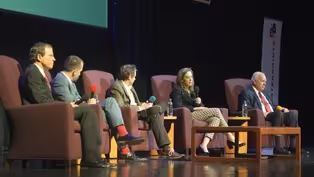
Civil Counterpoints - Freedom of the Press
Video has Closed Captions
A discussion series at TTU that covers difficult issues in a constructive and civil manner (1h 41s)
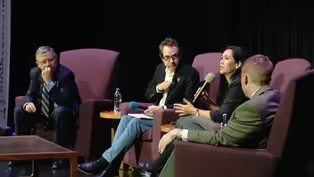
Civil Counterpoints - Waking From the American Dream
Video has Closed Captions
A discussion series at TTU that covers difficult issues in a constructive and civil manner (1h 25m 31s)
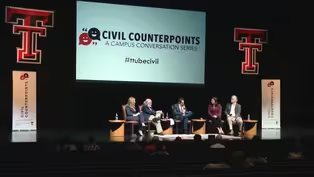
Civil Counterpoints - Cooling Down a Heated Debate
Video has Closed Captions
A discussion series at TTU that covers difficult issues in a constructive and civil manner (28m 48s)
Providing Support for PBS.org
Learn Moreabout PBS online sponsorship- I thank everybody for turning out.
This is a great, uh, I think, moment for the campus.
We can do some really interesting things here by having a discussion about some really challenging issues, I think in a very constructive way.
So, let me introduce the panelists briefly.
I'm Erik Bucy, Regents Professor in the College of Media and Communication here at Tech.
And to my left is Sean Cunningham, Associate Professor of History and Chair of the History Department here at Tech.
He teaches broadly in 20th century US History, focusing on American political culture.
He's published two books on Texas politics.
He's the recipient of numerous awards for his teaching and research and serves on the Board of Directors for the Texas State Historical Association as well as for Humanities Texas.
To his left is Professor Katie Langford, Associate Professor of Communications Studies here on campus and editor of the journal "Argumentation and Advocacy."
She's published widely in the area of constitutional interpretation and civil liberties.
Among her many accolades, Katie is the recipient of the James Madison Award for Outstanding Research in First Amendment Studies given by the Southern States Communication Association.
Finally, on our end is Professor Rick Rosen, Interim Dean of the School of Law here at Tech.
A Glenn D. West Endowed Professor of Law on campus.
Professor Rosen directs the Center for Military Law and Policy here at Tech and is admitted to practice law, hold on: in Florida; and before the US Supreme Court; and US courts of appeal for the 5th, 9th, 10th and federal circuits.
He joined the faculty in 2003 after a distinguished 26 year career as an officer in the US Army Judge Advocate General's Corps.
Thank you, panelists, for being here.
So with that, let's talk about opinion diversity and the need of, for it.
Let's just go back to the basics and just answer the question and I'd like to hear from each panelist.
Why is opinion diversity a healthy thing, both for society and for individuals, particularly for students, since that's our primary audience today?
Sean, you want to take it?
f th- e Suthrein.gs I tell my students in history classes, that history is the study of who we are and why we are the way that we are, and we are a diverse people.
We are a country of mixed opinions and ideologies and political parties, and I think that there-- It's easy sometimes to gravitate to areas where you're more comfortable and to protect yourself and I think that, that one of the things that university can do is challenge people, not necessarily to change their opinions, but to understand better why you, why you think the way you think.
What explains your background and how do you interact with the person next to you?
I think it's critical to engage in the classroom and to just-- Walking around campus and being part of a broader, intellectually robust community.
I think it's important to try to understand why you believe what you believe, and also to understand why others believe differently.
- I find similarly that within the classroom was that my students frequently don't know what they believe or they're scared if they express what they believe that they will be told they're wrong or they'll be kind of framed to make look silly or dumb.
And so, it's very important to equip students to understand what they believe, to be able to engage somebody else, to also understand the perspective of the other, because within our culture, reasonable people differ.
And that's one of the most important things about the culture and time at which we live in is that we like to frame it that that's not true.
That there are dogmatic positions that are correct.
But I say it over and over again in my classroom that reasonable people differ.
- Professor Rosen?
- First Amendment protects us, protects freedom of speech, not protect freedom from speech, and so people don't have a right not to be offended.
And it's a constitutional mandate in a public university.
I look at it as sort of black and white at a public university.
It's clear that we have to allow opposing viewpoints, regardless of how reprehensible we may think they are.
- So let's go back to the idea of having opinions and exchanging views.
Now, how do we prevent heated, or, let's say, passionate disagreement from devolving into, into heated animosity?
We see just a lot of, name calling and identifying of the other and in fact, are we really that different?
Even on the political spectrums.
- I think we tend to model a lot of-- I'll make a judgment here.
A lot of bad behavior in our political arena and even on non-political shows.
I would admit that, people who know me, I'm a big sports fan, and I love watching Pardon the Interruption on ESPN or Around the Horn.
And those are, those are shows that have been constructed in the last 15 years because they get ratings because you can put two people who will disagree with one another and then you can actually score them based on the quality of their argument.
At the end of the day, there are winners and there are losers, and I think that we've created a social cultural community in which people are competing with one another.
A sense of self, a sense of identity, wrapped up in being right and winning arguments.
I think there's a values problem in not truly seeking to understand or develop relationship, community with your fellow students or colleagues or just people that you run into on a daily basis.
- Right.
And from a media point of view, it does seem to be amplified, certainly, maybe exacerbated by the TV environment which encourages a certain amount of conflict and negativity - [Sean] Conflict gets ratings.
- Right, exactly.
So is the solution as easy as turn your TV off and, I don't know, slap the-- Slap media commentators with a contempt clause?
If you're on television, you just can't talk in certain ways.
Is that restricting speech too much?
- Yeah, I think so.
I mean, you can't do that.
It's fairly clear that news stations and commentators have the right to say whatever they want to say, believe whatever they want to believe.
The problem for people listening is to kind of filter out what's opinion and truth is something we can never, I guess, find, but find out what's-- what in fact is the closest we can get to a fact.
It's often difficult to do that.
It's better, probably, to just turn off the television if you get upset.
- It's interesting.
I have, I have turned my TV off a little more than I used to.
Now, let me move on to the next topic.
In the importance of considering other views and how this plays out in what Milton called "the marketplace of ideas."
So Milton articulated the importance of free press when its survival seemed in doubt in 17th century England, and he wrote some very eloquent things in defense of free speech and freedom of the press, one line in which he said, "Let truth and falsehood grapple.
Whoever knew truth put to the worse in a free and open encounter."
So truth will win out given enough time, given enough push back.
Here's the reality.
We're now in a-- Kind of a cybernetic social media space where bot-generated tweets can move much faster than humans trying to respond to a message they like or they don't like.
Katie.
- I, I would, I, you know, I'm also one that I do not believe that this time period is any worse than any previous time period.
I'm not someone who says, "Oh, things used to be so great and they're not great anymore."
Justice Brandeis said, and this is loosely paraphrasing him, the only cure for bad speech if more speech, not enforced silence.
And so, that is an idea that as we have more speech, good speech will beat out bad speech, right?
And Postman talks about this idea of kind of inundating culture.
That basically we're all just entertained by what's going on.
And our, our community ends up becoming, or developing a lack of seriousness.
And I do find that to be the case.
There is a lot that's going on, but I would never say have less.
The problem is that in this day and age with a lot more access to information is that people do self-select where they get that information.
And so they're not intentionally exposing themselves to a diversity of opinions.
- Earlier we were talking about, kind of the, you know, the functionality of talking to somebody who disagrees with you.
What about reading things, or just listening to arguments we don't agree with?
So, recent-- A couple developments in the New York Times recently.
They had a piece, a column, about why we should read books we actually hate.
And then, secondly, they're doing kind of an amazing thing for the New York Times, which is recommending partisan readings on both the left and the right and from around the blogosphere.
So they're acknowledging that there is a blogosphere and they're also saying, "Well, you know, it's not enough to just consume from one side."
So, so part of the argument is you should actually engage with the other view to fortify your own belief.
If nothing else, to define it and then decide what you're against and maybe you'll find pieces that you're for.
- Well, and you could find, you test your own beliefs.
And your beliefs may in fact not be true, or you may modify them.
So in my classroom, for example, say we're talking about Roe versus Wade, the famous abortion decision.
I will have people who are pro-choice argue in the descent, that there shouldn't-- That abortion isn't a constitutional right, and vice versa.
And that way they're forced to learn both sides of the issue.
Again, it's something that's essential in my trade.
I don't know what happens at the undergraduate level.
They don't seem to be offended by doing that, so I assume that, at least in their colleges, their professors are approaching it the same way.
- And yet we read in poll after poll about this tendency for people to have really hyper-partisan media diets.
And, you know, kind of, you know the echo bubble effect, where we only read news, only subscribe to feeds, and only consider posts that we already agree with.
So, you might have this belief, but it's never challenged, and when it is, it seems to be so remote we just consider it alien almost.
What are your thoughts on that?
- It's comfortable.
It's comfortable to do that.
It's um-- It's easier to do that.
You know, I saw, I saw this article in the New York Times talking about this, and it said something about, you know, reading books that you hate, and I thought immediately, "Well, how do you know you hate it if you haven't read it?"
Um, and I think that it's, it's certainly healthy.
I, I, I think there's nothing wrong with understanding why people with whom you disagree think the way they think.
I think if you don't understand why they think the way they think it's very, very easy, it's a quick step, to then say they're bad or they're stupid or they don't understand or, or, you know, I-- Other, other labels, pejoratives against someone that disagrees with you and I think those are conversation stoppers.
When people feel judged, categorized, labeled in a certain way, and not understood, it is going to be-- You can win an argument, but you're going to-- You lose a friend and lose an opportunity to develop that relationship and I think those are important things to, to not throw away even though it, it looks good on television.
You can model that behavior.
- Right, and it seems, you know-- What starts out as kind of, you know, a technique or a strategy for getting viewers on one show then generalizes the other shows, and then pretty soon we have campaigns that kind of revel in that as well and then it starts to become national and then it really starts consequences.
- Well, I mean, you think about the, the advent of modern day, televised debate and, and I'm sure there are several examples, but I think one of the better ones is 1968.
ABC news, losing in the ratings, asked William F. Buckley and Gore Vidal to come on television and spend ten minutes a night during this, the democratic and the republican national conventions, and it made for fantastic television.
You go back and look at some of the debates that they get into, and it was really nasty and really entertaining, but, but you see the, the success that that was for the news network, and then you see CNN and Crossfire and other examples over the years where, where that kind of contentious debate is encouraged.
And I understand why, and I think that can be a really helpful thing, but I think we need to be respectful of other opinions.
- I always try to encourage my students-- Another phrase I repeat is to become critical consumers of information.
To be aware.
I'm not saying not to use that media source, but to be aware of the bias that it does have.
There's a lot that we have to learn to adapt to.
I'm thinking about even, you know, the really fast movement of information is-- As educators and as critics of public discourse, we have to adapt to it.
And that's-- I think Jon Stewart, right?
Such a great example.
He was comedy, right?
But he was comedy that so many people turned in to to see what he had to say.
I think about him on Crossfire, too.
The classic example when he went on and said, "Stop, you're hurting America," right.
"This is all spectacle.
It's not actually debate.
I'd love to have debate."
And we need to have that awareness because a lot of people didn't realize the sort of thing Jon Stewart was doing, which was mostly media commentary.
I want to just have a little plug, as well.
There's an interdisciplinary effort that's called Citizen Critics.
It's a website, citi-crin-- citizencritics.org.
And so this is where academics at universities and from different disciplines are trying to evaluate public discourse and what's going on, but doing it in small, easily digestible ways.
Having these kind of short, short little blog posts, that are reminiscent of the type of information that people are consuming nowadays.
Citizencritics.org.
A little plug.
- I like that.
It's kind of like an elevator pitch for disagreement.
It's like, 90 seconds, just give me 90 seconds of the other side and you can walk out this elevator.
So, but this is an interesting point, and, you know, how do you know you disagree with something if you haven't really read it, if all you're catching is the headline, maybe not even the soundbite?
Or maybe you're catching the 140 characters on, on Twitter.
So, you know, we, we get to, you know, even things happening this semester, and there's been a couple kind of high profile bru-ha-ha's at campuses where they invite in speakers that don't even get a chance to speak.
And the reaction against the invitation is so harsh that there's either protests and violence and semi-riots or the talk gets canceled or the speaker has to kind of go underground and, and, you know, broadcast the talk, kind of in private.
So, Charles Murray.
His talk was more or less canceled at Middlebury College, and then he goes to the radio station after things die down on campus a little bit, and he, he gives this talk.
And then a couple of academics analyzed it, and they, they, they showed it to multiple people who read it and they all agreed it was pretty middle of the road.
Are we overreacting to this idea of difference, this idea of "you don't represent my views, therefore, not only do I not want to hear it, I'm going to do everything in my power, including take up arms, almost, to block you from doing that."
Professor Rosen?
- Um, it was the former President of the University of Chicago, Hanna Holburn Gray who said that education is not supposed to be comfortable; it's supposed to make people think.
And I think that those who protest have a right to protest.
They have a right to protest peacefully.
They don't have a right to have a heckler's veto, to shut down speech.
An action like that, I believe, quite frankly, is criminal.
If people are too emotionally fragile to hear views that they don't agree with, my suggestion is to invest heavily in ear plugs and blindfolds.
I mean, that's part of the educational process.
And so I very much oppose what has happened, for example, at Berkeley or Middlebury or a number of other colleges and universities.
- [Erik] Right.
- So here's, here's a dilemma.
And sorry for being kind of the, the curmudgeonly realist in some respects.
But we're also in an era, not only of acceleration, but also of customer orientation towards the student.
Now a customer experience is something that you, that you pay for, and you want to be comfortable.
It's like a cruise.
Everything's taken care of.
Aren't colleges to some extent becoming like this, and aren't we as kind of the marketers of education responsible to some extent for setting up this insularity?
Where "come to campus and have a good time, you're not going to be exposed to that much that's uncomfortable."
- I, I, I think that, uh-- That the university needs to, to be careful not to-- I mean, I do think, you know, we live in an ever competitive environment in which higher education institutions are, are battling for students and trying to recruit students, but I think we need to be careful about over-protecting our students and trying to avoid these challenges and these conflicts.
It's the root of what we're supposed to be doing, I think.
- The American Association of University Professors, AAUP, in 1992 came out with a statement about speech codes, and I'll just quote it very quickly, part of it.
It says, "On a campus that is free and open, no idea can be banned or forbidden.
No viewpoint or message may be deemed so hateful or disturbing that it may not be expressed.
The underlying principle does not change because the demand is to silence a hateful speaker or because it comes from within the academy.
Free speech is not simply an aspect of the educational enterprise to be weighed against other desirable ends; it is the very precondition of the academic enterprise itself."
And so if colleges cater to just provide comfort to students, they're not pro-- They're not accomplishing their mission.
- I actually wrote an essay about this about a decade ago.
I brought a copy, anybody?
- Oh, can you hand it around?
- Sure, and in it the argument that I make is that they're not mutually exclusive.
It's not like we have to choose one or the other, that we have to choose, you know-- I frame it as consumer student versus citizen student.
We don't have to choose one over the other.
We can both equip students to be in the actual market and workplace and we can also teach them ideals of citizenship.
So, we can achieve both at the university.
- So, essentially we're producing citizens, not satisfying consumers.
- I think both.
I don't think it has to be an either-or.
- That's interesting.
I think we're producing consumers, but that's my point of view.
Um, how do we solve this as academics, as educators?
Is there a way to, either model this on campus or to reinvent the curriculum that kind of introduces people to the idea of difference in year one rather than the idea of, you know, an all expenses paid, kind of, luxury cruise.
That's an exaggeration.
- Yeah, I've always been an advocate-- I used to be an academic advisor and I've been an advocate of, of a, of a true core curriculum in which students come to the university and get to experience the same classes, more or less.
So, 17-year-old prospective college students, high school seniors, are being asked to decide what they want to do with the rest of their life before they even get here, and then they are funneled into particular majors and then moved through those majors, and I think that it inhibits interaction because it's not necessarily true that individuals majoring in one particular field are going to be like-minded.
It's certainly not.
But I do think that it is true that if there was a greater integration of students from all majors into basic core courses-- By the way, I know there are people in the audience who handle some of this, and I have no solution on how to make that happen.
But ideally I would like to see something like that.
I think having those kinds of experiences as a freshman, sophomore, before you're expected to dive into whatever it is as a consumer.
That you're coming to the university to get a degree and a qualification and move on.
That would be nice.
- I think the conversations that we have in our classrooms is a good place to start.
Do we allow students the space to have conversation?
I start out most of my da-- most of my class periods having a conversation about what has happened in the news, right, that's been publicized and having a conversation.
Students have the ability to ask questions.
And I repeat, once again: Reasonable people disagree.
And so, if somebody has an opinion, that's great.
Let's hear that, right, and then somebody else can respond.
One thing that I would love for universities to do is kind of modeled after the 1960's, 1970's, is for us to hold teach-ins, right.
The university is a spot to be able to have these conversations, to model the type of behavior that we would like students to engage in once they leave the university, and I think teach-ins would be a great way to get those types of conversations started.
- I want to come back to this idea of placing the onus of sorting all this out on the individual.
How do we somehow equip, not just students, but citizens in general, right?
Because we should be educating the broadest possible audience.
How do we better equip people to deal with the onslaught, with the difference of opinion, with the heated opinion, and then the pace at which it's coming?
Katie.
- The larger public is hard, you know.
I go back-- I think about, you know, people have-- Some people don't have three meals a day.
We live in Lubbock, right, where one out of four children is food insecure and one out of five adults.
And if you're worried about where your next meal is coming from, you're not really concerned about the type of issues that we're talking about today.
For the university, I think, you know, we've had a lot of ideas where we want to model behaviors.
I would encourage students to try out for the debate team, which can be very scary, but it teaches you how to process a lot of information and to articulate different perspectives and viewpoints.
I wish, in an ideal world for me, our media, our representatives, everybody would model these behaviors, and we need to start with somewhere, right?
And we can start on the collegiate campus, with teachers doing this and with students learning to engage each other in the classroom in civilized discourse.
- You know, the thought that comes to mind is that, I think students today often get a bad rap.
And I think that's probably generationally true.
You ask someone about students in the late 80's or early 90's and they were spoiled or entitled or not prepared well in high school, but I find that, although you do have to work with students on, on basic skills that are fundamental to developing that next level of hierarchical thinking, of critical thinking and analysis and taking evidence and forming an argument, which is what we try to do in history, I find the students are very, very capable of being reasonable and interested and engaged.
I taught a class in the fall which was actually quite enjoyable up until about early November which was called Presidential Politics from Kennedy to Reagan, and it was an analysis of how political campaigns changed in the 60's, 70's, through to the 80's.
What I did on the first day of class was just tell my students, "Listen, I understand that it's the fall of 2016.
We're in the middle of a very heated debate.
We're not going to avoid sensitive topics.
Some people in here are going to agree with certain positions; some people are going to disagree with certain positions.
But we will be respectful of one another at all times, and every single opinion is welcome."
And I didn't have any problems at any point in the class.
And we had a wonderful time.
And even after the election, which was a tense-- I remember being a very, very tense day.
We were able to share quite a bit of laughter in the classroom and kind of talk about this in historical context and kind of make some comparisons to things that have happened that we'd talked about in the semester.
And I think that the crisis of the moment for some of my students was mitigated slightly just knowing that their opinions were welcome.
Just like I wanted to make sure that there were students in my class who were overjoyed at the outcome of the election, and that their opinions were welcome as well.
And so I think that doing that at the beginning of the semester rather than kind of backtracking after it had maybe been too late was helpful for me.
- Yeah, I like, I like that.
The resonance here of kind of the expectation of disagreement or difference as opposed to it being the exception, you know, and the thing that we have to be overly defensive about.
It's, it's now, you know.
- Yeah, just put it on the table and say, "This is how it's going to be.
It's going to be uncomfortable at times, but we'll make it through it."
And I think most of the time that can work.
I think students today are fully capable of having those kinds of debates.
- Okay, I'd like to take this moment, then, to thank our panelists for their insightful and collegial comments.
(applause) And I hope you join us for our next Civil Counterpoints Discussion here from the campus of Texas Tech.
(pleasant music) (awe-inspiring music)
 New Episode
- News and Public Affairs

Top journalists deliver compelling original analysis of the hour's headlines.
 New Season
- Drama

Hugh Bonneville stars in a crime drama inspired by one of the largest robberies in British history.
 New Episode
 New Season
 New Episode

 New Episode


 New Episode
Support for PBS provided by:
Inside Texas Tech is a local public television program presented by KCOS and KTTZ