
Conversations with Local Authors: Desiree Cooper, Ruta Sepetys and Arthur Horwitz
Season 11 Episode 8 | 26m 46sVideo has Closed Captions
Authors Desiree Cooper, Ruta Sepetys and Arthur Horwitz discuss their latest novels.
We’re talking with authors about their latest books. Former Detroit journalist Desiree Cooper discusses her anthology of stories about Black Detroiters’ summer experiences. Plus, Michigan native Ruta Sepetys talks about her novel, “A Fortune of Sand” and the publisher of the Detroit Jewish news, Arthur Horwitz, talks about his memoir on his life as the son of a Holocaust survivor.
Problems playing video? | Closed Captioning Feedback
Problems playing video? | Closed Captioning Feedback
One Detroit is a local public television program presented by Detroit PBS
Conversations with Local Authors: Desiree Cooper, Ruta Sepetys and Arthur Horwitz
Season 11 Episode 8 | 26m 46sVideo has Closed Captions
We’re talking with authors about their latest books. Former Detroit journalist Desiree Cooper discusses her anthology of stories about Black Detroiters’ summer experiences. Plus, Michigan native Ruta Sepetys talks about her novel, “A Fortune of Sand” and the publisher of the Detroit Jewish news, Arthur Horwitz, talks about his memoir on his life as the son of a Holocaust survivor.
Problems playing video? | Closed Captioning Feedback
Where to Watch One Detroit
One Detroit is available to stream on pbs.org and the PBS app.
Providing Support for PBS.org
Learn Moreabout PBS online sponsorship- Coming up on "One Detroit," we're talking with authors about their latest books.
Our former Detroit journalist, Desiree Cooper, discusses her anthology of stories about Black Detroiters' summer experiences.
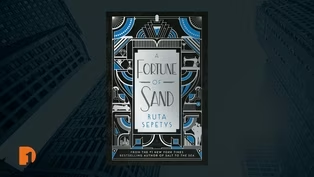
Plus, Michigan native Ruta Sepetys talks about her novel, "A Fortune of Sand."
And the publisher of the Detroit Jewish News, Arthur Horwitz, talks about his memoir on his life as the son of a Holocaust survivor.
It's all coming up next on "One Detroit."
- [Announcer] Across our Masco family of companies, our goal is to deliver better living possibilities and make positive changes in the neighborhoods where we live, work, and do business.
Masco, a Michigan company since 1929.
Support also provided by the Cynthia 7 Edsel Ford Fund for Journalism at Detroit PBS.
- [Announcer] The DTE Foundation is a proud sponsor of Detroit PBS.
Through our giving, we are committed to meeting the needs of the communities we serve statewide to help ensure a bright and thriving future for all.
Learn more at dtefoundation.com.
- [Announcer] Nissan Foundation.
And viewers like you.
(bright music) - Hello, I'm Zosette Guir.
On today's "One Detroit," it's all about books.
We'll talk with the author of a new novel inspired by an often overlooked chapter of Detroit's history.
Plus, journalist and community leader Arthur Horwitz reflects on his life as a second generation Holocaust survivor.
But first up, a new book titled "Black Summers: Growing Up in the Urban Outdoors," features a collection of stories, poems, and drawings by Detroiters about their summer experiences in the city.
The anthology explores the struggles, joys, and resilience of African Americans navigating summer fun in Detroit's public spaces.
The editor of The Anthology is award-winning author and journalist Desiree Cooper.
She talked about the book with "One Detroit" contributor, Steven Henderson on American Black Journal.
(light music) - I, of course, love this anthology, and you and I have talked about it now for a very long time.
But I don't think I know the answer to the question about how you came up with this as an idea, this idea of summer, summer in Detroit, and the experiences that we as African Americans have that are very distinct from other folks here in Detroit in the summers.
What sort of piqued your curiosity here about this subject?
- Yeah.
So the book is dedicated to the memory of Sarah Elizabeth Ray.
And she was the woman that not many Detroiters know about.
She integrated the Bob-Lo boat.
So that iconic summer experience for Detroiters, the Bob-Lo Boat, people remember being there with family, with people from all walks of life, it being integrated.
Well, it wasn't always the case.
And in 1948, she won a US Supreme Court decision that opened up the Bob-Lo boat for everyone.
And so part of me, I had been doing a lot of work around her history and telling her story.
And I just sort of had this question of, you know, what if she was around now?
You know, how would she feel about the liberties and the freedoms that we are experiencing now compared to 1948?
Well, I shouldn't say now because it's a little precarious now.
- Right.
We're not sure.
We're not sure, right?
(chuckles) - But to my point, or would she say, "Wow, I would've thought we would've come further," or "I would've though things would be much more different."
And so I said, "Why not ask current Detroiters about what their core summer memories are or experiences are, and how it's shaped by race still today?"
- Yeah.
Yeah.
One of the things about this collection that I think is really important to note is like all things Black, it represents this incredible breadth of experience, of emotion of though and understanding.
It's not one thing, it's not many things, it's all things.
And there's something, I think, kind of intrinsic about the African-American experience and noting that it is all things rather than, you know, a set of things or one things, which I think is, it too often gets reduced to that.
- Right, and I did, you know, I reached out and got writers who were 16, teenagers when they started.
This was a three-year project, so people aged out of those groups during the process.
And I think the oldest writer was 74 at the time when they offered the essay.
So I purposely tried to get a range in terms of that, in terms of geography.
And I will agree with you that everyone brought their own lives to the table, right?
But at the same time, there is this, the specter of race that is common.
And then their reactions were individual, you know, and how it played out for them in their lives as individual.
So one of my hopes was exactly as you're saying and that is that across the nation, people can read a book like this and find themselves in it, no matter who they are.
They can remember bike riding in the summer or the pools in the summer or the fishing in the summer.
But there's also going to be aspects of it that they'll say, "I never thought of," or that they will feel validated that their summer experiences, which haven't really been widely portrayed or are not part of that usual nostalgia around summer are included in these pages.
- Yeah.
Yeah.
The aspect of memory here, I think is also really really key.
The way that for us as African Americans memory plays a different role often in our lives in terms of how we come to the places we are or how we think of the world.
That's another theme that I think is so strong in the book.
- Steven, when I came to you and I said, "I have this idea and I'm wondering if you would be willing to contribute," you did not hesitate.
And you know what you said to me?
You said, "I have a story that I've always wanted to tell.
And I've never told.".
- Mm-hm.
Mm-hm.
- So get the book and hear the story that Steven has been holding in.
But I will tell you this much about that story.
That it explores what racial trauma does to a person, especially when they meet it out of nowhere as a child.
And I do feel that in this day and age, when we have now sort of been re-traumatized in real time with Black Lives Matter, with you know, the protest in Minnesota and ICE, we are seeing, we're horrified by these things.
And many people are saying, "I can't watch anymore.
I feel traumatized."
Well, dial it back, right, to the pre-civil rights era or before the rebellion in Detroit or during the rebellion in Detroit.
And one thing that I realized is that Detroit had a trauma that we have not quite... We don't, we don't talk about it as trauma.
And so of course it hasn't healed.
- Right.
- So there may be an aspect of that too, and I appreciate you sharing a story that really helps us open that up.
- Let's turn now to the latest novel by Michigan native and bestselling author, Ruta Sepetys.
"A Fortune of Sand" is a drama set in 1920s Detroit when the automobile industry was booming.
The story explores ambition, family loyalty, and the fortunes built and lost during a groundbreaking period in America's history.
One Detroit contributor, Lauren Smith of PBS Books spoke with Sepetys during the author's appearance at the Penn Theater in Plymouth.
(light music) - So tell us all about the book.
What inspired it?
- Oh, what inspired it?
My love for Detroit.
Also what inspired it is my question.
What determines how history is preserved and recalled?
Many people don't know that Detroit was once considered the Paris of the Midwest.
So I wanted to go back to Detroit's golden age and bring that history out of the dark via a story.
- Yes.
So it takes place in 1920s, Detroit.
What was different about that time than now?
And how does that sort of factor into the story?
- What surprised me about the '20s was that the dominant narrative of the '20s that we've accepted, flappers and jazz and, you know, this... That's not the complete narrative.
And when I started to look into Detroit history, I did find the complete narrative that represented what was happening across the entire the entire country.
And "A Fortune of Sand" follows an automotive family, the Lennox.
And the youngest daughter, Marjorie Lennox is an aspiring fashion designer.
And this is a very wealthy family who's behaving badly and gaining a lot of power while doing it.
And Marjorie discovers a web of lies in her own family and then has to face a terrifying truth.
Just how far will an American dynasty go to keep their secrets?
And those were things that I was uncovering about the city of Detroit.
And it was, the story was built with bricks from actual true stories.
- Wow.
And you actually looked into some of the old photographs and researched some of the old articles and papers.
Talk to us about the research process.
- Oh, I love the research process.
So to research this book, every morning with my coffee, I read the newspaper from whatever day it was, but in 1927, the setting for the book.
And what I found, again, was so interesting because the papers in the city of Detroit, so the free press, the news, at the time there was the Detroit Times.
I was reading something.
But then when I would go to a newspaper, let's say from Battle Creek or Lansing or Traverse City, there were stories that weren't reported in the Detroit papers themselves.
And keep in mind, during that time, newspapers carried so much power.
Newspapers, society pages, obituaries.
- That's, We talk about in this novel.
- Exactly!
Right.
And that's where the stories lied.
I did find that obituaries and death notices, people were very particular.
But think about it, this was their history.
But in one particular case of something I was researching related to the book, I don't want to give any spoilers, something didn't add up to me.
So I filed a request to get access to a death certificate.
And what was reported on the death certificate is not what was in the obituary.
So people were... There was this great contrast of fortune and facade.
And as a writer and a creative, we need that, right?
We need those opposing forces.
They illuminate each other.
So I really leaned into the fortune and facade of Detroit.
- I love that.
And let's talk a little bit about the title, "A Fortune of Sand," and that metaphor.
- Yes.
In "A Fortune of Sand," so sand sand is something that we walk on.
Sand is something that we wipe from our shoes, right?
But there's a paradox there.
Sand slips through our fingers.
So it's something that we might disregard.
But in a certain situation, sand can become really strong.
You know, sometimes when it's wet or under the right circumstances, we need sand to make glass.
And the Lennox family, they run a glass empire.
And glass then is also has these contrasts that, if glass can provide protection from the elements, it's something that maybe helps us see, but it can also become distorted and it can shatter.
And so when I was thinking about it, I though, "Oh my goodness, all these contrasts and juxtapositions, I'm gonna try to put those together into a title, "A Fortune of Sand."
- I love that so much.
And I thought the book was so great.
It's sort of a mix of historical fiction, but it feels a little gothic to me as well.
It's sort of spooky without there being any real ghosts.
And there's some really interesting, like, just Detroit landmarks.
There's the Grosse Pointe mansions.
But then there's also like Eloise Asylum and things like that.
I think for Detroiters, it's going to be a fascinating look at a city that maybe you hadn't considered in this way.
- I hope so, because, you know, history can be haunting.
And Detroit during the '20s was a city at war with itself.
This was during prohibition.
And think about what was going on.
But also, I want people to know and appreciate Detroit.
Detroit, during this time period, wasn't looking to the future.
Detroit was creating the future, right?
And so I really wanted people to, I don't know, understand Detroit during this age.
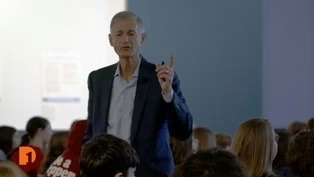
- Earlier this year, journalist and community leader Arthur Horwitz released his memoir titled "Dual Identities: Living in Meier Shadow."
In it, he tells his story as the son of a Holocaust survivor.
The book also details personal and professional aspects of his life, including his role as publisher of the Detroit Jewish News.
One Detroit contributor, Marty Fischhoff, spoke with Horwitz, who is a former chair of the Detroit PBS Board of Trustees.
(light music) - [Marty] We are at the Zekelman Holocaust Center in Farmington Hills to talk with Arthur Horwitz, longtime publisher of the Detroit Jewish News and esteemed community leader, about his memoir, "Dual Identities: Living in Meier's Shadow."
- The dual identities are mine and my mother's little brother.
My mother was a Holocaust survivor.
Her little brother didn't survive.
I am named in his memory.
And as I was looking at all of that, I realized that, you know, there's a story right at the core.
And the story relates to my mother, a Holocaust survivor.
My father, American born.
In fact, born in New Haven, Connecticut.
And me as the child of a survivor.
And recognizing as I fought back and looked at other kinds of books that had been written, that children of survivors are mostly writing about their parents' stories.
And what I saw was an opportunity to give voice to my own story, to speak for kind of a generation called 2Gs, children of survivors, who sometimes weren't really willing or able to talk about what it was like growing up post-World War II America as a child of a survivor.
- [Marty] Just before our interview, Horwitz spoke to a group of eighth grade students at the Zekelman Center.
He recalled rummaging through his mother's wallet as a kid looking for money.
That's when he found a photo that would change his life.
- This guy's in her wallet and I asked her, "Who is this?"
I already knew because growing up in a household as a child of a survivor, you're exposed to this photo.
This is, if you say is there one image that captures the brutality of the Holocaust, this would be one of those, if not the photo.
- [Marty] The boy in the photo was about the same age as the brother his mother lost to the Nazis.
She had no photos left of her brother and she would claim this was him.
- So I already knew it wasn't her little brother.
And I said, "It's not your little brother."
She said, "Yes, it is."
I said, "No, it's not.
You said you had no photos of any of your family members."
And by the way, she could name 91 family members who were killed, murdered, and there were six who survived.
And it was like at that point, Marty, that my mother decided that I would be living two lives.
Mine, as I mentioned, as related to the title of the book, and the one her little brother didn't have.
And from that point forward, my life, my family, my media career was through a filter or a frame of living two lives.
And for a 12-year-old, or for anybody, it's hard enough to living your own life, let alone two.
- [Marty] And thus, the book's titled "Dual Identities."
While some Holocaust survivors were hesitant to tell their stories, Horwitz remembers his mother, Sally Horwitz, speaking to student groups back in Connecticut, just as he does today.
- My mother would speak about the Holocaust, and she would speak to groups of children, school-aged children, you know, in New Haven.
And she would share her story.
And I went back and I looked at some of the scribblings that she had made of her presentations.
And the thing that stood out wasn't the bitterness.
It wasn't revenge of clearly from almost being wiped out.
You know, having, you know, children, grandchildren, great-grandchildren, you know, who followed her.
It's a miracle in and of itself.
But for her, the key was this is a great country.
And she would say in her presentations, "You know what?
God bless America.
Don't take freedom for granted.
Protect our democracy.
Remember that we were all from somewhere else, somewhere originally."
- You spent a lot of time speaking to students here from all over the state.
How did you get involved in that?
- I had been approached by the Zekelman Holocaust Center.
It was actually late in 2020, early 2021.
They were putting together a cohort, a first cohort of children of survivors to be trained over a period of several months to present to the thousands and thousands of students who were coming through the Holocaust Center since 2016 when Michigan Governor Snyder signed into law a public act that mandated Holocaust education, public schools.
As these kids were starting to come through, the Zekelman Holocaust Center realized they had a little challenge.
Well, there were fewer and fewer survivors.
So their motive, meaning the Zekelman Holocaust Center, was can we get some of their children and train them not just to parrot or repeat their parents' stories, but to weave their own stories into it.
So Gina, my wife, is also a daughter of a Holocaust survivor.
Her mother was on the Kindertransport.
And I talked to Gina and I said, "Is this something I should do?
I'm not sure.
I want to go there and dig up some of what's there in my past."
She encouraged me to do it.
It was the most important thing that I've done for, on a personal level, maybe my entire life, because it freed me up.
It gave me the opportunity to both extract what was inside of me, but also it allowed me to honor my mother and her family.
And it allowed me to leave a message of hope, which I thought was really important for these children.
Now let me tell you about Gogatz.
Gogatz was a foreman, Polish foreman pressed into service by the Germans at my mother's first slave labor camp.
I took after my mother, as she reminded me, she was always pushing the envelope.
She was always taking risks.
She snuck out of her camp, she got caught.
German puts his rifle to her head, that's it.
But no, Gogatz intervenes, pushes the rifle away, says, "She is my best worker.
I need her, I will take responsibility for her."
German could have pulled the trigger twice, once to put a bullet in my mother's head and once to put a bullet in Gogatz's head.
Instead, he hits Gogatz over the head with his rifle butt and goes off, okay.
No Gogatz, I wouldn't be here.
But what's important with Gogatz is he just did the right thing.
Okay, he saw something, he spoke out.
He wasn't a bystander.
- [Marty] After the war, Arthur's mother tried to find Gogatz, but learned he had been killed by the Germans.
- That particular message, and that my mother, when she would present, when I looked through her notes, would bring up Gogatz as an example of somebody who spoke up and spoke out.
There he was, in my mother's writings, there he was in that interview.
He was the ideal person to remind thousands, thousands of children that it only takes one person, and Gogatz saved my mother, which meant by extension he saved me, he saved my siblings, he saved my grandchildren.
And some of them have done things as physicians, et cetera, that have truly saved lives and extended lives.
And here's this guy 80 plus years ago who saved my mother's life, probably couldn't put his finger on a map of Michigan, and we're talking about him.
So that was my message, to try to leave.
Stand up, say when you see something wrong, don't be a bystander.
And if there's one person of all of the people I've spoken with, who in a year, 10 years, 20 years, 30 years, remembers the message of Gogatz and does something that helps repair the world, that helps save lives, then that's both a tribute to Gogatz himself, it's a tribute to my mother.
And it's a tribute to telling the stories to students in hope that someday the dividend will come back and they'll do something not just for somebody who's Jewish, but really beyond for humanity, if you will.
That's the hope, that's Gogatz's hope.
- [Marty] Then Horwitz shows the students a photo of his extended family.
- Because for my mother, on a personal note, this was her revenge.
This was how she fought back in the end against the Nazis, against the Germans, she brought life into the world, children, grandchildren, great-grandchildren, and in my family, three children, seven grandchildren, that was her revenge.
- [Marty] "Dual Identities" is a book about many aspects of Horwitz's life, his childhood, the journalism career that culminated in leading one of the most influential Jewish newspapers in the country and his life as a son, husband, father, and grandfather.
But what we may remember most are the lessons it teaches us about history and what we as people and a nation should never forget.
- That'll do it for this week's show.
Thank you for watching.
Head to the One Detroit website for all the stories we're working on.
Follow us on social media and sign up for our newsletter.
(light music) - [Announcer] Across our Masco family of companies, our goal is to deliver better living possibilities and make positive changes in the neighborhoods where we live, work, and do business.
Masco, a Michigan company since 1929.
Support also provided by the Cynthia and Edsel Ford Fund for Journalism at Detroit PBS.
- [Announcer] The DTE Foundation is a proud sponsor of Detroit PBS.
Through our giving, we are committed to meeting the needs of the communities we serve statewide, to help ensure a bright and thriving future for all.
Learn more at dtefoundation.com.
- [Announcer] Nissan Foundation.
And viewers like you.
(upbeat music) (bright music)
 New
NewArthur Horwitz: The memoir of a second-generation Holocaust survivor
Video has Closed Captions
Clip: S11 Ep8 | 10m 40s | The book details aspects of his life, including the impact of being the son of a Holocaust survivor. (10m 40s)
 New
NewAuthor Desiree Cooper on her new book, “Black Summers: Growing up in the Urban Outdoors”
Video has Closed Captions
Clip: S11 Ep8 | 10m 40s | The anthology explores the struggles and joys of African Americans navigating summer fun in Detroit. (10m 40s)
 New
NewVideo has Closed Captions
Clip: S11 Ep8 | 5m 14s | “A Fortune of Sand” is a drama set in 1920s Detroit when the automobile industry was booming. (5m 14s)
Providing Support for PBS.org
Learn Moreabout PBS online sponsorship New Episode
- News and Public Affairs

Top journalists deliver compelling original analysis of the hour's headlines.

- News and Public Affairs

Today's top journalists discuss Washington's current political events and public affairs.




 New Episode



 New Episode
 New Episode
Support for PBS provided by:
One Detroit is a local public television program presented by Detroit PBS