
Census officials work to count every person in remote Alaska
Clip: 1/3/2026 | 4m 12sVideo has Closed Captions
Census officials work to count every person in Alaska’s most remote places
The next major U.S. national census is in 2030, but this year, the Census Bureau will conduct field tests to try to come up with better ways to count the most hard-to-reach populations. In Alaska, officials came up with a plan during the last census to count one of the most remote villages in that state. Alaska Public Media’s Matt Faubion reports.
Problems playing video? | Closed Captioning Feedback
Problems playing video? | Closed Captioning Feedback
Major corporate funding for the PBS News Hour is provided by BDO, BNSF, Consumer Cellular, American Cruise Lines, and Raymond James. Funding for the PBS NewsHour Weekend is provided by...
Support provided by:

Census officials work to count every person in remote Alaska
Clip: 1/3/2026 | 4m 12sVideo has Closed Captions
The next major U.S. national census is in 2030, but this year, the Census Bureau will conduct field tests to try to come up with better ways to count the most hard-to-reach populations. In Alaska, officials came up with a plan during the last census to count one of the most remote villages in that state. Alaska Public Media’s Matt Faubion reports.
Problems playing video? | Closed Captioning Feedback
How to Watch PBS News Hour
PBS News Hour is available to stream on pbs.org and the free PBS App, available on iPhone, Apple TV, Android TV, Android smartphones, Amazon Fire TV, Amazon Fire Tablet, Roku, Samsung Smart TV, and Vizio.
Providing Support for PBS.org
Learn Moreabout PBS online sponsorshipALI ROGIN: Finally tonight, the next major U.S.
national census is in 2030.
But this year, the Census Bureau will be conducting field tests to try to come up with better ways to count the most hard to reach populations.
Places like remote Alaska, where during the last census, officials came up with an innovative plan to count one of the most remote villages in that state.
Here's Matt Faubion from PBS Alaska.
MATT FAUBION (voice-over): Alaska is known as the last frontier for his harsh winters and vast, remote landscapes.
But for more than 150 years it has also been by tradition the first place Americans are counted in the American census.
In 2020 it began in a small town of Nunakauyaq known as English Toksook Bay located along the state's southwest coast by the Bering Sea.
That year the U.S.
Census counted just 672 people, most of them Alaskan natives, members of the Yupik people, including James Sippary, whose family has lived in this area for generations.
JAMES SIPPARY, Elder, Toksook Bay: This village used to be a fishing camp and my grandfather's camp winter and summer for the survival of his families.
MATT FAUBION (voice-over): Today, survival for many in Toksook Bay depends on federal and state funding.
MAN: Get the rest of the stuff.
MATT FAUBION (voice-over): Vital resources that help cover the cost of housing, health clinics, and supplies for the only school here.
But as state demographer David Howell explains, in order to fairly dole out these funds, an accurate census is a must.
And in remote Alaska, that's no simple task.
DAVID HOWELL, Alaska Department of Labor: These places are not on the road system.
Most of the time you're flying in or boating in.
Rivers become highways for snow machines.
MATT FAUBION (voice-over): So during the last census, in addition to the traditional door to door outreach, they tried something else.
For the first time.
They gave residents the option to submit information by mail or online instead.
WOMAN: All census responses are completely confidential.
MATT FAUBION (voice-over): But their efforts to solve one problem quickly created another.
Residents voiced concerns about sharing sensitive personal data.
They worried their information could be intercepted in the mail or hacked online and their identities stolen.
It turns out those concerns were not unfounded.
The state had simulated an attack on resident census data years earlier.
DAVID HOWELL: A scenario in which if this data was stolen from the bureau, how many records could you match to the actual population?
And so they were able to match quite a high number.
MATT FAUBION (voice-over): The U.S.
census came up with a plan to address the residents of Nunakauyaq's concerns.
They embraced a cutting edge mathematical algorithm called differential privacy.
It compiles the big picture data statistics of a group while protecting specific private information of each individual.
It's kind of like if we took a high resolution picture of this Yupik dance group.
We can see facial features that could expose people's identities.
The algorithm adds digital noise to blur a few faces slightly or adds static to the overall photo.
And the quality is lowered just enough to protect everyone's identities.
The Census Bureau applied that photo altering principle to Toksook Bay in 2020.
They say it helped ease residents' fears and protected their identities.
It also produced an accurate count which made sure needed funding got to the right places.
DAVID HOWELL: And it's very prohibitively expensive to build.
With these grants they're able to build more homes for people, build community centers.
Just all sorts of projects are grant funded.
If your population is off, you may not get approved for such a thing.
MATT FAUBION (voice-over): Elder James Sippary is excited about how accurate census data can help tackle the desperate of his community.
JAMES SIPPARY: The very important things that I would like to see is the native workforce development.
Prepare our people for their future as we journey on forward to win for life.
MATT FAUBION (voice-over): As the census prepares for the next count in 2030, residents in Alaska's most remote places like Toksook Bay know they will be counted and their individual privacy will not be compromised.
For PBS News Weekend, Matt Faubion in Toksook Bay, Alaska.

Former U.S. ambassador analyzes goal of Maduro regime change
Video has Closed Captions
Clip: 1/3/2026 | 4m 23s | Former U.S. ambassador to Venezuela analyzes goal of Maduro regime change (4m 23s)

San Francisco sues food companies over ultra-processed foods
Video has Closed Captions
Clip: 1/3/2026 | 6m 45s | Why San Francisco is suing top U.S. food manufacturers over ultra-processed foods (6m 45s)

U.S. military captures Venezuela’s Maduro in surprise strike
Video has Closed Captions
Clip: 1/3/2026 | 4m 3s | Trump says U.S. will ‘run’ Venezuela after capturing Maduro in surprise military strike (4m 3s)
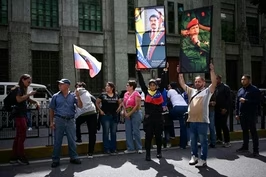
Venezuelans react to Maduro’s capture by U.S. forces
Video has Closed Captions
Clip: 1/3/2026 | 3m 5s | How Venezuelans in Caracas are reacting to Maduro’s capture by U.S. forces (3m 5s)
Providing Support for PBS.org
Learn Moreabout PBS online sponsorship
- News and Public Affairs

FRONTLINE is investigative journalism that questions, explains and changes our world.

- News and Public Affairs

Amanpour and Company features conversations with leaders and decision makers.












Support for PBS provided by:
Major corporate funding for the PBS News Hour is provided by BDO, BNSF, Consumer Cellular, American Cruise Lines, and Raymond James. Funding for the PBS NewsHour Weekend is provided by...