
Yemen's COVID Cover-Up
Clip: Season 2021 Episode 5 | 27m 28sVideo has Closed Captions
How the coronavirus pandemic has deepened Yemen's humanitarian crisis.
Yemen-born journalist Nawal al-Maghafi returns to her home country to investigate how the coronavirus pandemic has deepened what has been called the worst humanitarian crisis in the world. Following six years of war, an estimated 2 million children in Yemen suffer from starvation, and 3.5 million people have been internally displaced.
Problems playing video? | Closed Captioning Feedback
Problems playing video? | Closed Captioning Feedback
Funding for FRONTLINE is provided through the support of PBS viewers and by the Corporation for Public Broadcasting. Major funding for FRONTLINE is provided by the Ford Foundation. Additional funding...
Support provided by:

Yemen's COVID Cover-Up
Clip: Season 2021 Episode 5 | 27m 28sVideo has Closed Captions
Yemen-born journalist Nawal al-Maghafi returns to her home country to investigate how the coronavirus pandemic has deepened what has been called the worst humanitarian crisis in the world. Following six years of war, an estimated 2 million children in Yemen suffer from starvation, and 3.5 million people have been internally displaced.
Problems playing video? | Closed Captioning Feedback
Where to Watch FRONTLINE
FRONTLINE is available to stream on pbs.org and the PBS app.
Buy Now
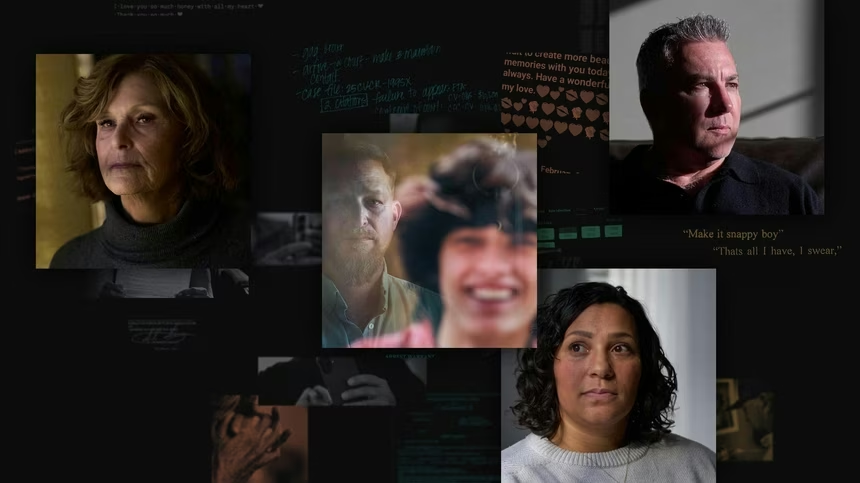
Inside the Scam
Follow scams as they unfold — and examine tactics used to manipulate victims. A collaboration between FRONTLINE and The Associated Press.Providing Support for PBS.org
Learn Moreabout PBS online sponsorship♪ ♪ (bustling market sounds) >> NAWAL AL-MAGHAFI: This is Sanaa, the capital of Yemen.
It's April 2020, and COVID is raging around the world, but here the city markets are still full of people.
>> (speaking Arabic): >> AL-MAGHAFI: When this was filmed, other countries were already under lockdown.
>> (conversing in Arabic): >> AL-MAGHAFI: They're selling qat, a stimulant.
Chewing the leaves is a national addiction.
>> (speaking Arabic): >> AL-MAGHAFI: The city seems to be in denial.
>> (conversing in Arabic): (man coughing) ♪ ♪ >> AL-MAGHAFI: Three months later, I'm heading to Sanaa.
I'm originally from Yemen, and for the past six years I've been covering the devastating war here.
This time I've come to see how the virus is impacting the dire situation, especially here in the north, which is controlled by the Houthis, a rebel group backed by Iran.
>> (chanting in Arabic): >> AL-MAGHAFI: There've been widespread reports of thousands of COVID deaths in areas where the internationally recognized government is in control, but here in the north the Houthis insist there have only been four cases.
Even before I arrive, doctors have been telling me the death toll is much higher.
>> (speaking Arabic): >> AL-MAGHAFI: I'm the first journalist from an international broadcaster to be allowed into the country since the pandemic began.
When I get to Sanaa, the Houthis require me to attend a press conference on the COVID situation.
The health minister, Dr.
Taha al Mutawakkil, spends most of the briefing criticizing the Houthi's enemies, the Saudi-led coalition that supports the internationally recognized government and has blockaded Houthi territory for years.
>> (speaking Arabic): >> AL-MAGHAFI: He says very little about the pandemic or what the Houthis are doing to fight it.
(in Arabic): >> (speaking Arabic): >> (speaking Arabic): >> AL-MAGHAFI: I try to press the minister as he leaves.
(conversing in Arabic): ♪ ♪ >> AL-MAGHAFI: After the press conference, the Houthis assign me a minder to accompany me wherever I go.
I head for one of Sanaa's main markets, Bab Al Salam.
I'd heard that one of the first COVID cases in Yemen was a shopkeeper here.
There are signs telling people to wash their hands.
But no one is wearing a mask.
As we walk, we're approached by the man on the left.
We soon realize he's an informant for the Houthi authorities; he tells us not to film anything about coronavirus.
A shopkeeper tells me I don't need a mask because COVID's over.
We're about to interview him when the man interrupts and tells him what to say.
>> (speaking Arabic): >> AL-MAGHAFI: Getting to the truth isn't going to be easy.
(in Arabic): The Houthis use their network of local informants to exert control over the population.
But some people are willing to speak out.
I shake off my minder and go to meet Dr.
Ehab Alsaqqaf.
I'm hoping he can help me piece together what's really going on.
He says the first wave of coronavirus cases has passed but that its effects were severe.
>> (speaking Arabic): >> AL-MAGHAFI: Dr.
Ehab is an epidemiologist.
Early on, the Houthi authorities appointed him to a team to test and trace COVID cases.
>> (speaking Arabic): >> AL-MAGHAFI: He says his team was reporting COVID numbers to the Ministry of Health but that publicly the ministry continued to deny that the virus had even entered northern Yemen.
>> (speaking Arabic): >> AL-MAGHAFI: Dr.
Ehab was one of the few people who knew the true scale of the COVID crisis, so when his own grandmother needed hospital care, he took extreme measures.
He set up an intensive care ward for her at home.
>> (speaking Arabic): (men chanting) >> AL-MAGHAFI: The Houthi authorities put out very little public information about the spread of COVID, but they've promoted propaganda videos like this one from May showing them mobilizing against the virus.
>> (speaking Arabic): >> AL-MAGHAFI: By May the 5th, the Houthis had admitted to a single COVID fatality.
But social media would soon tell a different story.
(car horn honks) >> (speaking Arabic): >> AL-MAGHAFI: Just 23 days later, this video, filmed outside Kuwait Hospital, showed how fast the disease was spreading.
>> (conversing in Arabic): >> AL-MAGHAFI: As soon as COVID hit, the Houthis banned journalists from hospitals.
But after two weeks of negotiating, they finally allow me in to one.
They insist that six minders accompany me.
The COVID ward in Kuwait Hospital is supported by an international NGO, Doctors Without Borders.
It's staffed with locals like Dr.
Rania Jashan.
Though the hospital is well equipped compared to others here, she tells me it was quickly overwhelmed.
>> (speaking Arabic): >> AL-MAGHAFI: Dr.
Rania said she wasn't allowed to tell me the exact number of deaths; but she said that many of those who died were young, a group considered low risk in other countries.
>> (speaking Arabic): >> AL-MAGHAFI (in Arabic): (voice breaking): >> AL-MAGHAFI: Despite what was going on inside their own hospitals, the Houthi authorities continued to deny they had a COVID crisis.
At the same time, they were rounding up people suspected of being infected.
Videos posted to Facebook in May show armed men taking sick people away by force.
>> (conversing in Arabic): >> AL-MAGHAFI: Here, a mother is separated from her daughter.
>> (speaking Arabic): >> (speaking Arabic): (gunshots, men shouting) >> (speaking Arabic): >> AL-MAGHAFI: Doctors told me they'd heard about many people who died at home without medical attention.
We found more cellphone footage that shows Houthi teams from the Ministry of Health collecting bodies dumped on the street.
We also found Facebook posts memorializing relatives and friends who died from the virus, evidence of a far higher death toll than the authorities were admitting.
In one week in June, we tracked hundreds of them.
Like this one, from the Jaralla family, who lost three brothers.
After all I've seen and heard, I want to question the Houthi health minister who dodged me at the press conference.
He finally agrees to meet me in the port city of Hodeidah.
The Saudis have bombed this road many times.
It's a dangerous six-hour drive.
All these lorries are carrying food and aid supplies to be distributed across the north, and they can spend days queuing for petrol, and because of the blockade, not much of it is coming in.
♪ ♪ The Saudi coalition has imposed a blockade on Hodeidah's port for the last five years to stop the Houthis bringing in arms.
As a consequence, supplies of medicine, food, and fuel are largely cut off.
It can take months for aid to reach people.
(crowd chattering) I'm meeting the minister in Hodeidah Central Hospital.
He wants to show me how the blockade affects people here.
>> (speaking Arabic): (baby crying) >> AL-MAGHAFI: The emergency ward is overwhelmed with children, most of them suffering from malnutrition.
>> (conversing in Arabic): >> (speaking Arabic): >> AL-MAGHAFI (in Arabic): >> (conversing in Arabic): (coughing in background) >> AL-MAGHAFI (in Arabic): >> (speaking Arabic): >> AL-MAGHAFI: The woman was echoing what I'd been hearing throughout my time in Yemen, that COVID has been a disaster here.
I pressed the health minister on the scale of the problem.
(in Arabic): >> (speaking Arabic): >> AL-MAGHAFI (in Arabic): >> (speaking Arabic): >> AL-MAGHAFI (in Arabic): >> (speaking Arabic): (car horns honking) >> AL-MAGHAFI: Just before COVID hit, the Houthis did something that would worsen the impact of the outbreak.
They threatened to tax foreign aid.
The U.S.
responded by suspending $73 million from programs it supports in the country.
Other countries and aid groups also cut funding around this time.
(ambulance siren blares) I want to see the effects of these cuts.
Just north of Sanaa, I'm allowed into the main hospital in the city of Amran.
>> (speaking Arabic): >> AL-MAGHAFI: 26-year-old Tariq Qassem tells me at the beginning of the outbreak he was often the only doctor working in the hospital's COVID isolation ward.
Without proper protective gear, he caught the coronavirus.
>> (speaking Arabic): >> AL-MAGHAFI: Government doctors like Tariq haven't been paid regular salaries since 2016.
Instead, they've had to rely on support from the World Health Organization.
Dr.
Tariq says he was getting up to $200 a month, until March.
(in Arabic): >> AL-MAGHAFI: The W.H.O.
stopped paying doctors just as COVID hit Yemen.
The head of the W.H.O.
in Yemen told us they had no choice due to their funding being slashed, and that their contribution was intended only to supplement the doctors' salaries, not replace them.
>> (speaking Arabic): >> AL-MAGHAFI: With no pay and no protective gear, some doctors stopped coming to work.
But others continued.
Dr.
Tariq takes me to meet his colleagues.
>> (speaking Arabic): >> AL-MAGHAFI (in Arabic): >> (conversing Arabic): >> AL-MAGHAFI: Dr.
Tariq tells me that because he's not being paid, he can't go home.
His family can't afford to support him.
He's been living in this hospital room since March.
>> (speaking Arabic): >> AL-MAGHAFI (in Arabic): >> (speaking Arabic): >> AL-MAGHAFI (in Arabic): >> (speaking Arabic): >> AL-MAGHAFI: I head to a region that's been hard hit by the ongoing war between the Houthis and the Saudi coalition.
It's called Aslam, and it's 180 miles from Sanaa.
(horn honks) Saudi air strikes have increased throughout the pandemic.
In 2020, it's estimated that there were almost twice the amount as the year before.
Many involved U.S.-made bombs.
(people chattering) There's just been one in a neighboring province.
A coalition air strike hit a convoy of cars on the road, wounding 15 people and killing eight children.
Between the war and COVID, community health services here are in a desperate situation.
>> (speaking Arabic): (baby wailing) >> AL-MAGHAFI: Nurse Makiya Al Aslami runs the only health center in the area.
It deals with malnutrition and maternity care.
The aid cuts mean she now has more patients, but less money.
>> (speaking Arabic): (baby crying) ♪ ♪ >> AL-MAGHAFI: The fighting has displaced three-and-a-half million people across Yemen.
They're forced to live in makeshift camps like this one.
I accompany nurse Makiya as she does her rounds looking for COVID cases.
>> (speaking Arabic): >> AL-MAGHAFI: We find Ali, a father of 17 children.
He lost his home in an air strike a year ago.
>> (speaking Arabic): >> (speaking Arabic): >> AL-MAGHAFI: Nurse Makiyah wants Ali to be quarantined in the local isolation center.
But he doesn't want to leave his children.
>> (speaking Arabic): >> AL-MAGHAFI (in Arabic): >> (speaking Arabic): >> AL-MAGHAFI: They've lost their homes in the war, they don't know where their next meal is coming from.
The one thing that that man was terrified of was that he'd be taken to quarantine, and he doesn't know who is going to feed his children.
At Nurse Makiya's clinic, there's a patient who keeps coming back.
>> (speaking Arabic): >> AL-MAGHAFI: Hassan is eight years old.
He's one of an estimated two million children who are suffering from starvation.
>> (speaking Arabic): >> AL-MAGHAFI: Severe malnutrition as a baby has affected Hassan's development.
He can't hear properly; he communicates with his father in sign language.
>> (speaking Arabic): (laughs) ♪ ♪ >> Go to pbs.org/frontline for the latest on the U.S.
role in Yemen.
>> They've lost their homes in the war, they don't know where their next meal is coming from.
>> And an interview with "Iraq's Assassins" filmmaker Ramita Navai.
>> This is despite the fact we are being escorted by eight heavily armed men.
>> Connect with "Frontline" on Facebook, Twitter, and Instagram, and stream anytime on the PBS app or pbs.org/frontline.
♪ ♪ >> For more on this and other "Frontline" programs, visit our website at pbs.org/frontline.
♪ ♪ "Frontline's" "Iraq's Assassins" and "Yemen's COVID Cover-Up" are available on Amazon Prime Video.
♪ ♪
Video has Closed Captions
Clip: S2021 Ep5 | 26m 38s | How Iranian-backed Shia militias are terrorizing Iraq. (26m 38s)
Video has Closed Captions
Preview: S2021 Ep5 | 31s | How Iranian-backed Shia militias are terrorizing Iraq. (31s)
Providing Support for PBS.org
Learn Moreabout PBS online sponsorship New Episode
- News and Public Affairs

Top journalists deliver compelling original analysis of the hour's headlines.
 New Episode
- News and Public Affairs

Today's top journalists discuss Washington's current political events and public affairs.
 New Episode
 New Episode
 New Episode
 New Episode
 New Episode



 New Episode
 New Episode
Support for PBS provided by:
Funding for FRONTLINE is provided through the support of PBS viewers and by the Corporation for Public Broadcasting. Major funding for FRONTLINE is provided by the Ford Foundation. Additional funding...