
Urban Wildlife: What's In Your Backyard?
Special | 5m 15sVideo has Closed Captions
Why do wild creatures live in urban spaces?
Animals make their homes in lots of places, sometimes right in your own backyard. Urban Wildlife live in cities because they can find the four things needed to survive: space, food, water and shelter. Having wild animals in cities and towns is sometimes okay and sometimes it’s not. Find out more about Urban Wildlife.
Problems playing video? | Closed Captioning Feedback
Problems playing video? | Closed Captioning Feedback
Science Trek is a local public television program presented by IdahoPTV
Major Funding by the Laura Moore Cunningham Foundation and the Idaho National Laboratory. Additional Funding by the Friends of Idaho Public Television and the Corporation for Public Broadcasting.
Urban Wildlife: What's In Your Backyard?
Special | 5m 15sVideo has Closed Captions
Animals make their homes in lots of places, sometimes right in your own backyard. Urban Wildlife live in cities because they can find the four things needed to survive: space, food, water and shelter. Having wild animals in cities and towns is sometimes okay and sometimes it’s not. Find out more about Urban Wildlife.
Problems playing video? | Closed Captioning Feedback
How to Watch Science Trek
Science Trek is available to stream on pbs.org and the free PBS App, available on iPhone, Apple TV, Android TV, Android smartphones, Amazon Fire TV, Amazon Fire Tablet, Roku, Samsung Smart TV, and Vizio.
Science Trek
Science Trek is a place where parents, kids, and educators can watch short, educational videos on a variety of science topics. Every Monday Science Trek releases a new video that introduces children to math, science, technology, engineering, and math (STEM) career potentials in a fun, informative way.More from This Collection
Every animal in an ecosystem plays an important role in the well-being of our planet. Some are predators. Some are prey. Some pollinate plants or spread seeds. Each contributes to its part of the community and land around it. Take time to learn more about the lives of animals.
Yellowstone: A Most Unusual Neighborhood
Video has Closed Captions
Yellowstone National Park is unlike anywhere else on Earth. (8m 14s)
Video has Closed Captions
What special skills do birds of prey have that make them such good hunters? (6m 52s)
Birds of Prey: World Center for Birds of Prey
Video has Closed Captions
Visit the World Center for Birds of Prey. (6m 8s)
Video has Closed Captions
Learn what bears like to eat and why you should avoid them. (6m 49s)
Bears: Grizzly, the Bear in a Coat
Video has Closed Captions
How are grizzly bears different from other bears? (5m 33s)

Video has Closed Captions
Architects borrow from nature all the time. Find out how. (6m 26s)
Rabbits: Are You Rabbit Ready?
Video has Closed Captions
What do you need to know before getting a rabbit for a pet. (5m 57s)
Video has Closed Captions
Showing rabbits at your local fair opens the door to science. (6m 30s)
Video has Closed Captions
What is White Nose Syndrome and why is it so deadly? (5m 15s)
Video has Closed Captions
How do bats find their food at night? (4m 17s)
Providing Support for PBS.org
Learn Moreabout PBS online sponsorshipJoan Cartan-Hansen, Host: Wildlife is everywhere.
Up on mountains, in the desert, and sometimes, in the middle of town.
[MUSIC] Student 1: Hey, come check this out.
Student 2: What is it?
Student 1: Just come look!
Student 2: Fine.
Ew, that's so gross.
What is it?
Student 1: Its raccoon poop.
My dad says raccoons poop in the same place every single time.
Student 2: Well I'm glad it's in your yard and not mine.
Student 3: Hey the raccoon was here this morning.
Look I even got a picture.
Student 1: Cool.
Student 2: Let me see.
Wow, that's really cool.
Student 3: Not really.
Now we have to be really careful with lucky.
Dad says the raccoon could really hurt our dog if she tries to chase it.
Student 2: Why would a raccoon even come into your yard?
I thought they were wild animals.
Student 1: I don't know.
Maybe it was hungry.
Student 2: What would it eat here in your yard?
Cartan-Hansen: Well there are lots of things.
Wildlife is frequently drawn to urban areas because towns can provide good habitat.
You know, food, water, shelter, and space.
Take food -- the things we grow to eat, such as our fruit trees and gardens, can make a yummy snack for wildlife.
Even your landscaping can be a meal for a wild animal.
Student 1: But space?
Cartan-Hansen: Sure.
Space is where food, water, and shelter are found.
How much space do you have in your town?
Do you have rivers, ponds, or Lakes for water?
What about trees for shelter?
Or someone's back deck?
Student 3: Yeah, that's where this raccoon is living.
Cartan-Hansen: Urban areas can provide habitat for smaller animals like fox, raccoons, and hawks.
Sometimes even bigger animals like deer make a city their home, especially in the winter.
Deep snow in the high country brings animals down to lower elevations.
They are looking for areas where there's less snow, temperatures are warmer, and it is easier to find food.
These areas are called winter ranges.
When people build homes in animals' winter range, wildlife may have no other place to go.
Student 4: So what happens to that wildlife in town?
Cartan-Hansen: Well, life in the city can be hard for some wildlife.
They can be hit by cars, chased by dogs and may even starve if they can't find enough to eat.
Student 4: Why don't we feed them?
Cartan-Hansen: Sometimes we do.
But certain wildlife like song birds don't become dependent on the food in your bird feeders.
While it can be fun to watch birds in your yard, if you run out of food, the birds will just move on to other food sources.
But you don't want to feed most other wild animals because they do become dependent on your handout.
And that can cause problems.
Large animals like deer and elk will gather around food source and never leave.
Stronger animals get all the food, leaving little for others that may really need it.
And once you start feeding, everyone brings their friends.
It's just like kids.
If you sneak a cookie in class, someone will notice.
Then someone else, and then two more, and then a few more -- well, you get the idea.
Also just like in a crowded classroom, someone gets a cold, and everyone gets sick.
The same thing happens to animals.
And they can't stay home from school.
And it's like your dog can get sick from eating your food, especially chocolate, animals like deer and elk can die from being fed the wrong thing.
And think about this.
These are wild animals.
If we make them dependent upon us for food, are they really still wild?
Wildlife that is no longer wild can be a hazard to humans and themselves.
A thousand-pound moose can be kind of scary if it doesn't run away.
Having wildlife in an urban area can add a lot to those lives, but there's a balance.
Don't leave your dog food outside to tempt the raccoons, but remember its ok to build a back yard for the birds.
Enjoy the wildlife you see and be glad they're wild.
If you want to learn more about urban wildlife, check out the science trek website.
You'll find it at science trek dot org.
[MUSIC] ANNOUNCER: Presentation of Science Trek on Idaho Public Television is made possible through the generous support of the Laura Moore Cunningham Foundation, committed to fulfilling the Moore and Bettis family legacy of building the great state of Idaho.
By the Idaho National Laboratory, mentoring talent and finding solutions for energy and security challenges, by The Friends of Idaho Public Television and by the Corporation for Public Broadcasting.
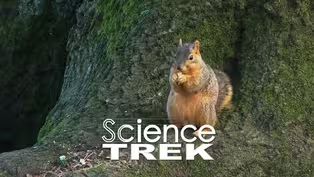
Urban Wildlife: Living Wild in the City
Video has Closed Captions
Clip: Special | 1m 4s | What kind of animals live in an urban environment? (1m 4s)

Urban Wildlife: Promote a Little Wildlife
Video has Closed Captions
Clip: Special | 1m 4s | What should you do and not do to promote Urban Wildlife in your backyard? (1m 4s)
Providing Support for PBS.org
Learn Moreabout PBS online sponsorship
- Science and Nature

Explore scientific discoveries on television's most acclaimed science documentary series.

- Science and Nature

Capturing the splendor of the natural world, from the African plains to the Antarctic ice.










Support for PBS provided by:
Science Trek is a local public television program presented by IdahoPTV
Major Funding by the Laura Moore Cunningham Foundation and the Idaho National Laboratory. Additional Funding by the Friends of Idaho Public Television and the Corporation for Public Broadcasting.