
'That 2nd strike was a violation,' ex-military lawyer says
Clip: 12/1/2025 | 6m 15sVideo has Closed Captions
'That 2nd strike was a violation of the laws of war,' former senior military lawyer says
For perspective on the U.S. military strikes on suspected drug boats and the legal concerns, Geoff Bennett spoke with retired Maj. Gen. Steven Lepper. He served as the Air Force's Deputy Judge Advocate General, and as such, was the service's second-highest-ranking uniformed lawyer.
Problems playing video? | Closed Captioning Feedback
Problems playing video? | Closed Captioning Feedback
Major corporate funding for the PBS News Hour is provided by BDO, BNSF, Consumer Cellular, American Cruise Lines, and Raymond James. Funding for the PBS NewsHour Weekend is provided by...
Support provided by:

'That 2nd strike was a violation,' ex-military lawyer says
Clip: 12/1/2025 | 6m 15sVideo has Closed Captions
For perspective on the U.S. military strikes on suspected drug boats and the legal concerns, Geoff Bennett spoke with retired Maj. Gen. Steven Lepper. He served as the Air Force's Deputy Judge Advocate General, and as such, was the service's second-highest-ranking uniformed lawyer.
Problems playing video? | Closed Captioning Feedback
How to Watch PBS News Hour
PBS News Hour is available to stream on pbs.org and the free PBS App, available on iPhone, Apple TV, Android TV, Android smartphones, Amazon Fire TV, Amazon Fire Tablet, Roku, Samsung Smart TV, and Vizio.
Providing Support for PBS.org
Learn Moreabout PBS online sponsorshipGEOFF BENNETT: For perspective on all of this, we turn now to retired major general Steven Lepper.
He served as the Air Force's deputy judge advocate general and, as such, was the service's second highest ranking uniformed lawyer.
Thank you for being with us.
So, as we just saw in that report, the White House is defending Admiral Frank Bradley, whom the White House today said ordered that follow-up strike that killed survivors on that alleged drug boat in the Caribbean, saying he was acting well within his authority.
Based on what's known, was he?
MAJ.
GEN.
STEVEN LEPPER (RET.
), Former U.S.
Air Force Deputy Judge Advocate General: Well, based on what's known, if he was the commander of the operation, then, yes, he would have been acting within his authority.
GEOFF BENNETT: Well, say more about that.
MAJ.
GEN.
STEVEN LEPPER (RET.
): OK.
Well, I mean, obviously, his authority as the commander extends to the entire operation in the Caribbean, and that would have included both the first strike and the second strike.
The question that we have all been asking over the last several days since the reports first came out are whether or not those orders emanated from a higher level and were simply executed by the admiral and all the people below him in the chain of command or whether the admiral himself ordered the second strike.
Either way, that second strike was a violation of the laws of war.
That second strike, the orders to conduct the second strike were illegal orders, and they should not have been executed.
They should not have been followed by anyone in what we call the kill chain.
GEOFF BENNETT: The defense secretary's reported order, The Washington Post reporting that Defense Secretary Pete Hegseth gave this spoken directive.
This is according to two people with direct knowledge of the operation, according to The Post, that the order was to kill everybody.
MAJ.
GEN.
STEVEN LEPPER (RET.
): Well, as an attorney who spent 35 years advising commanders on military operations and many other things, what that means to me is that the secretary, either intentionally or unintentionally, communicated to everyone below him that there would be no quarter.
And what that means in international law is that A no quarter order basically provides that no one should be left living after the strike.
So it suggests that anyone who surrenders be targeted.
It suggests that, as in this case, any survivors of the first attack be targeted, even if those survivors or anyone surrendering or anyone else who is -- quote -- "out of the fight" can continue to pose a threat to military forces.
GEOFF BENNETT: Well, explain why shooting at shipwrecked survivors is not the same as pursuing retreating enemy fighters on land.
What's the -- what's the distinction?
MAJ.
GEN.
STEVEN LEPPER (RET.
): Well, there is a distinction.
Retreating prisoners on -- or retreating forces on land are actually -- are usually engaged, unless they're surrendering, in a tactical maneuver intended to remove themselves from the battlefield, regroup and then presumably reattack.
They continue to be combatants.
They continue to be targets, lawful targets of the military.
On the other hand, survivors of a boat that has been disabled or destroyed and whose survivors are floating in the water with no means of opposing the force that put them there are considered hors de combat under international law.
They can no longer prosecute their original mission.
And, as such, our responsibility shifts from targeting them while they were in the boat while it was intact to rescuing them now that they're floating in the water, clinging to the wreckage.
GEOFF BENNETT: And there's language from the Defense Department Law of War Manual that spells that out.
I will read from it briefly.
It says: "Members of the armed forces and other persons who are wounded, sick, or shipwrecked, shall be respected and protected in all circumstances.
Such persons are among the categories of persons placed hors de combat," as you just said, out of combat or out of action."
Making them the object of attack is strictly prohibited."
So is there any legitimate gray area here or is what transpired a clear violation of law?
MAJ.
GEN.
STEVEN LEPPER (RET.
): Well, if the surveillance video showed two survivors clinging to wreckage, then there is no question that this was an unlawful order to target those two survivors.
There is nothing in international or domestic U.S.
law that would justify a second strike intended to kill those two survivors.
GEOFF BENNETT: There were U.S.
special ops forces involved in carrying out this strike.
And there are people who argue that special operators can push the bounds of the law.
In your experience, is that true?
MAJ.
GEN.
STEVEN LEPPER (RET.
): No, the rules apply to everyone, whether they are special operations forces or regular military forces.
The rules apply.
The Law of War Manual that you just quoted from a minute ago has an additional provision in it later on in the text that uses the precise example of shooting survivors in the water as an example of an unlawful order.
That order would be unlawful whether it is given to a regular military force or to special operations forces.
There's just no distinction among them as far as the law of war is concerned.
GEOFF BENNETT: Retired Major General Steven Lepper, thanks again for your time and for your perspective.
MAJ.
GEN.
STEVEN LEPPER (RET.
): Thank you.
A Brief But Spectacular take on community through farming
Video has Closed Captions
A Brief But Spectacular take on leadership and community through farming (2m 40s)

Crisis pregnancy centers' role in the anti-abortion movement
Video has Closed Captions
Rise of crisis pregnancy centers highlights shift in anti-abortion movement (9m 30s)

Tamara Keith and Amy Walter on reaction to boat strikes
Video has Closed Captions
Tamara Keith and Amy Walter on the political reaction to Trump's boat strikes (9m 15s)
Trump administration declines to mark World AIDS Day
Video has Closed Captions
Trump declines to mark World AIDS Day as funding cuts threaten HIV-prevention efforts (7m 45s)
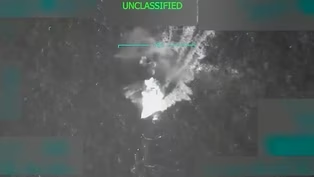
White House confirms U.S. fired twice at alleged drug boat
Video has Closed Captions
White House says U.S. fired twice at alleged drug boat, raising bipartisan legal concerns (3m 57s)
Providing Support for PBS.org
Learn Moreabout PBS online sponsorship
- News and Public Affairs

FRONTLINE is investigative journalism that questions, explains and changes our world.

- News and Public Affairs

Amanpour and Company features conversations with leaders and decision makers.












Support for PBS provided by:
Major corporate funding for the PBS News Hour is provided by BDO, BNSF, Consumer Cellular, American Cruise Lines, and Raymond James. Funding for the PBS NewsHour Weekend is provided by...