
December 17, 2025 - PBS News Hour full episode
12/17/2025 | 57m 46sVideo has Closed Captions
December 17, 2025 - PBS News Hour full episode
Wednesday on the News Hour, President Trump gets his worst economic approval ratings ever in a new PBS News poll as Americans worry about affordability. Some House Republicans buck party leadership, forcing a vote to extend Affordable Care Act subsidies. Plus, we catch up with a transgender teen and her parents, who left Texas because of the state's ban on transgender health care for minors.
Problems playing video? | Closed Captioning Feedback
Problems playing video? | Closed Captioning Feedback
Major corporate funding for the PBS News Hour is provided by BDO, BNSF, Consumer Cellular, American Cruise Lines, and Raymond James. Funding for the PBS NewsHour Weekend is provided by...
Support provided by:

December 17, 2025 - PBS News Hour full episode
12/17/2025 | 57m 46sVideo has Closed Captions
Wednesday on the News Hour, President Trump gets his worst economic approval ratings ever in a new PBS News poll as Americans worry about affordability. Some House Republicans buck party leadership, forcing a vote to extend Affordable Care Act subsidies. Plus, we catch up with a transgender teen and her parents, who left Texas because of the state's ban on transgender health care for minors.
Problems playing video? | Closed Captioning Feedback
How to Watch PBS News Hour
PBS News Hour is available to stream on pbs.org and the free PBS App, available on iPhone, Apple TV, Android TV, Android smartphones, Amazon Fire TV, Amazon Fire Tablet, Roku, Samsung Smart TV, and Vizio.
Providing Support for PBS.org
Learn Moreabout PBS online sponsorshipAMNA NAWAZ: Good evening.
I'm Amna Nawaz.
GEOFF BENNETT: And I'm Geoff Bennett.
On the "News Hour" tonight: President Trump gets his worst economic approval ratings ever in a new PBS News poll, as Americans worry about affordability.
AMNA NAWAZ: House Republicans buck their party's leadership, forcing a vote to extend Affordable Care Act subsidies and stave off a spike in health care premiums.
We speak to two lawmakers seeking a bipartisan solution.
REP.
JIMMY PANETTA (D-CA): You understand how Congress works.
Unfortunately, we don't govern by leadership.
REP.
KEVIN KILEY (R-CA): Or doesn't work.
REP.
JIMMY PANETTA: Yes, we govern -- we don't govern by leadership.
We govern by crisis.
And, therefore, it's a day-by-day situation.
GEOFF BENNETT: And we catch up with a transgender teen and her parents who moved out of Texas because of the state's ban on transgender health care for minors.
LEAH, Teenager: I hurt so, so, so much from the kids at school and just from people in Texas in general that I started to question, am I the problem?
(BREAK) GEOFF BENNETT: Welcome to the "News Hour."
President Trump is set to address the nation tonight to tout the work of his administration and look ahead to his priorities in the new year.
AMNA NAWAZ: The speech comes as economic concerns continue to be a top priority for Americans.
In a new PBS News/NPR/Marist poll, 57 percent of respondents say they disapprove of the job the president is doing on the economy; 36 percent think he's doing a good job.
It's the lowest approval rating he's seen on the issue in either of his terms in office.
For more insights from the poll, I'm joined now by NPR senior political editor and correspondent Domenico Montanaro.
Good to see you.
DOMENICO MONTANARO, Political Editor, NPR: Hey, great to be with you.
AMNA NAWAZ: Let's talk about the president's handling of the economy.
Tell us about that drop in support and who exactly is losing confidence in the president.
DOMENICO MONTANARO: I mean, this is a big deal; 36 percent of people approve of the job that the president is doing when it comes to the economy.
This is the lowest number that he's ever seen in the Marist poll as far as how he's handling the economy.
And this was a relative strength of his in the first -- in his first term as president.
And this is a big deal because he promised to bring down prices during the 2024 election.
It's a big reason, you could argue, that a lot of voters crossed over to vote for him, in particular, Latino voters, who repeatedly said that prices, affordability were huge issues for them as a reason why they voted for Trump.
We have seen all year that they have slid away from him, whether it's been in special elections, the elections earlier in November.
And in this poll, only 32 percent approve of the job that he's doing on the economy.
It's exceedingly low.
It's a really bad low point for this president.
And it's why you see him now starting to get out on the trail, trying to make the case on the economy, even though he continues to veer into culture issues like immigration.
AMNA NAWAZ: You mentioned those special elections.
We have seen affordability become the central message for Democrats so far.
Heading into this next midterm election year, is that working?
What do Americans think about the handling of the economy?
DOMENICO MONTANARO: Well, right here, now we're starting to see that Democrats have a four-point advantage when it comes to which party would be better to handle the economy, 37 to 33 percent.
That doesn't seem like a huge advantage, but traditionally Republicans have a bigger advantage on the economy than Democrats do.
And it's a 20-point turnaround from 2022, when Republicans had a 16-point edge on this and, of course, in a midterm did much better than Democrats did overall.
AMNA NAWAZ: That's a huge swing.
OK, on the issue of affordability, prices remain the number one concern for 45 percent of Americans.
That tops all other issues like housing and tariffs and job security.
But how do people view the economy personally right now?
DOMENICO MONTANARO: Yes.
And prices obviously leap out as the biggest issue.
But when it comes to how people are feeling about this, 70 percent of people say that their area where they live is not affordable for average families.
And that's up from 45 percent just this summer.
So a lot of people are feeling the pinch, whether it's of prices or housing.
Obviously, in neighborhoods, people are going to feel that, interest rates and all of that.
But that's a big number when seven in 10 people are saying that just their area is just simply not affordable.
And, look, presidents get way more blame and credit than they deserve when it comes to the economy.
But with this president, because of what he's done on tariffs, a lot of people are blaming him before that.
And they're saying that that's led to an increase in these prices.
And it should put Republicans in a terrible vortex of being viewed negatively politically.
We asked how the economy is working for you.
Is it working well?
Sixty-one percent of people said that it is not working well for them personally.
And when you dig inside the numbers, there were huge divides by race, gender, age, and of course, on income.
AMNA NAWAZ: We know tariffs, cost of living, prices are all an issue here.
Health care is another big issue for people.
We know those expanded subsidies under the Affordable Care Act are set to expire at the end of the month.
We don't yet know what Congress will or can do on the issue.
But how confident are people that they can pay for their health insurance?
DOMENICO MONTANARO: Not very.
I mean, we saw a majority -- and this really jumped out.
A majority of people, 54 percent, said that they're concerned, that they're worried that in the next 12 months they won't be able to pay for needed health care or medical procedures.
That's a very big number, especially considering millions of people in this country have big amounts of outstanding medical debt.
Some 20 million people have more than $250 a month that they owe, 14 million people more than $1,000 a month, according to a KFF-Peterson health tracker analysis.
So millions of people are worried about their health care.
We're also seeing in Congress right now these ACA subsidies, the Affordable Care Act subsidies, that could lapse.
And that could mean even higher health care for a lot of people who buy premiums on the Obamacare exchanges.
AMNA NAWAZ: Setting aside how they see it personally, how do Americans feel about the overall economy right now?
DOMENICO MONTANARO: They don't see it very well at all.
It's just the same theme, I feel like, throughout, with everything.
People have a very dim outlook of the economy.
A majority of people are concerned about what is going to come for the world in 2026; 57 percent said that; 63 percent say that the country is off on the wrong track.
And just a lot of people feel like they're not able to get by right now; 70 percent of people said that their income either exceeds or matches what their expenses are; 24 percent of people, a quarter of people in our poll said that their expenses exceed their income.
That means, if you calculate that out, some 46 million people in this country are going month a month accruing debt.
AMNA NAWAZ: Some striking numbers in the poll.
Full results are online.
Domenico Montanaro, always great to see you.
DOMENICO MONTANARO: You got it.
GEOFF BENNETT: We begin the day's other headlines in Australia where the surviving suspect in the mass shooting at Bondi Beach has been charged with 15 counts of murder, one for each of the victims, and 59 charges in all.
It comes as hundreds gathered to mourn at the first funerals today for the victims, among them, Rabbi Eli Schlanger, a father of five and an organizer of Sunday's Hanukkah event where the shooting took place.
The youngest victim, 10-year-old Matilda, whose last name was withheld.
She immigrated with her parents from Ukraine to escape the war.
Her funeral will be held tomorrow.
The oldest killed 87-year-old Alex Kleytman, who was also a native of Ukraine and a Holocaust survivor.
He died shielding his wife from harm.
Former special counsel Jack Smith testified privately to lawmakers today and reportedly said his investigators developed proof beyond a reasonable doubt that President Trump criminally conspired to overturn the 2020 election.
According to press reports, Smith also told lawmakers in his closed deposition that the president repeatedly tried to obstruct government efforts to recover classified documents from his Mar-a-Lago resort.
Smith had asked to testify publicly, something President Trump has said he supported.
House Judiciary Republicans, however, rejected that request.
The U.S.
Senate today passed a massive defense bill even as it's causing some friction with the White House and Pentagon.
Inside the National Defense Authorization Act is a record $901 billion, including a nearly 4 percent pay raise for troops.
At odds with the administration, the 3,000-page bill pressures Defense Secretary Pete Hegseth to turn over unedited footage of an alleged drug boat strike from September.
The bill also reins in the president's ability to limit troop numbers abroad and authorizes more U.S.
money for weapons to Ukraine.
Warner Bros.
Discovery has urged its shareholders to reject Paramount Skydance's hostile bid to purchase the company with an all-cash offer valued at over $108 billion.
The board instead recommended sticking with a $72 billion bid from Netflix.
In that letter to shareholders, Warner Bros.
said Paramount's offer relied too heavily on borrowed money and carried significant risks and costs.
Paramount defended its direct offer as a superior value, and the decision ultimately rests with shareholders who have until January 8 to vote on Paramount's offer.
Separately, the Academy of Motion Picture Arts and Sciences announced the Oscars will move online exclusively to YouTube starting in 2029, leaving broadcast TV for the first time ever and leaving ABC, where it's been shown for the last five decades.
Senators threw sharp questions at FCC Commissioner Brendan Carr during his first congressional appearance since the agency pressured broadcasters to remove ABC late-night host Jimmy Kimmel from the airwaves earlier this year.
SEN.
TED CRUZ (R-TX): But what government cannot do is force private entities to take actions that the government cannot take directly.
GEOFF BENNETT: Commerce Committee Chairman Texas Republican Ted Cruz had previously called Carr's comments - - quote -- "dangerous as hell."
Today, Democrats pressed Carr on whether he was politicizing an independent agency.
SEN.
BEN RAY LUJAN (D-NM): And just so you know, Brendan, on your Web site, it just simply says, man, the FCC is independent.
This isn't a trick question.
BRENDAN CARR, Commissioner, Federal Communications Commission: OK, the FCC is not.
SEN.
BEN RAY LUJAN: The answer is yes or no.
BRENDAN CARR: It's not, is not -- is not... SEN.
BEN RAY LUJAN: OK.
So is your Web site wrong?
Is your Web site lying?
BRENDAN CARR: Possibly.
The FCC is not an independent agency.
GEOFF BENNETT: During that hearing, the FCC's Web site changed, removing the word independent from its mission statement.
Also, on Capitol Hill, the Senate voted 67 to 30 to confirm Jared Isaacman to be NASA's next administrator.
The billionaire tech entrepreneur and close ally of SpaceX CEO Elon Musk was tapped twice for the role.
President Trump pulled his nomination earlier this year amid his public falling out with Elon Musk, only to renominate him last month.
That's as FBI Deputy Director Dan Bongino says he will resign his post next month.
The former Secret Service agent was previously a right-wing podcasting personality.
He hasn't shared his future plans.
During that time, he spread provocative conspiracy theories, including about the Epstein files and the investigation into the D.C.
pipe bomber.
It was an across-the-board sell-off on Wall Street today.
The Dow Jones industrial average had the smallest loss of the day at nearly half-a-percent.
The Nasdaq fell by more than 400 points, or nearly 2 percent.
And the S&P 500 dropped to its fourth straight loss.
And the bodies of two fallen Iowa National Guard soldiers who were killed in Syria returned to U.S.
soil today.
Sergeants William Nathaniel Howard and Edgar Brian Torres-Tovar were killed on Saturday in an attack the U.S.
blamed on the Islamic State.
A U.S.
civilian interpreter, Ayad Mansoor Sakat, also died.
President Trump joined military officials and the soldiers' grieving families for the dignified transfer of remains today at Delaware's Dover Air Force Base.
Still to come on the "News Hour": we delve into one proposal to address rising health care premiums by putting money into health savings accounts; the global implications of the U.S.
blockade on sanctioned oil tankers from Venezuela; and a Brown University student discusses the trauma he's experienced from the recent shooting and past gun violence.
AMNA NAWAZ: Affordable Care Act subsidies are set to run out for millions of people in just two weeks.
But, today, there was a shift on Capitol Hill.
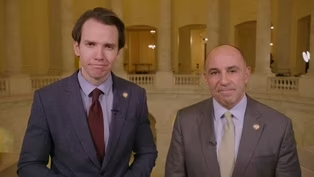
Four moderate House Republicans defied Speaker Johnson and signed a Democratic-led petition to force a vote on extending the subsidies.
That three-year extension now has the support to pass the House, but the vote won't happen until January.
Meanwhile, also today, House Republicans advanced a separate bill that would reduce health care costs overall, but would not extend the subsidies.
Congressional correspondent Lisa Desjardins spoke with lawmakers about where things stand.
LISA DESJARDINS: Joining me now are two members from the same state, but different parties, who have been working across the aisle on this issue, California Republican Kevin Kiley and Democrat Jimmy Panetta.
Representative Kiley, let me start with you.
This discharge petition that would extend these subsidies for three years is getting a lot of attention.
Are you ready to sign on to that or no?
REP.
KEVIN KILEY (R-CA): Well, I'm ready to do whatever will actually solve the problem.
My concern with that bill is that it is not a compromise and it's already been rejected by the Senate, so we could pass it in the House, but it won't actually solve the problem for 22 million Americans.
What we need to do is support one of three compromise proposals that are out there.
I have a bill with Sam Liccardo.
There's one with Jen Kiggans and Josh Gottheimer.
There's one with Brian Fitzpatrick.
All of these are reasonable compromises that provide for a temporary extension with reforms.
But, unfortunately, the leadership in both parties has refused to do what's necessary to get a vote on those bills.
LISA DESJARDINS: We're going to come back to those ideas, but just one quick check.
So is that a yes?
Are you thinking of signing on to this three-year extension?
REP.
KEVIN KILEY: I'm still considering whether that's the best option for actually getting the problem solved.
I'm not interested in taking votes just for the purpose of taking votes or to try to make it look like you're doing something.
I'm interested in actually finding a solution.
LISA DESJARDINS: Congressman Panetta... REP.
JIMMY PANETTA (D-CA): I... LISA DESJARDINS: Oh, go ahead.
REP.
JIMMY PANETTA: Yes.
No, and I appreciate that, Lisa.
I think the question for Mr.
Kiley and something he will figure out is whether or not he's going to vote for it, because, fortunately, there were four Republicans -- and I give them a lot of credit -- who signed on to the discharge petition today.
Therefore, we hope that there's a vote come early January.
Unfortunately, it's after the deadline, after 22 million are going to be affected by the cutoff in the tax credits for the ACA, but at least it's something.
And the unfortunate part, and I know Kevin feels this way, is that we have come to govern by discharge petition in the United States Congress, not by leadership.
And that's something that unfortunately has affected us throughout the 119th Congress.
But this is necessary to send over to the Senate so that they now have a tax vehicle upon which they can work with.
And, as you know, that's where the nuts and bolts are going to get added to this flatline extension of three years.
LISA DESJARDINS: Well, I want both of you to be brutally honest about this, because, obviously, millions of people's health care is at stake here.
How hopeful are you that there could be a solution in January here?
REP.
KEVIN KILEY: Well, I think that if we don't get a solution by the end of December, then, yes, we need to do everything we possibly can to get a solution in January.
But really what we should do is get a solution now.
I offered an amendment last night that would have been presented to the Rules Committee that I thought reflected what an acceptable compromise to our leadership was.
But, unfortunately, I was told that would be ruled out of order.
And so we just have gotten into these rigid positions from the leadership on both sides.
So it's fallen upon folks like me and my colleague here, Representative Panetta, to try to lead as members to find the common ground that will be necessary to solve this problem, as you say, for 22 million Americans who are going to pay massively more for health care in a matter of days if Congress doesn't act.
REP.
JIMMY PANETTA: Yes, I think we're going to have -- this is -- this has to be the short-term solution.
But we both know that there's got to be a long-term solution as to how we fix our health care system.
Right now, we understand it's expensive.
Right now, there are patients in my district and senior citizens who just aren't getting the care that they need, especially with doctors not getting reimbursed enough for Medicare.
So, obviously, you have the reimbursement issue with the ACA and you have the reimbursement issue with Medicare.
These are something that we have to focus on not just short-term, but long-term.
And, hopefully, this three-year tax extension gets to the Senate, comes back, gives us the foundation upon which we could then start having serious conversations, not just amongst members, but hopefully leadership actually understands how important it is to fix our health care system.
REP.
KEVIN KILEY: Yes, I totally agree with that.
This is designed to give us some runway to solve the larger affordability issues in our health care system.
And it has to be done in a bipartisan way.
We have seen far too much partisanship.
Republicans take control and try to do their health care plan.
Democrats take control try to do theirs.
But the costs have continued to spiral out of control.
To really fix health care in America, to control costs, to provide greater choice, to unleash innovation, we need to do it in a bipartisan way.
LISA DESJARDINS: I need to circle back on something you said, Congressman Kiley.
I'm going to attempt a yes-or-no question from you guys.
Is there any chance that these subsidies get extended in December?
It doesn't seem like it?
Doesn't it seem like... REP.
KEVIN KILEY: I think there's a -- yes, I am not ready to give up.
I think we have got two weeks left in this week.
We have got two weeks left in the year.
All it would take is for the speaker to bring one of these bills to the floor.
And I have been actively involved in discussions with him and members on both sides as recently as an hour or so ago.
So we're not giving up.
And if we do get to the point where they expire, we will do everything possible to mitigate the harm and try to make people whole.
REP.
JIMMY PANETTA: Lisa, you understand how Congress works.
Unfortunately, we don't govern by leadership Yes, we govern -- we don't govern by leadership.
We govern by crisis.
And, therefore, it's a day-by-day situation.
And, hopefully, the speaker actually develops the chutzpah to actually bring this bill to the floor, so that we can get it to the Senate and let them do the work that they need to do in order to give us a foundation for a short-term fix, extending the tax credits and then ultimately the foundation to talk about a long-term fix to our health care system.
LISA DESJARDINS: I want to make sure our viewers are clear-eyed, though.
Speaker Johnson has been clear he's not bringing up this vote.
There's no reason to think that he will.
And most of Congress is leaving tomorrow, probably, for holiday break.
Understanding your points, Congressman Kiley, my question to you is about January and what happens then.
This is actually for you, Congressman Panetta.
There's a funding deadline in January, at the end of January.
Should Democrats demand health care action in return for funding government again?
REP.
JIMMY PANETTA: Look, we -- that's what we demanded during the shutdown.
And we got to this point right now.
And, hopefully, that's something where we will be able to fix it in early January, because the last thing we want is a government shutdown.
That's not what I wanted back then.
It's not what I have wanted throughout my time in Congress.
But, unfortunately, it's gotten to that situation where we have had to shut down the government in order to fix our differences.
Hopefully, this is something, with this discharge petition, we can pass it out of the House, get it to the Senate, and then have something, a foundation to extend the tax credits well before the budget deadline.
LISA DESJARDINS: Congressman Kiley, you mentioned the speaker and leadership earlier.
The speaker himself has told reporters today that he was open to getting one of your bills on the floor and worked with you very hard, but that you moderates opted out because of requirements for pay-fors.
But what was his role exactly in all of this?
How do you see that?
REP.
KEVIN KILEY: Well, so, yesterday, it was very clear, and based on what the speaker said today even, that he had agreed to one of these compromise proposals with pay-fors.
And so I prepared an amendment for the Rules Committee last night that would have done precisely that, that would have stopped us from going off this cliff, would have spared 22 million people this huge increase in health care costs.
Unfortunately, the speaker then decided that he was not going to rule that to be in order and allow for a vote on the amendment.
So that's very disappointing to me.
I think that this is a failure of leadership, frankly, on both sides that we have seen.
And it's all too typical of Washington, of the current state of the U.S.
Congress, that most of the energy from party leaders seems to be spent trying to blame the other side for problems, rather than actually trying to work towards solutions to those problems.
Fortunately, we do have some members who are willing to reach across the aisle.
We have both signed on to one of the discharge petitions by Mr.
Gottheimer and Ms.
Kiggans that would solve this problem.
So we are still trying to work together to find a solution.
REP.
JIMMY PANETTA: And we're both members of the Problem Solvers Caucus, in which just today we had a meeting about this issue with senators, bipartisan, bicameral, in which they can basically discuss kind of the one runway that we have to take going forward.
But Speaker Johnson needs to understand this stat that, of those 22 million people, three-quarters of them are in red states.
It's amazing that he wouldn't appreciate the fact and listen to his constituents and their constituents in those red states to realize that you have got to be able to serve them and not just the president of the United States.
LISA DESJARDINS: All right, Congressman Kevin Kiley and Jimmy Panetta, we will stay very closely tuned.
Thank you both.
REP.
KEVIN KILEY: Thank you.
REP.
JIMMY PANETTA: Thank you.
LISA DESJARDINS: With these Affordable Care Act subsidies set to expire, we looked yesterday at how they work.
Tonight, we take a closer look at one of the main Republican alternatives to replace them and help Americans pay for their health care, something called health savings accounts.
The pushback started almost immediately.
PROTESTER: You lied!
PROTESTERS: You lied!
PROTESTER: You lied!
PROTESTERS: You lied!
LISA DESJARDINS: The Affordable Care Act was an instant lightning rod, which conservatives decried, challenged, and worked to replace.
That effort peaked in 2017, when a bill to repeal the ACA died with a dramatic thumbs down from then-Senator John McCain.
Since then, Republicans, including President Trump, in last year's debate, have struggled to articulate a specific Obamacare reform plan.
LINSEY DAVIS, Moderator: So, just a yes or no, you still do not have a plan?
DONALD TRUMP, President of the United States: I have concepts of a plan.
LISA DESJARDINS: But now conservatives are rallying behind a policy prescription predating Obamacare, the HSA, or health savings account.
JOHN C. GOODMAN, President and CEO, Goodman Institute: A health savings account allows people to manage some of their own health care dollars, and they decide how those dollars are spent.
LISA DESJARDINS: Let's stop here.
This is John Goodman, known as the father of the HSA.
JOHN C. GOODMAN: Primarily, people who save money get to keep it.
LISA DESJARDINS: Because, in 1992, he co-authored the book "Patient Power" laying out the idea.
It is the same today.
HSAs are accounts patients can use tax-free to save for health care.
They attach to the cheapest insurance plans, called high-deductible plans.
In those plans, patients pay less up front, but each time they need health care, they will pay more, maybe a lot more than in traditional plans.
That's a risk.
HSAs are designed to provide a cushion or a reserve of health care cash.
Ten years after Goodman's book came out, in 2003, President George W. Bush signed HSAs into law.
(APPLAUSE) JOHN C. GOODMAN: And it started out slowly, because this was something new that employers, insurance companies weren't used to.
But, today, there are 40 million of these accounts, and they cover 60 million people.
And, also, the idea has spread abroad.
Even China has health savings accounts.
South Africa has them.
Singapore has them.
So it's not just an American idea.
LISA DESJARDINS: And not just a private insurance idea.
Now HSAs are central to Republican plans for reforming in government, meaning Obamacare.
ACA subsidies vary by income.
Republicans want to see income caps, but they also want to change how the money flows.
Right now, individuals choose an insurance plan on the ACA marketplace.
And in most cases, the federal government sends subsidy money to the insurance company.
Republicans instead want subsidies to go to health savings accounts controlled by each person.
And they would then choose how to spend it, including on an insurance plan.
That may seem like a small difference, but supporters say it can cut down on fraud and changes the equation, because consumers are the best decision-makers.
GE BAI, Johns Hopkins University: Health care relates to our life, right?
But it's a business for everybody else.
LISA DESJARDINS: Ge Bai is a Johns Hopkins professor specializing in health care policy.
She testified last week in Congress about the Affordable Care Act.
GE BAI: Many people believe health care is a right.
That is fundamentally wrong.
Health care is a commodity.
LISA DESJARDINS: We spoke shortly after.
GE BAI: Once the patients control their dollars, all the providers have to compete to make patients happy.
So that will change all the incentives on market.
LISA DESJARDINS: Bai argues, give patients more control of dollars, and companies will compete for them directly, with some lowering costs.
GE BAI: You're going to see price collapse everywhere.
CYNTHIA COX, Program on the ACA Director, KFF: I think it would be very difficult for most people to shop around for health care.
LISA DESJARDINS: Cynthia Cox of KFF is among the health care analysts who say there are some practical issues and some big trade-offs with HSAs.
She says people can't yet access health care prices fluidly, and the very sick account for most health care spending, and usually blow through their deductible, leaving little incentive to shop around.
CYNTHIA COX: While it could potentially lead to lower costs for everybody if people do shop around more for health care, I think the savings would be pretty minimal from that.
LISA DESJARDINS: Critics on the left argue that HSAs disproportionately benefit the wealthy, who can put more into the accounts with large tax advantages.
But there is another factor.
Some Republicans want to dramatically expand HSAs, give qualifying Americans HSA accounts to spend on any insurance plan in or out of the ACA.
CYNTHIA COX: Which would create a huge incentive for younger, healthier people to not be purchasing into the ACA plans, which would lead to a death spiral potentially in the ACA markets.
It would effectively undo the Affordable Care Act.
LISA DESJARDINS: But that is the point for many conservatives like John Goodman, who see Obamacare as bad policy.
But he admits HSAs similarly don't solve a key problem.
JOHN C. GOODMAN: We're spending a lot on health care that doesn't extend our life expectancy or cure diseases.
We need to take a close look at the whole system and where the money is going.
LISA DESJARDINS: HSAs and the Affordable Care Act are important competing ideas that try to address who can get health care and how much they pay.
But also important, neither fundamentally shifts the bigger issue.
America's expensive health care system is not making America healthier.
For the "PBS News Hour," I'm Lisa Desjardins.
GEOFF BENNETT: President Trump today continued his rhetorical campaign against Venezuela's President Nicolas Maduro, as a large American naval force sits in the waters off the coast.
Mr.
Trump sent a social media broadside last night against Maduro, which he reiterated today.
The U.S., he says, will actively blockade and seize vessels it had already sanctioned, a move some critics have called an act of war.
Nick Schifrin starts our coverage.
NICK SCHIFRIN: In the Caribbean sea, U.S.
troops at the ready for a new mission with more targets, American-sanctioned Venezuelan oil tankers.
Last night on TRUTH Social, President Trump promised a -- quote -- "total and complete blockade of all sanctioned oil tankers going into and out of Venezuela."
DONALD TRUMP, President of the United States: Just a blockade?
Not going to let anybody going through that shouldn't be going through.
NICK SCHIFRIN: Already last week, the Coast Guard and military boarded and seized a tanker.
There are more than 30 such tankers off the Venezuelan coast, a ghost fleet of ships that Venezuela has used to evade oil sanctions.
That pressures Venezuela's chief source of revenue.
There are estimates that 90 percent of the economy is based on oil exports.
And U.S.
officials believe challenging that weakens Maduro's grip on power and could force him to step down.
QUESTION: So how far would you go to take Maduro out of office?
DONALD TRUMP: I don't want to say that, but... QUESTION: But you want to see him out?
DONALD TRUMP: His days are numbered.
MAN: A blockade is an act of war.
NICK SCHIFRIN: But on the Hill today, Democrats demanded that Congress vote on and reject direct military action against Venezuela.
SEN.
RICHARD BLUMENTHAL (D-CT): My preference would be that there would be a better leader than Maduro in place.
But that's not to say we can displace him by military means.
NICK SCHIFRIN: A blockade also opposed today by Mexican President Claudia Sheinbaum.
CLAUDIA SHEINBAUM, Mexican President (through translator): We reiterate Mexico's position according to our Constitution of nonintervention, no foreign interference, self-determination of peoples, and peaceful resolution of controversies.
NICK SCHIFRIN: But President Trump is making clear another U.S.
priority, the U.S.'
historic interest in Venezuelan oil and gas.
The country has the world's largest oil reserves, which the U.S.
helped develop exactly one century ago.
But former leader Hugo Chavez kicked out some U.S.
and other foreign energy companies before his death in 2013.
Today, only Chevron remains.
And Trump yesterday wrote that the U.S.
"will not allow a hostile regime to take our oil, oil, land or any other assets, all of which must be returned to the United States immediately."
DONALD TRUMP: You remember they took all of our energy rights, they took all of our oil from not that long ago, and we want it back, but they took it.
They illegally took it.
NICK SCHIFRIN: To that, Maduro accuses the U.S.
of resource colonialism.
NICOLAS MADURO, Venezuelan President (through translator): We tell the people of the United States our truth, and it is very clear imperialism and the Nazi fascist right-wing wants to colonize Venezuela to take our wealth, oil, gas, gold, iron, aluminum, and other minerals, not blood for oil, not war for oil.
The claims about drug trafficking are fake news, a lie, AN excuse.
NICK SCHIFRIN: For years, the U.S.'
pressure on Maduro was political, but now the U.S.
is treating his regime as a national security threat and possible military target, raising the stakes even higher.
For the "PBS News Hour," I'm Nick Schifrin.
GEOFF BENNETT: For one perspective on the latest Trump administration move against Venezuela, we turn to David Smilde, professor and chair of the sociology department at Tulane University.
He has written extensively about Venezuela for over three decades.
Thanks so much for making time for us.
DAVID SMILDE, Tulane University: Thank you.
GEOFF BENNETT: You have called this latest move to block Venezuelan oil exports misguided, at best.
Why, especially when the administration makes the case that this is the best way to pressure the Maduro regime?
DAVID SMILDE: Well, I think this will indeed pressure the Maduro regime.
The problem is that these kind of sanctions, these kind of sectoral sanctions on Venezuela affect the entire economy.
So it will affect the people even more than they affect Maduro.
And this is what we have seen in -- since 2017, we have had sanctions, and they have affected Maduro, but they have actually strengthened his hand vis-a-vis the population.
Basically, it gives him more control, more discretional control over what resources do flow in.
And we have seen this in the case of Cuba as well.
Over a half-century of sanctions have actually solidified the Communist Party there.
And so I think it's deeply misguided in that way in terms of trying to generate some kind of change.
And it also is going to have a huge humanitarian impact.
I mean, Venezuela's oil is the heart blood of the economy.
And this could end up generating a famine in Venezuela.
GEOFF BENNETT: Well, a question about the overall strategy, because for years U.S.
policy has rested on this idea that economic pain would trigger an internal revolt, especially within the military.
Why hasn't that happened?
DAVID SMILDE: It does cause economic pain.
But that economic pain is distributed across the whole country.
And the people that are most able to withstand that pain are precisely Nicolas Maduro and the people around him.
No, he's very good at divvying up rewards and making sure that they get the best of everything, while everyone else in the country suffers the sanctions.
That essentially sort of increases -- if you want to think about this way, increases Maduro ratio of power over the population.
So it's not going to lead to change.
GEOFF BENNETT: And when President Trump frames Venezuela oil as U.S.
oil on U.S.
land how does that rhetoric strike the ear of the Venezuelan public?
DAVID SMILDE: Well, it's really puzzling to understand what he actually means by this.
No, it's -- there's no jurisprudence in Venezuela or the United States that would suggest that the oil belongs to anybody other than the Venezuelan people.
And this is something that is sort of the center of Venezuelan culture.
I have been surprised just today with my colleagues, my Venezuelan colleagues, discussing with them how many of them who are fervent government opponents are outraged by this, by this entire discourse.
No, this is what Chavismo has been saying for 25 years, has been saying -- if the U.S.
criticizes democracy or human rights in Venezuela, they will always say it's about the oil.
The United States even -- really wants the oil, even when it was not about that.
And so now Trump comes along and says, well, it really is about the oil.
I mean, you can't imagine a discourse that fits better with Chavismo's whole idea, what they have been saying for 25 years.
GEOFF BENNETT: If sanctions and threats can't produce the desired result, what does history tell us has a better chance of working in a case like Venezuela?
DAVID SMILDE: I think all of this pressure that President Trump has put on Maduro and on Venezuela is real pressure, they are feeling real pressure, could be used to try and negotiate, to try and negotiate.
The thing is simply negotiating Maduro's exit is probably not going to work.
No, people tend to think, oh, this is a criminal government, so just pay him off and get him to leave and to do that.
But these people really think that they are the bearers of Hugo Chavez's.
And they want to -- and they see that as an anti-imperialist revolution.
So they really want to see this, see this government continue.
I think some kind of negotiation that not only provides for their safety and their exit, but also for the continuation of Chavismo, perhaps some sort of co-government during a couple of years, there's a number of proposals that are circulating that I think could be difficult.
They would be difficult.
There's no guarantee that they will work.
But compared to what is being proposed from the Trump administration, I think they would be much better ways to go.
GEOFF BENNETT: So, bottom line, when Americans hear that the Trump administration is exerting more pressure on Venezuela, what can the American people realistically expect in terms of outcome?
DAVID SMILDE: I don't expect any real outcome.
I think, in terms of if they're going to go forward with this kind of blockade of sanctioned oil vessels, this could cause a humanitarian catastrophe within Venezuela and we will be seeing images of that.
If there's some sort of effort at a military strike, I think minimal military strikes of the type that are being discussed would not lead to democracy.
I think they would lead to chaos, some kind of chaos like we see in Haiti right now, because there's so many armed actors within Venezuela that have their hands in illicit markets that -- and who are compromised, who are compromised by human rights abuses or corruption or other crimes, who really fear a transition.
So I think you would see some sort of chaos if that happened.
The one possibility is if President Trump could use all this pressure to try to negotiate some sort of reasonable transition that would have to include Chavismo in some way.
GEOFF BENNETT: David Smilde, the professor at Tulane University, thanks again for your time this evening.
DAVID SMILDE: Thank you.
AMNA NAWAZ: Five days after a mass shooting at Brown University left two students dead and nine others injured, authorities have not yet identified a suspect and the shooter remains at large.
Providence Mayor Brett Smiley acknowledged that many in the city remain restless and eager for an arrest.
Yesterday, the FBI released these images of a person of interest seen in the area moments before the attack.
Today, Providence police released these photos asking for the public's help to identify a man they say was in proximity of the person of interest.
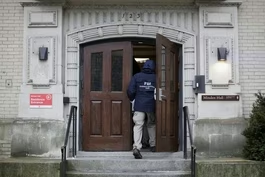
For one family, this shooting was a harrowing reminder of another traumatic incident, the attempted assassination of Louisville Mayor Craig Greenberg in 2022.
The mayor's youngest son, Ben Greenberg, is a junior at Brown University.
And both join me now.
Gentlemen, welcome to the show.
Thank you so much for joining us.
BEN GREENBERG, Brown University Student: Thank you.
CRAIG GREENBERG (D), Mayor of Louisville, Kentucky: Our pleasure to be here.
AMNA NAWAZ: So, Ben, I want to begin with you.
It's my understanding your apartment at Brown is across the street from where the shooting unfolded.
Just tell us how and when you realized what was unfolding and what you and your friends did when you realized that.
BEN GREENBERG: Yes, so I live across the street from Barus and Holley in a house.
It's a two-unit house, but it's essentially a house.
So I just got back from the gym and I was in my room.
And my friend texted me.
He's like: "What are all these sirens doing?"
He, like, makes a joke about, like, what's going on, just not knowing it's anything serious.
And we come -- we get a DPS notification from Brown saying there's an active shooter.
And all of my friends go to my roommate's room.
We barricade ourselves in the room, because we have a back door to the other unit that doesn't lock.
And we didn't know -- we didn't know really anything at the time and we're all pretty stressed if maybe the shooter could have theoretically gone in.
So we barricade ourselves in a room and stay the night all together.
AMNA NAWAZ: Ben, I'm so sorry for what you have had to endure.
And I have to ask your father here, Mr.
Mayor, take us back to the moment you learned about the shooting.
And having lived through what you did yourself in an attempt on your life, surviving gun violence, what did you think in the moment when you realized what your son was going through?
CRAIG GREENBERG: My heart sank.
You become physically numb in those types of moments.
My wife and I were at a University of Louisville basketball game when I got the -- we're up for alerts from Brown University as well.
So it immediately came in, and immediately reached out to Ben to see if he was safe.
And Rachel and I left the game shortly after we knew how serious it was, so we could stay in touch with Ben for the entire evening.
But it took us right back to Valentine's Day of 2022, when there was an assassination attempt on me in my campaign office.
It took me back to my time as mayor, when there was a mass shooting in April of 23, shortly after I became mayor here in Louisville, and then another one a few days later in one of our parks, which was a horrible week for our city.
But I have never experienced it before as a father.
And so Rachel and I had a long night staying on the phone and in constant touch by text with Ben and his roommates, answering questions, providing reassurance and just talking through things, given the stress, while we were all waiting for answers.
AMNA NAWAZ: Ben, I have to assume you're part of a generation that grew up going through lockdown drills in schools, like so many other kids in this country.
You are familiar with gun violence in terms of having witnessed what your father has been through himself.
Did you ever think something like this would happen?
Did you feel prepared when you realized what was unfolding?
BEN GREENBERG: That was one of the first things I talked to my friends about.
We were saying, really, it doesn't -- you see so many bad things on the news and you really don't think any of that stuff is going to happen to you personally until it does.
And especially this being the second time - - I haven't been actively -- thankfully, like, physically unharmed from any acts of gun violence, but this being the second time is just really -- I think multiple people are Brown, this has been their multiple occurrences with gun violence.
It's really sad that it's becoming - - it feels like it's becoming so commonplace.
AMNA NAWAZ: And are you worried about returning to campus?
BEN GREENBERG: Well, thankfully, I'm going abroad next semester.
So I think it'll be really nice to take a break from campus.
But one of my best friends -- I have a group of friends all going abroad, and I have one of them who's staying at campus.
And I really feel for him with the increase in security, especially one of my friends who was in the building at the time.
He's an engineering student, so he's always there 24/7.
And, really, how are you going to be in that building to do work, let alone to take finals in that building again?
So, heart really goes out to those students as well.
AMNA NAWAZ: Mr.
Mayor, of course, you have navigated these moments personally, also as a leader in your city.
And you recently announced you're taking some additional security measures in Louisville after what we saw was the targeted terrorist attack, another mass shooting in Australia, that one targeting members of the Jewish community there.
Tell us a little bit about why you're taking those steps and why now.
CRAIG GREENBERG: Well, we have to remain vigilant, whether it's in Providence, in Louisville, all across the country, particularly when it's around religious gatherings or political gatherings.
Fortunately, last night, our community menorah lighting went off without any incidents.
And we will continue -- people - - I want people to continue to live their lives.
I want everyone here in Louisville, everyone all across the country to feel safe when they're doing that, particularly when they're practicing their religion.
And so we are always vigilant about that with our police department.
We share a lot of intelligence with others around the country.
And we are doing everything we can to make sure that people in Louisville feel safe and are safe.
AMNA NAWAZ: Can I just ask you both briefly, your family has been through so much personally now in the last three or four years, having survived two different incidents of gun violence.
What is it you would say that you want to see happen to make sure that this doesn't happen to any other family?
Mr.
Mayor, I will begin with you.
CRAIG GREENBERG: I'd love to see some steps at the federal level, even if they're just small steps.
I understand the politics of issues around guns, but let's take some small steps to say, everyone, regardless of what political party you are, we all want to reduce the amount of gun violence.
So let's take some steps that we know the American people support.
American people support background checks for everyone who's buying a gun.
They support waiting periods.
We all wait right now at this holiday season.
We all wait to get the products and gifts that we have purchased in the mail.
Or even, when you're using Amazon Prime, there's still a little bit of a waiting period.
The same should be true for guns.
Let's ban got Glock switches in even more states that convert legal firearms into illegal automatic weapons.
Let's ban the use of 3-D printers to make guns.
Let's support more mental health initiatives.
There's so much that can be done.
I'd love to see Congress take some steps, even if small steps, to show this country that we're serious about cracking down on gun violence.
AMNA NAWAZ: Ben, I will give you the final word here.
What would you say?
BEN GREENBERG: I just hope that the -- Americans aren't becoming normalized to gun violence because, it really can happen to anyone.
Especially when you're so close geographically and really knowing people who have been affected, it makes you realize that it can be anyone.
And we're really just -- I'm so fortunate to be OK, that my dad's OK.
But I really hope that the American people knows that this is not OK and cannot be normalized.
AMNA NAWAZ: That is Louisville Mayor Craig Greenberg and his son Ben joining us tonight.
Thank you to you both.
We really appreciate your time.
CRAIG GREENBERG: Thank you.
BEN GREENBERG: Thank you.
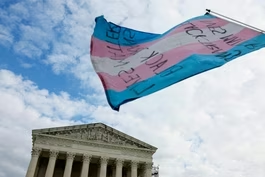
GEOFF BENNETT: In 2023, we introduced you to a transgender girl named Leah.
She was living in Texas with her parents, John (ph) and Mary.
We concealed their identities because families like theirs faced growing threats.
Since then, lawmakers have taken steps to further restrict the rights of transgender people.
In June, the U.S.
Supreme Court upheld state bans on transition medical care for minors.
And this evening, the U.S.
House passed a bill that would make it a felony to provide those treatments.
It still needs Senate approval.
William Brangham recently caught up with Leah and her family as they wrestled with their next steps.
WILLIAM BRANGHAM: This is a day that, for a while, Leah hoped would never come.
She told us as much a couple years ago.
LEAH, Teenager: We just have our whole life here, and the last thing I want to do is, you have to move.
WILLIAM BRANGHAM: But now, at the age of 15, Leah and her parents, John and Mary, have decided they must move.
They have packed their entire life into boxes prepped for the truck in their driveway.
They're leaving Texas for Colorado, seeking refuge in a state with friendlier policies for transgender kids like Leah.
LEAH: I have lived here pretty much all my life, so definitely it's going to be a big change.
WILLIAM BRANGHAM: Leah came out as trans several years ago.
First, she transitioned socially, changing her name and her clothes.
She did years of counseling, started on puberty blockers, and just over a year ago began taking estrogen.
Those steps are all considered gender-affirming care, which is endorsed by major U.S.
medical associations.
But those treatments have come under increased scrutiny in recent years, and more than half of U.S.
states now have laws restricting this kind of care for anyone under 18.
Texas passed its ban in 2023.
Last year, Leah and her family began making regular trips to New Mexico for her treatment, traveling hundreds of miles and spending thousands of dollars.
MARY, Mother of Leah: We have other kids.
We have adult kids, and I feel like we have given them every opportunity for anything that they wanted to do, and we cannot do that right now for Leah.
And she deserves that too.
WILLIAM BRANGHAM: Texas now requires a person's driver's license to match the gender on their birth certificate.
It bars teachers from discussing gender identity or sexual orientation, and prohibits school clubs focused on those issues.
And just this month, a law went into effect banning the use of public bathrooms that don't correspond to a person's sex at birth.
MARY: It still didn't feel unsafe necessarily, but it felt -- it did feel direct.
We had to talk to Leah about just laying low, which it just kind of goes against everything we believe and have always told our kids to, like, be themselves and be proud of who they are.
And it was kind of the first time we really had to be like, we can't talk about this at all.
WILLIAM BRANGHAM: So, this fall, John and Mary decided to put their House on the market.
JOHN, Father of Mary: We just need to get rid of the anchor.
We will hang out here.
And then, that way, we can go as needed.
The way things unfolded, the house sold within days of setting it up.
So we just had to look at the situation and say, OK, maybe it's time to go now.
WILLIAM BRANGHAM: In October, they piled into the moving truck and made the over-14-hour trek from Austin to Denver.
Colorado is known as a trans refuge state, and many families with trans kids have moved here in recent years.
It's one of 17 states in the District of Columbia that protect access to gender-affirming care.
Earlier this year, Colorado passed an anti-discrimination law that, among other provisions, aims to ensure that trans people are called by their chosen names.
So, when you saw the "Welcome to Colorado," it felt like?
JOHN: As soon as we crossed over, there was a little bit wave of emotion.
And I did not expect that at all, the motion of relief.
There was a happiness to it, and there was an immediate calmness.
MARY: Just today, you said "I haven't felt this peaceful" in I don't know how long.
So just that, I think, has made all of this worth it, honestly.
WILLIAM BRANGHAM: Leah, John and Mary are now renting a house in the Denver area.
Leah has started at a new school and she recently got into a local clinic for her care.
LEAH: Everybody is just like - - wants me here.
It's amazing.
MARY: She will share, like, "Today, in English class, we read an essay and the essay was about a gay boy."
And she's like, "I'm just -- I'm so happy we're here."
And I'm just like, OK, this is why we did this.
WILLIAM BRANGHAM: Despite that relief, John especially is shaken by the idea that they have become refugees in their own country.
JOHN: I have been having conversations with my parents about our parallel journeys.
Back in the 80s, we fled Central America because of the communist wars and we fled to the United States.
And the United States gave us a life, gave us opportunity that we didn't expect.
So now we're looking at, we need to keep our family, safe.
What does that mean?
We're looking at it from one state to another state within the country.
Within the country that the world used to flee to for safety and opportunity, we're looking to flee from.
And that's just mind-blowing.
WILLIAM BRANGHAM: And there's a larger concern that, even in Colorado, the threats are not eliminated.
DONALD TRUMP, President of the United States: Official policy of the United States government that there are only two genders, male and female.
(CHEERING) WILLIAM BRANGHAM: Since retaking office, President Trump has moved to restrict the rights of transgender Americans.
The State Department stopped allowing passports that match trans people's gender identities.
The Pentagon reinstated a ban on transgender troops.
PETE HEGSETH, U.S.
Defense Secretary: Expressing a false gender identity divergent from an individual's sex cannot satisfy the rigorous standards necessary for military service.
DONALD TRUMP: The war on women's sports is over.
(CHEERING) WILLIAM BRANGHAM: The administration threatened to withhold funding from states where transgender girls are allowed to play in girls sports.
DONALD TRUMP: We will defend the proud tradition of female athletes and we will not allow men to beat up, injure and cheat our women and our girls.
WILLIAM BRANGHAM: And an executive order in January put hospitals and clinics at risk of losing federal dollars if they continued to practice gender-affirming medical care.
KAROLINE LEAVITT, White House Press Secretary: The Biden administration peddled dangerous policies that defied medical science in favor of radical transgender ideology.
But President Trump has put an end to that, to ensure America's children's innocence is protected.
WILLIAM BRANGHAM: Some providers preemptively stopped those treatments, even in states where they were otherwise protected.
Multiple clinics in Colorado stopped care for a while.
MARY: We were looking at other states because of that.
We ended up here because we have other children and we need to be near them, and this was the closest that we could be to them.
But that was definitely something that we took into consideration and for a while crossed Colorado off of our list.
But here we are and we feel safe for now.
JOHN: At the end of the day, we're going to keep her safe and she's going to transition.
Whether we got to do it here in Canada, in Spain, in Antarctica, wherever it is, we're going to do that.
And we have decided that we are going to be prepared to pivot as much as we need to.
WILLIAM BRANGHAM: Leah says, despite all her parents' efforts, the pressure on trans people in America is pervasive and it's hard to keep it at bay.
LEAH: Transitioning is like the best thing that's ever happened to me.
So, like, I never take that back.
Now that I'm here with my people that want to protect me, I mean, it's a totally different mind-set, because, at some point, I did feel like I hurt so, so, so much from the kids at school and just from people in taxes in general that I started to question, am I the problem?
MARY: I didn't know you thought that.
She's done a great job of hiding that.
She's the bravest person I know, fearless.
WILLIAM BRANGHAM: For the "PBS News Hour," I'm William Brangham in Denver, Colorado.
AMNA NAWAZ: And be sure to join us again here tonight for live coverage of the president's address to the nation.
That's online and here on PBS beginning at 9:00 p.m.
And that is the "News Hour" for tonight.
I'm Amna Nawaz.
GEOFF BENNETT: And I'm Geoff Bennett.
For all of us here at the "News Hour," thanks for spending part of your evening with us.
Ben Greenberg reflects on past trauma after Brown shooting
Video has Closed Captions
Son of Louisville mayor reflects on past trauma after Brown University shooting (8m 23s)
Colorado becomes refuge for Texas trans teen seeking care
Video has Closed Captions
Colorado becomes refuge for Texas family seeking gender-affirming care for trans teen (8m 39s)
Dem, GOP lawmakers on uniting to force vote on ACA subsidies
Video has Closed Captions
Democratic and GOP lawmakers on uniting to force vote on ACA subsidies (8m 56s)

GOP proposal would steer money into health savings accounts
Video has Closed Captions
What to know about the GOP proposal to steer money into health savings accounts (5m 58s)

Trump escalates Venezuela confrontation with oil blockade
Video has Closed Captions
Trump escalates Maduro confrontation with blockade on Venezuelan oil tankers (8m 57s)

Trump gets his worst economic ratings ever in new poll
Video has Closed Captions
Trump gets worst economic ratings ever in new poll as Americans worry about affordability (5m 38s)
Providing Support for PBS.org
Learn Moreabout PBS online sponsorship
- News and Public Affairs

FRONTLINE is investigative journalism that questions, explains and changes our world.

- News and Public Affairs

Amanpour and Company features conversations with leaders and decision makers.












Support for PBS provided by:
Major corporate funding for the PBS News Hour is provided by BDO, BNSF, Consumer Cellular, American Cruise Lines, and Raymond James. Funding for the PBS NewsHour Weekend is provided by...