
December 23, 2025 - PBS News Hour full episode
12/23/2025 | 57m 46sVideo has Closed Captions
December 23, 2025 - PBS News Hour full episode
Tuesday on the News Hour, the latest release of files related to Jeffrey Epstein includes many mentions of President Trump. The White House recalls dozens of career diplomats in the latest effort to reshape U.S. diplomacy and foreign policy. Plus, an inside look at Ukraine's rapidly developing drone capabilities.
Problems playing video? | Closed Captioning Feedback
Problems playing video? | Closed Captioning Feedback
Major corporate funding for the PBS News Hour is provided by BDO, BNSF, Consumer Cellular, American Cruise Lines, and Raymond James. Funding for the PBS NewsHour Weekend is provided by...
Support provided by:

December 23, 2025 - PBS News Hour full episode
12/23/2025 | 57m 46sVideo has Closed Captions
Tuesday on the News Hour, the latest release of files related to Jeffrey Epstein includes many mentions of President Trump. The White House recalls dozens of career diplomats in the latest effort to reshape U.S. diplomacy and foreign policy. Plus, an inside look at Ukraine's rapidly developing drone capabilities.
Problems playing video? | Closed Captioning Feedback
How to Watch PBS News Hour
PBS News Hour is available to stream on pbs.org and the free PBS App, available on iPhone, Apple TV, Android TV, Android smartphones, Amazon Fire TV, Amazon Fire Tablet, Roku, Samsung Smart TV, and Vizio.
Providing Support for PBS.org
Learn Moreabout PBS online sponsorshipWILLIAM BRANGHAM: Good evening.
I'm William# Brangham.
Geoff Bennett and Amna Nawaz are away.
On the "News Hour" tonight: the latest# release of thousands more files related## to the late sex offender Jeffrey Epstein, files# that include many mentions of President Trump.
The White House recalls dozens of career diplomats## in the latest effort to reshape# U.S.
diplomacy and foreign policy.
And an inside look at Ukraine's# rapidly expanding use of drone warfare.
UNIT COMMANDER, Ukrainian Defense Intelligence# (through translator): We're targeting Russian## fuel bases, logistics hubs, command headquarters,## and this forces them to move all# of this away from the front line.
(BREAK) WILLIAM#BRANGHAM: Welcome to the "News Hour."
The Justice Department released nearly 30,000# more pages of documents related to t.. convicted sex offender Jeffrey Epstein, including# many that reference President Donald Trump.## The new batch comes as the DOJ is being# criticized for not releasing all of the## documents by the deadline set by Congress and# heavily redacting many of those they have put out.
Our White House correspondent, Liz Landers,## has been going through the recent# batch, and she joins us now.
Hi, Liz.
What is in this latest release?
LIZ LANDERS: This is 30,000 more pages# that were put up last night, taken down,## and then reposted by the Justice# Department.
This includes photos,## video surveillance, a lot of legal# correspondence between different## prosecuting areas that were prosecuting# the Epstein and Ghislaine Maxwell case.
There are few pages of this that are fully# redacted, no explanation why.
There's also## an e-mail that mentions 10 co-conspirators# that the FBI was discussing in 2019.
That## is some news that people have picked up on.
And# there's also a few mentions of President Trump.
WILLIAM BRANGHAM: Let's talk about some# of those mentions of him.
We should say## the president has not been accused of# any wrongdoing in relation to Epstein,## but there are some troubling references in here.
LIZ LANDERS: There is a reference in one# FBI file that includes a rape allegation.## This was apparently made during# the height of the 2020 campaign.
There's also a court document that# talks about a 14-year-old girl who## was taken to Mar-a-Lago in 1994.
She said# that she was there with Jeffrey Epstein,## who introduced her to its owner, Donald Trump.# Epstein apparently elbowed Trump playfully,## asking him, referring to Jane Doe: "This is a good# one, right?"
Trump smiled and nodded in agreement.
They both chuckled and Doe felt uncomfortable, but# at the time was too young to understand why.
There## is another Department of Justice internal e-mail# sent from a U.S.
attorney to an unknown person,## again redacted.
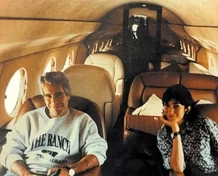
This was sent in January of 2020# talking about Trump being on Epstein's plane.
It says -- quote -- "For your situational# awareness, we wanted to let that the flight## records we received yesterday reflect that# Donald Trump traveled on Epstein's private## jet many more times than we previously had# reported or that we were aware of."
And it## said that he is listed as a passenger on at# least eight flights between 1993 and 1996.
Now, the Department of Justice put out a statement# this morning on social media saying that:## "Some of these documents contain untrue# and sensationalist claims made against## President Trump that were submitted to the FBI# right before the 2020 election.
To be clear,## the claims are unfounded and false.# And if they had a shred of credibility,## they certainly would have been weaponized# against President Trump already."
WILLIAM BRANGHAM: But we don't know which# of those documents they're referring to.
LIZ LANDERS: No, there's not# a clear indication in there.
WILLIAM BRANGHAM: So what is# President Trump saying about all this?
LIZ LANDERS: So President Trump was asked# yesterday at his club in Palm Beach .. some of the release that had come out,# and in particular about former President## Bill Clinton being in some of those images# that we saw last week.
Here's what he said.
DONALD TRUMP, President of the United# States: A lot of people are very angry## that pictures are being released of other# people that really h.. Epstein.
But they're in a picture with# him because he was at a party and you## ruin a reputation of somebody.
So a lot of# people are very angry that this continues.
LIZ LANDERS: The president# has repeatedly expressed## his frustration that the Epstein files# story continues to dominate the news,## while he said it's overshadowing some of# the accomplishments of his administration.
WILLIAM BRANGHAM: This is not how this was all# supposed to roll out, right?
Congress passed a## law.
Legislators are upset about this, as are# some of the survivors.
What are they saying?
LIZ LANDERS: To put it bluntly, the way that# this has been released by the Department of## Justice has not been in compliance# with the original intent of the law.
The Epstein Transparency Act directed the# Department of Justice to publish all of the## files and materials related to Epstein and# Ghislaine Maxwell.
Flight logs, records, any## grand jury testimony, all of that was supposed to# be released, redactions to protect victims' names,## but that was it.
And anything related to ongoing# investigations, that was supposed to be redacted.
What we have seen is that not everything# has been released all at once.
Instead,## we're seeing this kind of trickle out over the# course of several days now.
We've also seen names## that have been redacted in some of these e-mails# with no apparent reason why between attorneys,## it looks like.
That's not supposed to be# covered up in some of these redactions.
And, also, we've seen that these# files have been posted and then## taken down in two instances now without# explanation from the Department of Justice.
WILLIAM BRANGHAM: Liz Landers, thanks# for staying on top of all this for us.
LIZ LANDERS: Of course.
WILLIAM BRANGHAM:## In the day's other headlines: The# Supreme Court has blocked the Trump## administration from deploying National# Guard troops to Chicago for now while## a legal challenge moves forward.
It# leaves in place a lower court ruling## that barred the deployment and marks# a rare setback for President Trump.
The court's conservative majority has frequently# sided with the administration on previous tests of## presidential power.
Trump has utilized the Guard# in Chicago and in other Democrat-led cities to## protect ICE agents and federal buildings over# the objections of state and local officials.
The U.S.
military struck another boat that it# said was smuggling drugs, killing one person## on board.
The latest strike, which occurred# yesterday in the Eastern Pacific, is now the## 29th known boat strike carried out since the# fall.
At least 105 people have been killed.
As with previous strikes, the Pentagon provided# no evidence that the vessel was carrying drugs.## The Trump administration has said these# strikes are part of a push to pressure## Venezuelan President Nicolas Maduro.
That# pressure campaign has also included the## seizure by U.S.
forces of several# oil tankers in the Caribbean sea.
Turning to Ukraine, officials there say# more than 600 Russian drones and dozens## of missiles bombarded the country, killing# at least three people, including a child.## The strikes also hit the power# grids of more than a dozen regions,## triggering widespread outages# amid freezing winter temperatures.
Ukrainian President Volodymyr Zelenskyy took# to social media, saying this barrage in the## middle of peace negotiations was a -- quote --# "clear signal of Russian priorities."
He added:## "Putin still cannot accept# that he must stop killing,## and that means the world is not putting enough# pressure on Russia.
Now is the time to respond."
The U.S.
economy grew this summer at its# fastest pace in two years.
New GDP data,## which got delayed due to the government shutdown,## showed that a rise in consumer spending helped# to drive 4.3 percent economic growth from July## to September.
That's an acceleration from# the previous quarter.
Some economists expect## GDP growth to slow in the fourth quarter# because of that record government shutdown.
Meantime, those solid GDP figures led to moderate# gains on Wall Street.
The Dow Jones industrial## average added just under 80 points, the# Nasdaq gained more than half-a-percent,## and the S&P 500 rose enough# to reach a new all-time high.
Former Nebraska Senator Ben Sasse# revealed today that he has terminal## stage four pancreatic cancer.
In a social media# post, Sasse said the diagnosis came just last## week.
He wrote -- quote -- "Advanced pancreatic# cancer is nasty stuff.
It's a death sentence."
Sasse was first elected to the Senate in 2014# and stood out among Republicans for his vocal## criticism of President Trump.
He resigned in 2023.# Sasse, who is 53, ended his announcement today## on a determined note, writing -- quote -- "The# process of dying is still something to be lived."
And Vince Zampella, the video game# developer behind the mega successful## series "Call of Duty," has died.
The iconic# first person shooter game debuted in 2003,## originally as a World War II simulator,# before delving into more modern warfare.## That franchise has gone on to sell more# than half-a-billion copies worldwide.
Zampella was also behind other# widely popular shooter games,## including "Battlefield" and "Medal of# Honor."
Multiple reports say he was## killed in a car crash in California this# weekend.
Vince Zampella was 55 years old.
Still to come on the "News Hour": a historical# look at the Kennedy Center for the Performing## Arts that's been renamed after President Trump;# who the so-called Trump savings accounts,## which are meant for children, will# benefit most; and the murders of Rob## and Michele Reiner highlight the mental health# struggles that families face, often privately.
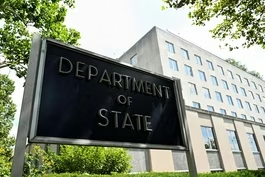
In an unusual move, the Trump administration is# recalling the ambassadors from nearly 30 countries## around the world.
According to the Associated# Press, nations in Africa are losing the most## diplomats, followed by Asia, then Europe, the# Middle East, and here in the Western Hemisphere.
The State Department told the "News Hour" in a# statement that -- quote -- "This is a standard## process in any administration.
An ambassador# is a personal representative of the president,## and it is the president's right to# ensure that he has individuals in## these countries who advance# the America first agenda."
So, for one perspective on this move,## we turn to John Dinkelman.
He is the president# of the American Foreign Service Association.## He had a nearly four-decade diplomatic# career with the U.S.
State Department.
John, thank you so much for being here.
JOHN DINKELMAN, President, American Foreign# Service Association: Thank you for having me.
WILLIAM BRANGHAM: How unusual is this.. year into an administration?# Is this standard practice?
JOHN DINKELMAN: This is not standard practice.# This is unprecedented.
This is unheard of.
This is a sabotage of the American# diplomatic machine.
This is an## affront to the professional Foreign# Service that we have spent decades,## a century in building in our country.# And I don't know what it foretells.
WILLIAM BRANGHAM: Sabotage?
JOHN DINKELMAN: Definitely.
When individuals# have spent their lives devoted.. to representing our country overseas, and, en# masse, you tell those who have qualified to## represent our country, to carry out our policies,# to execute any administration, any president's## goals in any given country, when you tell them all# summarily that for some reason they don't qualify,## something is definitely wrong.
WILLIAM BRANGHAM: I mean, you heard the State# Department's position on this.
They.. this happens with every administration.
Many# of these people were appointed by the Biden## administration, and the president# wants his own people in there.
What do you make of that argument?
JOHN DINKELMAN: This -- it is entirely# incorrect and a misrepresentation of the## reality.
Every American ambassador submits# their resignation to the incoming president,## who either chooses to accept or reject# those resignations at that time.
WILLIAM BRANGHAM: And all# these ambassadors did that?
JOHN DINKELMAN: All of these ambassadors# did that about one year ago right now.## And the Trump administration not# only refused those resignations,## but actually encouraged the individuals to remain.
Even within the past few weeks,## senior-level Cabinet individuals have visited# with these various ambassadors on trips,## reaffirming the desire of the administration# that they stay in their positions, only to## find them getting a phone call and surreptitiously# being told they haven't until January to get out.
WILLIAM BRANGHAM: We know that the U.S.
already# had about 80 vacant ambassadorships before this## event.
Then this comes.
What is your# sense of what the impact is going to## be on our ability to project American power# in ways, soft and hard, all over the world?
JOHN DINKELMAN: Simply put,## we're taking our star play.. These individuals will not be able to exercise the## personal and professional bona fides and# relationships that they have established## over decades.
And what will be very# interesting is who replaces them.
If it's a member of the professional Foreign# Service, I have to worry, as the president## of the Foreign Service Association, what# kind of loyalty oath are they going to## be required to take that demonstrates# their fidelity to the administration,## in addition to the fidelity that they should have# sworn to the Constitution in the first place?
WILLIAM BRANGHAM: Have you seen any# evidence that there is such a loyalty## oath being passed around to potential candidates?
JOHN DINKELMAN: I have not yet seen# that, and I am looking for it closely.
WILLIAM BRANGHAM: Have you been hearing -- I# imagine your phone must be ringing off the hook?
JOHN DINKELMAN: Incessantly, yes.
WILLIAM BRANGHAM: And what are they saying to you?
JOHN DINKELMAN: They're hurt.
They're concerned.# Many of them are afraid.
There.. what in the world they could have done that# would have caused the ire of our leaders.
They have done everything they could to# carry out the policies of the president,## as they would for any elected leader# of our country, because that's what## the Foreign Service does.
But, in this# case, they are left stumped, as am I,## as to what would have caused this en masse# dismissal of our leaders in our Foreign Service.
WILLIAM BRANGHAM: Is it possible,# just playing devil's advocate, that,## to take the State Department's stated# position, that some of these people were## not enacting what President Trump believes is# an America first agenda in their positions?
JOHN DINKELMAN: I find it inconceivable.
Individuals like myself who have spent# decades trained to make sure that they're## advocating on behalf of our leaders, on behalf# of the elected leaders of the United States,## it is incomprehensible to me# that individuals would do this,## much less 30 or 40 of them en masse# all at once.
It simply cannot happen.
WILLIAM BRANGHAM: At the beginning, I# put the list up of all those nations## that were -- where the ambassadors have now# been pulled.
Are there particular nations,## when you look at that list, that you're# -- that concern you specifically?
JOHN DINKELMAN: There's various that concern me,## but I'm particularly interested in what's going# on in Guatemala, where not only our ambassador,## but our deputy chief of mission, both senior# Foreign Service officers with decades of## experience each, have been summarily# told that they are to leave the post.
Given the immigration crisis that the# administration says we are in and the key## role that Guatemala plays in that crisis,# how we could determine that the individuals## in charge of our mission there, on the other# side of that problem, working with the other## side of the equation, are no longer going to be# there and who will fill that gap is beyond me.
WILLIAM BRANGHAM: You mentioned earlier to one# of my colleagues the concern that you have that,## if every new administration comes in and# basically guts the corps, civil service,## what that does to America's ability to enact# its foreign policy.
What did you mean by that?
JOHN DINKELMAN: It will politicize us as# a profession.
We come into the service## sworn loyal to the Constitution and nothing# else.
And when presidents change -- I myself## have been through six different presidents and# have served willingly under each one of them.
I know that the thousands of men and women in# the Foreign Service will continue to do so,## because that's what they were sworn to do.
If,# on the other hand, we start to move our people## in and out with every administration, it's going# to deplete our ability as diplomats to get the## job done.
It will hurt our credibility# and it will hurt our nation in general.
WILLIAM BRANGHAM: John Dinkelman,# thank you so much for being here.
JOHN DINKELMAN: Thank you.
WILLIAM BRANGHAM: Tonight, we give you# an inside look into one of Ukraine's## most rapidly evolving tools in its war with# Russia, drones.
These small unmanned machines## have come to dominate the battlefield from the# front line in the east to long-range strikes## against power facilities to the waters# of the Black and Mediterranean Seas.
Special correspondent Volodymyr# Solohub gained rare access to a## military unit that is responsible for some# of Ukraine's highest-profile drone strikes.
And a note, we allowed them to review some of# our footage before it aired for security reasons.
VOLODYMYR SOLOHUB: On a river outside of Kyiv,## Ukraine's Defense Intelligence is taking# us to one of their most prized weapons.## They have helped push Russia's fleet away from# occupied Crimea, disrupted supply lines, and## changed the balance of power at sea, naval drones# operated by a unit known as Group 13, Magura 5,## a kamikaze boat.
Magura 7 outfitted with American# missiles, inventing new weapons out of necessity.
Ukraine doesn't have its own navy.# When Russia annexed Crimea in 2014,## Ukraine lost almost all of its navy.
So,# when the new invasion in 2022 started,## Ukraine had to rely on unmanned naval drones like# these to fight a more powerful and much better## equipped enemy.
They're fast, effective, difficult# to detect, and has caused Russia a lot of trouble.
Just last week, in a highly produced video,# Ukraine showed off how its naval drone struck## a Russian submarine.
That helps keep the# Western Black Sea open to Ukraine experts,## and forces Russia's ships to dock in# Novorossiysk in their own territory,## well east of the occupied Crimean Peninsula.
Group 13's commander, who we promised to keep# anonymous, explains his unit's core mission.
GROUP 13 UNIT COMMANDER, Ukrainian# Defense Intelligence (through translator):## Little by little, we pushed the most active# and most dangerous part of Russia's Black## Sea fleet off the western part of the# Black Sea.
Right now, Russians do not## keep anything that is valuable or important# in Crimea.
Everything is in Novorossiysk.
VOLODYMYR SOLOHUB: But even in Novorossiysk,## Russia's fleet is not safe.
From summer# of 2023 to the spring of 2024, Ukrainian## naval drones pummeled Russian ships hundreds# of miles from Ukraine-controlled territory,## including the patrol ship Sergey Kotov,# which Ukraine said was worth $65 million.
It's an example of Ukraine using relatively cheap# weapons to take down expensive Russian hardware.
GROUP 13 UNIT COMMANDER (through# translator): In our missions,## we work in flocks if we're talking# .. during the mission on Kotov, we were# working in flocks and were hunting it.## The ship was trying to hide between the commercial# vessels and escape near the Crimea Bridge.
VOLODYMYR SOLOHUB: Group 13 even uses drones# to strike Russian helicopters.
But, recently,## Ukraine's tactics have shifted.
The drones are# now striking Russia's so-called shadow fleet,## the oil tankers Russia uses to# evade sanctions and finance the war.
And Ukraine's drone targets aren't only military.# Kyiv believes that one way to pressure Putin is to## bring the war home to everyday Russians.
Ukraine's# built an army of long-range drones that have also## targeted Russia's economic lifeblood, energy# facilities, some as far as 600 miles away.
At one point this year, long-range Ukrainian# drones took down more than 10 percent of## Russia's refinery capacity.
Just last# week, long-range aerial drones struck## a Russian tanker in the Mediterranean# Sea, 1,200 miles from Ukraine's border.
Inside an unmarked hangar, the Beaver# is a 200-pound kamikaze drone capable of## traveling up to 600 miles.
This commander# also asked us to keep him anonymous.
UNIT COMMANDER, Ukrainian Defense Intelligence# (through translator): With our deep strikes,## we're targeting Russian fuel bases, logistics# hubs, co.. them to move all of this away from the front# line.
And thus their logistics take more time.
VOLODYMYR SOLOHUB: But Russia is# way ahead of Ukraine with its own## deep strikes.
Over the last week alone,# Moscow launched an average of 726 drones,## mostly at energy and infrastructure targets.
And Russia's ability to manufacture drones# exceeds Ukraine's.
At this factory shown on## Russian TV earlier this year, workers claimed# they manufactured more than 400 per day.
But,## at sea, Ukrainians are still on the offensive.
GROUP 13 UNIT COMMANDER (through# translator): We're fighting for our survival.
We have no choice but to fight.
VOLODYMYR SOLOHUB: As the war continues,## unmanned systems are reshaping the battlefield.# And as both sides brace for what co.. Ukraine's unmanned army is now an# increasingly central part of the fight.
For the "PBS News Hour," I'm# Volodymyr Solohub in Kyiv, Ukraine.
WILLIAM BRANGHAM:## Since returning to the White House earlier# this year, President Trump has made quick## work reshaping Washington, D.C., in his image, in# some cases literally.
That will be on full display## during what he's calling the Trump-Kennedy Center# Honors, which is being broadcast on TV tonight.
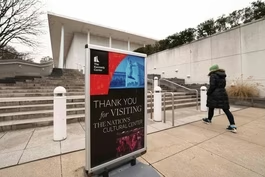
The president hosted the event from the recently# and controversially renamed building, one that## has roots tracing back to the Eisenhower# administration more than 60 years ago.
Stephanie Sy takes a closer look# at its history and evolution.
STEPHANIE SY: When the building opened to the# public in 1971, the John F. Kennedy Center for## the Performing Arts stood as a living memorial to# the late president.
That legacy stood untouched## until last week, when the Kennedy Center board,# most of whom were appointed by President Trump,## followed through on the president's wishes and# voted to rename it the Trump-Kennedy Center.
While it takes an act of# Congress to make that official,## construction teams wasted# no time.
Within 24 hours,## President Trump's name was emblazoned# alongside Kennedy's in the marble facade.
For more on this change and how it's# part of a larger effort by the president,## I'm joined by presidential# historian Mark Updegrove.
Mark, it's a pleasure to have you on the show.
Comment on this move.
Is there any president# for a sitting president to have major cultural## buildings named after him, especially ones# in which they themselves control the board?
MARK UPDEGROVE, Presidential# Historian: No, not at all.
I mean, it would be unthinkable, I think,.. chairman of the Kennedy Center board.
That was# unprecedented.
The president is presiding over## the nation.
He has some big problems to# resolve.
And I think the American people## would agree that that is not the function of a# president.
We don't want to see our president## acting as the chairman of the# board for the Kennedy Center.
We want him addressing the challenges and# the problems that come across his desk,## as being not only the president of our# nation, but, for all practical purposes,## the leader of the free world.
So this# is unprecedented on so many levels.
STEPHANIE SY: From a historian's perspective,## why do you think it matters that the# name of this building is being changed?
MARK UPDEGROVE: We shouldn't have our presidents,## I think, thinking about things that# should be named in their honor.
President Trump is barely a quarter into# his second term in office, at a time when## most Americans are worried about affordability.# We saw that as almost -- the off-year elections## as a referendum on the Trump presidency# and his failure to deliver on the promise## of resurrecting our economy, bringing down# inflation, boosting our employment numbers.
He hasn't accomplished that, but what he has# done is renamed institutions in his honor,## not something that we see from a# president.
I think of humility as## an American value and part of the# American brand.
But, of course,## narcissism is really part of the Trump brand.
This# shouldn't surprise us, but it should alarm us.
STEPHANIE SY: Tell me more about this building and## how it originally came to be# named after President Kennedy.
MARK UPDEGROVE: The Kennedy Center# was not something that President## Kennedy had imagined.
Rather, it# was the thinking of Lyndon Johnson,## President Lyndon Johnson, who succeeded# President Kennedy after his assassination.
President Johnson wanted to do something to# reflect the best of the arts in America and## named the Kennedy Center in -- for President# Kennedy, partly to get it through Congress,## but partly to honor the accomplishments# of our 35th president, John F. Kennedy.
STEPHANIE SY: This is not the first time# in recent months that the president has## shown what critics say is disregard# for historical and cultural sites,## the demolition of the White# House East Wing, for instance.
As a historian, how would you frame# all of these changes taken as a whole?
MARK UPDEGROVE: I think it's very concerning,## deeply concerning, to see this# president, I think, overreach.
Fifty years ago, we called the Nixon presidency# the imperialistic presidency, but it really## pales in comparison to what we have seen from# Donald Trump.
The demolition of the East Wing## of the White House is another example of President# Trump just deciding to do something and doing it## without consulting anyone, without looking at# the rules, without looking at the precedents.
And I think that in itself is dangerous.
STEPHANIE SY: Mark, but, of course,# Trump was elected.
He was elected twice,## and he has millions of supporters.
We also know# that, as a real estate magnate, he was long known## to put his name on his properties.
Of course,# we're talking about government buildings now,## including the Institute of Peace# building, which bears his name.
His picture is now, by the way, in front of# many buildings, like at the Department of## Agriculture.
But, as much as Trump critics say# this is something that looks like we'd see in## authoritarian regimes, haven't we seen a lot of# renaming of monuments in the last several years,## for example, to more align with what# is viewed as politically correct today?
I mean, do you see parallels or contrast there?
MARK UPDEGROVE: No, I don't see any parallels.
I think there are renaming of institutions.# And a couple of examples are the JFK Airport,## which was named for President Kennedy, like the# Kennedy Center, after his assassination.
It was## posthumously named for President Kennedy.# The National Airport in Washington, D.C.,## was renamed Reagan National.
Ronald Reagan was# diagnosed with Alzheimer's early in the 1990s,## and so it was renamed for President Reagan in# 1998, when President Clinton was in office.
So President Reagan was still very much# alive, although ailing from Alzheimer's.## We don't generally see these things until a# president has left office and has rendered## a legacy.
In President Trump's case,# he is only one-quarter through his## second term in office.
We have yet to see# the legacy he will render as president.
And I think he would do well to think# that -- not about being remembered for## his name being on a building, but what# he does in the office of the presidency## of the United States to better the American# people in our nation and around the world.
STEPHANIE SY: That is Mark Updegrove,# the president of the LBJ Foundation.
Mark, thank you so much for joining us.
MARK UPDEGROVE: Thank you very much.
WILLIAM BRANGHAM: You may have heard in# the last couple of weeks about these new## savings and investment accounts for kids known# as Trump Accounts.
They recently got a big boost## from a philanthropic donation that's among the# largest ever delivered directly to Americans.
The accounts are now available and the accounts# are first expected to open next May.
And the## question is, can they deliver the benefits# over the long haul that are being promoted?
Our economics correspondent, Paul# Solman, dug into that question.
DONALD TRUMP, President of the United# States: Trump Accounts will be the first,## I guess you could say, real trust# funds for every American child.
PAUL SOLMAN: To which tech# billionaire Michael Dell added: MICHAEL DELL, CEO, Dell: We believe the smartest## investment that we can make# is an investment in children.
PAUL SOLMAN: So what exactly are these# so-called Trump Accounts?
Part of this## year's One Big Beautiful Bill Act, they're# tax-advantaged savings accounts available## for every American child up to the age of 18,# and parents can put in up to $5,000 annually.
For kids born between 2025 and# 2028, Uncle Sam salts away $1,000## no matter what parents do.
And all parents have# to do is opt in through a tax form.
Moreover,## other philanthropists, employers and states# are invited to add to the accounts as well.
Susan and husband Michael Dell are the first## philanthropic contributors of# many, Brad Gerstner thinks.
BRAD GERSTNER, Entrepreneur: Moms and# dads adding five, 10 bucks a week,## kids saving a little money in the summertime.# Philanthropists like the Dells, states like## the state of Texas have said they're# going to add $1,000 to these accounts.
PAUL SOLMAN: Silicon Valley entrepreneur# Brad Gerstner helped make the idea a reality.
BRAD GERSTNER: The objective here is to get# the 70 percent Americans who feel left out## and left behind by capitalism into the game,# to make everybody a capitalist from birth,## sharing in the great upside# of the American economy.
WOMAN: U.S.
savings bonds,# now watch how they grow.
PAUL SOLMAN: Now, putting money# away for a kid was pretty common## back when folks like me and Teresa# Ghilarducci were babes in the woods.
TERESA GHILARDUCCI, Economist:# I used my own example of what## happened when my grandmother# gave me a little baby bond.
PAUL SOLMAN: She eventually became a prominent# economist, a left-wing one, who's long promoted## something like government trust funds from# birth.
She even wrote a proposal for them.
TERESA GHILARDUCCI: Along with Kevin Hassett,## who's on the other side of# me on the political spectrum.
PAUL SOLMAN: Kevin Hassett, President# Trump's top economic adviser.
Given## her politics, how could she pair up with him?
TERESA GHILARDUCCI: We came# together as economists,## and we know that wealth gives# people security and power.
PAUL SOLMAN: She and Hassett,# despite their different politics,## have now been meeting with Brad Gerstner.
That comes as no surprise to# early-wealth-building expert Ray Boshara.
RAY BOSHARA, Aspen Institute: I have been# working on this idea for 20 years and it's## been bipartisan over those 20 years.
It's# important to remember that the bottom half## of the population owns only 2.5 percent of the# nation's wealth and only 1 percent of stocks## and bonds.
We have a long way to go to build# wealth for the bottom half of the population.
Trump Accounts, designed properly, can do that.
PAUL SOLMAN: Designed properly.
But that's only# the first problem, says policy expert Amy Matsui.
AMY MATSUI, National Women's Law Center: We# already have extremely significant wealth## gaps by income, by race, by gender.
And# the way that this policy is structured,## it's not going to narrow them.
It# has the potential to widen them.
PAUL SOLMAN: How so?
AMY MATSUI: Because the practical aspects of# these ac.. that are very well off will benefit# much more than anybody in the bottom## 90 percent.
Most families will not be able to# contribute the $5,000 for the tax advantage.
A family who's been able to steadily# contribute the maximum would have almost## $200,000 in assets.
And, in contrast, a# family that has the $1,000 and has the## 6 percent rate of return may have something# more along the lines of $2,000 or $3,000.
PAUL SOLMAN: But Teresa# Ghilarducci remains hopeful.
TERESA GHILARDUCCI: The Trump# Accounts surely can be restructured.
PAUL SOLMAN: But here's a# real question: Will they be?
TERESA GHILARDUCCI: The technocrats around# populist policies would absolutely endorse## a tweak of these accounts so they don't just# serve the top 1 percent or top 10 percent.
PAUL SOLMAN: Her tweak of choice, eliminates# tax advantage for families earning over $250,000## per year to make the program more progressive.# She expects Brad Gerstner will be sympathetic.## And to listen to him, he may be.
BRAD GERSTNER: I started this when my oldest# child was 13 years old coming out of COVID-19,## 2021.
And I showed them the custodial accounts# that I had opened at birth and added to over the## years.
And they had compounded into a fair# bit of money.
And my oldest son, Lincoln,## said to me: "Dad, this is incredible.
But what# about all the other kids who don't have these?"
And that really was the conversation around## our dinner table that led to# the birth of Invest America.
PAUL SOLMAN: And now here's another problem,## a teenager and money.
What happens when he or# she turns 18 and suddenly there's a windfall?
TERESA GHILARDUCCI: I used to be a Boy Scout# counselor for the Personal Finance Merit Badge.## And I talked to many teenage boys over the years# about their finances.
I bet that 90 percent of## the teenagers that you talk to will say that# they would buy a car or somehow fix their car.
PAUL SOLMAN: What did she# do with the grandma bond?
TERESA GHILARDUCCI: The bond that my grandmother# gave me was cashed in to pay our back rent.
BRAD GERSTNER: As a father of a 17-year-old and# a 14-year-old, I think about that all the time.
PAUL SOLMAN: And so the new law tries# to address the problem, he says.
BRAD GERSTNER: At 18, kids can use up# to 25 percent of this to buy a home,## start a business, go to college.
If they# don't use the money for that purpose,## it automatically rolls into an IRA and is subject# to the IRA rules.
So, yes, you can take it out,## but it will be subject to a stiff penalty# if you take it out at that point in time.
PAUL SOLMAN: But college?
That# isn't for most Americans, right?
TERESA GHILARDUCCI: Two-thirds of people# don't go to college.
And so if they take## the money out to buy a car, they have to pay a# penalty.
So you're actually penalizing people## who don't go right from high school to# college.
And so that has to be changed.
BRAD GERSTNER: They can use this money# to go to a trade school.
They can use## this money to study a profession that# isn't a typical four-year education,## community college, to start a small business.
PAUL SOLMAN: OK, but what about# this potential final snag?
AMY MATSUI: Trust in government# agencies is pretty low.
And for## families who don't have a lot of financial# literacy or a portfolio of their own,## they may be unwilling or reluctant to take# the steps to open accounts for their children,## even if they could receive that $1,000# of seed money from the government.
PAUL SOLMAN: Brad Gerstner says# he's keenly aware of the problem.
BRAD GERSTNER: Failure for me would be if we had# a bunch of accounts that were not claimed by the## bottom third of the economic ladder.
We have# to make sure that we make it seamless for these## people to know about the accounts, to get excited# about the accounts and to claim the accounts.
PAUL SOLMAN: So what's the bottom line right# now?
Pitfalls galore.
But these accounts are,## says longtime proponent Ray Boshara: RAY BOSHARA: The down payment on a big idea# that can and sho.. And it's important to look at history here.# Social Security, one of our most successful## social policies, started out largely# excluding women and minorities.
But,## today, it's one of the most inclusive,# successful programs that we have.
TERESA GHILARDUCCI: These Trump Accounts,# since they are completely wide open for## an 18-year-old to spend, will not achieve# the goals that right now President Trump## and Michael and Susan Dell say they# want it to achieve.
It needs reform.
PAUL SOLMAN: But better than nothing?
TERESA GHILARDUCCI: Better than nothing.
PAUL SOLMAN: And if reforms do happen# in myriad ways and if money pours in## from myriad sources, potentially much better.
For the "PBS News Hour," Paul Solman.
WILLIAM BRANGHAM: The murders of filmmaker# Rob Reiner and his wife Michele Singer Reiner,## allegedly by their son Nick, have renewed# difficult conversations across the country## for other families who are struggling# with mental illness and addiction.
Nick Reiner had many well publicized struggles# over the years, serious health crises, repeated## treatments for substance use, and recent# reports suggested he was being treated for## schizophrenia.
We still don't know what happened# with the Reiners, but we do know mental illness## and addiction can be profoundly difficult# challenges, even for families with means.
So we turn to someone who has traveled# that difficult path within his own family,## Virginia State Senator Creigh Deeds.# In 2013, his 24-year-old son, Gus,## who'd struggled with bipolar disorder for years,# attacked his father, before taking his own life.
Senator, thank you so much# for being here and talking## with us about this very, very difficult topic.
We should say at the outset --# I know you know this -- that## people struggling with mental illness# are not inherently violent.
They're## much more likely to be the victims of# violence than the perpetrators of it.
STATE SEN.
CREIGH DEEDS (D-VA): Absolutely.
have happened with the Reiner# family, what was your reaction?
STATE SEN.
CREIGH DEEDS: Well, just heartbreak# for the family, heartbreak that these beautiful## people were lost, and heartbreak that they# couldn't get the help they needed for their son.
I mean, mental health is so misunderstood, and# we built up this wall of stigma around it for## years and really prevented, put up roadblocks# in the way of people trying to get help.
So I## also thought about the struggle of# trying to care for an adult child.
You know, even -- just because a# child turns 18 doesn't make them## less of a child.
But there's a huge# challenge to try to get services.
You## can lead a horse to water.
You can't make# them drink, as an old saying, I guess,## and the same thing is true when you're trying# to get services for somebody you care about.
WILLIAM BRANGHAM: I want to ask you# a little bit more about that.
Again,## we don't know the full extent of# what happened with Nick Reiner.## But we also know that mental illness and# substance abuse often go hand in hand.
Can you just tell us a little bit more about the## struggles that you had trying# to get care for your son, Gus?
STATE SEN.
CREIGH DEEDS: Well, that was# a long time ago now, but the reality is## that a lot of people don't understand that# they are ill.
They won't accept the fact## that they are ill.
And they don't want --# there are things they don't want to do.
And as an adult child, you have# to either get them to be treated,## I guess to volunteer at some point, even when# it's involuntary, to try to get them to treatment,## or to get them to sign something that will give# you the authority to help them make decisions,## or you're going to have to# go to court and file suit.
It just -- there's one difficulty# after another one.
And with my son,## we just -- we struggled to get him to# acknowledge the problems and acknowledge## that he needed care.
And, in the end, he# was just ill and delusional and he would## not accept care.
He would not.
So it's not# a laughing matter at all.
It's very tough.
WILLIAM BRANGHAM: And you're saying that, once# a person turns 18, legally, for all sorts of## medical privacy and autonomy reasons, you as a# parent don't have autonomy over them anymore.
STATE SEN.
CREIGH DEEDS: That's# absolutely true.
I mean, in fact,## lots of cases, under federal law# and state law, once they turn 14,## they have a certain amount of independence.# They don't have to be treated, have to receive## the treatment you prescribe for them, you# think they need, that I think that they need.
I wanted my son to receive care.
I did# the best I could to get him to places## where he could receive that care.
And# he refused.
And that's often the case.
WILLIAM BRANGHAM: After your family's tragedy,# you were part of a commission in Virginia to## look at the gaps in mental health care.
That# was over a decade ago.
What has happened in## your state?
What has happened nationally?
Are# we doing a better job now than we were then?
STATE SEN.
CREIGH DEEDS: We're doing# a better job, but the reality is,## we had -- had, we for so long neglected the# issue that we still have so much work to do.
When I was in the hospital for several days after## my son's situation, after he attacked me# and then he died -- I was in the hospital## and I was just scheming up.
I was in# the fortunate position of being in the## General Assembly.
So I was going to be able# to make some change or hope to make change.
I had lots of questions.
I had quite more# questions than answers.
We created this## commission to study mental health.
And out of that# group -- that met for about eight or nine years,## out of that group, the Virginia Behavioral# Health Commission, which is a permanent,## staffed commission that staff is doing research# on figuring out ways to address mental illness.
What we have done in Virginia is, we have# added several hundred million dollars a## year to our public mental health system,# because we have had to build out services.## We have taken the list of mandated# services from public health providers,## public mental health providers, our community# service boards in Virginia, from two to nine.
We are focused on keeping people out# of crisis.
We have done some things,## yes, and I'm proud of that work,# but we have still got a lot to do.
WILLIAM BRANGHAM: The Reiner family was# very public about their struggles.
They## even made a film that dramatized some# of Nick's experience.
You, as you said,## were in the legislature when this happened.
You# couldn't avoid talking about what had happened.
But a lot of families, as you mentioned,# feel an intense stigma and shame and## blame and struggle to talk openly# about what they're dealing with,## let alone get help.
How much of# an issue is that still today?
STATE SEN.
CREIGH DEEDS: It's a huge issue.# Here's the thing.
There are tragedies every day,## and nearly every family suffers# a tragedy of some kind.
They're## not all on the front page of the# newspaper.
In fact, few of them are.
So you have to have empathy for what# people are going through.
And I think## that you have to show kindness all# the time.
But the reality is that,## historically, we have had walled# stigma up around mental health.## We have made people be -- feel discouraged, feel# embarrassed about mental health, feel discouraged## from seeking treatment, feeling discouraged# from acknowledging that a problem exists.
And the stigma is still out there.
We are slowly# tearing down the walls.
We -- several years ago,## we put in Virginia in the health curriculum of# public -- our public schools some mental health## awareness, particularly in# eighth and ninth grades.## It's true that about 70 percent# of those people that have serious## mental illness first experience a crisis# some time between the ages of 14 or 24.
So you want to build up the knowledge of# mental health and the knowledge of warning## signs for people when they're# in that age group.
In Virginia,## what we have done is incorporate mental health# awareness into our health curriculum in the## public schools for eighth and ninth graders,# so that young people at the age when they might## begin experiencing some mental health crisis# can have some knowledge of what's going on.
Here's the problem.
The brain is part of the body.# Mental health care is health care.
People have to## acknowledge that.
They have to acknowledge that# it's all right to feel bad.
It's all right to## have these -- a mental illness.
It's just -- the# frustrating thing is that we have fund-raisers.
We focus on things like breast cancer or a whole# bunch of other illnesses, but, for mental health,## we use words like crazy.
And it begins by thinking# about the way we talk, thinking about the way we## talk.
We can tear down the walls of stigma# ourselves.
We just have to focus on trying## to make sure that people can get the treatment# they need and can get well in their communities.
WILLIAM BRANGHAM: That is Virginia# State Senator Creigh Deeds.
Senator, thank you so much for taking the# time.
Really appreciate your insights.
STATE SEN.
CREIGH DEEDS: Thank# you so much.
Yes, bye-bye.
Watching the classic Christmas movie# "It's A Wonderful Life" is a beloved## tradition for millions.
Its director, Frank Capra,## always said his film was in part about# the beauty of life in small-town America.
One little town in Rhode Island believes it# was the inspiration for this holiday favorite.
Pamela Watts of Ocean State Media has that story.# It's part of our arts and culture series, Canvas.
JIMMY STEWART, Actor: Yes!
Hello,# Bedford Falls!
Merry Christmas!
PAMELA WATTS: The Christmas classic "It's# A Wonderful Life," starring Jimmy Stewart,## was filmed on a Hollywood set.
Seneca Falls,## New York, boasts it's the model# for the beloved movie small town.
ACTOR: Hey, George, don't# take any plugged nickels.
PAMELA WATTS: But whole the popcorn.
Could# Little Compton have also played a big role?
Town historian and native Marjory O'Toole## says clues of the connection are# sprinkled throughout the film.
Is it kind of a given that people# in Little Compton do believe that## they are really a part of "It's# A Wonderful Life," the movie?
MARJORY O'TOOLE, Little Compton Historical# Society: Oh, we're 100 percent in on that.
PAMELA WATTS: That certainty began here.# Hollywood husband and wife scriptwriting## team of Frances Goodrich and Albert# Hackett, who created the screenplay,## often vacationed at the Goodrich family cottage.
MARJORY O'TOOLE: Frances and Albert summered# on Bailey's Ledge in Little Compton,## on the Bailey family farm.
And so I think the fact# that they named their incredibly sympathetic main## character George Bailey is an absolute tie to this# summer home, summer community that they loved.
PAMELA WATTS: Need more proof?
In the church# cemetery on Little Compton's town common,## here lies George Bailey and nearby Mary Bailey.
JIMMY STEWART: Hey, Mary.
(SINGING) PAMELA WATTS: Goodrich and Hackett# borrowed other area names too.
MARJORY O'TOOLE: The folks in Seneca Falls may# argue this, but Little Compton sits in between## two cities, New Bedford and Fall River.# And so I think the fact that the town in## the movie is called Bedford Falls is a direct# combination of the names of those two cities.
PAMELA WATTS: That may all seem a# coincidence until this scene in the movie.
ACTOR: You had me worried, one of# the oldest trees in Pottersville.
JIMMY STEWART: Pottersville?
PAMELA WATTS: There's actually a# Pottersville n.. MARJORY O'TOOLE: Today, it's a perfectly# beautiful little neighborhood in Little## Compton.
But 100 years ago, Pottersville was one# of the poorer neighborhoods in Little Compton,## where working-class people# would have lived and worked.
PAMELA WATTS: Senior digital producer Dan# Medeiros of The Herald News in South Coast,## Massachusetts, has traced# another local tie to the movie.
DAN MEDEIROS, Herald News: I found that someone# from "It's A Wonderful Life" was born in Fall## River.
And I thought, well, who could that be?# I know I have seen the movie a million times.
PAMELA WATTS: Don't blink.
The photo of the# pharmacist's deceased son is the headshot of actor## Glen Vernon.
Medeiros discovered Vernon wasn't# even credited in the movie, but he got paid.
DAN MEDEIROS: That actor from Fall# River was a part of it, a very,## very small part, but he is a part nonetheless.
PAMELA WATTS: At first, Vernon didn't# mention he was in "It's A Wonderful## Life," which flopped at the box office,# winning only one Oscar for special effects.
All the snow in the movie was made of soap# flakes, sugar, water, and fire extinguisher foam.
As for Vernon, was he ever like, I'm# the guy from "It's A Wonderful Life"?
DAN MEDEIROS: Well, kind of, yes.
He# would add that to his credit.
He would## become like a background actor or just# like bit parts.
He was in "Lassie."
He## was in an episode of "Columbo."
He's# in the movie "Breakfast at Tiffany's."
PAMELA WATTS: Meantime, Goodrich and Hackett# would go on to write other screenplays,## including the "Thin Man" detective movies,## the characters Nick and Nora based on their# own witty and close marriage.
Eventually,## the couple won a Pulitzer Prize and a Tony Award# for their stage play "The Diary of Anne Frank."
And back in Little Compton... ACTRESS: Every time a bell# rings, an angel gets his wings.
PAMELA WATTS: Even if you're skeptical# about Little Compton being this## prototype for the story, is it a# wonderful life in Little Compton?
MARJORY O'TOOLE: Oh, it's always a# wonderful life in Little Compton.
ACTOR: To my big brother# George, the richest man in town.
(CHEERING) MARJORY O'TOOLE: Every time I watch the movie,# I keep my eyes open for additional connections.
(SINGING) PAMELA WATTS: For the "PBS News Hour," I'm# Pamela Watts in Little Compton, Rhode Island.
WILLIAM BRANGHAM: And that is the "News# Hour" for tonight.
I'm William Brangham.
On behalf of the entire "News Hour"# team, thank you so much for joining us.
How diplomat recall fits into Trump's foreign policy shift
Video has Closed Captions
How recall of career diplomats fits into Trump's foreign policy shift (7m 28s)

How 'Trump accounts' for children work, and who will benefit
Video has Closed Captions
How 'Trump accounts' for children work, and who will benefit most (8m 32s)

Inside look at Ukraine's high-profile drone strikes
Video has Closed Captions
Inside the Ukrainian drone unit responsible for high-profile strikes (5m 39s)
Kennedy Center renaming highlights Trump's reshaping of D.C.
Video has Closed Captions
Kennedy Center renaming highlights Trump's reshaping of Washington in his image (6m 52s)
Reiner deaths renew talks for families facing mental illness
Video has Closed Captions
Reiner deaths renew conversations for families struggling with mental illness, addiction (8m 56s)

Rhode Island town says it inspired 'It's a Wonderful Life'
Video has Closed Captions
How a small town in Rhode Island is connected to 'It's a Wonderful Life' (5m 22s)
Where Trump is mentioned in latest Epstein files release
Video has Closed Captions
What the latest Epstein files release reveals, and where Trump is mentioned (4m 50s)
Providing Support for PBS.org
Learn Moreabout PBS online sponsorship
- News and Public Affairs

FRONTLINE is investigative journalism that questions, explains and changes our world.

- News and Public Affairs

Amanpour and Company features conversations with leaders and decision makers.












Support for PBS provided by:
Major corporate funding for the PBS News Hour is provided by BDO, BNSF, Consumer Cellular, American Cruise Lines, and Raymond James. Funding for the PBS NewsHour Weekend is provided by...