
Detroit election inspector training ahead of 2022 midterm
Clip: Special | 11m 39sVideo has Closed Captions
Bill Kubota examines the process of training election workers for the 2022 midterm season.
New plans for how Detroit will verify votes during the 2022 election season will include more stringent protocols for counting and verifying ballots. Senior Producer Bill Kubota teams up with the Detroit Free Press to take a look behind the scenes of one of Detroit's election inspector trainings to learn what election workers must know to preserve the democratic process.
Problems playing video? | Closed Captioning Feedback
Problems playing video? | Closed Captioning Feedback
One Detroit is a local public television program presented by Detroit PBS
Detroit election inspector training ahead of 2022 midterm
Clip: Special | 11m 39sVideo has Closed Captions
New plans for how Detroit will verify votes during the 2022 election season will include more stringent protocols for counting and verifying ballots. Senior Producer Bill Kubota teams up with the Detroit Free Press to take a look behind the scenes of one of Detroit's election inspector trainings to learn what election workers must know to preserve the democratic process.
Problems playing video? | Closed Captioning Feedback
Where to Watch One Detroit
One Detroit is available to stream on pbs.org and the PBS app.
Providing Support for PBS.org
Learn Moreabout PBS online sponsorshipTake a look.
- I'd just like to start off by saying greetings to each and every one of you on behalf of the Detroit Department of Elections and our Detroit City Clerk.
Like I said, I've been doing this since 1985.
I love this stuff, elections is in my blood.
I'd like to welcome each and every one of you to the Central Counting Board training class.
My name is Daniel Baxter.
I just wanna share a couple of things with you, as we engage in this particular training.
Our election inspectors are basically the lifeblood of the operation.
They're the folk who come in at five o'clock in the morning, and every Detroit resident who votes by absentee ballot is definitely depending on them to guarantee that their ballots are processed accurately as well as timely.
- And then there is a secrecy sleeve.
- [Bill] Detroit's elections operation's been under scrutiny for years.
At times, vote count's out of balance, that is, numbers not adding up.
Then came the Trump/Biden election.
Detroit's absentee vote count, at what they used to call the TCF Center, hit by the national spotlight.
- 2020, when all of that happened, it was perhaps the most exciting election that I had ever engaged in.
And I thought 2008 - [Barack] Yes we can.
- [Daniel] was it.
(crowds cheering) - America, we have come so far.
- [Bill] 2008, the year Barack Obama was first elected, lots of Detroit votes to be counted then.
- [Interviewer] Where are you from?
- Oh, I'm from down river.
- [Interviewer] Okay.
- I'm here because of the 38,000 ballots that arrived here at 3:45 a.m., that are just now sitting over there and getting counted.
- [Bill] But 2020 Republicans and President Trump questioned how Detroit handled the vote.
- Detroit is another place, and I wouldn't say has the best reputation for election integrity.
- The craziest it got, were in the middle of folks counting the ballots, you'd get a big group of Republican challengers that would form a circle around one table.
(crowd chanting) Some chanting going on.
And they'd start chanting, "Stop the count, "stop the count," and clapping as they did it.
And as you can see right now, we've got several police officers heading out there on the floor.
And the police would come in, they'd escort 'em out.
- The number of Republican vote watchers were removed from the hall, and so, a group of angry protestors came down and started banging on the windows of the basement of where we were at.
(crowd chanting) - And then you'd have people complaining, "We got kicked out of the process."
Well, you were chanting in the middle of the floor and causing a scene.
(crowds shouting) - All the Republican challengers out of this room.
- [Election Worker] Everybody standing in this area needs to be-- - A lot of conspiracy theories that were being thrown at us.
And there was also a directive from folks.
They said, challenge everything, challenge every ballot.
And they were doing it, they were, "Well, this doesn't look good because of this or because of that, and at some point, someone had to step in and say, "Enough."
- Those people, the way they were behaving, to demand that we stop counting, I mean literally demand.
I can't imagine what would've happened if they had broke down that door and gotten inside.
- People were not only banging on the windows, but they were taking their phones and they were videotaping the counters as they were counting the ballots.
Well, A, that's not allowed, and B, it was intrusive and bothersome.
So the ballot counter said, "Listen, these folks outside the windows are videotaping me," so they taped up the windows.
- One major hub for counting ballots in Detroit covered up the windows again with large pieces of cardboard.
- You know, in the mind of somebody who thinks that they're already being shut out of a process, you put up a piece of paper so that they can't see it, then they're like, "Aha, they're hiding something."
- And so they wanted to protect and block the counting area.
They didn't want anybody seeing the counting, even though these were observers who were legal observers that was supposed to be there.
- [Bill] There were plenty of Republican challengers inside.
Too many actually, working, some perhaps not so civilly, with trained election inspectors.
- We had a lot of training.
We had three days over a period of maybe three weeks.
- Election supervisor Edith Lee-Payne, a Democrat, she was in there.
- Even though I was a supervisor, I had to know what was expected of me as a supervisor.
I also needed to know what challengers, the rights that they had, because they were there.
- [Interviewer] Can you understand some of those folks that showed up that didn't trust the system?
- I can understand why some of the people that showed up not trusting the system, (sighing) because they themselves wanted to, they didn't want, some people can't handle the truth, as has been said in the movie.
- You all excited about this election?
- [Trainees] Yeah.
- I am too.
- [Bill] Despite that turmoil two years ago, these election inspectors have returned to count another day.
- I think that this is probably, these next couple elections are probably gonna be the most important elections of our country.
- We have two shifts, and it's roughly anywhere from 1100 to 1300 people who work to ensure that all of those ballots are processed.
- We are going to go through this training.
This training is probably going to be about three hours or so.
It's for CCB, as Mr.
Baxter said, CCB is Central Counting Board.
We count all the absentee ballots for the City of Detroit.
- We stand on the fence, if you will, in terms of engaging in this process.
We're not Democrats, we're not Republicans.
We're a nonpartisan entity, who is responsible to ensure that all ballots are counted.
- The attire for inspectors is white top, black bottom, closed toe shoes, no jeans, no Greek or partisan paraphernalia are allowed.
- When you go to the polls on Election Day, when you cast your vote, you have to fill out an application and you have to sign it.
And that application has to be verified or bumped against your record in the electronic poll book.
The same thing is true for an absentee ballot.
- [Bill] That's part of the process that would be suspect to some who questioned the absentee count in 2020.
They didn't understand or maybe they didn't want to.
- When those ballots come back, we have to verify that signature, to make sure it's the exact same signature that was on file when the individual requested it, and it takes time, so once we processed all of those ballots, then they were delivered to the Central Counting Board, and it was late.
- [Bill] The mysterious late night arrival seen in surveillance video circulated on the internet?
Just ballots that had to be verified ahead of the count.
- They're going to take they first 50 out of whatever precinct that they're working in.
They're gonna go through every single one of those ballots, or that's envelopes, to ensure that there is a signature on each one of those, that there is an election date that is correct, and that the precinct number, which is on the label, is the precinct that we're working in.
- [Bill] In 2020, poll challengers roamed freely on the counting floor-- - Only nonpartisan-- - [Bill] With too many challengers, when some left, they weren't let back in.
- [Protester] You don't know how many are in there.
- [Bill] Now, a new plan.
- So for this year, what we did was, we revamped the entire operation.
For instance, in 2020, they had to sign in on just a regular sheet of paper.
But for this election, they'll be responsible for swiping in with their driver's license so that they might be able to enter.
That information will be uploaded in our system, where we might be able to keep account of who's actually in the Central Counting Board as we process absentee ballots.
Each individual will be given a name tag with their party affiliation or their challenging affiliation on it, as well as, they'll be responsible for being stationed at one of the counting boards/tables.
So instead of roaming about throughout the entire building or throughout the entire Counting Board, they will be restricted to a certain table.
- Cell phones are not permitted in Hall E, not permitted to be used, excuse me.
If you are using a phone in Hall E, you will be asked to leave, and potentially not paid for that day.
- Last year during our municipal election cycle at the Central Counting Board, we probably had less than 100 Republicans to engage in the process.
This year, we received applications for upwards of 800 individuals to work with us on Election Day.
However, at the Central Counting Board, we'll probably have roughly 200, maybe 250 of them to serve as inspectors to help us with the tabulation of the absentee ballots.
- [Bill] Republican election inspector Max Rohtbart, he worked the Detroit primary election in August.
- 2021, actually, the clerk's office, they balanced every precinct at the absentee counting board, something they hadn't done in over 20 years.
It really is a remarkable accomplishment.
- [Bill] Rohtbart's done Oakland County elections for years, but wanted to see Detroit's process, knowing past issues there.
- And usually, if you have about over 30 precincts, there's at least one that's out of balance, because you're working a 13 to 17-hour shift.
And if you make one mistake and you don't catch it, you're off.
- [Trainer] Now, this supply box has everything that you need for the entire day.
We have below the supply box a black bin.
- We received kudos from both the Wayne County Board of Canvassers, as well as the State Bureau of Elections for our efforts.
So we're excited about that.
As we begin to engage in the off-year election here for the gubernatorial, we expect the same.
And after this election, we're definitely going to look at how we can even enhance and improve it for the 2024 presidential election cycle.
- So, your section supervisor and your team lead will fill this document out, but all inspectors must sign this document at the end of the night.
- The way the absentee board works, there's no position at the absentee counting board that really involves discretion.
The entire process of the absentee counting board now is a very singular assembly line task, where it's very tough to really impact or throw a wrench into the socket.
And if there is a problem, it's very easy to remove and have an alternate replaced.
- I like to add something.
I think that the reason why, after the 2020 presidential election, nobody quit in Detroit at the Department of Elections, is because, over the years, we get beat up a lot, (laughing) we get beat up a lot, and it's a thankless job.
And I think that what it did for us, it built thick skin.
Around the country, they probably never experienced that before.
We've had protests in front of the Department of Elections, the clerk, so it was almost like, par for the course.
But in Detroit, we have to deal with that a lot.
- Clara Hendrickson, you did the original reporting on the training session we just saw.
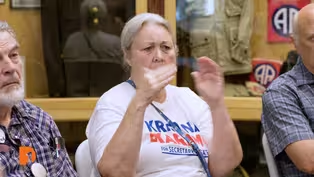
Voting Machine Test Educates Voters on Election Process
Video has Closed Captions
Clip: Special | 12m 12s | Clara Hendrickson learns how votes are cast and counted with two Michigan city clerks. (12m 12s)
Providing Support for PBS.org
Learn Moreabout PBS online sponsorship New Episode
- News and Public Affairs

Top journalists deliver compelling original analysis of the hour's headlines.
 New Episode
- News and Public Affairs

FRONTLINE is investigative journalism that questions, explains and changes our world.
 New Episode
 New Episode
 New Episode
 New Episode
 New Episode
 New Episode


 New Episode
 New Episode
Support for PBS provided by:
One Detroit is a local public television program presented by Detroit PBS