
February 10, 2026 - PBS News Hour full episode
2/10/2026 | 57m 46sVideo has Closed Captions
February 10, 2026 - PBS News Hour full episode
Tuesday on the News Hour, the fallout from the Epstein files grows as members of Congress accuse the Justice Department of inappropriate redactions. Top homeland security officials remain defiant in the face of questions about the deaths of two U.S. citizens during Trump's immigration crackdown. Plus, new details emerge about why FBI agents raided a Georgia elections office.
Problems playing video? | Closed Captioning Feedback
Problems playing video? | Closed Captioning Feedback
Major corporate funding for the PBS News Hour is provided by BDO, BNSF, Consumer Cellular, American Cruise Lines, and Raymond James. Funding for the PBS NewsHour Weekend is provided by...
Support provided by:

February 10, 2026 - PBS News Hour full episode
2/10/2026 | 57m 46sVideo has Closed Captions
Tuesday on the News Hour, the fallout from the Epstein files grows as members of Congress accuse the Justice Department of inappropriate redactions. Top homeland security officials remain defiant in the face of questions about the deaths of two U.S. citizens during Trump's immigration crackdown. Plus, new details emerge about why FBI agents raided a Georgia elections office.
Problems playing video? | Closed Captioning Feedback
How to Watch PBS News Hour
PBS News Hour is available to stream on pbs.org and the free PBS App, available on iPhone, Apple TV, Android TV, Android smartphones, Amazon Fire TV, Amazon Fire Tablet, Roku, Samsung Smart TV, and Vizio.
Providing Support for PBS.org
Learn Moreabout PBS online sponsorshipAMNA NAWAZ: Good evening.
I'm Amna Nawaz.
GEOFF BENNETT: And I'm Geoff Bennett.
On the "News Hour" tonight: The fallout from the Epstein files grows at home and abroad, as members of Congress accuse the Justice Department of inappropriate redactions.
AMNA NAWAZ: Top Homeland Security officials remain defiant in the face of lawmakers' questions about the deaths of two U.S.
citizens during the Trump administration's immigration crackdown.
REP.
SETH MAGAZINER (D-RI): Is it proper procedure to aim pepper spray into the window of a moving vehicle?
RODNEY SCOTT, Commissioner, U.S.
Customs and Border Protection: I'm not familiar -- I don't have all the details on this.
(CROSSTALK) REP.
SETH MAGAZINER: I'm not asking about... GEOFF BENNETT: And new details emerge about why FBI agents raided a Georgia elections office last month.
(BREAK) AMNA NAWAZ: Welcome to the "News Hour."
New questions continue to emerge today over the Justice Department's handling of the Jeffrey Epstein files.
GEOFF BENNETT: One Democratic congressman went to the House floor today to read the names of six wealthy, powerful men whose identities were shielded in the public release of the Epstein files.
Congressman Ro Khanna is the co-sponsor of the Epstein transparency act.
He reviewed some of the unredacted files at the Justice Department yesterday, and he joins us now.
Thanks for being with us.
REP.
RO KHANNA (D-CA): Thank you for having me.
GEOFF BENNETT: You have raised concerns about redactions even in the so-called unredacted files.
What specific categories of material are still being withheld, and what do you think accounts for it?
REP.
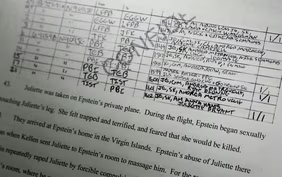
RO KHANNA: Donald Trump's FBI scraped these documents in March, and the thing that they took out were survivors' statements to FBI agents about rich and powerful men who raped them or committed heinous acts.
And then those documents from the FBI were sent to the Department of Justice in a redacted form.
They were already scrubbed.
We need those documents to be unscrubbed.
That's what the American people want to know.
All of the rich and powerful men, many of them who raped these girls, are in those FBI statements, and those statements are still redacted.
GEOFF BENNETT: As we said, you read the names of six men you believe are likely incriminated.
How do you differentiate between individuals who were mentioned in the files versus those who are complicit in Epstein's criminal conduct?
REP.
RO KHANNA: It's a very important distinction.
There are many people who are mentioned who may be totally innocent, and this should not be a witch-hunt.
But the names that I read were listed as co-conspirators on documents.
And the reality is, the Justice Department acknowledged that their identities should not have been redacted.
And I just thought it was important for someone to step up and say, I'm going to hold these elite, powerful men accountable.
I mean, there has been no accountability in the United States.
In Britain, the British monarchy is in trouble.
The British government may fall.
The Norwegian princess may not become queen.
Other countries are having total investigations of anyone who even shared e-mails with Epstein.
And in our nation, we have not had accountability.
And so it was a symbolic act.
It was an act of courage and defiance to start naming names on the House of Representatives' floor.
GEOFF BENNETT: Having reviewed the materials, do you now believe there's enough evidence for the Trump Justice Department to bring charges or at least open new investigations?
REP.
RO KHANNA: Yes, I'm convinced of it.
First of all, anyone who's in the Epstein files saying that they planned to or were going to or did visit Epstein's island needs to be investigated under oath.
They need to be asked some basic questions.
What did you see?
What did you know?
Did you rape underage girls or see other people rape underage girls?
How can you show up to a convicted pedophile's island or ranch or home where you know that young girls are being abused and then not have an investigation or not have someone ask you questions?
And yet that's what's gone on in America for decades.
It is one of the biggest cover-ups and scandals in our country's history to see so many people in finance, in tech, in real estate, in politics go to this pedophile's island and face no consequences.
GEOFF BENNETT: So I hear you say this isn't a question of insufficient evidence.
It's a question of prosecutorial discretion.
How then can you compel the Justice Department to do more?
REP.
RO KHANNA: Well, I can't compel them.
I can compel them to follow the law.
They have not released the FBI files that the law requires.
And we can go to a judge to do that.
We can ask the attorney general tomorrow in hearings.
We can have the FBI director explain why those documents were scrubbed.
But in terms of the prosecution, that's for the Justice Department.
It may come to a new American president who has to do the investigations and the prosecutions.
Congress can hold these people in front of a committee and ask them under oath to testify about what happened.
But this is not just a Trump thing.
These women were raped or abused for decades.
And our country turned a blind eye.
And our country turned a blind eye because rich and powerful people were involved.
And some of these people had never had to ask questions.
Some of them are still in the high echelons of our society.
I mean, you look at Howard Lutnick, who is the secretary of commerce, and it's evident now that he lied.
He admitted to lying.
And he is allegedly in all the files having business relationships with Epstein after he's a convicted pedophile.
And he's going to the island after Epstein's a convicted pedophile.
How is that person still in our government?
GEOFF BENNETT: So how should accountability -- I mean, what accountability for Howard Lutnick should follow, in your view?
REP.
RO KHANNA: There should be a bipartisan call for him to resign.
I'm not out there defending Keir Starmer.
I know Keir Starmer.
His ideology is similar to mine, on the left, or Mandelson.
But I'm for accountability whether it's left or right.
And if Lutnick was in a Democrat administration, I'd call on him to resign too, because of his lying to the American people and his affiliations that have come out with Epstein after Epstein was convicted of pedophilia.
GEOFF BENNETT: Are there structural or procedural changes beyond releasing the files themselves that Congress should consider to prevent similar withholding in future investigations?
REP.
RO KHANNA: That's a very profound question.
First, we need to make sure that there is a transparency at the Justice Department that, when you have allegations or complaints about pedophilia, that they're acted upon.
This all could have prevented, much of it, if Maria Farmer's complaint to the FBI in 1996 had been acted upon.
But there was no urgency in the FBI or Justice to take action.
So this needs to be a priority, sex crimes and crimes against children, for the FBI and Justice Department.
Second, there needs to be clarity in America that we don't protect the rich and powerful to be above the law.
And that's why we need accountability now, because if we just kind of move on, as the president says, then the message to rich and powerful people is, you can get away with it.
And the message to every other American is that there are two tiers of justice.
And if you're a working-class girl seeing that, you're going to be scared about coming forward.
GEOFF BENNETT: Congressman Ro Khanna, Democrat from California, thanks for your time this evening.
REP.
RO KHANNA: Thank you.
GEOFF BENNETT: In the day's other headlines: The FBI released images and videos today of a masked person outside Nancy Guthrie's Tucson home the night she went missing.
The footage shows someone with a backpack and long sleeves walking up to the 84-year-old's front door and then attempting to use gloved hands and plants to cover a security camera.
The person also appeared to be wearing a holster.
FBI Director Kash Patel said the previously inaccessible new images were recovered from residual data located in back end systems of a doorbell camera.
Guthrie's daughter, Today Show co-host Savannah Guthrie, posted the footage on social media, asking the public to help bring her home.
Canadian Prime Minister Mark Carney says a dispute with President Trump over a new bridge that connects Michigan and Ontario will, in his words, be settled.
The two leaders discussed the Gordie Howe International Bridge in a call this morning, named after the Canadian hockey legend.
That's after Mr.
Trump threatened to block the project, writing on social media last night -- quote -- I will not allow this bridge to open until the United States is fully compensated."
At a briefing today, White House Press Secretary Karoline Leavitt echoed the president's claims that the U.S.
has not benefited enough from the project.
KAROLINE LEAVITT, White House Press Secretary: The U.S.
should own at least half of the bridge, have shared authority over what passes across it, and participate in the economic benefits generated by its use.
This is just another example of President Trump putting America's interests first.
GEOFF BENNETT: In fact, Canada paid for the construction of the $4.7 billion bridge, which is jointly owned by the Canadian government and the state of Michigan.
Detroit's regional Chamber of Commerce said any effort to block the bridge would have, in its words, tremendous consequences for the region, state and country.
Turning now to the war in Ukraine, Estonia says that Russia has no intention of stopping the fighting, despite recent talks aimed at ending the conflict.
In their annual assessment, Estonian officials instead found that Moscow is using the negotiations as a tool for manipulation to buy time to build up its military.
Estonia is a NATO member that borders Russia and has backed Ukraine in the war.
The country's intelligence chief says that, while Russia does not plan to launch a military attack on any NATO state this year or next, nearby countries should still be prepared.
KAUPO ROSIN, Estonia Foreign Intelligence Service: In order to keep that situation in the mid and long term, from the NATO perspective, we have to invest in our defense today, defense capabilities, also internal security.
That's how we are able to manage and contain Russia also in the future.
GEOFF BENNETT: Meantime, Russia's bombardment of Ukraine continues.
Officials in Eastern Ukraine said today that Russian planes dropped seven powerful glide bombs, damaging more than a dozen buildings and killing at least two people, including a child.
A group of Buddhist monks completed their 15-week Walk for Peace today.
Wearing saffron robes and moving in single file, the monks crossed into Washington, D.C., the last stretch in a 2,300-mile journey that began in Texas.
They say the walk is meant to promote mindfulness and inner peace, especially during a time of deep division and uncertainty.
That message has resonated across the country, with thousands gathering along their route to watch them pass, along with their ever-present rescue dog, Aloka.
Millions more have followed their journey online.
The monks plan to make a final appearance at the Lincoln Memorial tomorrow.
Paramount is once again sweetening its hostile takeover bid for Warner Bros.
Discovery.
The company says it would pay Warner Bros.
shareholders extra cash if the deal does not close by a certain date, plus a breakup fee if Warner Bros.
agrees to drop its deal with Netflix.
But the underlying offer from Paramount remains unchanged at $30 per share.
Warner Bros.
stock jumped more than 2 percent after the news.
Elsewhere on Wall Street today, stocks ended mixed after a disappointing report on retail sales.
The Dow Jones industrial average continued its record run, adding about 50 points.
The Nasdaq went the other way, losing more than 130 points.
The S&P 500 also ended lower.
And at the Winter Olympics, the U.S.
added to its medal count today, though gold was hard to come by.
And a warning: We have some spoilers ahead.
Team USA won two silvers on the slopes, plus a bronze across freestyle skiing, cross-country skiing, and the alpine skiing team event.
But star Mikaela Shiffrin's team just missed the podium, coming in fourth.
In mixed doubles curling, the U.S.
settled for silver today against Sweden.
Those wins helped put the U.S.
at fourth on the total medal count, with seven overall at last check.
Norway and home country Italy lead the pack.
In other Olympics news, U.S.
figure skater Maxim Naumov made an emotional Olympic debut today just a year after losing his parents in an air collision over Washington, D.C.
And the U.S.
women's hockey team beat Canada 5-0 in a group stage matchup, as the two nations renewed their historic rivalry on the ice.
Still to come on the "News Hour": a mother tells of her experience being detained along with her U.S.
citizen children; we sit down with a spokesman for Iran during a potential inflection point in its relations with the U.S.
; and acclaimed opera singer Denyce Graves takes her final bow.
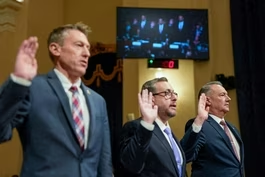
AMNA NAWAZ: Federal immigration officials today defended their officers before Congress amid public outcry after two fatal shootings in Minneapolis last month.
The heads of U.S.
Immigration and Customs Enforcement, U.S.
Customs and Border Protection, and U.S.
Citizenship and Immigration Services appeared before the House Homeland Security Committee.
Among the questions they faced, whether the tactics used by their agents during arrests and deportations run afoul of the Constitution.
Lisa Desjardins has our report.
LISA DESJARDINS: On Capitol Hill, those in charge of President Trump's immigration enforcement called to account.
REP.
ANDREW GARBARINO (R-NY): Do you solemnly swear that the testimony you will give... LISA DESJARDINS: Immediately facing bipartisan review for recent conduct.
REP.
ANDREW GARBARINO: This is all unacceptable and preventable.
REP.
BENNIE THOMPSON (D-MS): The Department of Homeland Security has the blood of American citizens on its hand.
LISA DESJARDINS: The House Homeland Security hearing was the first since the fatal shootings of U.S.
citizens Alex Pretti and Renee Good by federal immigration agents.
Both killings are under investigation.
REP.
BENNIE THOMPSON: I ask that the committee observe a moment of silence.
LISA DESJARDINS: The officials defended their personnel in general and pointed at those opposing them.
RODNEY SCOTT, Commissioner, U.S.
Customs and Border Protection: Our officers and agents are increasingly facing an unprecedented level of aggressive interference and intimidation when executing the laws that you have asked them to enforce.
TODD LYONS, Acting Director, U.S.
Immigration and Customs Enforcement: In fiscal year 2025, death threats against ICE personnel increased more than 8000 percent.
Assaults on officers have skyrocketed over 1400 percent.
One officer in Minnesota had his finger bitten off by a protester egged on by elected officials characterizing our officers as Gestapo or secret police.
LISA DESJARDINS: But Democrats insisted that's the effect, not the cause... WOMAN: Get your hands off of me.
LISA DESJARDINS: ... that immigration officials are making things unsafe.
REP.
DELIA RAMIREZ (D-IL): You have used your power to perpetrate great evil.
And it's about time you answered this committee for the lawlessness that you have empowered and defended in your testimony.
REP.
SETH MAGAZINER (D-RI): All right, I'd like you to view this video.
LISA DESJARDINS: Rhode Island's Seth Magaziner showed a video of a family being pepper-sprayed in their car.
MAN: You OK, Mama?
You OK?
REP.
SETH MAGAZINER: Is it proper procedure to aim pepper spray into the window of a moving vehicle?
RODNEY SCOTT: I'm not familiar -- I don't have all the details on this.
It's an ongoing investigation.
REP.
SETH MAGAZINER: I'm not asking about... RODNEY SCOTT: But to answer your specific question... REP.
SETH MAGAZINER: Is it proper procedure?
RODNEY SCOTT: ... you try to avoid that.
No, it's not.
LISA DESJARDINS: But many Republicans defended ICE and Border Patrol agents, with Oklahoma's Josh Brecheen showing photos of violent migrants detained.
REP.
JOSH BRECHEEN (R-OK): To all those who are second-guessing the reactionary moments to the law enforcement who have to respond in real time, go to the Department of Homeland Security Web site and Google your area and look at who's being picked up in your backyard.
That's how we recenter this conversation to truth.
I want your children protected.
LISA DESJARDINS: Ranking Democrat Bennie Thompson countered with the overall numbers.
REP.
BENNIE THOMPSON: Contrary to the administration's claim, only 14 percent of those arrested by ICE had violent criminal records.
LISA DESJARDINS: The heads of ICE and Border Patrol insisted their agents are fully trained, though ICE has sped up that training, but Democrats kept pushing.
REP.
JULIE JOHNSON (D-TX): I'm sure that there are many, many fine agents who are doing everything they can to exercise their duty lawfully.
But the problem is, there are agents who are not.
And the power that they have is gone to their head.
And they use that power unconstitutionally.
LISA DESJARDINS: Representative Dan Goldman of New York: REP.
DAN GOLDMAN (D-NY): I have a simple suggestion.
If you don't want to be called a fascist regime or secret police, then stop acting like one.
LISA DESJARDINS: To calls for action, Congressman Eric Swalwell asked for specific words.
REP.
ERIC SWALWELL (D-CA): Mr.
Lyons, will you apologize to the family of Renee Good for being called a domestic terrorist by the president and his leadership?
TODD LYONS: No, sir.
REP.
ERIC SWALWELL: Why not?
TODD LYONS: Sir, I welcome the opportunity to speak to the family in private.
LISA DESJARDINS: Later, Lyons expressed sympathy.
TODD LYONS: Sir, the loss of any life is unacceptable.
And the heart -- my heart, prayers and thoughts go out to anyone who -- tragically losing his life, especially a child, since I suffered personal loss in my life.
But I'm not going to comment on an ongoing investigation.
LISA DESJARDINS: Republicans said Democrats are to blame for inflamed rhetoric.
REP.
BRAD KNOTT (R-NC): We would not be having this hearing if the Democrats attacked illegal immigration with the same vigor that they're attacking law enforcement and the men at this table.
LISA DESJARDINS: But the hearing was about how lawmakers see the situation now.
REP.
SHRI THANEDAR (D-MI): Your agencies have lost the trust of the American people, with millions taking to the streets.
LISA DESJARDINS: From those leading the immigration crackdown, a consistent line, admitting no mistakes and asking for backup.
RODNEY SCOTT: I think the rhetoric and the back-and-forth, the politicizing of law enforcement in general detracts from the general morale of our personnel.
REP.
ANDREW GARBARINO: This committee stands adjourned.
LISA DESJARDINS: The hearing will echo into another debate over DHS funding, which runs out Friday night.
AMNA NAWAZ: And Lisa Desjardins joins me now.
Lisa, you were covering that hearing in the room.
You have been talking to lawmakers about these debates over ICE reforms and DHS funding as well.
Where do those stand?
LISA DESJARDINS: OK, there are two trains here that are connected.
So let's talk about those.
Let me give you some basic bottom lines.
First, the ICE reform train, that right now, there are real negotiations happening, largely between the White House and especially Senate Democrats.
However, bottom line, I can't see a deal coming together this week.
It's complicated.
Now, the train that's connected to that, of course, is DHS funding.
That's the second thing.
Where are we with that?
We are in limbo.
I cannot tell you right now if there will be funding for homeland security on Saturday.
That is right after the deadline ends.
Now, part of the thinking here is that Democrats, talking to them today, they told me in the Senate they actually seem to be digging in.
They seem more firm, more resolute on the idea that they need real reform.
They need codified changes in law.
So they say, to get to a short-term bill, which is what we need to keep DHS funded, they need a real negotiation.
They need more offers from Republicans.
Some of them, like Catherine Cortez Masto, say they want that serious offer from the White House.
SEN.
CATHERINE CORTEZ MASTO (D-NV): We are asking our colleagues in the White House to work with us.
It's common sense.
Work with us.
Unfortunately, we're not seeing that.
So I will say this.
I am not going to support a C.R.
LISA DESJARDINS: But as happens on this usual waterslide toward a government funding shutdown or breakdown, we are hearing from those in the majority, in this case Republicans, that they need to get together on a short-term funding deal now.
Here's John Thune.
SEN.
JOHN THUNE (R-SD): These federal employees at TSA and other agencies shouldn't be held hostage by the Democrats in potentially another government shutdown.
So the best way to avoid that is to strike a deal.
And I think that means we got to keep people at the table.
LISA DESJARDINS: A lot of people think that the key to unlock all of this is President Trump himself.
How much does he get involved?
Clearly, I can report, and this is from senior White House sources too, that they do want to get to a deal.
Can they do it and when, that's the question.
AMNA NAWAZ: Let me ask you about one piece of this I know you have been reporting on, and you have laid out what Democrats want to see here in the way of guardrails around DHS conduct.
What do you hear from Republicans about that?
LISA DESJARDINS: Right.
They want something too.
I think there's broad agreement among Republicans that they want some way to have local and state officials, especially in blue states, cooperate more with ICE.
How do you codify that?
It's not clear.
One person who has an idea about that is Senator Lindsey Graham of South Carolina.
He actually would like to make it a crime, a federal crime, for local officials who resist working with ICE who have what he calls sanctuary cities.
A mayor, for example, could be charged with a federal crime.
Now, there's no question that is a constitutional question about state versus federal power.
And I also don't think there's a chance that idea could pass in Congress any time soon.
It's just to say there's a conversation among Republicans about cooperating on the local level.
There are also Republicans who would like to see ICE reformed and want to see it in law.
One of those is Senator Rand Paul.
He chairs the House Homeland Security Committee.
I talked to him today.
He told me that he does see civil liberties at stake here and he wants changes in law.
AMNA NAWAZ: And it is Senator Paul who is going to be heading the next hearing with ICE and CBP officials.
That's on Thursday, I believe.
Did you talk to him about what he took away from today's hearing?
LISA DESJARDINS: I did.
This was important, because I told him really -- he hadn't seen it yet.
He's reviewing the tape now.
I said, they weren't admitting any mistakes.
And he said, if they do not admit errors in my hearing, they're in for a very tough time.
And more than that, Amna, he said it would be helpful if the Trump administration would admit publicly that ICE has made mistakes and that they want reform, because he says that's what they're doing behind the scenes, and that would help the negotiations overall.
AMNA NAWAZ: So, another hearing ahead on Thursday on these two trains, as you laid them out, on potential ICE reforms and DHS funding.
What are you watching for next?
LISA DESJARDINS: OK, first of all, let's talk about what a shutdown would mean, because that has to do with the incentive for everyone to come to a deal.
So here's what we know about a DHS shutdown.
First of all, as we have said before, ICE and CBP are funded because of funding passed last summer.
FEMA has reserves to last a little while.
Overall, though, 95 percent of this agency of Homeland Security would have to stay on the job, very few furloughs.
All of those folks would stay on the job without pay.
They are, most of them, being paid this week, so it would take a week-and-a-half before people would miss some pay.
But that's not out of the realm of possibility here, depending on what happens in the next couple of days.
I will also say this.
We have covered so many of these tough negotiations.
There are more ways out of this one than I have seen in a while.
So there is reason for hope that they can figure out a deal.
One of them is that a lot of lawmakers leave on Thursday for the Munich Security Conference, and next week is recess.
AMNA NAWAZ: And deadlines really do help to focus the minds sometimes.
Lisa Desjardins, great reporting, as always.
GEOFF BENNETT: The Trump administration has said its immigration crackdown targets the worst of the worst.
But many people without criminal records are getting swept up and detained, some of them along with their families.
Our Lisa Desjardins spoke earlier with one of them.
LISA DESJARDINS: In October, Jackie Merlos was released from an ICE processing center in Tacoma, Washington, after spending more than 100 days in federal custody.
Merlos came to the U.S.
illegally in 2003 from Honduras.
She later gained a temporary legal status while her full visa is pending.
She has no criminal history.
Jackie was detained along with her four children, all of whom are U.S.
citizens, at a park in Washington state near the Canadian border.
She and her kids spent 14 days in detention before her children were released to a family friend.
Jackie was able to reunite with her family after her time in custody.
Meantime, her husband, Carlos, has been deported to Honduras.
Joining me now is Jackie Merlos and her lawyer, Sarah Kahn.
Jackie, you were there in Peace Arch Park just back from visiting your sister, who lives in Canada.
What did the officers who approached you say and then what happened?
KENIA JACKELINE "JACKIE" MERLOS, Detained by CBP and ICE: They just approached us and took us to the detention center, saying that I was smuggling my family, something that is a false accusation and doesn't make any sense.
LISA DESJARDINS: You were in a windowless detention room with your four children, who are elementary school-age for two weeks.
How do you explain that to a child?
KENIA JACKELINE "JACKIE" MERLOS: They treat us not as human beings.
They treat us more than animals.
The detention center wasn't good for -- to have a family there.
My kids started having so much hunger of all the stress and trauma that they were going through.
And kneeling on our knees and reading the Bible was one of the things that helped us through those long 14 days that we spent in detention.
I told them, don't worry about it.
You know Mommy didn't do anything.
They kidnapped us for 14 days.
No one knew anything about us.
They didn't let us to use the phone to call daddy.
They didn't let me have access to my attorneys.
They blocked everything for us.
LISA DESJARDINS: You had a thriving construction business.
Can you help us understand, where are you now?
KENIA JACKELINE "JACKIE" MERLOS: I lost my business.
I lost all my clients.
And we live in fear.
My kids live in fear.
Those 14 days and four months that I spent in detention were really, really bad for them, because there's been so much trauma.
My little one pee in his pants, and they are not the happy kids that they were before our detention.
LISA DESJARDINS: Sarah, I want to ask you.
In your view, none of this was legal.
Can you help us?
Let's start with the kids.
What laws do you think could have allowed them to detain these kids for 14 days?
Are there any?
SARAH KAHN, Attorney For Kenia Jackeline "Jackie" Merlos: No, there are no laws that permit DHS to detain United States citizens.
And CBP and ICE now do detain children all the time, including United States citizens, when a parent is detained.
But, no, it is illegal to -- for DHS to detain a citizen.
LISA DESJARDINS: I want to ask you also then about Jackie's status.
She applied for a U visa, which we have talked about before on this program.
A U visa is given to someone who is a witness to a crime, might help in the prosecution of it.
She was held at gunpoint in a different incident.
Now, she doesn't have that visa yet.
Can you explain why you think that is a protected legal status?
SARAH KAHN: So for 30 years, Congress has written and strengthened legislation that protects survivors of crime.
Those protections include this pathway to a visa and then to citizenship.
Because there's a cap on the number of visas, people wait for a very long time.
And if, while they're waiting, the government looks at their application and decides that they're very likely to be approved, they grant them deferred action and work authorization.
Jackie had deferred action and she had permission to live here and to work lawfully when she was arrested.
There was absolutely no reason for her arrest.
LISA DESJARDINS: We asked, and the Department of Homeland Security did not respond to "News Hour"'s requests for comment.
But a U.S.
Customs and Border Protection spokesperson told Oregon Public Broadcasting that agents arrested you, Jackie, for attempting to smuggle illegal aliens into the U.S.
on June 28, and that the kids were present during the smuggling attempt and that you requested the children remain with you during detention.
How do you respond to that?
KENIA JACKELINE "JACKIE" MERLOS: They questioned my kids twice without me being present.
It's -- when I came to the cell, they were so afraid of them.
And they said to me: "Mom, they are saying that they are going to give us to DHS."
And I say: "There's no way that they are going to give you guys to DHS.
Mom is a good mom.
And if they try to do that, families should be together, not separate.
And they want to separate us."
LISA DESJARDINS: Jackie, you arrived in this country illegally.
What do you say to people who believe you shouldn't be here and you should be removed from this country?
KENIA JACKELINE "JACKIE" MERLOS: I ran away from my country because of the violence and because I was thinking one day to have a family, so we can live free, and not to be in fear.
And now we are living in fear.
My kids are living in fear.
It's, what we're going to do with all this generation that are living in fear, even knowing that they are citizen of United States?
They don't have rights anymore.
LISA DESJARDINS: As you mentioned, your kids are U.S.
citizens.
They're also just in elementary school.
You said that they live in fear right now.
Do you have a sense of how they view this country right now?
How do you view this country right now?
KENIA JACKELINE "JACKIE" MERLOS: I don't really make -- I don't really have words for that.
How are we going to deal with this generation, with all the kids that are supposed to be playing and enjoying their life?
Now any time when we go somewhere, they have to look through their shoulders any time, if the ICE is not coming, if no one is going to come to get us.
Every day right before they go to school, they say to me: "Mom, don't go anywhere."
I barely drive.
I don't have the life that I was having before that.
I was taking my kids to all the things that they were having, like music lessons.
I stopped taking them to music lessons.
I stopped taking them to a lot of activities just because I live in fear that they can detain me again.
Even knowing that I won my case and I spent four months of my life in detention, I still live in fear.
LISA DESJARDINS: Jackie Merlos and Sarah Kahn, thank you so much for talking with us.
KENIA JACKELINE "JACKIE" MERLOS: Thank you.
SARAH KAHN: Thank you.
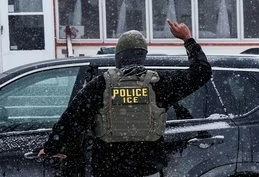
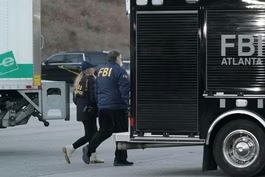
AMNA NAWAZ: The FBI raid last month on a Georgia elections office, seizing more than 700 boxes of ballots, was fueled by an investigation into so-called deficiencies in the 2020 election.
That is according to an unsealed FBI agent's affidavit filed by the DOJ in federal court.
White House correspondent Liz Landers has been following the updates from this case and joins me now.
So, Liz, what more are we learning from that latest legal filing about the raid and why the federal government seized those election documents?
LIZ LANDERS: This 22-page affidavit that was unsealed this afternoon gives us a glimpse into what the federal government's argument is here about why they conducted this raid a few weeks ago.
And they say that this is based on belief that there's probable cause that there is violation of the retention and preservation of election records in Fulton County and also deprivation of a fair election, so the way that they conducted the election there, apparently was not fair.
This is according to some of this document.
So the main FBI agent who wrote this affidavit has been at the agency for five years now.
And he goes through some of the issues, some of the deficiencies that the government is saying occurred.
He said that they did not have, the county did not have scanned images of all 528,000 ballots.
They are making the allegation that some of the ballots were scanned multiple times, that the hand count did not match the actual count.
I would add that a hand count almost always is inaccurate because of human error, and that total votes were 17,000 votes fewer than the original count.
Many of these claims have already been out in the public before.
Some of these have been addressed by Fulton County and by the secretary of state's office.
But this is the compilation in the affidavit, which was signed off by a magistrate judge there.
And one other detail in here, the FBI says that this investigation originated with a referral that was sent by Kurt Olsen, who is a Trump-appointed director of election security and integrity now.
AMNA NAWAZ: So they're alleging Fulton County did something wrong here.
What's Fulton County saying about all this?
LIZ LANDERS: Well, Fulton County, the Board of Commissioners, has already sued the federal government at the end of last week to get these ballots back.
They say that this was an improper raid and search.
I spoke earlier today with the Fulton County Board of Commissioners chairman, Robb Pitts.
We talked to him right as these documents were coming out.
And he said that they, the Fulton County Board of Elections, complied with everything that the FBI was asking for.
They turned over those 700 boxes worth of elections material, tabulator votes, the absentee ballots, all of the ballots, and the voter rolls.
Everything, they said that they complied with and turned over to the FBI.
But he says that this is not just about Georgia.
He says that this is a broader affront to voting and to elections in this country.
Listen.
ROBB PITTS, Chairman, Fulton County, Georgia, Board of Commissioners: I think it's much, much bigger than Fulton County.
The president has also mentioned 15 states that he has some concerns about.
Georgia, I think, is probably at the top of that list for the reasons that I have stated, but the others need to be aware as well.
And that's why I think, if they're successful in doing whatever they plan to do here in Fulton County, Georgia, and in the state of Georgia, they're simply going to go to other states and do exactly the same thing.
LIZ LANDERS: Pitts also said, Amna, that now that that material, all the elections material that was seized, has left their own premise, their own building, that he doesn't know where that is now.
And he said that he can't verify some of the personal identifying information that's in some of those documents, like in the voter rolls.
And just one more thing, Amna, that I want to underscore for our viewers is that this all happened at the direction, Tulsi Gabbard says, of the president.
She was down there at that election office in Fulton County.
Highly, highly unusual to see the director of national intelligence at an FBI operation like this.
AMNA NAWAZ: I want to circle back to a name you mentioned, Kurt Olsen.
As you mentioned, he's a special government employee President Trump has now empowered to investigate the 2020 elections.
Tell us more about Mr.
Olsen and what we should know about his role.
LIZ LANDERS: If you have been following some of the January 6, this special committee that happened up on Capitol Hill a few years ago, and you have been following some of this election denier movement, you have maybe heard of Kurt Olsen before.
He's an attorney.
He has been involved in litigation fighting what he said was Joe Biden's false win.
So he has long denied the election results of 2020.
He also represented Kari Lake when she was running for governor and then she did not accept the election results in Arizona.
And at the time, Olsen was sanctioned by an Arizona court for false statements that he made related to that case.
He now is overseeing these investigations.
The CIA confirmed to me today that the president has asked Mr.
Olsen to look at intelligence related to the 2020 election, and the agency, the CIA, is ensuring that he has the access necessary to do his work.
Politico is reporting that he has access to sensitive intelligence.
When I asked the White House about this earlier today about his work, what kind of sensitive intelligence he has access to, they said: "The president has the authority to provide access to classified material to individuals as he deems necessary.
The entire Trump administration is working together to ensure the integrity of U.S.
elections," Amna.
AMNA NAWAZ: White House correspondent Liz Landers, we know you're going to continue to cover this story.
Thank you.
LIZ LANDERS: Of course.
GEOFF BENNETT: The drumbeat of war between the U.S.
and Iran seems to have quieted for now after indirect talks in Oman last weekend between the two sides, but the threat remains.
Tomorrow, Israeli Prime Minister Benjamin Netanyahu will visit the White House.
The U.S.
joined Israel's attacks on Iran last June.
Now, for a rare view from Iran and its perspective, special correspondent Reza Sayah sat down this morning in Tehran with Esmaeil Baghaei, a member of Iran's negotiating team and the spokesperson for Iran's Foreign Ministry.
REZA SAYAH: Mr.
Baghaei, first of all, thank you for your time.
Up until a week ago, there was reports that war was imminent, Mr.
Donald Trump, the U.S.
president, hyping his forces, saying war is on the table.
How much do you worry?
ESMAEIL BAGHAEI, Iranian Foreign Ministry Spokesman: For one thing, I think no human person of common sense welcomes war.
No one wants war.
And for the past five decades, for the past 47 years, we have been facing these threats, which are, of course, unlawful, unwarranted, unjustified.
REZA SAYAH: Do you worry?
Do you think it's becoming more of a possibility?
ESMAEIL BAGHAEI: You see, we have always lived with these looming threats.
So, while we should be concerned about the consequences, but I think we have been courageous, our people have been courageous, because they know this is not just.
This is a threat that wants to impose their will on our people.
So we have to deal with that.
REZA SAYAH: The indirect talks in Oman, I want you to take me there because you were there.
One location, you have the American team.
In another location, you have the Iranian team.
Did you ever cross paths with the Americans?
Did you see them?
ESMAEIL BAGHAEI: So we started with a short briefing with Minister Busaidi, and then they had their own interaction.
I mean Americans and Omanis.
And in between, there was a short shake-hand between Iran foreign minister and American envoy.
REZA SAYAH: So, they met?
They shook hands?
ESMAEIL BAGHAEI: Yes.
Yes, they met.
They... REZA SAYAH: Did you shake their hands?
ESMAEIL BAGHAEI: I was not there.
REZA SAYAH: You were not there.
ESMAEIL BAGHAEI: Because it was between Minister Araghchi and American envoy Steve Witkoff.
REZA SAYAH: So was it pleasant?
Did they smile?
Did they exchange greetings?
ESMAEIL BAGHAEI: Iranian diplomats are polite.
REZA SAYAH: A lot of people are still not clear of what was achieved in that first session and what can be achieved, because Washington's demands are your red lines.
If no one's budging from their position, where is their room to negotiate?
ESMAEIL BAGHAEI: I think, at the end of the day, if the intention is to have a result-oriented negotiations, there should be a compromise.
This was the first step.
And the fact that we managed to get together after eight months, I think, by itself, was important.
The distrust between the United States and Iran is very deep, and it is not because of Iran's behavior.
Just seven or eight months back, we had to face with this unlawful attack against our nuclear facilities by the United States.
So I think it was very courageous for Iranians to decide to go for these negotiations, knowing that the previous rounds resulted in an American attack against Iran.
REZA SAYAH: Is there anywhere the Islamic Republic can show flexibility when it comes to enriching uranium, sending out their stockpile, limiting their missile system, cutting off ties with the proxies?
Is there any place where you can show some flexibility?
ESMAEIL BAGHAEI: The negotiations are going to be focused on nuclear issue.
REZA SAYAH: So let's take the nuclear issue.
Would you consider, consider enriching uranium at a lower level, sending out some of your stockpile, maybe pausing the uranium enrichment for a couple of years?
ESMAEIL BAGHAEI: What we want is based on an established rule of international law.
We are a member of nonproliferation treaty.
We are for nuclear energy for peaceful purposes.
We have said many times that it is part of our established doctrine that nuclear weapon has no place in our defense doctrine.
The hype has been produced by Israel that, for the past four decades, they are claiming that Iran is at the verge of producing nuclear weapons.
That's a big lie.
So, as far as nuclear issue is concerned, enrichment being part of that, we have shown flexibility.
We have said that we would be ready to talk about the level of enrichment.
REZA SAYAH: So you are willing to consider talking about the level at this point?
ESMAEIL BAGHAEI: Of course.
We have said many times that we would be ready to talk about the level of enrichment, about the stockpile.
But the important thing is that our right, which is recognized under an international treaty, should be respected.
REZA SAYAH: Tensions between Washington and Tehran escalated, and it coincided with the recent protests and the crackdown.
It's Iran's position that there were foreign elements in these protests, some of them were armed.
Video also shows that security forces were firing at protesters.
How seriously do you take this matter and how seriously is the Islamic Republic working to hold anyone accountable that killed innocent people?
ESMAEIL BAGHAEI: Every single life matters.
They are Iranians.
And we regard that as a very, very unfortunate situation.
Peaceful assemblies, peaceful protests is something that we respect.
But what happened after 10 or 12 days, from 8 to 10 January, was completely different.
The gunmen mushroomed in many cities across the country.
They were armed.
They used handguns.
And they started killing our security forces.
It is not a matter of secrecy.
Israeli officials, they have said that Israeli Mossad-affiliated agents are in these streets.
They are with the protesters.
You see, they have been claiming 100,000 protesters being killed.
They are all lies.
And... REZA SAYAH: What can you do to verify the death toll?
ESMAEIL BAGHAEI: They have done it.
The president's office issued a statement with the names and national code number of all those who have been killed.
REZA SAYAH: What is the Islamic Republic doing to investigate their own security forces, to hold their own security forces accountable and be transparent with that investigation?
ESMAEIL BAGHAEI: We have mechanisms, we have established mechanisms.
Security forces, those who were involved in any unlawful shooting, we hold trials for them.
REZA SAYAH: What makes you hopeful that Iran will overcome this very difficult time and the negotiations will be successful?
What keeps you hopeful?
ESMAEIL BAGHAEI: Many things.
REZA SAYAH: Like what?
ESMAEIL BAGHAEI: We are coming from a very rich civilization, and we have experienced many problems across centuries.
We have no other choice, other than overcoming this crisis as well.
GEOFF BENNETT: And that was Reza Sayah reporting from Tehran.
AMNA NAWAZ: After more than four decades on the world's top opera stages, acclaimed mezzo-soprano Denyce Graves took her final bow recently and is now devoting herself to teaching the next generation.
Senior arts correspondent Jeffrey Brown joined Graves in the days leading up to her farewell for our arts and culture series, Canvas.
JEFFREY BROWN: In opera, Denyce Graves says there's enormous focus on how to make it, but not so much on how or when to leave it.
DENYCE GRAVES, Opera Singer: With all of the preparation and with all of our attention sort of centered around, what does it take to actually get into the world's greatest opera house, what does that require?
And then, when you're there, when is it time, after you have done that -- if you're lucky, when is it time to sort of bow out gracefully?
JEFFREY BROWN: There's not a lot of guidance for that.
DENYCE GRAVES: Nope, not at all.
JEFFREY BROWN: Now she's done just that with a final series of performances in George Gershwin's classic "Porgy and Bess," reprising a role in a production first presented in 2019 at The Metropolitan Opera, one of the grandest stages of all.
(SINGING) JEFFREY BROWN: It was a supporting, not starring role.
And that, she told us with a laugh in The Met's renowned hall just days before her final time on stage, came with implications behind the scenes.
DENYCE GRAVES: When I started here, I had the first dressing room, right?
And now it's the last one.
It's the last one.
There's nothing else after it.
(LAUGHTER) JEFFREY BROWN: That's a sign.
DENYCE GRAVES: The next thing is out of the door.
There's no other dressing room after that one.
Like, it's the end of the line.
JEFFREY BROWN: So it's time.
DENYCE GRAVES: It's time.
It's time.
JEFFREY BROWN: And, at 61, she's doing it on her terms, publicly announced in a recent New York Times essay.
And it's not about dressing rooms, of course, as much as the extraordinary physical and emotional demands of her profession.
DENYCE GRAVES: This is very unnatural what it is that we do and the amount of discipline, the amount of training, the amount of sacrifice that it takes.
It's one that asks for your entire being.
Everything that you do affects what happens, because you are the instrument.
JEFFREY BROWN: Perhaps her best known role was the fiery, sensual Carmen in Georges Bizet's opera.
But she told us of being a shy and awkward child growing up in what she calls humble surroundings in Washington, D.C.
among her guardian angels, Judith Grove Allen, a music teacher she first met in grade school, who taught and then encouraged her to attend Washington's Duke Ellington School of the Arts.
The two remain in regular contact to this day.
Among her role models, legendary soprano Leontyne Price, whom Graves first encountered in high school listening to recordings.
DENYCE GRAVES: And I discovered this art form and I said, what is this?
I'd never heard anything like that before.
I saw this woman who looked like me, and I said, what is this?
And I said that's what I want to do.
I want to do whatever it is that she's doing.
JEFFREY BROWN: So then, to make it, it must require drive, ambition.
DENYCE GRAVES: Oh, you better believe it.
JEFFREY BROWN: And do those come with doubts and anxieties and fears all along the way?
DENYCE GRAVES: Sure.
A fire has to be ignited inside of you somewhere and you have to believe that you have something unusual to offer.
JEFFREY BROWN: In the New York Times piece you wrote announcing the retirement, you said that, as a Black woman, you write of the difficulties "of pursuing life in a culture that often seemed foreign to me or that saw me as foreign to it."
DENYCE GRAVES: Absolutely.
I remember looking once at a production photo of myself on the stage with my colleagues and how different I was from everyone else, and some directors who would say to me: "There's no way you're going to be believable in this character."
JEFFREY BROWN: As a white European character?
DENYCE GRAVES: I mean, I had -- I can say these things now, I guess, maybe, maybe.
But I had the director at the Vienna Staatsoper, one of the world's greatest opera houses, said to me: "There's no way that I would hire you for like 99 percent of the roles here, because you just would not be believable."
And we were talking about Mozart's "Cosi fan tutte," in which I would sing the role of Dorabella.
He said: "Nobody would believe you as a sister."
And I said: "Well, I could be adopted or she could be adopted."
JEFFREY BROWN: Graves says the world of opera has changed a lot in terms of the stories being told and greater representation on stage.
And that's been part of her work with her foundation, to which she will now devote much of her time, and focus on training and mentoring a new generation of singers, including at historic Black colleges and universities.
Another focus, helping to preserve history as an advocate for the restoration of the former National Negro Opera House in Pittsburgh once home to an organization started by singer Mary Cardwell Dawson, who, feeling shut out of most opera companies, decided to start her own.
DENYCE GRAVES: I was so moved by her and her story and by the fact that I didn't learn about her.
She's a great, great hidden figure who really changed in the shape of the landscape of this profession.
WOMAN: In the very best sense of the word, you are one of our divas.
DENYCE GRAVES: Oh!
WOMAN: Yes.
JEFFREY BROWN: Graves is leaving behind legions of colleagues, including in The Met's costume and wig shop, but looks forward to continuing to coach singers and a new pursuit, direct operas.
But, on January 24, it was time for a final performance as a singer and on-stage celebration.
DENYCE GRAVES: I'm incredibly grateful and feel incredibly fulfilled.
I did many of the roles that I wanted to do.
And when I look around me on the stage, I see another generation.
JEFFREY BROWN: Days before, though, she had told us of one demand following years of self-discipline to protect her voice and body.
DENYCE GRAVES: After I finish that performance, somebody better hand me a dirty martini.
That's what I'm looking forward to.
(LAUGHTER) JEFFREY BROWN: That will really be the end.
DENYCE GRAVES: That will really be the end.
You're right.
(SINGING) JEFFREY BROWN: For the "PBS News Hour," I'm Jeffrey Brown at the Metropolitan Opera in New York.
AMNA NAWAZ: And that is the "News Hour" for tonight.
I'm Amna Nawaz.
GEOFF BENNETT: And I'm Geoff Bennett.
For all of us here at the "News Hour," thanks for spending part of your evening with us.
Documents show what led to FBI raid of elections office
Video has Closed Captions
FBI documents show what led to raid of Georgia elections office (5m 36s)
Epstein files scrubbed to protect powerful men, Khanna says
Video has Closed Captions
Epstein files scrubbed to protect 'elite, powerful men,' Rep. Khanna says (6m 56s)
Immigration officials defend tactics amid public backlash
Video has Closed Captions
Immigration officials defend officers and tactics as public backlash grows (10m 19s)

Iran spokesman on tensions with U.S.: 'No one wants war'
Video has Closed Captions
'No one wants war': Iran spokesman discusses diplomatic path with U.S. after Oman talks (8m 44s)

Opera singer Denyce Graves takes her final bow on stage
Video has Closed Captions
Opera singer Denyce Graves takes her final bow on stage (7m 19s)
Providing Support for PBS.org
Learn Moreabout PBS online sponsorship
- News and Public Affairs

FRONTLINE is investigative journalism that questions, explains and changes our world.

- News and Public Affairs

Amanpour and Company features conversations with leaders and decision makers.












Support for PBS provided by:
Major corporate funding for the PBS News Hour is provided by BDO, BNSF, Consumer Cellular, American Cruise Lines, and Raymond James. Funding for the PBS NewsHour Weekend is provided by...