
Georgia State Railroad Museum, Hour 2
Season 30 Episode 5 | 54m 5sVideo has Closed Captions
All aboard as ROADSHOW travels to Savannah, GA in search of America’s hidden treasures.
All aboard! ROADSHOW travels to Savannah to discover hidden treasures including a 19th C. Jim Williams-owned Federal hunt board, a Jesse Arms Botke oil, ca. 1940 and a 1978 Tom Petty & the Heartbreakers-signed poster. Which is the top find?
Problems playing video? | Closed Captioning Feedback
Problems playing video? | Closed Captioning Feedback
Funding for ANTIQUES ROADSHOW is provided by Ancestry and American Cruise Lines. Additional funding is provided by public television viewers.
Support provided by:


Georgia State Railroad Museum, Hour 2
Season 30 Episode 5 | 54m 5sVideo has Closed Captions
All aboard! ROADSHOW travels to Savannah to discover hidden treasures including a 19th C. Jim Williams-owned Federal hunt board, a Jesse Arms Botke oil, ca. 1940 and a 1978 Tom Petty & the Heartbreakers-signed poster. Which is the top find?
Problems playing video? | Closed Captioning Feedback
How to Watch Antiques Roadshow
Antiques Roadshow is available to stream on pbs.org and the free PBS App, available on iPhone, Apple TV, Android TV, Android smartphones, Amazon Fire TV, Amazon Fire Tablet, Roku, Samsung Smart TV, and Vizio.
Buy Now

ANTIQUES ROADSHOW's 2026 Production Tour
Enter now for a chance to win a pair of free tickets to one of the three stops on ANTIQUES ROADSHOW's 2026 Tour. Sweepstakes entry deadline is April 6.Providing Support for PBS.org
Learn Moreabout PBS online sponsorship♪ ♪ CORAL PEÑA: "Antiques Roadshow" is seeing thousands of treasures at the Georgia State Railroad Museum in Savannah.
APPRAISER: It's just gorgeous-- when you took it out, my eyes went boom!
(laughs) (chuckling): Wow!
Wow!
(chuckles) (gasps, laughing): Wow!
That's great!
(appraiser chuckles) ♪ ♪ PEÑA: The Georgia State Railroad Museum, now a National Historic Landmark, started as a repair shop for steam trains in the 1850s.
The spot was mostly spared from General Sherman's Union troops in 1864 as they march across Georgia during the Civil War, destroying infrastructure and resources.
Only to be closed in 1963 after the dominance of diesel overtook steam locomotives in the mid-1900s.
(train bell ringing) The site was saved for preservation and has tens of thousands of visitors annually.
What treasures have been saved and brought to "Roadshow" today?
APPRAISER: And at some point, maybe 50 years ago, or 100 years ago, they got mixed and put the wrong cup with the wrong saucer.
GUEST: This right here is what I suspect to be a 200-year-old pair of Spectacles.
It's all handmade.
Would you try 'em on for us?
(laughs) Well, why not?
Oh, you look fabulous.
(chuckling): Yeah.
GUEST: In 1948, my husband and I went to this little antique shop in Atlanta.
We, uh, found Ralph.
Y-- now, you call him Ralph?
(chuckles) You've not-- why you call him Ra-Ralph?
Well, it looks a lot like a friend of ours.
Does Ralph know that you call him Ralph?
No.
(laughs) No?
Ralph do-- that's good.
That's a good thing.
We never told him.
(chuckles) Okay, well, what have you found out about it, and what would you like to know?
Well, in the front it says K-I-S-E-R Bill.
And I thought it said "kiss her, Bill."
And then somebody else looked at it and said, "No.
I think that's Kaiser Bill."
Yep, Kaiser Bill misspelled here as K-I-S-E-R Bill would have referred to Wilhelm II, the last German emperor, during and just after World War I. America actually entered World War I in 1917, and so Kaiser Bill would not have been very popular with Americans.
We can narrow down the date of the manufacture of this jug to 1917 to 1918.
We know from the handwriting, from the way that that inscription was done, we know whose handwriting it was.
I believe that it was made in Atlanta by a guy named Davis Pennington Brown.
Uh-huh.
And Davis Pennington Brown is from a family of famous potters that all went to Arden, North Carolina.
But during 1915, 1920, Davis Pennington Brown, the most famous of the Brown brothers, the potters in Georgia... Uh-huh.
...was doing jugs like this; this is actually white clay.
It's covered with this coat of Albany slip, which is this brown clay that they wash all over it.
And then salt is shoveled into the kiln and it vitrifies and coats everything and gives it that orange peel kind of look to the surface.
A lot of things about this jug confirm it as Davis Pennington Brown, and among them, the C-shape of the ears, the fact that the teeth are made of clay instead of porcelain, like he used in Arden, North Carolina later on, and that the handwriting is really in his own hand.
Mm-hmm.
So all those things support an attribution to Davis Pennington Brown.
It's just a classic example.
It's a larger size than most of 'em.
Also, the condition is amazing.
How much did you pay for it?
$25.
Paid $25.
I feel that in a, in a retail setting, this could easily be priced at $6,000.
Uh-huh, well that's... Yeah.
That, I guess, that was better than interest on $25.
(chuckling) I'd-I'd, I'd say yeah, uh, that's pretty.
I-I'm not sure what $25 was worth back in 1948, but that's not bad.
(chuckling): Yeah.
GUEST: It's my grandfather's violin.
He used to play the violin when he would come for Christmas.
We'd have a Christmas concert for all of our relatives.
(chuckling): He never knew how to play the violin very well, but we would play together.
He was a soldier in World War II.
It's my belief he brought it home-- I think it's German.
I tried to get it appraised 15 years ago.
There was an online site where you could take pictures of it.
I think I remember the appraisal being around $500.
APPRAISER: I'm seeing a maker who was inspired by Stradivari.
We see a lot of those, but this one, really, he tried to emulate the accuracy of Antonio Stradivari.
Things like the overall shape, the back being a one-piece back with this very distinct flame in the maple, the ribs also having the flame.
So the label says K.A.
Gütter, Markneukirchen, 1921.
Kurt Arno Gütter.
He grew up in Markneukirchen, one of the big centers of violin making in Germany.
Wow.
And he studied with all the greats of that period.
The value as is, taking into account that there is a crack here that needs to be repaired, and one here, would be about $8,000.
(chuckling): Wow!
Yes!
And then if you got that repaired... Sure.
...it would be worth more, perhaps as much as $10,000 to $12,000.
Amazing.
It is, isn't it?
Yes.
That's more than $500.
Oh, yeah!
Absolutely amazing.
Well, thank you.
Thank you so much.
Thank you very much.
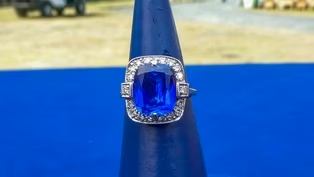
GUEST: This is my mother's ring.
She got it from my father, probably in the late '60s or early '70s.
Our neighbor was a jeweler in a small town in New Jersey.
My father just walked downtown one day and came back with this for my mother.
It wasn't her birthday.
It wasn't a holiday and it's always been a puzzle.
So why do you think he bought it for her?
(chuckling): I think he felt guilty about something in his past.
(laughing) (laughing): Oh.
I think he was making amends.
(chuckles) What would you like to know about the ring?
Well, I don't know-- is it real?
(chuckling): Because it's a large stone.
It is real.
It is a real sapphire.
Good to know.
And it's a really beautifully cut, old cushion cut stone.
It's mounted in platinum and it's framed by old single cut diamonds.
I think the ring was made probably in the 1940s.
Wow!
And it's very pretty.
There are no hallmarks that would tell us who made it or where it's from.
However, based on the style, I would suspect that it was probably made by a high-end jewelry maker in New York City.
In order to determine where it was mined, we would have to send it out to a laboratory.
But that cut and color, it's very typical of sapphires that we see that have been mined out of Ceylon or modern-day Sri Lanka.
Oh.
I would be comfortable saying that it's a Ceylon or Sri Lankan sapphire.
It's very clean.
When you look at it under magnification, you really don't see any inclusions.
And I did a weight by formula, and it's coming out to be about 7-and-a-half carats.
Wow, that's exciting.
So it's a nice size.
Now, what was your mother like?
Did she wear it?
She did when she went out to dinner.
Mm-hmm.
She was never a showy woman.
My father was not extravagant with gifts, so this is really a big surprise.
Any idea what he might have paid for it?
No idea.
But this was a good friend and a neighbor.
Mm-hmm.
And maybe he called my father and said, "Ed, get down here.
I've got the ring for you to give your wife."
(chuckles) Long-suffering wife.
He was a straight up guy.
I think he just knew that he was sometimes difficult.
As you might know, with sapphires, they are very often heat-treated in order to enhance that color.
So you would have to send it to a laboratory in order to determine that, which for a couple of $100 I would recommend doing because then you would know for sure.
If it's heat-treated, you'd be in the $5,000 to $10,000 range.
Okay.
If it is not heat-treated, we'd be in the $15,000 to $20,000 range at auction.
That is excellent.
♪ ♪ PEÑA: In the first half of the 20th century, one of the fastest trains in the South was operated by the Central of Georgia Railway.
TERRY KOLLER: The Nancy Hanks route was a route for passengers between Savannah and Atlanta with a stop in Macon.
We have one car in our collection from the Nancy Hanks.
It's the blue and gray car behind me; Nancy Hanks the train was named for an undefeated racehorse.
That racehorse was named for the mother of President Abraham Lincoln, Nancy Hanks Lincoln.
The earlier Nancy Hanks ran in 1892 and 1893.
Nancy Hanks II operated between 1947 and 1971.
♪ ♪ GUEST: This clock has been in my house since I was very little.
My mother was at her friend Connie's house and noticed it on her shelf and just told her that she liked it, and Connie told her to take it home, that she could have it.
And it's-- she put it on the shelf at home and it was there for the next 50 years.
Wow.
That-that's a very nice present.
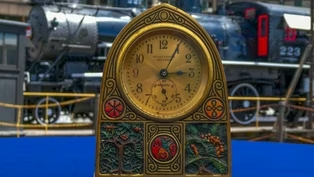
What you have is a Tiffany Studios clock.
It's in the bookmark pattern.
It has, uh, printer's marks from the 15th and 16th century, and they're on the top here.
And there are a couple of things that are unusual about it.
First of all, it's been coal-painted.
And sometimes the clock would come just with the gold finish.
And once in a while it would come this way with this beautiful painting and it really makes the piece pop.
The other thing that I love about this, it has its original key that is nestled inside the door.
And this also has the printers' marks on it.
And that's fantastic.
I looked it up.
I wanted to see what this cost initially, which was probably, in the teens, it cost $70.
Okay.
That was a tremendous amount of money for a clock.
It was part of a whole desk set and you could buy up to 21 pieces.
But to me, the clock was the crème de la crème.
It's just gorgeous.
It's really-- when you took it out, my eyes went boom!
(chuckles) I was very excited.
Uh, in a retail shop today, this would cost between $6,000 and $8,000.
(gasps) Oh my God, that's much more than I thought it would be.
That's huge.
(quietly): Wow.
It's a great present.
(chuckling): Amazing.
GUEST: I brought my Willem de Kooning sketch that was personalized and given to my father in 1966.
How did your father know de Kooning?
I'm not exactly sure.
My father passed in 1995.
Willem de Kooning was in Hampton Bays, New York on Long Island... Mm-hmm.
...and my father was on Long Island as well.
My father was an artist and he met many artists, and he must have been very friendly with him because he called him Jimmy.
My father's name was James.
Only friends called him Jimmy.
Willem de Kooning is one of the most important American artists of the 20th century.
The style that he's most known for and the artistic movement that he's most known for is abstract expressionism.
It really is what it sounds like.
There's abstraction, kind of a move away from realism and how they should look and more into the expression of it, the movement of something, the thoughts of something, the subconscious ideas of it.
In 1963, de Kooning moved to the Hamptons, to Springs, New York, and what was interesting about that is that there were a lot of other artists living very close by, including Pollock and his wife Krasner.
So it was a kind of place where artists would congregate.
At that point especially, he was always drawing in a way that was free flowing.
It's an exemplary work by him because it, it does show his love for form, but in the style of abstraction.
This is graphite on paper.
It is signed and dated lower right, which is in 1966.
And it says "To Jimmy, and good luck to you, Bill de Kooning."
It's later in his career.
He really became famous for his abstract expressionist works in the '50s and '60s.
What do you think it might be worth?
I would love for it to be in the thousands, but I'm gonna say $200 to $300.
Real de Kooning drawings are exceedingly rare.
A lot of the major, uh, foundations for some of these bigger abstract expressionist artists and a lot of artists in general now do not authenticate works.
What you often have is a situation where it's hard to prove something is authentic.
What can overcome that is provenance, and that's what you have.
And that's what's great, that this was given to your father directly by the artist.
I would put a conservative auction estimate of $8,000 to $12,000 on it.
Wow.
Thank you, Dad.
(chuckles) It was his birthday yesterday, he would have been 80 years old.
I got this as a Christmas present when I was about six years old.
I have the outfits-- some are complete, some are not.
Some of the shoes got lost, or my dad stepped on them and he threw 'em out.
But this is what I've got.
GUEST: This is one of a pair-- that's Martha.
We think they were painted, uh, back in 1845.
Got 'em from, uh, my parents.
They bought 'em in Boston.
I do have the other one, but it was a little cumbersome to bring it today, so we just brought Martha today.
PRODUCER: Is she the prettier one of the two?
Not really.
(laughs) No, she's not at all.
(chuckling): He-- Francis was actually a little more attractive.
I was a chart manager at "Cashbox" magazine, one of the music trade magazines, from 1977 to 1984.
And one of the perks of the job is, uh, often times the record companies would bring stuff like this for me to see and enjoy.
It's a pretty good position to be in.
People want to be your friend when you're the one coming up with the charts.
Yup.
Exactly.
So you brought in today, obviously, this, um, record store window promo poster for Tom Petty and the Heartbreakers' second album.
Correct.
"You're Gonna Get It!"
1978.
And it's not just that poster, it's, uh, signed, which is really great.
And they're huge signatures.
It's not just signed by Tom Petty, we have Stan Lynch, Mike Campbell, Ron Blair and Benmont Tench.
So we have, like, the full five founding members here.
Yup.
That's it.
And Tom's signature is really big in the middle and he's dated it, so this is about a month after the record came out in June of '78.
Correct.
And I love that he signed it "To Cashbox," Right.
One quick question; how did you guys determine what the charts were?
Did they send you sales information or...?
It was kind of fly by the seat of your pants back in those days-- this is pre, uh, computer era, pretty much, when I was there.
So lots of telephone calls to record stores and radio stations and we kind of mashed it all together and came up with the charts every week.
What's so great about this poster, in addition to the fact that it's big, it's a little rare because it's not paper and it was made to put on a window.
Mm-hmm.
Obviously, this is why it's transparent.
(chuckles) Translucent, mm-hmm.
And so you, you have the adhesive strips up here, which you'd stick on.
Right.
And you can put them up to the glass.
Right.
And most of the ones that were made probably were used in the stores and didn't survive so well.
Because if you had this in the sun for a few months, I'm sure they faded out.
They tore, people took them.
Right.
Um, yours is in pretty great condition, but even more so than that, obviously, yours is signed.
Do you remember this one cruising up the charts?
Oh, yeah.
For sure, made it to, uh, number... ...23 or thereabouts.
At auction, I would expect it to fetch somewhere in the $3,000 to $5,000 range.
Phew, wow.
More than I thought.
That's great.
Now that you've had your appraisal, I got to tell you not to come around here no more.
(chuckles) Well, damn the torpedoes.
(laughs) We could go all day, 'cause I'm an American girl, so.
Yeah, yeah.
There you go.
(laughter) GUEST: After I graduated from college 1985, I was in a small antique gallery in Pass Christian, Mississippi and I saw four of these paintings that each were $20.
But I only had $20 in cash on me, so I only could buy one of 'em and this is the one I bought.
And what about the other two?
Right.
The, the tray and the cards?
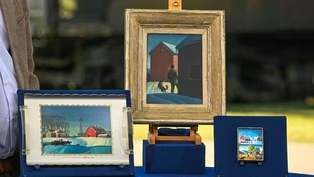
Years later, my wife and I were just looking online to see if there was anything else by Dale Nichols and we came across these items.
It makes for a nice group.
These are both illustrated works on products, that this being an offset lithograph on a tray and we have that deck of cards with scenes by Nichols.
Both the box of cards and the tray mass produced and would be circa 1940s or '50s.
Okay.
Dale Nichols is born in 1904 in David City, Nebraska.
Ah.
And made his way to Chicago for his studies and in the 1930s and '40s emerged as one of the prominent American regionalists.
Nichols was an illustrator and a fine artist, but along his career path he was always doing commercial work.
He's best known for this kind of subjects.
Now, while this is a small painting, it has all of the bells and whistles that a collector of Nichols' work would want.
It's a winter scene.
We have a little figure, looks like he's sort of turning the corner at a house or a barn, and it's clearly a rural subject.
He's got his dog there-- it's a little gem.
It's an oil on Masonite board, which was a more inexpensive medium.
A lot of illustrators used Masonite.
It is signed, although he had a really distinct teensy, tiny way... Mm.
...of signing his works, and it's dated 1949.
It has one little issue.
It has some flaking, but all in all it's in a nice state of preservation.
So to value-- the tray and the decks of cards together would be worth about $20 today.
Okay.
The painting itself, an auction value would be in the $6,000 to $8,000 range.
Whoa.
(chuckling): Not bad for 20 bucks, I guess.
Not at all.
Yeah.
Really cool, thank you for bringing it in.
Yeah.
Thank you.
Did you read all of these and flip through them?
I had, but years and years ago.
So, right.
GUEST: These have been used.
So part of the value characteristics of these we really look at, have they been graded?
First of all, collectors want comic books that are graded.
Once they're not graded, then we downgrade whatever the value is.
Mm-hmm.
Then you look at the condition and you can see that you have all this discoloration.
You're probably looking in that $20 to $100 for some of these; some of them better than others.
Memories are worth something, so we keep them.
APPRAISER: This is a Babe D. Zaharias signed tennis ball.
How did you get this?
GUEST: This is something my dad gave me in 1949 when he was 16 years old.
He went to, uh, Madison Square Garden and Babe was there with some sports thing and she was chipping these balls out into the audience with her golf clubs.
My dad just reached his hand up and he grabbed a ball.
That's how I ended up with... So was it signed?
She had them signed and then was just sending 'em out into the audience.
So what have you learned about Babe?
Um, well, I know that she got the name Babe from Babe Ruth, because her real name was Mildred.
That's, that's right.
So I'd go with Babe, too.
(both laugh) In 1932, she went to the Olympics.
She won two gold medals, one for javelin, one for hurdles, and then she got a silver medal as well.
And she did, she did golf, she did tennis.
She was a seamstress that sewed her own tennis uniform sometimes.
Babe Didrikson Zaharias is the greatest all-around female athlete in history.
She got her start playing AAU basketball.
She was a ringer for her office team.
She played baseball.
And then, of course, she ran track and field... Right.
...went to the Olympics, won the two gold medals, won a silver medal and set four world records in 1932.
Wow.
And then just for the heck of it, a few years later in '35, when she was 24, she decided she was gonna take up golf.
Yeah, amazing.
And what happens?
She becomes the leading female golfer in the world.
Mm-hmm.
She wins ten major women's tournaments.
She's one of the founders of the LPGA.
You said she was a seamstress.
She, yeah.
She also played the harmonica, she was recorded... I heard, yes, yes, that she was a harmonica player.
And she spun some tall tales, too.
She's the one who put out the Babe story.
Really what happened is her mom called her Bebe, and that turned into Babe.
I know it's priceless to you, but have you ever had this valued?
My dad did, uh, I think, about 20 years ago maybe, um, he had it valued at somewhere between $500 and $750 bucks, something like that.
Well, have you seen the growth in women's sports over the last several years?
Oh yeah, absolutely.
The memorabilia market has also gone up.
I would place an auction estimate of $1,500 to $2,500 on the ball.
Oh, cool.
Oh, that is awesome.
My dad will be very happy.
(laughs) That's neat, that is really, really cool.
(laughs) ♪ ♪ PEÑA: The museum is part of the old Frogtown neighborhood, named after the abundance of amphibians that emerged after it rained.
NORA FLEMING LEE: The Frogtown neighborhood housed most of the employees at the railroad.
Most of that neighborhood was Irish immigrants and then eventually transitioned into an African American community.
Coastal Heritage Society owns two of the houses that are left of what was known as the Frogtown neighborhood.
GUEST: I got it when I lived in Alaska and we were looking to renovate our house.
So I would go to the Salvation Army store... APPRAISER: Mm-hmm.
...looking for art to put on the walls, and I found this one, but it didn't match.
We were doing all silver frames... Right.
Yes.
...and this had a gold, gold so it wouldn't match.
But I really liked it, so I bought it anyway.
So did you know what you were getting?
The art?
No, not a clue.
I figured out the name of the artist after a while.
Okay.
And I found another print that he had for sale on the internet... Right.
...and it was about $150.
Ooh, right.
Back in 2016.
So the artist's name is, you...?
I think it was Oshi.
Hoshi.
Hoshi.
H-O-S-H-I, Hoshi and that means "star" in Japanese.
Joichi Hoshi is from Japan, northern part of Japan, um, Niigata, the north.
And he studied in Musashino Art University, which is very prestigious.
And he was actually in Taiwan, he was teaching.
Oh.
But so he started doing woodblock prints later in his life.
So this is a woodblock print, but it's different from traditional woodblock prints.
Where other specialists did the carving and the printing, the artists usually do the drawing only.
But these modern Japanese woodblocks, they do everything.
Wow.
They carve their prints, they design, they carve, and they print.
On the lower right, he dates this 1978.
And above this, the red seal is his top mark and the title is in Japanese.
On lower left, it's "Autumn Light."
Oh, did he print mostly trees?
Yes, his popular things are mostly trees and he did other colors.
So did you pay $100 or...?
I paid $5.99.
Right.
Five dollars?
Wow.
Yeah.
I think it's really getting popular.
Uh, prints are good market, Japanese prints, and I think I've seen this type of nice tree making in retail, $1,500.
(gasps, laughing): Wow!
That's great.
(laughs) $1,500!
Woo-hoo!
Oh, that's good.
Right.
I don't know a whole lot about it.
It's from my husband's family.
We think maybe it's a cathedral light or lamp or candle tower, possibly used for funerals, but we're looking forward to finding out some history about it.
GUEST: My great-great uncle was the head chemist and senior vice president of the Coca-Cola Corporation in the '60s.
As far as I know, it's some sort of correspondence that details the effect of the coca plant, and it's possible that it's related in some way to an early form of Coca-Cola.
When he passed, he left this in his wine cellar.
We've been told that it hung in his office when he was the vice president.
Sometimes when people bring things in, I have to ask them to pull it out of a bag or pull it out of a box.
But you're wearing what you brought.
(chuckling): Oh, yeah!
Yes.
We sort of squeezed into it.
You look great.
Well, we couldn't eat lunch.
I'll put it that way.
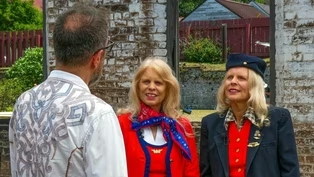
(laughter) Mine is a Delta flight attendant uniform from 1973.
This was my very first uniform.
The scarf was different.
Right.
This was '96.
This scarf is from, um, the Olympics.
Delta was the sponsor of the 1996 Olympics.
And mine is an Eastern Airlines 1975 uniform-- actually, the vest and the shirt are from '75, and the jacket is 1991.
And the hat was '91.
APPRAISER: Awesome.
I love it.
And you're sisters, obviously?
Yes.
We're twins.
We're twins.
Your uniform is very complete.
Yes.
And Delta at the time, I believe was using Sharon Harris as a designer for that uniform.
Oh, okay.
Tell me a little bit about the, the five star pin.
This was the five star award if you went above and beyond.
And we were going from Atlanta to Charlotte, I believe.
And there was a child in the gateway that had a seizure and quit breathing.
So I helped the child.
The captain was so nice and he told everybody what happened and he wrote it up and I got the five star award.
That's awesome.
So in the world of uniforms, the reason people are interested in them is because, I mentioned Sharon Harris, but there were other... Uh-huh.
Oh, yes.
...big designers like Edith Head, so that has generated some interest in the fashion folks.
But also there's this issue of supply and demand.
So there is a demand and interest to preserve the cultural heritage, but there is a limited supply.
So your ensemble is a little bit of a mixed period.
Yes.
You've got some '90s, you've got some '70s.
For the blazer, the vest, the blouse, and the hat with all the emblems, we're probably looking at auction value of around $800 to $1,000.
Really?
Oh, wow!
What?
Oh, my goodness, that's fantastic.
Oh, wow!
And the '70s version with the, the slacks and the jacket and everything is more complete.
And it's got the Sharon Harris association.
We're probably looking at $1,000 to $1,500 for this outfit.
Oh, wow.
You're kidding.
Yeah.
So it's a lovely group.
Oh my goodness.
Oh, this has been so much fun.
GUEST: These are two vases that my father-in-law gave to me.
He said his mom got them in the '40s in Queens, and that she was told that they were pulled from the Normandie.
But that's all that I know.
Okay.
And, um, what would you like to know about them today?
Honestly, I just want to know anything about them, because I'm a giant "Antiques Roadshow" fan girl and I'm just so excited to be here.
So just to know anything, really, at all.
These were in fact designed for the S.S.
Normandie.
The S.S.
Normandie was brought into service in 1935.
Mm-hmm.
And at the time it was the fastest ship to cross the Atlantic.
It was fitted out on the interior by many designers, but including Georges Bastard and Edgar Brandt, both notable designers of the time.
These are a pair of nickel-plated chrome vases.
They measure approximately 13 inches tall and there were two sizes that were fitted out in the ship.
There was the smaller versions and these large 13-inch examples.
At the beginning of the 1940s, the S.S.
Normandie was actually seized by the American government to be converted into a troop ship and at that time, it was decommissioned in New York City and the interiors were completely pulled out.
They took out all the furniture, decorative arts, lighting, and accessories.
In 1942, there was a fire on the ship, and then it actually sank.
There are a lot of pieces that came off the ship that still exist today.
On this wonderful pair of vases, they're actually signed.
First of all, in the middle we have the monogram of the French company, which was a private public conglomerate that was the owner of the ship, which is Compagnie Générale Transatlantique.
Okay.
And then they're also signed.
Lower left is Georges Bastard and then lower right is Edgar Brandt.
It was a great collaboration.
So when we look at these two, one of them is just ever so slightly unstable.
They are just bolted up through the bottom and it's likely a thread that just tightens up just a little bit.
Oh, okay.
These are really in very good shape.
Because there was a lot of them made-- and by a lot, I don't mean hundreds, but dozens of pairs... Yeah.
...we have really good sales records for them.
If I were to see these come up for auction in today's market, I would expect to see a value of $8,000 to $12,000.
Wow!
(laughs) That's so exciting.
Just to hear you say that, (laughing): I'm like, "I'm really on 'Antiques Roadshow'!"
That's so awesome.
I'd recommend an insurance value of around $20,000.
Wow, okay.
Good to know.
GUEST: My godmother went to South America, and came back with some pottery that she gave me when I was like, 12.
We don't know how old it is.
Yeah, we're not sure how old it is.
He claims it's really special and he always wants to display it in our house, but I'm like, I don't know what this is.
So I think it's old and awesome, and we'll see.
PRODUCER: And if it's not old and awesome, it gets not displayed, I think.
It still gets displayed, but in my office.
No.
It's going back in the office.
GUEST: A year and a half ago, my mom passed away.
I don't know if they were hers or somebody in the family.
What you brought here were two marionettes from "The Howdy Doody Show."
It was the kids show of all time.
Remember them saying "It's Howdy Doody time."
"It's Howdy Doody time."
A little rough on and-- but they have the original colorful boxes.
Value wise, I would say, in auction, you're looking around $200 to $300, which is not a bad price.
For the two of 'em?
For the two of them.
Mm-hmm.
And they'd be sold as a pair.
That's great.
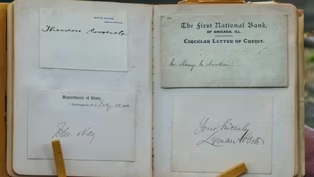
GUEST: This is an autograph book that I discovered at a antique show in Miami about 40 years ago.
It is a book filled with autographs that were mailed to a lady that started this book, a Florence Hooker from Chicago.
But the autograph that caught my attention and the reason that I bought this book was the signature of Teddy Roosevelt.
My grandfather served with Teddy Roosevelt in Cuba as a Rough Rider.
And so this signature meant a lot to me.
And do you remember your grandfather growing up?
I do.
He limped, because he was wounded in the Battle of San Juan Hill at-- in Cuba.
And when you purchased the album at the antique show, what did you pay for it?
I paid $1,000 for it.
This is a really super album, autograph album.
It's who's who of late 19th century, early 20th century autographs of some of the most famous people in America at the time.
You have Teddy Roosevelt, and what's really great about this Teddy Roosevelt autograph is A-- when it comes to autographs, you want strength of signature.
And this is as clear and crisp as you can get.
Also, it's on the White House executive card, and collectors of presidential autographs love that.
That adds substantial value.
Included in the book, besides the Teddy Roosevelt, on White House cards as well, you have Grover Cleveland.
Right.
You have his wife, Frances Cleveland.
Right.
I believe there's a Benjamin Harrison as well.
You also have a McKinley, not on an executive card.
There's your William McKinley.
Down in this corner here, we have a great signature and inscription of Susan B. Anthony.
We do.
Why don't you read what it says for us?
"Perfect equality of rights for women-- civil and political-- is the demand of yours truly, Susan B.
Anthony."
Great inscription, and one that she used very often.
Yeah.
It's also signed and dated in Rochester, New York, where her home is still there as a museum.
She lived there for 40 years.
Wow.
It's just a phenomenal encapsulation of what she was all about, the suffrage movement and everything else.
It was, yeah.
We also have a really, really cool... signature of Mark Twain.
Uh-huh.
There's an enormous amount of great autographs in here.
One of the things that I'm not crazy about is that collectors generally want to take the signatures apart, so they can frame them and mat them with photographs.
Right.
In this case, I like the idea of keeping this together as an archive.
I agree.
It's a history of one person's enjoyment, what she did for a hobby.
In terms of value, the Teddy Roosevelt autograph by itself would be more than what you paid for the whole book.
It would be about $1,000 to $1,500.
Wow.
The Susan B. Anthony, probably in the $1,200 to $1,800 range.
And these are auction estimates.
A Mark Twain good cut signature like that, also probably in the $1,000 to $1,500 range.
Wow.
And then you have the presidents mixed in, some of them in the $200, $300, $400 range.
So by the time you're done adding all those up, a conservative auction estimate, as an album... Right.
...would be somewhere between $5,000 and $8,000.
Wow.
It's something I really treasure.
Thank you, very much.
Thank you.
PEÑA: One of the Georgia State Railroad Museum's restoration projects is a segregated passenger car.
TERRY KOLLER: This car behind me is Georgia Railroad #67.
The car has partitions within it that separated Black passengers from white passengers.
This was in accordance with the Jim Crow laws which were enforced just after the Civil War, between 1865 all the way up until the Civil Rights Act of 1964.
This car was built in 1911.
It was a copy of a car built in 1880.
By 1911, most passenger cars were being built primarily of steel.
This car is built of all wood components.
We have another segregated car in our collection that was built around 1930, but it was refit in 1950.
The contrast between the construction of this car and the newer car is so stark, and it really paints a picture of how long these Jim Crow laws were enforced.
GUEST: My dad gave it to me.
He was working in China, in Hong Kong in the late '70s.
He worked for Philips Consumer Electronics.
Apparently, he was one of the first businessmen to be going into the area during the time; it was when China was opening up for the first time.
He says that it's like a farewell thank-you gift.
When did he give it to you?
Not too long ago.
They were downsizing their house, I said I liked it, he said, "it's yours."
(chuckling): Good choice.
Yeah.
I do know that it is from 1628.
There's like a very handy, um, sign on the back that I'm guessing he put there.
He told me it was from a Dutch cartographer.
I hung it on my wall and I'd never thought about it again, basically, until my husband surprised me with tickets to the "Antiques Roadshow."
Yes, it was printed in 1628, which is astonishing.
It's an engraving.
The coloring is original, and it's watercolor.
It was done by hand.
There's no name on here.
There's no indicator of who made it, and when I see these maps, the first thing I respond to is the moiré pattern in the ocean.
Hondius, who is the map maker, is famous for engraving that pattern to show waves.
The wave pattern is one of my little techniques I use to tell if it's old or not.
And then, also, the frame is open in the back, so we're able to see that there's text, which is in French, and that's a good way to tell that it's 17th century as well.
Your father wrote a note that said "Mercator Hondius," and that is correct.
Mercator Hondius was a partnership.
Gerard Mercator started the project and couldn't finish it, so Jodocus Hondius bought the plates from the family and issued these maps to complete the project.
So, they call it like the Dream Team of the 17th century for map makers.
This map was printed in Amsterdam, and that was the center of production for mapping in the 17th century.
There's a lot of pictorial elements to it.
There's boats, there's sea monsters.
There's also an image of someone on a cross, and the text below describes that in Japan, in the 17th century, Christianity was outlawed, so Jesuits in Japan were executed.
The other thing I do when I look at maps of China, is I look for the Great Wall, which is really well-illustrated here, and it's very, very big.
The other thing I find fascinating is that Korea is so elongated and it's shown as an island.
So, they're getting there with their geographical techniques, but not quite yet.
There's so many rivers and lakes and mountains.
It's a baroque beauty.
In terms of value, do you have any idea what it's worth?
I have absolutely no idea.
Okay, well, maybe we shouldn't tell your dad-- (laughing): No, I'm just kid-- I just-- it's, it's, um, so it's a multiple, many, many thousands of this map were made.
We don't know how many survive.
Yours is in particularly good condition, and I would put a retail value on this map of about $3,500 to $4,500.
That's awesome.
That's so cool.
Thank you so much.
I really love it.
Yeah, that's great.
Thank you.
GUEST: This is a little jewelry box that I picked up at an estate sale.
It has a little dog in there, and at the time, I had a little dog that looked just like that.
I paid $25 for it.
GUEST: I brought a 50th anniversary Fender Stratocaster and there was 2,500 of 'em made for the 50th anniversary, and this one's 2,341 out of 2,500.
It's never been played.
Have all the original paperwork from the factory, everything.
GUEST: This is a mid-, early-, maybe 1900s hunt board.
The unique thing about it is its provenance.
It was once owned by the leading character in the novel and movie "Midnight in the Garden of Good and Evil."
Jim Williams, right?
Yes, yes, exactly.
I saw it online, I really liked it, and I needed an excuse to buy a Christmas present for my wife.
So I thought, "What better way to get what I wanted, what she wants as well, so, uh..." I like the way you think.
(laughs) That's pretty-- pretty awesome.
Don't tell her that.
And how long ago did you acquire it?
Just this past year.
Well, it's a great, great piece.
I absolutely love it, and you're, you are correct-- It's a Federal, fancy painted, yellow pine hunt board.
It's made in the southern states, and I would say it was probably made between 1810 and 1850.
One of the characteristics that we can tell why it's Federal is this nice tapering leg.
It's something that we start to see in the late 18th century and into the 19th century.
And the paint decoration is so fabulous.
It's just a rural interpretation of high-style urban furniture.
So this cabinet maker has done an amazing job.
He's painted this vibrant yellow and these wonderful compass-decorated pinwheels meant to simulate inlay.
If you look on the side, they've got these green paint-decorated bottles.
The glass knobs seem to be later 19th century... Mm-hmm.
...and I think the piece is a little earlier, so I suspect it probably had another wooden pull on it.
When I take a step around to the back, you've got the James T. Cheek, which is likely the cabinet maker, because it's done in the same paint.
It's got great form and function.
It's wonderfully artistic, I just love the vibrant colors.
And then you add the Jim Williams provenance to it, which is just fascinating.
And if you're living in the Savannah area, you probably know that name because of "Midnight in the Garden of Good and Evil."
Yup.
He was the central character.
In his 35 years he was in Savannah, it's reputed that he's, uh, restored over 50 houses.
Quite the historic preservationist.
Mm-hmm.
A, uh, important figure in Savannah history, which I think really adds to the value here.
Remember what you had to pay to bring this terrific Christmas gift home?
It was all in about $9,000.
I think you did pretty well on it.
If I were to insure it, I think I'd insure it between $15,000 and $20,000.
Okay.
It is just a terrific piece.
I'm going to have to come up with a really smart Christmas gift... (both laugh) Which is gonna put some pressure on me on the home front.
So you, you set the bar really darn high.
Why we're testing this-- that usually ancient gold is usually alluvial gold.
I just wanted to be sure with the gold.
I'm gonna test the shank.
Okay.
Don't wear it out, Kevin.
(chuckles) You know us jewelers, always trying to get a little extra gold.
And I'm gonna test the bezel, also.
Okay.
I'm gonna hit it with 18 first.
So that's the shank, and that's the bezel.
Okay.
This is 18-karat acid.
So, the bezel, it's holding on the 18, the shank, it's not, it's not holding.
You see that discoloration right there?
Yeah, sure.
Probably sized with a lesser metal.
Okay.
It was given to my grandmother.
She was a young woman, and she was working in Palm Beach, Florida, and she met someone, and he had been on an archaeological dig and he gave it to her as a gift, and told her to hold on to it, that it might be worth a lot of money one day.
That was in the early 1930s.
My parents took it to The Metropolitan Museum of Art.
They looked at it and said that it belonged to King Thutmose III, a pharaoh of the 18th Dynasty, I believe.
It was priceless, is what we were told, and we have just never been able to have anybody tell us basically what it was worth.
It's a scarab, and beautifully made, and from the 18th Dynasty, and it is ascribed to Tuthmose III.
He was an extraordinary pharaoh.
Yes.
He was, I think, just two years of age when his father died.
And, because he was so young, he then had a regent, his stepmother... Mm-hmm.
...and his stepmother was Hatshepsut... Yes.
...and she was a really famous pharaoh also.
And when she declared herself a pharaoh, most of her sculptures depicted her as a man.
She was only, I think, the third woman ever to be a pharaoh in ancient Egypt.
It was a good reign, you know... Mm-hmm.
And it wasn't contentious, because even when she was making her declarations on monuments and things, she would put herself as pharaoh and also acknowledge Tuthmose III.
By the age of about 18, she made him head of the army.
He ruled from April 1479 BC until March 1425 BC, and he transformed Egypt into a superpower.
Anything with his name on it becomes a very powerful amulet.
I don't believe that your ring belonged to Tuthmosis, but it's a very beautiful ring.
It would have definitely belonged to one of the elite, 'cause it's gold.
Why I think it probably wasn't a royal one, because the choice of stone for the scarab.
It would have been lapis or jasper for them.
But this is steatite.
It's sort of a-- it's a bit of softer stone, but it's nice.
Uh-huh.
It's a rather unusual cut.
It has the very high dome on it.
It's a wonderful swivel ring here.
On the back, it has the cartouche.
This is the oval area where it has the name of Tuthmose III in it.
So that's the amulet.
What we weren't absolutely sure of was the gold content.
Now, normally with antiquity gold, it's alluvial-- found in the river.
Some was found in the Nile, but most of it came from Nubia, which is in the Upper Egypt.
Mm-hmm.
And when it's alluvial, it's generally pretty pure.
We tested it and it was high karat on most of it... Ah.
...but one part tested low, like 14 karat.
Then we looked at it very carefully, and it's been sized.
And so that's the little bit which was 14 karat.
Everything else is fine.
I'd be very comfortable with a retail value of $12,000 to 15,000.
Oh, really?
Yes.
(surprised laughter): Okay.
That's pretty awesome.
I would insure this for $20,000.
Oh, really?
It's a beautiful ring... Yes.
...and the color of that ancient gold is extraordinary.
It's lovely, you know.
Oh, thank you.
I had a, um, friend who called me one day and asked, uh, if I would go and help this gentleman who had acquired a storage unit, and he had, uh, some Navajo rugs in it.
And she knew that I collected Navajo rugs.
So I went by there, looking through his-- all his stuff that he got out of this unit.
These dolls were in there, and I had no idea what they were.
I knew they weren't Hopi.
So I kept going back to look at 'em.
And I was there for a couple hours, and he said instead of paying me, he would give these to me for looking at all his stuff, and I said sure.
That's a swell gift.
(chuckling): Yeah, it was.
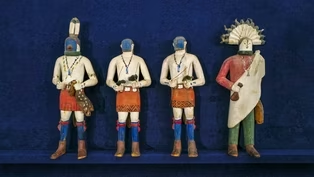
Um... these are folk art carvings, representing Yeibichai dancers, which are part of a nine-day healing ceremony held by the Navajo.
And they're made by Clitso Dedman, a Diné artist who was born in the late 1800s.
He died in 1953.
And looking at the style of these, I would say he carved them around 1950.
They're extraordinary pieces of Navajo folk art.
And he's very, very highly collected and held in high esteem.
If they were to go to an auction setting as a set of four, my expectation would be that they would sell for between $2,600 and $3,500.
Nice.
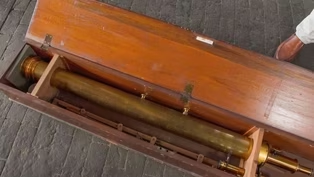
GUEST: It's a large brass antique telescope.
I got it from my dad, and he acquired it from a gentleman up in Vermont who had it in like, a barn sale, garage sale.
My dad paid about $250 for it.
It is a telescope, all brass construction.
It's made by a company called Alvan Clark & Sons.
They were established in the mid-19th century in Cambridgeport, Massachusetts.
And they were the go-to guys for big telescopes.
So, some of the biggest telescopes in the world, up until about 1900, were made by-- by this firm, up to be almost 40 inches in diameter... Wow.
...at numerous observatories throughout the United States.
It measures an impressive almost five feet long and the tube itself is about 4.5 inches in diameter.
The optics do appear to be in good condition, which is a huge thing with antique telescopes.
I'm thinking it's probably in the 1870-to-1880 range, so kind of in their prime.
If it came up to auction today, I think it would conservatively bring $3,000 to $5,000.
Wow, that's fantastic.
(chuckling): That's really awesome.
GUEST: This painting was owned by my great aunt and uncle.
My great aunt died in 1958.
It was given to my mother and passed on to our family.
We've had it about four or five years.
Jessie Arms Botke, the artist of your painting, was born in Chicago in the late 19th century, and was well-trained and well-traveled.
She was a painter, she was a muralist, she was a designer, and she was kind of ahead of her time in so many other ways.
They talk about her being very outspoken and marching in the suffragette parades.
Yeah.
Given the quality and style of it, I think it was probably painted at the height of her career, which would be 1930 to 1950.
She was represented by some of the finest galleries in the United States, so I suspect that it was an expensive painting even when it was acquired.
The painting is oil on board.
It's painted very thinly.
She loved, especially, white peacocks.
She displayed this bird in just such a wonderful way where you could see through the feathers.
The alley going into the background is really quite exceptional, and with the sculptures directing your eye into the painting.
I believe that this alley is a pastiche of great houses.
There's a little Versailles in there, There's a little Crane estate in there.
I don't see it as being attributable to a specific location.
Mm-hmm.
I really think, and I've spoken with my colleagues, it's one of the best we've seen in a long time.
The combination of the bird, the architecture, the palette is just beautiful.
At auction, I would estimate it between $60,000 and $80,000.
(softly): Wow.
Wow.
Today would have been my mother's 99th birthday.
Oh, my gosh.
So, it's... Oh!
She's watching.
Thank you.
Insurance valuation would be $150,000.
This makes my day.
My year.
(both laugh) PEÑA: And now it's time for the "Roadshow" Feedback Booth.
We came with our 1865 newspaper announcing Lincoln's assassination, We came with our grandmother's teacup from occupied Japan, We came with Grandpa's Loblaws truck-- it's steel-- and the appraisers liked the best... the box that he concocted in order to carry the Loblaws truck, with the duct tape, the pool noodle... Pool noodle.
...and the clothesline string.
I've got a copy of Amelia Earhart's book signed by Amelia Earhart, and, uh, good news and bad news.
The good news is it's worth a fair amount of money.
The bad news is it belongs to our son and not me.
(chuckles) We found out this locomotive bell is worth $400 to $600.
And weighs about 100 pounds.
Cheers to "Antiques Roadshow."
(bell rings) This is a Civil War flag that I was under the impression was a reunion flag, and it was actually used as collateral for a loan to a family friend.
Well, we found out today that the flag is a fake and we will be calling that family friend shortly after this.
We came today because we thought our baseball would get us on TV, but it... (chuckles) ...we didn't make the cut.
But, my pens from the Olympic ceremonies were worth about $50 to $75, and we had a great time at "Antiques Roadshow" today.
Uh, I brought my cello.
and it's not worth much, but I still love it.
Had a good time.
We're here to celebrate.
I just beat cancer, and then I won the tickets to "Antiques Roadshow."
We're super happy to be here.
Thanks, guys.
PEÑA: Thanks for watching.
See you next time on "Antiques Roadshow."
GUEST: My father went to the Students Arts League in New York City.
I don't know how their paths crossed, but obviously they did somewhere along the line.
This is the way that ads were illustrated.
It's the way that even news articles at the beginning of the 20th century were illustrated.
And illustrations are very collectible.
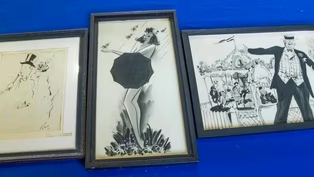
So you have three different artists here.
This is Gilbert Bundy.
He was especially busy in the 1930s, '40s, and then early '50s.
It's a great drawing.
It's got a lot of energy and fun.
You're probably looking at about $300 to $500 for auction purposes.
This is Jaro Fabry.
This would be a little bit later, 1950s, a little bit more simplistic in terms of its execution, probably $200 to $300 for it.
And then the Pagès.
Happily, this is very conveniently dated for us, so we know it's 1941.
This is probably gonna be about $300 to $350.
It's a wonderful collection.
Thank you for your help.
Thank you.
GUEST: Ken Burns's miniseries on baseball on PBS in 1994.
One of the chapters of the miniseries was on Negro League Baseball.
He came to Kansas City for a publicity campaign, and he got together all the living Negro League Baseball players, and they signed autographs, and they had the shirts and things.
Now, except for Ken Burns's autograph on here, everyone else has passed.
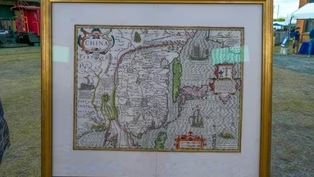
Appraisal: 1628 Mercator Hondius Map of China
Video has Closed Captions
Clip: S30 Ep5 | 3m 27s | Appraisal: 1628 Mercator Hondius Map of China (3m 27s)
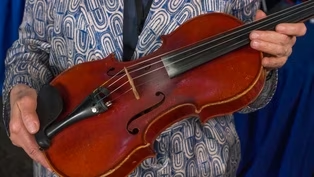
Appraisal: 1921 Kurt Arno Gütter Violin
Video has Closed Captions
Clip: S30 Ep5 | 1m 33s | Appraisal: 1921 Kurt Arno Gütter Violin (1m 33s)
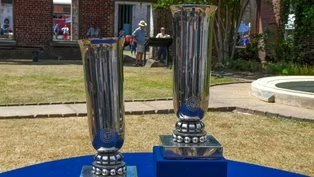
Appraisal: 1935 S.S. Normandie Art Deco Chrome Vases
Video has Closed Captions
Clip: S30 Ep5 | 2m 38s | Appraisal: 1935 S.S. Normandie Art Deco Chrome Vases (2m 38s)
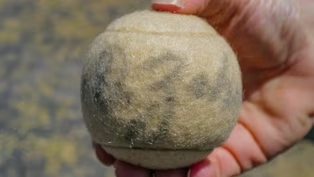
Appraisal: 1949 Babe Didrikson Zaharias-signed Ball
Video has Closed Captions
Clip: S30 Ep5 | 2m 34s | Appraisal: 1949 Babe Didrikson Zaharias-signed Ball (2m 34s)
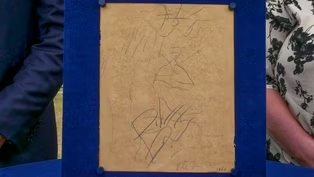
Appraisal: 1966 William de Kooning Sketch
Video has Closed Captions
Clip: S30 Ep5 | 2m 25s | Appraisal: 1966 William de Kooning Sketch (2m 25s)
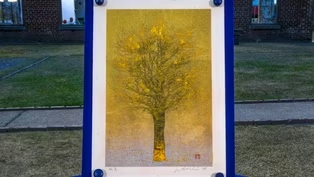
Appraisal: 1978 Joichi Hoshi Autumn Light Woodblock
Video has Closed Captions
Clip: S30 Ep5 | 2m 17s | Appraisal: 1978 Joichi Hoshi Autumn Light Woodblock (2m 17s)
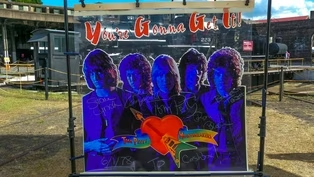
Appraisal: 1978 Tom Petty & the Heartbreakers-signed poster
Video has Closed Captions
Clip: S30 Ep5 | 2m 13s | Appraisal: 1978 Tom Petty & the Heartbreakers-signed poster (2m 13s)
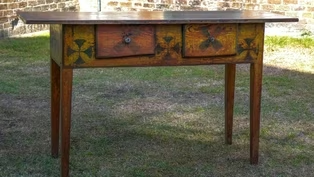
Appraisal: 19th C. Jim Williams-owned Federal Hunt Board
Video has Closed Captions
Clip: S30 Ep5 | 2m 45s | Appraisal: 19th C. Jim Williams-owned Federal Hunt Board (2m 45s)
Appraisal: Alvan Clark & Sons Refractor Telescope, ca. 1875
Video has Closed Captions
Clip: S30 Ep5 | 1m 14s | Appraisal: Alvan Clark & Sons Refractor Telescope, ca. 1875 (1m 14s)
Appraisal: Autograph Book, ca. 1900
Video has Closed Captions
Clip: S30 Ep5 | 3m 1s | Appraisal: Autograph Book, ca. 1900 (3m 1s)
Appraisal: Clitso Dedman Wooden Carvings, ca. 1950
Video has Closed Captions
Clip: S30 Ep5 | 1m 31s | Appraisal: Clitso Dedman Wooden Carvings, ca. 1950 (1m 31s)
Appraisal: Dale Nichols Group, ca. 1950
Video has Closed Captions
Clip: S30 Ep5 | 2m 20s | Appraisal: Dale Nichols Group, ca. 1950 (2m 20s)
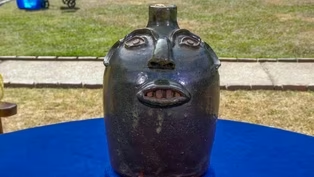
Appraisal: Davis Pennington Brown Stoneware Face Jug, ca. 1917
Video has Closed Captions
Clip: S30 Ep5 | 2m 53s | Appraisal: Davis Pennington Brown Stoneware Face Jug, ca. 1917 (2m 53s)
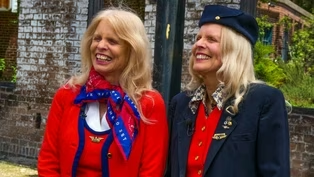
Appraisal: Delta & Eastern Flight Attendant Uniforms
Video has Closed Captions
Clip: S30 Ep5 | 2m 21s | Appraisal: Delta & Eastern Flight Attendant Uniforms (2m 21s)
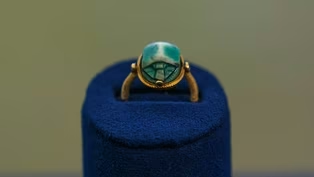
Appraisal: Egyptian 18th Dynasty Scarab Ring, ca.1450 BCE
Video has Closed Captions
Clip: S30 Ep5 | 3m 35s | Appraisal: Egyptian 18th Dynasty Scarab Ring, ca.1450 BCE (3m 35s)
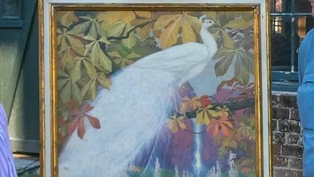
Appraisal: Jessie Arms Botke Oil Painting, ca. 1940
Video has Closed Captions
Clip: S30 Ep5 | 2m 14s | Appraisal: Jessie Arms Botke Oil Painting, ca. 1940 (2m 14s)
Appraisal: Sapphire & Diamond Ring, ca. 1940
Video has Closed Captions
Clip: S30 Ep5 | 3m 5s | Appraisal: Sapphire & Diamond Ring, ca. 1940 (3m 5s)
Appraisal: Three Illustrations, ca. 1945
Video has Closed Captions
Clip: S30 Ep5 | 1m 4s | Appraisal: Three Illustrations, ca. 1945 (1m 4s)
Appraisal: Tiffany Studios "Bookmark" Pattern Clock, ca.1915
Video has Closed Captions
Clip: S30 Ep5 | 2m 2s | Appraisal: Tiffany Studios "Bookmark" Pattern Clock, ca.1915 (2m 2s)
Preview: Georgia State Railroad Museum, Hour 2
Video has Closed Captions
Preview: S30 Ep5 | 30s | Preview: Georgia State Railroad Museum, Hour 2 (30s)
Providing Support for PBS.org
Learn Moreabout PBS online sponsorship
- Home and How To

Hit the road in a classic car for a tour through Great Britain with two antiques experts.












Support for PBS provided by:
Funding for ANTIQUES ROADSHOW is provided by Ancestry and American Cruise Lines. Additional funding is provided by public television viewers.