
Greenland's Hidden Methane
Clip: Episode 1 | 4m 58sVideo has Closed Captions
Is Greenland's ice leaking methane? Glaciologist Alun Hubbard descends into a moulin to find out.
Each summer, the Greenland ice sheet sheds more than 250 billion tons of ice, and the pace keeps rising. Glaciologist Alun Hubbard suspects more than warming is at work. Descending into a thundering moulin, he takes what he believes is the first methane reading from one, a sign that an ancient forest thawing beneath the ice may be releasing a gas current climate models don't account for.
Problems playing video? | Closed Captioning Feedback
Problems playing video? | Closed Captioning Feedback
Greenland's Hidden Methane
Clip: Episode 1 | 4m 58sVideo has Closed Captions
Each summer, the Greenland ice sheet sheds more than 250 billion tons of ice, and the pace keeps rising. Glaciologist Alun Hubbard suspects more than warming is at work. Descending into a thundering moulin, he takes what he believes is the first methane reading from one, a sign that an ancient forest thawing beneath the ice may be releasing a gas current climate models don't account for.
Problems playing video? | Closed Captioning Feedback
Where to Watch Ages of Ice
Ages of Ice is available to stream on pbs.org and the PBS app.
Share Inspiring Moments From The Film
Explore the PBS Giphy collection for Ages of Ice.Providing Support for PBS.org
Learn Moreabout PBS online sponsorshipNarrator: Each summer, the Greenland Ice Sheet sheds more than 250 billion tons of ice.
In just three decades, the rate of ice loss has increased around five times over.
Ah, youre commited.
Ah, you cheat.
[Laughter] It's too much for my little Welsh legs.
Narrator: Something more than rising temperatures is driving this change.
Alun wants to find out what that is.
The ice sheet is always melted.
If it didn't, it would take over the whole planet.
But this ice sheet, which holds over seven meters of global sea level rise, that's been taking a real hammering in the last two decades.
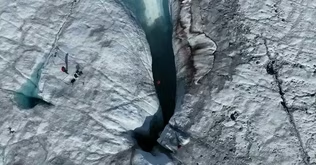
Narrator: Meltwater rivers wind their way across the ice.
Only to disappear down deep shafts known as moulins, draining into the depths below.
Which for most people, is a good reason to keep your distance.
For Alun, it's yet another invitation.
The adventure assignment just wants to go in there and have a look and see what the hell is happening.
Narrator: Alun believes these sinkholes may unlock new clues as to why there's accelerating change.
The idea here is we're going to put in a methane sensor to see what methane may be expelling out of the ice and from the bed.
It's only a hunch, but you have to try.
All right, he says.
Yeah, I'm very confident.
A bit nervous now, actually.
Been thinking about it too much.
Hopefully I won't be doing a Darwin Award today.
But first, we need to clean up a little bit here.
Joe, do you want to go down?
Sure.
Piece of cake.
Piece of cake.
Okay.
♪ The gates of Hades.
You can feel the thundering and vibration of the water going down there.
The whole things shaking.
Narrator: But there is method in Alun's madness.
So we sense that what's under this bit of ice below us is a fossilized ancient Arctic forest.
As the base of the ice sheet thaws and more meltwater accesses it, it's starting to break down that organic matter, and it's starting to leak methane.
Amazingly, at the moulin there, I got quite an elevated methane signal.
That's a first, right, so that's interesting.
That's something new.
Nice.
Everything good?
Interestingly, I got actually quite a high methane reading.
Really?
Yeah.
It's actually emissions coming out of this moulin from the bed of the ice sheet or from stuff that's trapped in the ice sheet.
Either that, or it was the Moroccan lentil curry I had last night.
Narrator: Methane is a powerful accelerator in the climate system.
And ice sheets may be hiding more of it than we realize.
It's one of those things weve speculated about.
I don't think anyone else has ever measured methane out of a moulin before, so that's quite cool.
I went quite away in, so I was definitely in the updraft of what's coming out of there.
So quite good to be able to sense it.
Narrator: Current climate models don't account for methane leaking from ice sheets.
Only by standing here face to face with change, can we begin to see whats emerging.
Video has Closed Captions
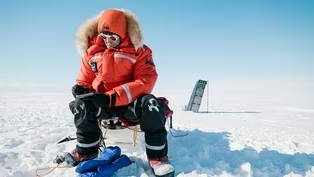
Clip: Ep1 | 4m 48s | Five strangers, 220-pound sleds, 30 days on Greenland's ice, all to map what lies beneath. (4m 48s)
Providing Support for PBS.org
Learn Moreabout PBS online sponsorship New Episode
- Science and Nature

Explore scientific discoveries on television's most acclaimed science documentary series.
 New Episode
- Science and Nature

Capturing the splendor of the natural world, from the African plains to the Antarctic ice.

 New Episode







Support for PBS provided by: