NH Crossroads
Herbert Waters
Clip | 8m 45sVideo has Closed Captions
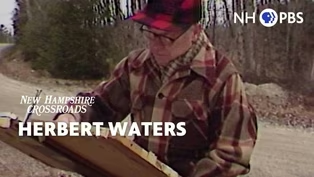
NH Crossroads introduces viewers to Herbert Waters, an artist who works by engraving wood.
Herbert Waters is a New Hampshire artist renowned for his wood block prints. In this segment from NH Crossroads, we visit Herbert at his studio to get a behind-the-scenes look at his creative process. As he takes viewers through the steps involved in creating a wood print, Herbert talks about what he looks for in each piece.
Problems playing video? | Closed Captioning Feedback
Problems playing video? | Closed Captioning Feedback
NH Crossroads is a local public television program presented by NHPBS
New Hampshire Crossroads celebrates the people, places, character and ingenuity that makes New Hampshire - New Hampshire!
NH Crossroads
Herbert Waters
Clip | 8m 45sVideo has Closed Captions
Herbert Waters is a New Hampshire artist renowned for his wood block prints. In this segment from NH Crossroads, we visit Herbert at his studio to get a behind-the-scenes look at his creative process. As he takes viewers through the steps involved in creating a wood print, Herbert talks about what he looks for in each piece.
Problems playing video? | Closed Captioning Feedback
Where to Watch NH Crossroads
NH Crossroads is available to stream on pbs.org and the PBS app.
(water flowing) A good wood engraving, like a good poem or good essay, or a good building for that matter, a good piece of music, is not just a list.
It's not like a grocery list, which is the bottom of the line.
And far as I was concerned, just a list of things like that.
It's more like a poem, is, it's distilled down, so to speak.
And in my case, I look for sort of I guess you'd call it a rhythm running through things and tying them together in an interesting way.
Music The process for wood engraving, as it's done by Herbert Waters, consists basically of three parts.
Drawing or sketching the subject.
Cutting the woodblock.
And then printing.
I remember that Paul Gauguin one time, trying to educate his friend Vincent van Gogh, said, be calm.
Be cool.
Think it all through.
And Vincent just growled, who can be calm while fighting a duel?
Well, that's what it is.
There's sort of a duel going on, but the drawing is, for me, that was the first step in it.
This mailox setup is sort of my little hero in this thing.
A design is (inaudible) like a stage scene.
You know, there's a soloist sometimes singing, and then there's a chorus.
Some things have to really be more important.
And in this case, this thing has a rather interesting shape.
And then, it stands out in front of the house, and then I have a stone wall back of it.
It might be interesting to just to tell you that when I came, I traced this and got it on a woodblock cause, you'll see it's up there in the studio now, the very first thing I engraved, just for sheer fun, was the snow on the top of the mailbox, which made an interesting shape.
The mailbox is a static thing.
It's a manufactured item, but it has an interesting shape and it vaguely repeats the shape of the house and curves.
But the snow is an accidental thing.
And and the accidental thing gave it life.
And the next step in the life of a wood engraving is the transfer of the drawing to the woodblock.
The drawing in front of me is the same one that you saw out of doors.
Except there's one real difference: it's been turned the reverse.
And that's one reason why I do a lot of drawing on tracing paper is if you want the print to come out facing the right way, the drawing will have to be reversed.
Sometimes it doesn't matter.
So then I went down to the Plymouth newspaper The Record Citizen, where there's a very accommodating lady runs her camera up there and she has a reducing camera, so she reduces it down to whatever size I want.
And I asked her to make one approximately four and 7/8 by five and 1/4, something like that, inches about the size of my block.
They would be called a cartoon.
That that is the original meaning of the word was a line drawing to guide you in doing a painting or engraving or etching or whatever.
So I put tracing paper over that and make a tracing of it, and that stage it looks like that.
And then I make some carbon paper myself.
I can use regular carbon paper, but the trouble is that there's an oily substance in the carbon paper that interferes with the ink later on.
So I make my own out of a soft pencil, put that over like that and trace it off on the block.
At that stage, the block is yellow.
It hasn't been stained in any way.
It looks to about like this.
And this drawing that I get from my homemade carbon paper is very light, in fact you can hardly see it.
And so I redraw it with a pen.
That's a pen drawing on the engraving wood, which is a boxwood, very smooth end-grain wood.
So I end up with a very fine line drawing which is buried down underneath here.
Now you can see traces of it here and there.
And then I stain the block with a combination of black printer's ink, which I'll use in a few minutes to print from, and turpentine.
That gives a sort of dark brownish gray a stain, because it's really vital and it really takes all the fun out of it if you don't, if you can't see what you're doing.
So I stain mine and then, hopefully, go to work.
You're going to brood over that little piece of wood for maybe a month, maybe two months, something like that.
Music Great question, of course, you always face is, when do you stop?
And, what you worry about is going too far.
There is a point.
But finally, the block will be ready to print.
Here, Herbert Walters demonstrates the printing process with an earlier engraving of his studio.
Incidentally, he bought his 125 year old Acorn Press from the old Plymouth wrecker.
The roller is carefully coated with printer's ink and then rolled on to the top of the wood block several times.
Then the protective smudge sheet is laid over and the special parchment printing paper is positioned.
And you try to put it down so it doesn't move.
Music The rest of the overlayment consists of various paper thicknesses and a metal sheet, all necessary to distribute the pressure evenly.
However, there is one special sheet in there called a make-ready sheet.
It is made up of many, many thicknesses of very thin proof paper like the Japanese paper I was just showing you, and you make a paste up and this rides directly over the woodblock line for line.
It's in registry, in other words.
And by this process of pasting up many thicknesses of very thin proof paper where you want heavy darks, in my case, it sometimes takes me a week.
That's maybe printing three times during that week to get this make-ready mask in good shape so that it does what I want it to do.
Music Oh, that's not too bad.
Once he gets the print right, he has a printer in Portsmouth run off the rest of the edition.
Most of my editions are less than 100.
Sometimes I put out a second edition, done just as carefully as the first.
And again, maybe 30 or 40 or 50 or 60, something like that.
Music (silence)
 Now Playing
Video has Closed Captions
Clip | 8m 45s | NH Crossroads introduces viewers to Herbert Waters, an artist who works by engraving wood. (8m 45s)
Providing Support for PBS.org
Learn Moreabout PBS online sponsorship New Episode
 New Episode
- Drama

Lesley Manville and Tim McMullan return in the final installment of the Susan Ryeland mysteries.


 New Episode


 New Episode

 New Season

Support for PBS provided by:
NH Crossroads is a local public television program presented by NHPBS
New Hampshire Crossroads celebrates the people, places, character and ingenuity that makes New Hampshire - New Hampshire!