Here and Now
Here & Now for February 20, 2026
Season 2400 Episode 2432 | 26m 48sVideo has Closed Captions
Watch the entire episode of Here & Now for February 20.
Watch the entire episode of Here & Now for February 20.
Problems playing video? | Closed Captioning Feedback
Problems playing video? | Closed Captioning Feedback
Here and Now is a local public television program presented by PBS Wisconsin
Here and Now
Here & Now for February 20, 2026
Season 2400 Episode 2432 | 26m 48sVideo has Closed Captions
Watch the entire episode of Here & Now for February 20.
Problems playing video? | Closed Captioning Feedback
How to Watch Here and Now
Here and Now is available to stream on pbs.org and the free PBS App, available on iPhone, Apple TV, Android TV, Android smartphones, Amazon Fire TV, Amazon Fire Tablet, Roku, Samsung Smart TV, and Vizio.
Providing Support for PBS.org
Learn Moreabout PBS online sponsorship>> The following program is a PBS Wisconsin original production.
>> Today, as I announce my intention to not seek reelection in November, I do so with deep gratitude and with pride in the work we've done.
>> After 13 years as Assembly Speaker, the longest in state history, Robin Vos is stepping down from office.
[MUSIC] I'm Frederica Freyberg.
Tonight on "Here& Now", analysis of Speaker Vos departure and the final business of the legislative session.
An immigration attorney on the fast changing legal landscape.
Candidates for governor weigh in on data centers and how teams of people are preserving indigenous canoes thousands of years old.
It's "Here& Now" for February 20th.
>> Funding for Here and Now is provided by the Focus Fund for Journalism and Friends of PBS Wisconsin.
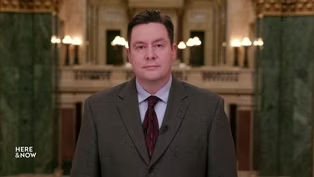
>> A powerful figure in the state legislature is not seeking reelection after 22 years representing his Racine County district and 13 years leading the Assembly, Republican Speaker Robin Vos said late this week he is retiring from office.
The Vos announcement comes as Democrats try to flip control in the legislature in upcoming elections under new voting maps.
Senior political reporter Zach Schultz is at the Capitol with more on.
Hi, Zach.
>> Hello, Fred.
>> So describe just how powerful Speaker Vos has been in the legislature.
>> Well, he is the longest serving Assembly speaker in state history, and that did not come without him learning how to consolidate power within his own party, within his own caucus in the Assembly.
He had a lot of nicknames from both friends and foes.
Vos Vos the Shadow Governor.
It was basically known that nothing could become law without him saying yes, and signing off and allowing it to come to the floor in the assembly.
And he controlled that chamber for quite a long time.
>> What does his departure say about how real the potential of November elections might be for the partisan makeup of the legislature?
>> Well, Democrats certainly see it as a positive sign.
They're definitely proclaiming in all their press releases that this is the sign.
Republicans know that this is going to be a Democratic fall, and they're going to pick up those five seats that they need to flip the assembly.
I wouldn't look as far into it as that.
In his announcement, he wasn't going to seek reelection.
Vos said he had a mild heart attack last fall.
He certainly is.
He said he's going to continue to campaign.
He certainly set up a machine within the Republican Party to win those seats, even when they're facing into headwinds, so I wouldn't count that out.
It's a lot about optics, though.
Democrats are going to campaign and say they've got momentum because of this.
And certainly the idea of what the Assembly will look like in the future without Robin Vos, no matter who is in charge, means there's a lot of uncertainty coming to the chamber and to the Capitol.
>> How realistic is a flip from Republican to Democratic majority in the Assembly and Senate?
>> Well, in the Senate, it's two seats that the Democrats need to pick up.
They have their eyes on those, and they feel very confident that they've got good candidates in seats.
They've got some open seats.
As Republicans are retiring and not choosing to defend some of those seats, they're optimistic in that chamber and the Assembly.
It is an uphill climb.
They they had those same seats that they had two years ago.
And the Senate side, it was seats that weren't up two years ago.
So they couldn't have done it.
The Assembly Democrats had their chance.
They they won ten, but they lost the five.
They needed to flip it.
They've retained candidates.
They've got their eyes on who they want to see targeted.
We all know what those battleground races are going to be.
A lot of it depends on what the wave looks like at the top.
If there is one one way or the other, but down ballot.
And that's one thing Vos has been known for, is insulating his candidates in those seats so that they don't face some of those political headwinds that may impact other candidates.
So it is a complete toss up in the Assembly.
>> Meanwhile, the Assembly was adjourning with a little undone business on the floor, including that deal between the Republicans and the governor over property tax relief.
That could still happen.
Or what do we think?
>> Well, there's always time.
The Assembly Republicans say that this is the last time they're going to be in session, that they're taking the rest of the year off to get ready for the campaign.
However, there are floor session dates available in March if they want to come back in regular order.
And obviously they can always come back in special session or extraordinary of deal that could get done on a moment's notice, simply because there's a lot of political incentives going into the fall for both sides to want to figure out how to spend some of this surplus and campaign on that.
However, the two sides are not on the same page right now, and they are running out of their own set deadlines for how long they have, so who knows?
>> I wanted to ask you about the bill that passed in both chambers.
That's the Medicaid expansion expansion to give one year postpartum coverage to to new mothers.
I thought Vos didn't like that.
>> Yes, he was the lone person standing in the way of that bill becoming law for at least a couple sessions now.
He told me last December he didn't believe in expanding the welfare state, which is why he opposed Medicaid expansion.
However, the people that were lined up the Republicans out front to announce they'd reached a compromise were those very vulnerable Assembly Republicans running to protect that majority for next year.
It wasn't a coincidence that they were ones to announce that that bill was going to pass.
And in the end, Vos voted for it on the floor.
>> All right.
Well, Zac Schultz, thanks so much.
>> Thanks, Fred.
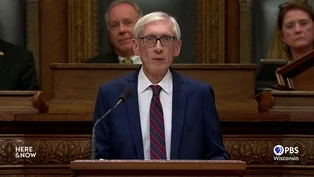
>> Governor Tony Evers, last state of the state address called 2026, the year of the neighbor, and asked Wisconsinites to be good neighbors to each other.
The neighborly spirit was strained by week's end, as Republican lawmakers and the governor were still working to reach an accord on property tax relief before the legislature adjourns for the session.
Republicans blame a spike in taxes on the governor's 400 year veto that enshrined a $325 per student annual school funding increase until 2425.
Here are Evers and Senate Republican Majority Leader Devin LeMahiue speaking on the matter.
>> A decade of Republicans consistently failing to meaningful invest meaningfully to invest in our kids and our K through 12 schools has consequences.
Wisconsinites.
Wisconsinites have been going to referendum in high numbers in years, raising their own property taxes just to keep the school lights on.
It started long before I became governor.
I get Republicans want to blame my 400 year veto for property taxes going up.
Why, of course it's politics.
Of course, Republicans running under fair maps need someone else to blame for for failing to fund our schools at the levels I've asked them to for about two decades of my life.
>> Thanks to strong Republican majorities here in the legislature, Wisconsin families have only seen one example of what state government could look like with full Democratic control.
Governor Evers disastrous 400 year veto that is driving property taxes through the roof.
The.
If the Democrats were in charge in Madison, Wisconsin would be a very different place.
>> While the immigration enforcement surge in Minneapolis has wound down, targeted arrests, including in Wisconsin, continue.
The mass deportation policy.
Has the immigration system scrambling to keep up.
What kind of limbo does this leave people in, and what is happening in the immigration system?
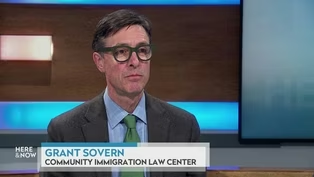
We turn to immigration attorney Grant Sovern, thanks very much for being here.
>> Thank you for your interest.
the immigration system right now as an emergency on two fronts.
How so?
>> Well, on one side, there are just so many more people being picked up than there ever have been before.
I mean, it appears that there's some sort of quota that Ice and Border Patrol have to reach.
So it's just an unbelievable, unprecedented volume of people that we have to address, and we have to get to them quickly.
If we don't find them within a day or two days, or at the most three, they get moved to a facility away from their family, away from a lawyer who can help them in a jurisdiction that's often much more difficult.
But on the second side, the government is just changing the rules every day, every week.
Something that lawyers have to find out about when you're in court and waiting for a hearing.
And they're just changing the rules that make due process almost impossible for anybody to get.
>> Speaking of changing the rules, what are you seeing among people who have followed all the rules to become U.S.
citizens?
Or they're here on some kind of protected status or refugee status or something like that?
>> Yeah, I think, you know, we hear from the government that all immigrants are criminals and therefore they should be deported.
But and then we also hear, if only you wait in line like everybody else, if only you file the right application, which frankly, does not exist anymore.
But successive presidential administrations have come up with their own programs because Congress basically hasn't done an overhaul of the immigration system since 1952.
But because of that, the next president can just cancel those things.
And this administration has been doing that left and right.
So people who followed every rule, they're supposed to fill out the right application, waited when they should, paid the right fee, are now being told that we are making you illegal.
If that's a term that can be used that the administration uses.
But they have done everything right, especially now we're talking about people from really problematic places like Ukraine and Venezuela and places with civil wars and natural disasters where people have gotten the application been approved and are here in a legal path.
The government just pulls the rug out from under and says, you're no longer illegal.
And the worst that I can think of from our own perspective are the 800 families, people from Afghanistan who are airlifted out of Kabul, who helped us, and our government, who are now being told that the programs that they have temporary protected status or humanitarian parole are no longer valid.
And so we're going to pick you up if you are still in that status.
>> And there's a brand new rule out this week about refugees.
>> This is something it has been going on for almost 75 years in the United States, where we take people who have been languishing in refugee camps around the world for 10 or 15 years and give them a new life in the United States, that's called refugee status.
But all these people are ones who have participated in this program, have been granted status by the State Department or by the Immigration Service, and they're allowed to stay in the United States indefinitely because they can't be sent back.
They shouldn't be sent back.
The law says they shouldn't be sent back.
And yet, just this week, the government turned a rule that says, you may apply for a green card within a year from your refugee asylum status so you can have permanent resident status.
Stay, work wherever you want.
Travel in and out of the United States.
They've now turned that rule around to say, if you didn't apply for a green card within a year, we reserve the right to detain you, to investigate you, and potentially deport you for no stated reason whatsoever.
Except it seems like to have more numbers to be able to say to the American people, we've deported a lot of people.
>> What kind of scramble is this for people in your line of work?
>> Yeah, I can't tell you.
Times are difficult enough.
Like where I work at the Community Immigration Law Center.
There are lawyers who are fighting every day, and it's a really tough job.
Just normally between the volume and the stories and the humanitarian side, kids and families.
But now the government is just changing everything they do, and it is a very difficult situation to be try and represent somebody.
If you don't have a lawyer right now, I can tell you you have 100% chance of being deported because the rules have changed so much.
The the ground on which we are standing in immigration court is changing every day or every week.
>> If you do have a lawyer, what are your odds?
>> I mean, I can tell you, you know, a case that happened just in the past few weeks with our organization is somebody was applying for asylum from Latin America because they had a very bona fide claim of persecution that would happen to them if they got sent back to their home country and fortunately came to us at the last minute and said, Will you please come with us?
And we didn't have time to prepare.
But when we went there, we found out about these alternative country agreements that the government is using to say, well, we can't send you back to your home country because of persecution, but we're going to send you to some third country to which you've never been before, and without a lawyer to know that that's going to happen and to prepare a case about what would happen to that person if they got sent, for example, in Latin America, the government has arranged this agreement to send almost everybody to Honduras.
If you're from Africa, everybody is sent to Uganda.
And without a lawyer, there's almost no way for you to prepare that.
And even with the lawyer, it is extremely difficult.
>> Where does this end up?
>> Both for the families but also for our community.
The fact that you can be picked up, sent to another country and in the middle, put in prison for a potential civil violation without any due process, is something that I and people in our community in Wisconsin can't abide.
Everybody should have a fair shot.
At least I and the lawyers who work at the Community Immigration Law Center are trying just to make sure today's people are getting some due process.
So all we can do is see what's in front of us today and do the best we can.
>> All right.
We leave it there.
Grant Sovern, thanks very much.
>> Thank you.
>> What do the leading candidates running for governor think about data centers?
Here and now?
Senior political reporter Zac Schultz asked them as part of our continuing series on the biggest issues in the race for governor.
>> Wisconsin's utility companies are asking the Public Service Commission to approve the largest rate hikes in history.
And that's before we see any impact from the data centers being proposed around the state.
So we asked the candidates what role the state should play in approving or facilitating these data centers.
>> Exciting new technology.
I think we need to make sure, on the energy side of it, that we do not harm existing ratepayers.
So residential ratepayers and manufacturers, it would be unfair to existing manufacturers for them to pay much higher electricity rates just because a new industry came in.
So we're going to probably have to find a new template.
If AI and the data center specifically come into Wisconsin, we're probably going to have to find a new template of how we deal with energy and the data centers.
>> There shouldn't be any corporations that are coming in and jacking up prices for ratepayers.
And I'm not interested in the state providing subsidies and handouts for large corporations that are coming in who are really going to impact our clean lakes, our air.
And so the subsidies that folks might be proposing and support are really concerning to me.
And I think right now we are seeing democracy at its core strength with people who are speaking out and defending their communities and talking about why they do or do not support data centers.
to our party, if they want to be here, let's invite them.
But let's be at the table making sure that they are good partners for the state and making sure that we are negotiating the best deals that we can for the state.
I'm somebody who's been at that table.
I've had those conversations.
I've worked with the big data centers and the big providers.
I've worked with many big companies in negotiating for Wisconsin, and I have that experience that I would bring to the table, and I would be very hands on in making sure that we're doing everything we can to protect Wisconsin ratepayers, Wisconsin's environment, but also take advantage of the opportunity that's offered by the investment we're seeing in technology.
>> This is a huge issue, and we need a statewide strategy to deal with data centers because they're coming into local communities and kind of steamrolling them.
And I think that people deserve to have a voice in what happens in their need to really know what the impact is going to be on our environment, on the water and land usage, as well as the impact on ratepayers for these data centers.
I've sponsored legislation along with my colleague, Senator Jodi Habush Sinykin, to ensure transparency as these data centers are coming in and trying to negotiate.
>> So data centers, it's important for us if they are going to be built here, there has to be a community benefits agreement.
If they are to come.
That means ensuring that there is local hiring.
That means ensuring that utility rates are not going up for customers.
It also means ensuring that community input is prioritized.
There shouldn't be data center construction if there's mass opposition from the communities that they are going to go in.
And this also means addressing concerns like water quality.
>> We all have a little anxiety about that, and you see that at the local level with these things.
But I think the responsibility that we have fundamentally is to just ensure that these conversations, some that are happening at the state level, a lot that are happening at the local level, that they are the main thing that we have with them is that there is transparency around them and that the users of this are accountable and that, you know, the benefits accrue to all of us and that the responsibility for the costs aren't borne by taxpayers.
In the state of Wisconsin.
be a conversation with the community, and we want to make sure that those data centers are in a community that wants them.
But what we have to do on the front end is to make sure, contractually, that the energy uses are not going to be borne on the back of taxpayers, that they are going to be investing, particularly in renewable energy, and that they are going to be bearing those costs for those energies, because we certainly don't want it to be on the backs of taxpayers.
for us to utilize new technology, leverage the legacy industries that we have here locally.
When you think about manufacturing and agriculture and and water technology and things of that nature, to really make it a community benefit, you know, bringing in a tech tech centers and data centers and AI can be good, but we have to make sure that we have those protections in place, while also making sure that there's community benefits that are going to be tied to this level of development.
How do we utilize this for our schools?
How do we utilize this to expand broadband?
How do we utilize this to to to expand the access that our entrepreneurs have in every corner of the state of Wisconsin?
>> Reporting from Madison.
I'm Zac Schultz for "Here& Now".
>> In environmental news, a court ruling maintains that a permit was properly granted by the Wisconsin Department of Natural Resources, allowing the Canadian oil company Enbridge Energy to reroute an oil pipeline around the Bad River reservation in northern Wisconsin.
The tribe challenged the permit, saying the line poses an environmental threat to local waterways if a spill were to occur.
The administrative law judge deciding the case wrote, quote.
While the band expresses concern regarding potential impacts, they have failed to provide evidence demonstrating that the authorized activities will in fact violate state water quality standards.
The fears that they express are fears they lack, evidence showing that these changes will occur and impact water quality.
The band has filed a challenge to the ruling.
In a statement, an attorney from Earthjustice representing the tribe said, quote, Enbridge's project threatens permanent damage to the bands treaty protected water plants and medicines, all for the enrichment of a foreign oil pipeline company.
The band will continue to fight to protect their interests and halt construction.
In recent days, divers announced the discovery of a 150 year old shipwreck in Lake Michigan.
The Lac La Belle steamer ship sank in 1872, in Madison.
Historical underwater discoveries date much, much older.
Of the 16 ancient canoes found in Lake Mendota, the oldest is 1200 years old, dating back to indigenous water travel "Here& Now", and ICT reporter Erica Ayisi tracks their discovery and preservation.
>> Here you can see how the contour lines are a little bit flatter.
We made it to this turnaround and that's where the canoe was.
Lots of cool stuff you can find in the lake.
Just got to go look.
>> Tamara Thomsen maritime archeologist for the Wisconsin Historical Society, went on a recreational dive to the bottom of Lake Mendota in 2021 to collect fishermen debris and told a colleague she saw a long slope exposed through 24ft of water.
>> You know, I really think that was a dugout canoe.
I don't think that that was that was just a random piece of wood on the bottom.
But we should get another tank and we should go out.
And I think I can find it again.
>> But only the top portion was exposed.
So the bottom was still covered with silt and it was just pristine.
And it was so nice that I thought, well, it can't be old.
archeologists pulled the canoe from the lake and through radiocarbon data analysis, found it to be 1200 years old or Jung two Moore very, very ancient canoes were found a year later.
>> One ended up being 3000 years old, which is recovered in in the tank.
And then we found another one next to it, a little bit shorter, 2000 years old.
>> Thompson says the canoes are at least 15ft long and made of cottonwood, elm and oak.
>> Red oak is very porous, and so they they would have had to understand how to seal that cellular structure in the canoe when they were building it, in order to make the vessel watertight.
>> A total of 16 canoes were found in Lake Mendota between 2022 and 2025.
The oldest is 5200 years old.
>> To put yourself in that place and think what were what were these people like?
What were they doing in these canoes?
And then why are all these canoes in this one spot?
>> So at what point in this did you start reaching out to Wisconsin's native nations?
>> Before any of the canoes were recovered?
There was consultation with with the native nations of Wisconsin.
>> Lawrence Plucinski, Tribal historic preservation officer for the bad River Band of Lake Superior Chippewa, helped with the preservation process.
When the second canoe was pulled from the lake, he says his ancestors used inland waterways as transportation between one side of the lake to the other to harvest, hunt, and fish.
>> You couldn't carry much because they weren't like the total dugout type canoes, you know, some were more leveler.
>> So what does that mean?
The fact that they didn't carry and take them with them, they were left there.
>> The canoes were not owned by each individual or whatever.
It was like a community.
>> There are no plans to move the remaining 14 canoes that are sitting here at the bottom of Lake Mendota.
In a decision made collaboratively between Thompson and Wisconsin's native nations with the goal of responsible stewardship.
>> We're not in the business of bringing up the canoes, especially the shape that they were in.
They were they were broke apart in your hand if you brought them up.
>> The two extracted canoes are sitting in a makeshift tank filled with polyethylene glycol at the State Preservation Facility in Madison to stabilize the fragile but heavy wood and then freeze dry them.
>> Any water that's left in the cellular structure will be taken off.
>> One canoe will be stored at the preservation facility, and the other will be on display at the upcoming Wisconsin History Center, where Plucinski says their indigenous history can be preserved.
>> Let our knowledge be told, you know, let our our history be told of how we traveled.
>> In Madison.
I'm Eric Ayisi for "Here& Now" and ICT.
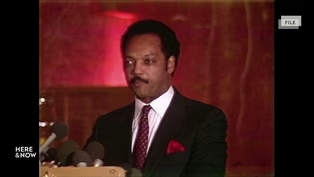
>> In other news, Reverend Jesse Jackson, the civil rights icon with strong Wisconsin connections, died this week.
Jackson visited Milwaukee and environs many times, advocating for civil rights and social and economic justice.
In the 1988 presidential primary election in Wisconsin, Jackson came in second in what the Milwaukee Common Council this week described as a barrier breaking run for the presidency, calling him a generational leader.
At the time, Jackson told The New York Times he was very proud.
He got so many white votes in Wisconsin.
Jackson marched in Milwaukee with Father James Groppi in the 1960s and was in Wisconsin most recently in 2020, for encouraging voter registration.
Reverend Jesse Jackson died at the age of 84.
>> In drugs and guns.
>> For more on this and other issues facing Wisconsin, visit our website at PBS Wisconsin and then click on the news tab.
That's our program for tonight, I'm Frederica Freyberg.
Have a good weekend.
.
>> Funding for "Here& Now" is provided by the Focus Fund for Journalism and Friends of PBS Wisconsin.
 New
NewEvers, LeMahieu Address Schools, Taxes at State of the State
Video has Closed Captions
Clip: S2400 Ep2432 | 1m 50s | Tony Evers and Devin LeMahieu speak to K-12 school funding and property taxes. (1m 50s)
 New
NewGrant Sovern on Changes to The US Immigration System's Rules
Video has Closed Captions
Clip: S2400 Ep2432 | 8m 48s | Grant Sovern on changes to the immigration system and for people applying for citizenship. (8m 48s)
 New
NewJudge Upholds Permit to Reroute Enbridge's Line 5 Pipeline
Video has Closed Captions
Clip: S2400 Ep2432 | 1m 13s | A judge rejected a challenge by the Bad River Band's to permits for rerouting Line 5. (1m 13s)
 New
NewThe Political Legacy of Rev. Jesse Jackson in Wisconsin
Video has Closed Captions
Clip: S2400 Ep2432 | 58s | Civil rights leader and presidential candidate Rev. Jesse Jackson died at 84 years old. (58s)
 New
NewZac Schultz on Speaker Robin Vos Retiring From The Assembly
Video has Closed Captions
Clip: S2400 Ep2432 | 4m 35s | Zac Schultz on Assembly Speaker Robin Vos announcing he will not run for another term. (4m 35s)
 New
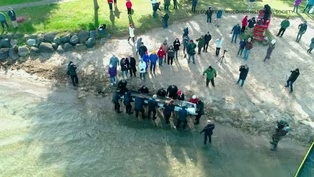
NewThe Epic History of Ancient Native Canoes in Lake Mendota
Video has Closed Captions
Clip: S2400 Ep2432 | 4m 27s | Ancient canoes are inspiring collaboration to preserve Indigenous history. (4m 27s)
 New
NewData Centers and Wisconsin's 2026 Candidates for Governor
Video has Closed Captions
Clip: S2400 Ep2432 | 5m 17s | Candidates in the 2026 race for governor on regulating the development of data centers. (5m 17s)
Providing Support for PBS.org
Learn Moreabout PBS online sponsorship
- News and Public Affairs

Top journalists deliver compelling original analysis of the hour's headlines.

- News and Public Affairs

FRONTLINE is investigative journalism that questions, explains and changes our world.












Support for PBS provided by:
Here and Now is a local public television program presented by PBS Wisconsin