Here and Now
Here & Now for June 12, 2026
Season 2400 Episode 2448 | 26m 46sVideo has Closed Captions
Watch the entire episode of Here & Now for June 12.
Watch the entire episode of Here & Now for June 12.
Problems playing video? | Closed Captioning Feedback
Problems playing video? | Closed Captioning Feedback
Here and Now is a local public television program presented by PBS Wisconsin
Here and Now
Here & Now for June 12, 2026
Season 2400 Episode 2448 | 26m 46sVideo has Closed Captions
Watch the entire episode of Here & Now for June 12.
Problems playing video? | Closed Captioning Feedback
How to Watch Here and Now
Here and Now is available to stream on pbs.org and the free PBS App, available on iPhone, Apple TV, Android TV, Android smartphones, Amazon Fire TV, Amazon Fire Tablet, Roku, Samsung Smart TV, LG TV, and Vizio.
Providing Support for PBS.org
Learn Moreabout PBS online sponsorship>> The following program is a PBS Wisconsin Original production.
>> A settlement over polluted water still leaves many left in the wake, and a wave of tax credits looks to alleviate a strained rental housing market as inflation costs surge.
[MUSIC] I'm Frederica Freyberg.
Tonight on "Here& Now", the real cost of cleaning up toxic forever chemicals.
Then the leader of the state's housing authority on helping fund affordable rental units.
We hear about the state of the state's health and the cost of state university tuition going up.
It's "Here& Now" for June 12th.
>> Funding for "Here& Now" is provided by the Focus Fund for Journalism and Friends of PBS Wisconsin.
>> After trading new airstrikes with Iran this week, President Trump suddenly announced a deal was imminent and could be signed this weekend.
This comes after inflation reached a new high since the conflict began.
Wisconsin's U.S.
senator spoke with WPR this week, responding to questions about high fuel costs and fertilizer prices for farmers.
>> A lot of them don't have the money right now to fill their tanks for planting season and then fertilizer.
Many of our farmers are having to do without the full complement of fertilizer that they need for their fields.
This is going to have ramifications for months and months to come.
And our farmers work harder than anyone I know.
So, you know, there may be a glitzy rally that the president holds in Wisconsin, but that does nothing to deal with the real harm our farmers and ultimately the American consumers of their products will have to deal with.
>> In June of 2022, because of President Biden and the Democrats policy, they're waging the war on fossil fuels.
Average gasoline prices were $5 a gallon.
Yeah.
I don't like the high fuel prices, the high fertilizer prices.
Nor does President Trump know, nor do any of us.
But I also recognize that what would be far worse is if Iran became a nuclear power and they wiped out our grid.
That would be orders and orders of magnitude worse as well.
So hopefully this is just short term pain.
It is painful, I recognize that, but that's why the sooner this war, the sooner we win this war, the better for everybody.
>> Tyco Fire Products reached a settlement this month with the state of Wisconsin to clean up PFAs contamination in Marinette County.
Tyco manufactured firefighting foam that spread the forever chemicals in soil and water.
The settlement requires Tyco to put $10 million into Wisconsin's PFAs Trust Fund for future cleanup.
Provide clean water in the Marinette area, including deep drinking water wells in a prescribed area for 20 years.
Monitor and report water quality within the 35mi!S that includes parts of the city of Marinette and the town of Peshtigo, and requires Tyco to remediate and restore the environment in soil, groundwater and surface water.
Another lawsuit against the company and others is ongoing for reaction to the PFAs settlement.
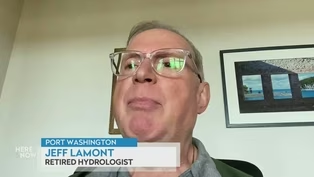
We turn to Jeff Lamont, a resident in Marinette and a retired hydrologist.
And Jeff, here.
you for having me.
>> So how long in coming was this settlement?
>> They found PFAs on their fire training facility three and a half to four years before they reported it to DNR, which violated the spills law.
And they let the community drink this contaminated water for four years before reporting it.
So, yeah, we're seven years in.
We were first informed of the contamination in November of 2017.
So it's almost been ten years.
>> But in your mind, this settlement barely touches the problem.
>> Yes.
So the settlements were not happy at all about because what it did, essentially it said there was the initial investigation area and then there was an expanded investigation area.
And for ten years the DNR had fought with Tyco about the responsibility beyond this essential first area that was investigated.
The contamination was the same.
I mean, we're talking in places where it's neighbors right across the street.
Well, we're going to take care of you on this side of the street.
But the other side of the street, that's not our contamination.
And this lawsuit limited their liability to just the initial investigation area and not the expanded investigation area or the 3000 acres of of contaminated biosolids that was spread in Marinette County.
>> But isn't the settlement a $125 million in state funding and potential of an ongoing lawsuit?
Starting point better than nothing.
>> It is better than nothing.
But if you want to put that in into perspective, Tyco has set aside $180 million just for this site.
So, I mean, we're just one of many, you know, dozens, if not hundreds in the state that are impacted.
So it really does not go very far.
And the deep wells Tyco has been putting in approximately $100,000 a piece.
So if you look at another $10 million, that might address another 100 wells in the community beyond the initial investigation area that are still contaminated with their PFAs.
>> So you have experience in large scale cleanups with the EPA.
What, in your experience should be happening?
>> Well, you know, I try to let the citizens of our community know that these are very, very long, drawn out processes.
I mean, a lot of the Superfund sites that I worked on had been in the gears for ten, 15, 20, sometimes 30 years before the remediation actually went into place or started.
And often these remedial efforts can take multiple years.
The, the Waukegan Harbor cleanup I did, we were there for 7 or 8 years from once we started the the project.
>> So can PFAs, these forever chemicals, can they be removed, remediated, make people safe.
>> They can be.
There's.
There's a number of technologies and as.
And as PFAs has become such a huge problem countrywide, a lot of companies have started to invest a lot of money in different techniques to clean up.
You know, Tyco chose, in my opinion, a very ineffective solution.
They did a pump and treat system to to remove shallow groundwater and treat it with granular activated carbon.
And, and, and resins.
And it can remove that.
But there are more practical ways.
They're more expensive.
They're reactive barrier walls are one that is being used a lot these days on Air Force bases and, and in different communities across the country.
But Tyco chose, in my opinion, a very ineffective method to address this.
>> Do you hold out hope that that this will be adequately remediated in Wisconsin?
>> Not a lot with with without significant, you know, outpour and outcry from the public.
It's just it's such a costly endeavor that unless there's a responsible party like we have Tyco Johnson controls, this is going to fall on the taxpayer.
And, you know, there's only so much resources in the state budgets for this kind of thing.
And like we talked about earlier, $135 million is kind of a drop in the bucket, really, but it is a starting point.
So I should be more optimistic, I guess, for that.
>> All right.
Well, we will leave it on that note.
Jeff Lamont, thanks so much.
>> Thank you so much.
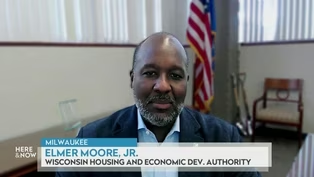
>> Affordable rental housing across the state is getting a boost with the Wisconsin Housing and Economic Development Authority announcing nearly $50 million in housing tax credits to developers that are expected to create rentals for up to 5000 people from working families.
For more on this, we are joined by WHEDA CEO Elmer Moore RFK, Jr.
Thanks very much for being here.
>> I am delighted to be here and share with you some of the good news of the work we've been doing.
>> Where is the need most acute for affordable rentals, and will these developments be located in those areas?
>> You know, an interesting thing about housing in today's environment is that it's acute everywhere.
The need for affordable housing is experienced in rural and small, urban and in the in the city centers.
And so wherever we can make strategic investments in in the form of housing tax credits across the state, they're going to be desperately appreciated.
>> And these developments and developers will be working across the state.
>> Absolutely.
It's 35 developments.
You know, one of the realities is that we have not seen a tax credit development in all 72 Wisconsin counties, but in in this instance, we're going to be looking at 26 communities across the state, which is actually pretty, pretty successful.
>> What is the definition of affordable?
>> I'm so glad you asked that.
And I'm going to give you two definitions.
When we talk about affordable housing, usually what we're referring to is what I refer to as capital A affordable, which means a subsidized housing development that is rent restricted to people with incomes 80% or below of the area median income.
These are often financed with tax credits or other public sources.
The other side of affordability is really just housing that occupies no more than 30% of a family's income.
So we have started a conversation about affordable housing with that capital A also housing that people can afford, which might be unrestricted.
But it's it's not necessarily as expensive as what we have historically called market rate.
>> I was just going to ask if this is a model that has worked historically.
>> The the light tech program, the low income housing tax credit program was a bipartisan effort from 1986.
This was Ronald Reagan's administration's work.
It is well understood as the most successful private public, private public partnership in in our country's history.
It has generated hundreds of thousands of rental housing units and homeownership units across the country.
For WHEDA alone, we're talking 61,000 units have been created using the the housing tax credit program.
You know, we have deployed.
Are you ready for this number, $644 million in just tax credits?
That has really moved the needle, and it has incentivized the investment of communities and developers in the form of housing across the state.
>> How does a lack of such kind of affordable rental units affect the economic health of the state, not to mention the needs of lower income renters?
>> That is playing out in the form of diminished health outcomes.
There's an aspect to educational outcomes.
Everything that we care about in our society is impacted by whether or not people have safe, stable housing.
If they can't afford the housing that they are occupying.
And very many people, something like 60% of renters are in housing that actually is considered unaffordable.
They are rent burdened.
The economic outcomes is they're not able to make very key investments in things that will support them thriving, whether that's childcare, investing in their own education, access to health care, whether it's the choice between paying rent or putting gas in your car so you can get to work on time.
Housing is at the very core of how we experience life.
>> Is it the expectation, though, that because of declining working age population, the need for new housing units like this will also decline?
>> Unfortunately, that There's multitudes of housing, whether it's senior housing, family housing, housing for people with special physical or cognitive needs.
In Wisconsin, 60% of the housing is more than 40 years old.
You know, I live in a house that's 120.
And I can guarantee you, when those craftsmen were building that structure, they didn't necessarily plan for me to be living in it.
120 years later, that's how housing has always been.
We are in a crisis because housing is unaffordable.
We aren't producing enough of it, and what we have is often aging out.
>> Well, Elmer Moore, we leave it there.
Thank you so much for joining us.
>> I'm so grateful.
Thank you for your time.
>> Turning to health news, 20% of Wisconsinites are self-reporting poor or fair physical health, and 1 in 7 say the same of their mental health.
This is according to the new state health assessment, which comes out every five years.
The Department of Health Services is looking for ways to fill in the gaps.
Steven Potter spoke with the state health officer, Paula Tran for Moore, beginning with what the report is measuring.
>> Overall, we are measuring the things that shape Wisconsinites health as well as the health outcomes.
So we're looking at things like demographic factors who lives in Wisconsin, where they live.
We're also measuring the main causes of death, and we're also looking at all of the factors that really shape an individual's ability to be healthy and well, like economic factors, looking at housing, looking at affordable access to resources that people need, like food and transportation, as well as their access to health care directly.
>> What are the most significant health concerns facing Wisconsinites?
>> Yeah.
Well, we know that Wisconsinites are dying younger than before the pandemic, and we know that there's a lot of challenges for Wisconsinites in accessing both the daily resources that they need to be healthy and well.
So healthy food, having safe, secure housing, having transportation to get them to where they need, as well as having good access to affordable care where they need it, when they need it.
>> One of the key points in your new report is that Wisconsinites feel that there are major obstacles to them receiving health care.
They need to be healthy.
What are those barriers?
>> Yeah, some of the barriers are costs, and access to insurance actually covers all the kinds of care that they need, and cost and insurance kind of go together.
And we know that most people access insurance through their employer.
So if they are experiencing gaps in employment, that might insurance and their for their access to care.
When we look at care directly, we know that in parts of our state, there are gaps in kinds of care.
So hospitals have closed over the last several years and more rural areas.
And even in urban areas, we're seeing clinics and other health care providers closed down or just just based on, you know, the challenges it takes to run a health care organization.
So both getting to care in a way that's accessible and access can be defined again, by cost, by being able to drive to the care or and also having the right kind of provider for the care you need.
>> A large number of residents rated their own health as poor or fair.
About 20% of residents said that.
Why are they feeling this way?
>> Yeah, it again, when we look at all of the challenges that Wisconsinites are facing, we know that overall costs are rising across not just health care, but all daily living needs.
So that is putting a stress on families.
And because our incomes are also being impacted and not rising as quickly for some, with the inflation of other costs, Wisconsinites are being forced to choose between these really important things that they need, whether it's putting food on the table with medications or accessing care because there's a co-payment that they cannot afford.
So all of those things are contributing to how Wisconsinites are feeling and to their health outcomes, that we continue to be challenged around obesity, obesity, hypertension that causes a whole host of chronic diseases.
So there are both the drivers of health that are causing more stress for Wisconsinites and accessing the things that they need to be healthy and well are also exacerbating and allowing other health outcomes to persist.
>> Along the lines of with mental health.
What did your report find?
>> Yeah, we know that Wisconsinites are struggling, they're experiencing stress, and they're also reporting that their mental health is is poor.
And when they need supports around mental health, it's very difficult to access the kind of mental health care that they need.
And we know our mental health care environment has a lot of room to improve around coordinating around different kinds of care, receiving the right referrals for the care you need, and all across the care continuum, making sure we are coordinated so that at any part of the entry of that continuum, folks are accessing early and not allowing some of those challenges to persist, to become worse and potentially be in crisis situations.
>> Your report also measures some good things.
Residents who vote, volunteer, or do favors for others.
Why is it important to measure these things and what did you find?
>> Yeah.
What the current evidence tells us is communities that are more engaged and active and connected to each other, the healthier those communities are.
It both helps from a mental health perspective.
But when in a community, a neighbor is in need of something, they're much more likely to be able to have community support be responsive to those needs.
So there's a lot of different reasons why community connectedness and community engagement and being civically involved helps a community stay healthier and access the resources it needs.
So that's an absolutely great finding for us that more Wisconsinites are feeling like they help others and others help them when they're in need.
>> The cost of attending University of Wisconsin schools is going up in the fall.
This month, the UW Board of Regents approved a 2% tuition hike for in-state undergraduate students, plus roughly commensurate increases in fees and room and board that will put UW-Madison at $12,416 on the high end, and UW Parkside at 8851 at the lowest price point.
It's the fourth tuition increase in a row after a ten year freeze.
In the midst of increasing cost pressures on families, how reasonable is the tuition hike?
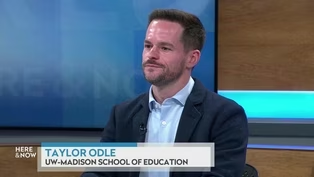
We're joined by professor in the UW-Madison Department of Education Policy, Taylor Odle, and thanks for being here.
>> Thanks for having me.
>> So a 2% tuition hike on paper seems really modest, but at a time, as we said, when people questioned the value of a college degree, does it turn some people away?
>> I think it's very important to acknowledge that a 2% increase is very real money for students and families.
I think at the same time, we also have to acknowledge that costs are going up for all of us, including organizations and businesses like the Universities of Wisconsin.
2% is relatively modest and predictable, and below the rate of inflation right now doesn't mean it doesn't, you know, have important conversations about dollars and cents at the end of the day.
But what students and families should really care about is the net price of college.
So when you quote that $12,000 or that $8,000, that's what we call the sticker price, what you see on the website.
But from that, we know people get grants and scholarships, and that pulls it down to what we call the net price, the check that you have to write at the end of the day to be able to enroll.
And that number has actually been relatively flat over the last several years because UW is taking money from these tuition back into financial aid.
>> With a 30% decline in highest paying international students and volatile federal research funding.
What is a university to do except use that tuition lever?
>> That's a great question.
UW the universities of Wisconsin have three primary revenue sources, right?
Federal grants, which we are among the top in the nation at securing.
We enroll students who pay tuition and fees, and we receive funding from the state.
State support has long stagnated, with the exception of a recent increase.
And so tuition dollars are a primary way of raising funds.
With a tuition freeze for many, many years, our ability to do that was hamstrung.
And so it quite literally strangled some of the campuses.
We benefit from having international students and even students from out of state who pay higher tuition rates because they can afford it.
They are mobile geographic for colleges with a decline in international student enrollment.
There aren't many other students that we can look to except for our in-state students, especially now because the state has begun to increasingly regulate our ability to even draw students from Minnesota and Iowa and other out-of-state partners.
>> So how kind of in jeopardy are the finances of the Universities of Wisconsin given all of these factors?
>> It's a very serious position, right?
We've already seen campus closures of many regional campuses.
We've seen cuts to academic programs.
We've seen staff and faculty restructurings.
And so no one wants to raise prices.
If you're a business owner, you don't want to walk out and show your customers raising prices.
The university doesn't want to do that either.
We want more people to access and have access to a college education.
Like you said, for upper social and economic mobility.
But when the state is no longer a primary funding partner, federal research and grants landscape is certainly uncertain.
Tuition is one of the only lovers left.
>> So some Republican state policymakers are super angry about this tuition increase, saying it's, you know, the fourth in a row after a state budget gave the system $256 million.
What about that persuasion?
>> Yeah, I think the average Wisconsinite should also be super angry about that characterization.
So 256 million is a big number and it's a very important investment.
It's however, a biennial increase.
So we have to divide that by two because it's going to be the 120 something million every year.
And just to put that in context, the university leverages its the state's largest public employer, and its operating budget is around $7 billion.
And so that increase is less than almost 1.5%, so substantially below inflation.
And more importantly, that $256 million came with a lot of important caveats.
Most importantly, an unfunded tuition or salary raise for faculty and staff across the institution.
So no other piece of state government has unfunded mandates in that same way.
So we're required to raise salaries by 2% for all faculty and staff.
But the state didn't put in the money to fully fund that raise.
And so the Regents have said that the tuition increase will predominantly fund faculty and staff salary increases mandated.
>> Well, that's another piece that some policymakers are unhappy about, because they say the number of staff has gone up, whereas the number of students has not.
>> So many people, when they think about staff increases on cross campus.
We use this federal survey where we report people in these huge buckets.
Do they teach?
Do they work?
Are they administrative in different ways?
It doesn't capture the granularity of what those staff are actually doing.
So if we hire more students to provide career exploration or oversee internships for students or help them get placements with employers, those are staff members and those are very valuable staff members.
I'd be happy to double or triple those numbers.
And so it's a really nuanced conversation, right?
Are there efficiencies to be had?
Of course, but we need to have better data and a more frank conversation around what staff are actually increasing.
>> All right.
Well, we leave it there.
Taylor Odle, thanks very much.
>> Thanks.
>> For more on this and other issues facing Wisconsin, visit our website at PBS wisconsin.org and then click on the news tab.
That's our program for tonight.
I'm Frederica Freyberg.
Have a good weekend.
[MUSIC] >> Funding for "Here& Now" is provided by the Focus Fund for Journalism and friends of PBS Wisconsin.
 New
NewElmer Moore, Jr. on Rental Housing Tax Credits in Wisconsin
Video has Closed Captions
Clip: S2400 Ep2448 | 5m 29s | Elmer Moore, Jr. on nearly $50 million in tax credits to build affordable rental units. (5m 29s)
 New
NewHere & Now opening for June 12, 2026
Video has Closed Captions
Clip: S2400 Ep2448 | 1m | The introduction to the June 12, 2026 episode of Here & Now. (1m)
 New
NewJeff Lamont on Wisconsin's PFAS Settlement with Tyco Fire
Video has Closed Captions
Clip: S2400 Ep2448 | 8m 33s | Jeff Lamont on terms of a settlement to address PFAS contamination in the Marinette area. (8m 33s)
 New
NewTaylor Odle on the Universities of Wisconsin's Tuition Hikes
Video has Closed Captions
Clip: S2400 Ep2448 | 5m 58s | Taylor Odle on what the Universities of Wisconsin increasing tuition means for the state. (5m 58s)
 New
NewWisconsin's U.S. Senators on War with Iran and Inflation
Video has Closed Captions
Clip: S2400 Ep2448 | 1m 48s | Tammy Baldwin and Ron Johnson on the war in Iran and effects on fuel and fertilizer costs. (1m 48s)
 New
NewPaula Tran on the Health Challenges Facing Wisconsinites
Video has Closed Captions
Clip: S2400 Ep2448 | 5m 52s | Paula Tran on findings of the 2025 State Health Assessment for Wisconsin. (5m 52s)
Providing Support for PBS.org
Learn Moreabout PBS online sponsorship New Episode
- News and Public Affairs

Top journalists deliver compelling original analysis of the hour's headlines.
 New Episode
- News and Public Affairs

Today's top journalists discuss Washington's current political events and public affairs.
 New Episode
 New Episode
 New Episode
 New Episode
 New Episode
 New Episode
 New Episode
 New Episode
 New Episode
Support for PBS provided by:
Here and Now is a local public television program presented by PBS Wisconsin