
“How Oligarchs Dominate Our Democracies”
Clip: 5/29/2026 | 17m 29sVideo has Closed Captions
Prof. Jeffrey Winters discusses how oligarchy fused with democracy in America in "The Blind Spot."
Political scientist Jeffrey Winters argues that, while the wealthy have dominated the masses throughout history, the gulf between oligarchs and the average citizen today is even greater than during Imperial Rome. In his new book, Winters points out one key difference: Today, this disparity is often achieved and maintained through democratic means. The author joins Hari Sreenivasan to discuss.
Problems playing video? | Closed Captioning Feedback
Problems playing video? | Closed Captioning Feedback
“How Oligarchs Dominate Our Democracies”
Clip: 5/29/2026 | 17m 29sVideo has Closed Captions
Political scientist Jeffrey Winters argues that, while the wealthy have dominated the masses throughout history, the gulf between oligarchs and the average citizen today is even greater than during Imperial Rome. In his new book, Winters points out one key difference: Today, this disparity is often achieved and maintained through democratic means. The author joins Hari Sreenivasan to discuss.
Problems playing video? | Closed Captioning Feedback
Where to Watch Amanpour and Company
Amanpour and Company is available to stream on pbs.org and the PBS app.
Watch Amanpour and Company on PBS
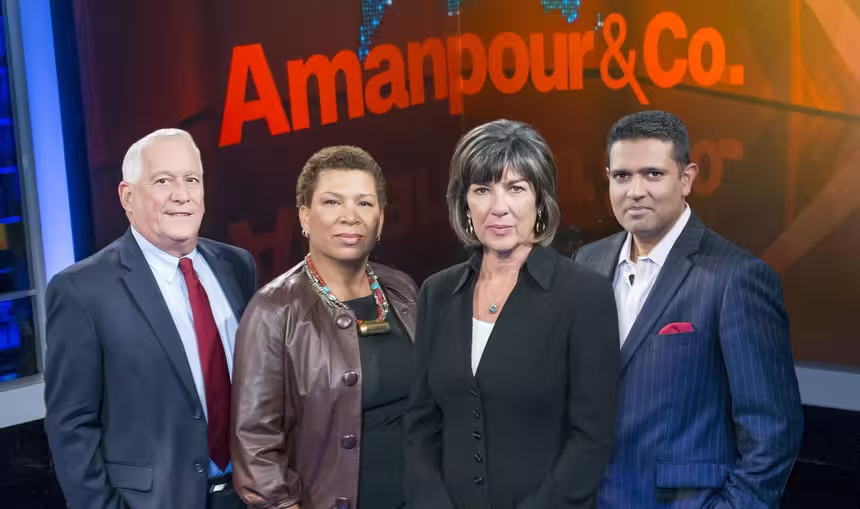
PBS and WNET, in collaboration with CNN, launched Amanpour and Company in September 2018. The series features wide-ranging, in-depth conversations with global thought leaders and cultural influencers on issues impacting the world each day, from politics, business, technology and arts, to science and sports.Providing Support for PBS.org
Learn Moreabout PBS online sponsorshipJeffrey Winters, thanks so much for joining us.
You've written a new book.
It's called "The Blind Spot, How Oligarchs Dominate Our Democracies".
I guess first, what's the blind spot?
Well, the blind spot is we live in a democracy where we see that democracy works in so many ways.
Think of it as among the non-rich.
If you were excluded as women, you struggle and you get in.
If you're excluded on the basis of race and ethnicity, there are so many ways in which democracy works horizontally among us.
We assume that because democracy works in those spaces, that it will also work vertically.
That is, with regard to inequality in our societies.
And in fact, that's not the case.
Our democracies are actually designed not to work vertically.
That was something that goes all the way back to the founding.
And so the blind spot really is about our collective assumption that we can actually address rising inequality through democracy.
And that's an incredibly hard thing to do.
In fact, we're going in the opposite direction, Hari.
We're, we're, strangely enough, over the 250 year course of American independence, we are vastly more democratic, and we are vastly more unequal.
In fact, now, democracies around the world are the most unequal societies ever to have existed in human history.
And that's, that's just shocking and it makes no sense.
Yeah, let's talk a little bit about the structure.
I mean, you're right that the rich dominate us not despite democracy, but through it.
How is the design itself flawed?
Yeah, so it's built in.
So think of it, think of it like this.
First of all, all of us have what might be called participation power.
This is the right to vote, voice, speech.
But some of us and that we distribute that radically equally one person, one vote.
Sure.
And that's the basis of the legitimacy of democracy itself.
And yet, that those are not the only kinds of power that operate in politics.
We also have wealth power, that's the power of oligarchs.
And that is not distributed at all equally.
And so the two systems are actually fused, they're actually woven together.
And one of the things that that oligarchs who were there before the rest of us in terms of governing, one of the things they were so worried about, as we came into the democratic era was, if there was power sharing with the many, basically, the power of the vote and the legislature would be used democratically and legitimately to redistribute wealth.
There was a great panic about that.
And in fact, if we go back to the convention of 1787, one of the things that the framers were struggling with was a clash at the time between democratic power, participation, and wealth power.
And they tried very hard to build institutions that would meld them together.
You're saying that even the framers in that constitutional convention were not interested in an actual rule by the will of the people?
Well, I wouldn't quite frame it that way.
Here's the dilemma they faced.
On the one hand, they were very committed to consent of the governed.
They were committed to freedom.
But they also recognized that there was a wealth pyramid in society and that they thought that that wealth pyramid was normal and just and they tried to say how is it that we can basically have both at the same time.
Consent of the governed, democracy, responsiveness and yet safeguards that are built in.
So they ran actually to Philadelphia in the middle of a crisis in the 1780s.
It was an economic crisis after the war.
And it was a debt crisis.
A lot of us don't remember that the first prisons in the United States were debtors prison.
So if you were in debt, and there was a lot of debt at the time to try to pay for the war, people were being thrown into debtors prisons.
And the response in the States was to give relief to the average farmer.
And the creditors oligarchs at the time were getting a haircut.
Part of the reason they actually gathered in Philadelphia was to say that that injustice of what the many were doing to the few had to be limited.
So when they gathered people like Hamilton, Madison, and a number of others all said, the first problem we need to deal with is there is an excess of democracy in the United States, we have to limit it.
And what did they do?
They said, the people get to vote on the House, the Senate, we didn't get to vote on and it was its job was to block the house in case any kind of threatening politic policies came up.
Yeah, and then they gave a veto power to the president in case those two institutions down below failed.
And then finally, they built five people in a Supreme Court who would be able to block the entire democratic process.
So that is their democracy?
Yes, but we have to understand it as being with limits.
So I call it in the book, participatory inequality is what we end up with.
Okay, what about the idea that listen, this one person, one vote is only as good as the people who actually show up?
What responsibility does low voter turnout have when it comes to either your local school board election or the presidential?
So participation is so incredibly important there's no doubt about it.
If people are going to be able to affect the kind of policies in their favor that help them, they've got to show up.
Actually, oligarchic power is very different.
Wealth power is set in motion.
It sets in motion others, what I call a wealth defense industry.
So actually, oligarchs can golf and do other kinds of things, and their wealth power is still working in their favor.
We all know that we get to vote on Election Day.
And then prior to that, we have an opportunity to vote in the primaries.
Prior to that is what might be called the wealth primary, which is two years before any voter ever gets involved.
And that's when candidates who want to be viable put themselves in front of oligarchs to try to get money so that they can go forward.
In essence, oligarchic power is filtering the choices we later get to have.
So whether it was Donald Trump or Kamala Harris, you're saying they both had to curry favor from the oligarchs to fund their campaigns to give them a shot at winning their party's endorsement.
Is that right?
Absolutely.
So what I'm describing here, you know, Joe Biden in his last speech from the Oval Office famously warned that oligarchy is rising in the United States.
What he didn't say is that, Hari, it's fully bipartisan.
And, in fact, Donald Trump raised 1.5 billion, Kamala Harris raised 2 billion.
The difference between the two is that a smaller number of really big political investors put their money in, I don't call them donors, because these are not donations, these are political investments.
They put their money into the Republican side.
On Kamala Harris's money poured in many, many more oligarchs at a smaller level, the biggest being around 50 million.
So it is it is unfortunately a bipartisan system.
And that explains also how it could be that over the last 50 years, whether it's Democrats or Republicans, inequality in the United States has been exploding.
So here, you know, you could see hyper capitalists say, this is just name calling.
This is what the market set up.
I and other people have won.
We are we have done the best.
We've innovated the best products.
We've made the best widget, so to speak.
And that's why we're wealthy.
What's wrong with that?
Yeah.
So one of the things we have to do is, is, is separate just pure wealth from the political influence that wealth buys.
And so Americans are actually quite tolerant of, of great inequalities in society.
When Bernie Sanders runs around and does his fight oligarchy rallies and so on, and he stands in front of the audience and he says, you know, we have millionaires and billionaires who are who you know wealth inequality, the audience doesn't go very crazy.
When he says that wealth is being used to distort democracy.
That's when people's sense of legitimacy gets offended.
They don't like the idea that wealth is turned into power, which is turned into outcomes that benefit tilt the system in favor of the few.
And so that that really explains how it is that we can be tolerant of difference.
Somebody's got a yacht, somebody's got a robot.
That doesn't necessarily offend everyone.
But if you start taking the fundamental principle of one person, one vote, and start saying, well, thanks to Citizens United, which has really thrown open the floodgates, we now have people who have the equivalent of millions of votes, what it amounts to in terms of their power and their influence.
That is why we're now talking about oligarchs, not in the Russian oligarch sense, but in the American oligarch sense.
And we haven't talked like this since the Gilded Age, since the Robber Baron Age.
And that's because although oligarchs have been there all the way along, the visibility of oligarchs today is so different, that it's impossible for the average American to say, well, are we are we in a democracy?
Or are we in an oligarchy today?
We had this Corporate Transparency Act that was supposed to be the bipartisan measure that increased our ability to see who's funding what.
You would describe that as kind of an anti-oligarchy piece of legislation, right?
What happened to it?
So the Corporate Transparency Act, one of the things that works in favor of oligarchs is that unlike you and me, all of our money on a W-2, on our wages, is completely transparent to the IRS.
But when money is made from money through shell corporations and trusts and foundations and placed in secrecy jurisdictions, it's not transparent.
So in Delaware, Wyoming, Nevada, and a number of other states, you can set up a shell corporation where what is called the beneficial ownership of it is not known.
So you can't tax that which you can't see.
And so one of the things the wealth defense industry in the United States does, lawyers, accountants, wealth management professionals, is make oligarchs help them avoid paying taxes.
And so the Corporate Transparency Act was put, was passed in the National Defense Authorization Bill.
And it basically said, there's gonna be a registry where we're gonna know every corporation and who owns it.
That got blocked in March of 2025.
And it was an incredible victory to sort of reduce secrecy and transparency toward oligarchs.
And it's been it's been reversed.
There's something called the tax gap.
Okay, this is the amount every year that the IRS is required to calculate.
And it's the difference between what the IRS expects it ought to be able to bring in given all its data and all of its records and what it actually brings in.
That number, that gap is now one trillion dollars a year.
Remember that our national defense budget is 900 million.
So this is more than our entire defense budget.
It's a massive number and who's not paying?
Well, it turns out that the average citizen, where the government knows every penny you've made, they basically cheat at about a 1% level.
Oligarchs cheat at a 55% level.
What they're doing is they're holding on to their money and they're making money on that money.
Is this pattern of this notion of oligarchy or inequality as a political outcome something that you see repeated in other societies besides the United States?
Yes.
So everywhere where there is dramatic wealth concentration and not just in the democracies but also in authoritarian states, that means that this small group of people have tremendous power.
How that plays out in each country is very different.
So for example, two countries that used to not have oligarchs because of, frankly, because of their revolutions, Russia and China, have an explosion of new oligarchs.
And the way one operates as an oligarch in China is very different from the way one operates as an oligarch in, in Putin's Russia.
But also, a lot of people maybe don't realize that very sort of quasi socialist countries like the Scandinavian countries, Norway, Sweden, and so on, who have extensive welfare cushions in their society, those societies have as much wealth concentration as the United States does.
In other words, what I'm saying is, the taxes that are collected to be able to create welfare in those Scandinavian countries are taxing the many, not the wealthy few.
They evade and avoid taxes as successfully as anyone else does anywhere.
All right, so let's talk about some of those changes.
What would you propose?
First of all, I would go back to what you mentioned earlier, something as fundamental as the Corporate Transparency Act.
It's already the law, but the Treasury Department has decided to exempt 99.9% of all firms from the law.
That was just an executive decision.
That is something that could be reversed.
We don't have to re-pass the law.
That's one.
There's another very simple law.
It's a policy called the Enablers Act.
It was blocked by one senator a few years ago.
It had bipartisan support.
What is the Enablers Act?
We all know that banks are required to know their customer.
This happens because of terrorism and everything else.
They wanted to be able to track the flow of money.
So oligarchs and others began to avoid banks and they went through wealth management professionals, family offices and all kinds of things.
Basically passed in all kinds of places.
Basically that law requires the same kind of reporting of suspicious activity.
Let me turn to something a bit more deep cutting.
Wealth taxes.
Here's what's interesting about wealth taxes.
What is the number one store of wealth for the average household?
And the answer is their home.
And it turns out, all of us are already paying a wealth tax every year on our homes.
And it's adjusted whether we sell the home or not.
That's how vicious the system is.
It is putting a wealth tax on all of us at the average level.
And including sometimes someone, you know, granny has lived in a house for 50 years, paid it off, has to sell it because the property taxes on the house keep going up.
Meanwhile, the main store of wealth for oligarchs is not their home, not their property, but their stuff and their financial assets and so on.
When you're taxed on your home, you're taxed not only on your equity, the part of it you actually own, you're taxed on the mortgage as well.
So we are taxing our debt.
That is an example of how the system is slanted in favor of the very wealthy and against the average citizen.
Jeffrey Winters, thanks so much for your time.
It's been a pleasure, thank you.
 New Episode
- News and Public Affairs

Top journalists deliver compelling original analysis of the hour's headlines.
 New Episode
- News and Public Affairs

Today's top journalists discuss Washington's current political events and public affairs.
 New Episode
 New Episode
 New Episode
 New Episode
 New Episode
 New Episode
 New Episode
 New Episode
Support for PBS provided by: