Prairie Sportsman
An Inspirational Hunt and Prairie Pothole Day
Season 17 Episode 4 | 27m 46sVideo has Closed Captions
Host Bret Amundson hunts ducks with John Kriesel and goes to the 42nd Prairie Pothole Day.
Host Bret Amundson hunts ducks with wounded Iraq War veteran, former Minnesota state legislator, radio personality, and motivational speaker John Kriesel; Prairie Pothole Day, an event connecting people with the outdoors, celebrates its 42nd year; and forager Nicole Zempel shows us how to identify the hedgehog mushroom.
Problems playing video? | Closed Captioning Feedback
Problems playing video? | Closed Captioning Feedback
Prairie Sportsman is a local public television program presented by Pioneer PBS
Production sponsorship is provided by funding from the Environment and Natural Resources Trust Fund and Shalom Hill Farm. Additional funding provided by Big Stone County, Yellow Medicine County, Lac qui...
Support provided by:


Prairie Sportsman
An Inspirational Hunt and Prairie Pothole Day
Season 17 Episode 4 | 27m 46sVideo has Closed Captions
Host Bret Amundson hunts ducks with wounded Iraq War veteran, former Minnesota state legislator, radio personality, and motivational speaker John Kriesel; Prairie Pothole Day, an event connecting people with the outdoors, celebrates its 42nd year; and forager Nicole Zempel shows us how to identify the hedgehog mushroom.
Problems playing video? | Closed Captioning Feedback
How to Watch Prairie Sportsman
Prairie Sportsman is available to stream on pbs.org and the free PBS App, available on iPhone, Apple TV, Android TV, Android smartphones, Amazon Fire TV, Amazon Fire Tablet, Roku, Samsung Smart TV, and Vizio.
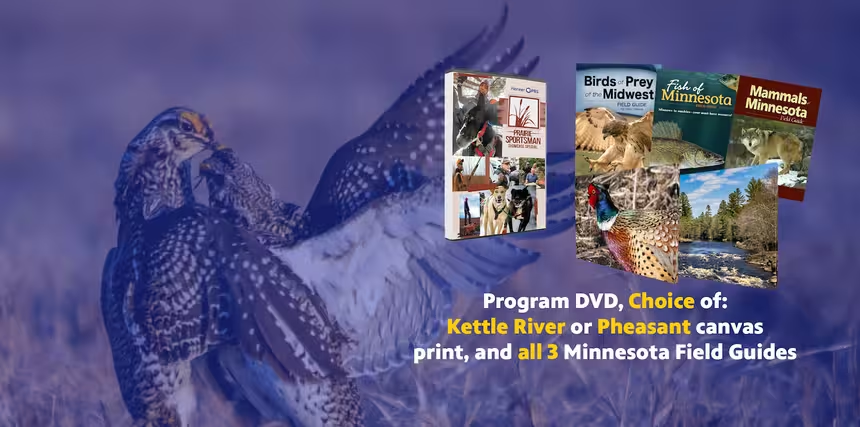
Prairie Sportsman Premium Gifts
To order, email yourtv@pioneer.org or call 1-800-726-3178.Providing Support for PBS.org
Learn Moreabout PBS online sponsorship(gentle music) - [Bret] Right there.
Right there.
Shoot them, John.
(gun fires) - [Bret] On today's "Prairie Sportsman," we go duck hunting with John Kriesel and hear his inspirational story.
- I was wounded near Fallujah, Iraq.
I promised to not waste this second chance at life.
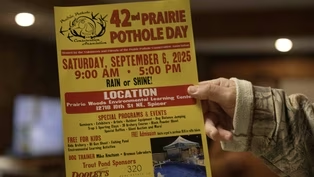
- [Bret] Then we visit Kandiyohi County for the 42nd Annual Prairie Pothole Day.
(water splashes) (people cheering) - [Dog Owner] Good boy!
- [Bret] And Nicole Zempel teaches us how to identify a hedgehog mushroom.
- This one has what's called teeth, and I just think that's so cool.
- Good job.
All right.
Welcome to another episode of "Prairie Sportsman," where we celebrate Minnesota's great outdoors.
(gentle music) - [Announcer] Funding for "Prairie Sportsman" is provided by the Minnesota Environment and Natural Resources Trust Fund, as recommended by the Legislative Citizen Commission on Minnesota Resources.
By Mark and Margaret Yackel-Juleen on behalf of Shalom Hill Farm, a retreat and conference center in a prairie setting near Windom, Minnesota.
On the web at shalomhillfarm.org.
And by the Friends of Prairie Sportsman.
To become a Friend of Prairie Sportsman, visit pioneer.org/prairiesportsman - [Bret] Right there.
Right there.
Shoot him, John.
(gun fires) Hit him again.
(gun fires) One more time.
(gun fires) - Come on.
- Oh no!
(both laughing) - Blair Walsh.
(both laughing) - Welcome to "Prairie Sportsman".
I'm Bret Amundson.
Minnesota National Guard Vet John Kriesel was severely wounded in Iraq in 2006.
Today he's a motivational speaker, a former member of the Minnesota House of Representatives, and spends his Friday mornings on "The Power Trip Morning Show".
We asked him to come duck hunting and tell us his story.
(light music) ♪ I know, I know, I know ♪ There's a place for me ♪ There's a place for me ♪ I know, I know - [Bret] Today we're in western Minnesota, setting up in a pond with some friends, including Tony Crotty from Midmigration Outfitters.
Do you need earplugs or anything?
- I suppose.
- I got some extra ones.
- [John] I suppose I'll do.
Save what hearing I have left.
- [Bret] I'm a big proponent of hearing protection.
- [John] I used to not.
Why not?
There's ducks coming in now.
(duck quacking) ♪ Getting started - Right, go ahead and get them.
- Go ahead and shoot, John.
- Shoot, shoot, shoot, shoot.
- [Bret] Take one out.
(gun fires) Heck yeah.
- [John] Yeah.
- [Tony] Nice shooting, John.
(gun fires) ♪ We're just getting started - Love it.
- That bird.
- It's a good problem to have is saying- - Back.
- [John] "Which one am I gonna shoot at first?"
- [Bret] Where is it?
Left side?
Okay.
- [John] Yeah, I think it fell right about there.
- She should be on it now.
I mean, duck hunting is like that, right?
You get out here, you get set up, and before you can even try to start a TV show, there's ducks bombing into the decoys.
So it's been a great morning so far.
John Kriesel is out here with us.
And John, this is the second time you've ever duck hunted?
- Yep.
- What do you think?
- Love it.
- Yeah?
- Yeah.
- It's fun.
- I love the pace.
- It can be- - A lot of action.
- It can be crazy.
- Mm-hm.
- The pace can be sometimes too fast.
He's gonna come around.
- [John] Okay.
(duck call blowing) Beautiful.
(light music) (duck quacking) - Well, that was a surprise.
- Yeah.
- Yeah.
- My full-time job is I'm the director of veteran services for Anoka County, so I help veterans get VA benefits.
Very rewarding job.
It's awesome.
I also travel, telling my story, overcoming adversity, motivational speaker type stuff.
And then bought part of Northland Vodka.
So that's become a part job.
And my weekly appearance on KFAN.
So it's- - Three and a half jobs.
- Three and a half jobs.
Yep.
For half of a person.
- For half of a person.
(upbeat rock music) (duck call blowing) (duck quacking) (upbeat rock music) (duck quacking) (upbeat rock music) - All right, go ahead and shoot them ones up front.
(gun fires) Nice.
(gun fires) - Well.
Did that first one go down or just the second one?
- I think just the second one.
- Back?
- Yeah, I didn't hit one.
- You hit one.
Did anybody else shoot?
- Yeah.
- Yeah.
- [Bret] Oh, okay.
It looked like you tickled that first one, at least.
- I think.
Yeah, I saw something, but it wasn't gonna... - All right.
- That's probably gonna be our shot.
- That's fun, huh?
- Getting some shooting in.
- Yeah.
- Yeah.
- They're doing it perfect.
That's awesome.
- I like my percentage at the beginning, though.
(both laughing) - One for one.
- Yeah.
- You know, usually, when we take people out like this, we always do, like, a safety talk.
Make sure they know their way around firearms.
Have you shot a gun before, John?
- Couple times.
Couple times.
- Couple times?
First of all, thanks for your service, man.
- Thank you.
- Appreciate that.
You were in the guard here in Minnesota?
- Yep.
- Okay.
Tell me about your service.
- 10 years.
So I joined on my 17th birthday 'cause I knew when I was 10 years old and saw the first Gulf War on TV, that's when I was like, "That is what I wanna do."
Then 9/11 happened.
And deployed to Kosovo.
And then the whole time in Kosovo, we kind of felt guilty 'cause we weren't in any danger.
We were doing important work, keeping peace in an area that hadn't had it for a long time.
But we would always see the news updates of Iraq and Afghanistan, and we were an infantry unit.
When our unit got back, my contract was expiring, but one of my buddies called me (clears throat) and said that there was a deployment to Iraq on the docket.
And so I reenlisted.
And then those of us who had been in the Kosovo deployment, the guard couldn't make us go on the Iraq deployment 'cause we hadn't been home long enough.
But you can sign a waiver to waive that- - Oh, really?
- Period.
And me and a bunch of those guys, probably around 20 of us, had said, "We're not gonna sit back at fort living room."
So we signed that, the CO-T TAD waiver, ended up in Iraq in 2006 during a pretty, pretty busy time there.
- Yeah.
(somber music) - I was wounded on a combat patrol near Fallujah, Iraq, on December 2nd, 2006.
We drove over a 200-pound bomb that killed two of my best friends, Corey Rystad from Red Lake Falls, Minnesota, and Brian McDonough from Maplewood, Minnesota.
And I don't remember flying through the air and I don't remember landing on the ground, but I remember waking up on the ground.
I didn't, I hadn't yet opened my eyes, but I heard rocks falling, rocks hitting the ground, rocks hitting metal.
It sounded like a large hailstorm.
I heard my buddy yelling, "What's going on?
What happened?
Where's Brian?"
And I felt myself start to get very, very cold.
Like coldness creeping through my body.
I don't think it takes a trained EMT to realize that a good Minnesota boy on an 80-degree December day in Iraq should not be feeling cold.
So I was pretty sure things were wrapping up.
So I remember praying hard, wanting to survive.
I mean, I said, "Tell my family I love them."
I woke up eight days after the blast.
And like, during that time, I had been shocked back to life three times.
I didn't expect to survive.
I mean, laying on the ground, seeing the injuries, there's no way.
So when I woke up, and the medically induced coma medication was wearing off, and I realized that I was alive, I was so thankful just to be alive.
Hearing that my friends had been killed at that moment was like, I have nothing to complain about.
The same incident they were in, I survived.
So I promised to not waste this second chance at life.
(light music) ♪ Oh, I know, I know ♪ What's meant for me (gun fires) ♪ There's a Northern star ♪ Where you are ♪ That I follow - [Bret] You ever shot a goose?
- [John] With a golf ball.
(both laughing) ♪ I know, I know, I know ♪ There's a place for me - So, as a radio guy, I always like hearing how people get into radio.
And as somebody that actually spent some time working at KFAN back in the day and then running a KFAN station in Fargo.
And then, you know, just being a fan of KFAN and "The Power Trip" in general, like, I mean, me and half the world right now.
That show is a monster.
- It is.
- It's crazy how big it's gotten.
- It is a blast to be a part of, for sure.
- Sounds like so much fun to be in that room.
How'd you get to be a part of that?
- When I was at Walter Reed, about, it was close to six months after I had been wounded, my friends were having a fundraiser to help make my house wheelchair accessible.
And the National Guard PR guy brought me around when I was on "The Power Trip".
We just hit it off.
Chris Hawkey said, "When you're back in Minnesota for good," 'cause the estimate was that I was gonna be in the hospital for two years.
'Cause he said, "Let me know when you're back and we'll have John Kriesel Week."
- [Bret] John ended up spending nine months at Walter Reed having 35 surgeries and has now been on "The Power Trip Morning Show" for 17 years.
Just a year and a half after returning home, John was talked into running for a seat in the House of Representatives.
He won.
- I served one term, and then decided not to run for reelection.
I promised myself, I promised my friends that I would not change who I was and I'm gonna get out before that can happen.
And it was, I left at the right time because people were like, "We wanted you to run again.
We wanted you..." - Yeah.
- And that's the perfect time to leave.
- [Bret] After his short political career came to a close, more and more people were learning about what he went through.
He was then asked to speak at a fundraiser.
- They had a huge turnout.
They raised a bunch of money.
It was awesome.
And as I was walking to my vehicle afterwards, a gentleman named Jim Cosmo, I saw a guy kind of following me, and he was like, "Your story is amazing.
It should be a book, and I wanna write it."
- [Bret] During some promotional book tours, John found a way to communicate to an audience that not only helped them understand his story, but helped him heal.
- When I'd get a little choked up about it, that I would inject humor.
And that was for me.
But I saw the audience be relieved and laugh too.
And that's when I thought, "Okay, I think we're onto something here."
If I can inject humor to make sure that the audience is able to walk away uplifted and inspired.
I already believe what I did over there and what my buddies did was worth it.
This makes it even more worth it.
You gotta laugh.
Sometimes things get so bad, as a Vikings fan, understanding that as well, that all you can do is laugh.
♪ I know, I know, I know ♪ There's a place for me - And you don't have to be at one of those events to appreciate a morning like we had out here today.
- My goodness.
This was awesome.
This was a highlight of my year.
- Oh.
- Really, this was one of my highlights of the year.
'Cause it's been a good year, but just- - That's awesome.
- Getting out here before the sun came up, taking a break from all those things we talked about.
I have a very busy life.
- Yeah.
- Which is awesome.
I wouldn't change it for the world.
It makes me 100 times more appreciate a morning like this.
Not just the stuff I've been through in my life too, but sitting out there with... I didn't know any of you guys before this, but I feel like I've known you guys for years.
You know, a morning in the field.
Didn't know if that was a booger or what.
Just hanging.
Or if it was a bug.
A picture perfect morning.
- It was fun.
And you even hit a couple.
- I did.
I did.
Yep.
A broken clock even works twice a day, right?
- [Bret] John's story is inspiring.
It'd be easy to be mad about his circumstances, but he isn't.
His positive outlook on life is infectious.
- I'm not wired to be like, "I wish this didn't happen."
'Cause of course I wish it didn't happen, but I know I can't change that.
So I don't ever dwell on that kind of a wasted energy, wasted thought.
I really am thankful for the lessons I've learned.
In a weird way, because I wouldn't have this perspective- - [Bret] Yeah.
- If I hadn't gone through what I did.
I know not to take simple moments like sitting in a duck blind, watching a sunrise.
That's special to me, you know?
♪ There's a place ♪ For me ♪ There's a place for me ♪ Oh, oh, oh, oh (light music) - [Troy] I would say it's probably one of the best kept secrets in Western Minnesota.
- The hedgehog, pretty easy, right?
If it smells fruity and it's got the teeth.
Also, the stem is very, like, thick and it is white.
- Come on.
(upbeat music) (water splashing) (upbeat music) - Prairie Pothole Days has been going on for 42 years.
This is our 42nd annual event.
Just people getting out in the outdoors.
- [Bret] Prairie Pothole Day dates back to the early 1980s, when a group of five avid outdoorsmen from the Willmar area were looking to start an outdoor educational event that would serve as a fundraiser for waterfowl.
- Prairie Pothole Day was started by Roger Strand, Jim Boyer, Dave Lais, Phil Iverslie, and John Lindstrom.
They had started with another waterfowl organization, and they were raising money for waterfowl.
And they had learned that most of the proceeds that they were raising were leaving the state of Minnesota.
And they wanted to do projects that would stay local, stay in Kandiyohi County, and improve the waterfowl habitat for Kandiyohi County and the local surrounding counties.
(light music) So we don't charge an admission.
It's completely free to come.
So, from our concessions, our raffles, our silent auction, and our donations is where we raise all of our funds.
- [Bret] For decades, the event took place on the property of one of the event's founding members, Willmar area physician, Dr.
Roger Strand.
- Roger was instrumental.
He was the driving force.
When you think of a man opening up his 600-acre farm.
And he invited 4,000 of his near and dearest guests to come out and then spend the day on his property.
I don't think you'll ever find another person that would do that again.
And then not charge an admission.
And it was all about the youth and education to get people to learn about the outdoors.
- [Bret] For Dr.
Strand, his personal connection to the outdoors began early in life.
- We spent all our summers, from the time I was not quite one year old, on Green Lake, on the north shore of Green Lake.
My dad was born in New London and my mother in Willmar, so they're Kandiyohi County folks.
But we went to school in Minneapolis.
And my dad made his living there in business.
But as soon as school was out, we'd get in the car.
We'd spend less than a day there.
My folks thought we might, maybe they thought we might get into trouble in the big city, but really what they wanted us to do is grow up in the outdoors.
And both my mother and dad were really interested in the outdoors and loved Northern Kandiyohi County.
- [Bret] In addition to hosting Prairie Pothole Day, Dr.
Strand visited schools to share his knowledge of waterfowl.
It was during one of these visits where he made an impression on Troy Heck, a student at the time.
- He was teaching about wood duck boxes.
And I said, "Well, there's no wood ducks left."
And he's the one that said, "Well, if there's no wood ducks left, you need to start putting up wood duck boxes and raise wood ducks, because they're a homing bird."
And I wanted to shoot more ducks.
I didn't wanna raise ducks, I wanted to shoot ducks.
But I learned if I didn't raise the ducks, I didn't shoot the ducks.
So the more I learned from Roger on ducks, the more I hung out with him.
The student from hanging out with Roger became the teacher.
I actually go to the schools and teach now.
I like to do it because I'm teaching the next generation.
- [Bret] Over the decades, Prairie Pothole Day introduced thousands to the outdoors and conservation and helped restore habitat for waterfowl.
But after thriving for years, the organization faced trying times.
(gentle music) - A couple years ago, Prairie Pothole Day was almost to the point where it wasn't gonna exist anymore.
Unfortunately, Roger passed.
You know, as we all get older, Roger passed.
And we didn't know what was gonna happen to the property.
We were already in motion to have our 40th anniversary.
So they allowed us to have that one.
So then we were scrambling to find a new piece of property.
And Prairie Woods Environmental Learning Center stepped up.
Another great resource in the area.
And then our president, Tom Hanson, unexpectedly passes away.
And we had a lot of committee members that were just in their 70s and late 80s or early 80s.
And we were struggling to find the next generation.
And we put out a radio ad that said, "If you wanna see Prairie Pothole continue on, come to this meeting."
- [Bret] By chance, Lee Wierschem, a longtime conservationist and friend of Roger Strand had his radio on.
- 'Cause I heard it on the radio, that they were gonna maybe be folding.
And I didn't realize that they were getting that close to not having another event.
It was important to me not to see that go away, you know, because it's so good for the community.
And so that's what got me going.
So my wife okayed it.
Then there was one more bigger one.
I just retired two years ago.
And my grandchildren, they knew I was gonna start attending all their games and stuff.
They were both active in sports.
And so when I had to ask them, "Do you mind if I do it?"
And they said, "Okay.
For one more year."
And so I got the okay.
And that's what got me going into this position.
(light music) My main objectives were to have a successful event, keep the program going, find new board members, and put some more gas in the old ones, and find a new president.
And this Charlie Koch that we got now is just a gung ho guy, and he's all for it.
His family's for it.
- Charlie Koch here at Prairie Pothole Day.
We are gonna be at our event here today, taking a look at everything we got going on.
I appreciate everybody coming out and having a great time with us here.
So let's start by walking through and taking a look at what we got.
(upbeat music) Great volunteers helping us out here today.
And we just can't thank them enough for coming out.
(upbeat music) We have kids' archery here.
So any kid, you don't gotta be experienced.
Long as you can pull the bow back, maybe even a little help from a parent or a guardian, you can jump in and give her a shot.
(upbeat music) Okay, well, over here, we have our own little barn, where we have silent auction items set up in.
A lot of these are just Prairie Pothole specialty items.
(upbeat music) So many things here that I just love and enjoy.
And one thing that you're not gonna see a lot of people out here doing is kids on devices.
You're not gonna see cell phones out and about or iPads.
The kids are out here having fun.
They're eating food.
They're climbing the rock walls.
They're playing the games.
You name it.
- [Lee] We have ax throwing, BB gun shoot for the kids.
- [Visitor 1] Perfect.
- We have a 3D archery for the older people to go around out in the woods and hit 3D targets.
That's always an exciting one.
Just a lot of fun and games out there for the kids.
We have a new one this year.
It's the trout pond, where the kids can go in there and catch rainbow trout.
It's catch and release.
I think that's gonna be a big hit this year.
- We're out here at Prairie Pothole Days, putting on a trout pond.
We put on many of these throughout the year.
And we're just happy to be here putting rods in kids' hands and helping them to catch fish.
- [Bret] While the trout pond is a new addition, another event has been a Prairie Pothole Day fixture for years.
It's one that's very close to Lee Wierschem's heart.
- I was a dog trainer for 30 years, and so I always liked the dog events.
We have a dog jump out there, where they see how far they can leap off the dock when they throw a retrieving dummy.
(water splashing) (people cheering) - [Dog Owner] Good boy!
(ears flapping) - [Visitor 2] It's nice of him.
- [Visitor 3] It is.
It is kinda (indistinct).
- [Bret] While many Prairie Pothole Day events have remained constant, Troy Heck has noticed a change in the events attendees over the years.
- I remember being a small child at the very first Prairie Pothole Day.
I was running around, spending my dad's money.
And the reason I say my dad's money, it was father and two sons getting ready for duck hunting season.
Now, I see a lot of moms, I see a lot of girls, I see a lot of families.
I think it's huge that it's that way, because some of the parents are not hunters or not fishermen.
My daughter has a good friend.
She comes from a non-hunting family, doesn't own guns, but she'll come here, grab a pheasant hunting gun and go pheasant hunting with my daughter.
And her parents are okay with it, but they just don't hunt, they don't fish.
So to me, that's the key and the cool part of Prairie Pothole Day is it's getting the people outdoors.
- Myself, I'm an avid sportsman.
And so just being out in the wild has just been fun for me all my life.
And knowing what we're contributing, leaving a legacy on for our children, that's what's important for me.
(light music) (upbeat music) (light music) - Okay, so I'm really excited about this.
I stumbled upon a beautiful fruiting patch of what is commonly called the hedgehog mushroom or the sweet tooth.
Sweet tooth conjures up images of kind of like fruitiness and desserts.
And that is one of the things that the hedgehog or sweet tooth mushroom can be used for.
But also, it's great in pastas.
And it's very similar to a chanterelle, which we were also lucky enough to stumble on some of those.
So the hedgehog or sweet tooth, oftentimes, foragers will find them both growing kind of in similar areas.
Mossy areas, hardwood.
So like elm, ash, bass wood.
And both mushrooms are actually mycorrhizal.
And that means they are growing in relationship with certain trees, or host trees, and they're sharing nutrients back and forth.
Both mushrooms, once you get to know them, they're very easy to identify.
And one of the telltale signs actually of both, and I'm actually gonna put the chant down 'cause we are talking about the lovely hedgehog mushroom.
If you smell it, it's got kind of that fruity smell.
Also, what's really fun and cool, mushrooms have so many different things going on underneath of their cap.
And what is underneath of their cap is part of how to ID a mushroom.
This one has what's called teeth, and I just think that's so cool.
And then for a chanterelle, they have what's called folds.
They grow in kind of dense patches, but then they will grow, like, as a single mushroom.
But they're very near their sibling mushrooms.
Both are excellent in pasta dishes, dessert dishes.
I actually make a really great cake.
And something to note as well, there are different growth stages of mushrooms.
They do grow fast, but they could look different a little bit at every stage of their life.
And so getting to know those mushrooms is so important.
Now, the hedgehog, it's pretty easy, right?
If it smells fruity and it's got the teeth.
And then also the stem is very, like, thick and it is white when you slice it open.
Chanterelles also, I mean, they look very different at different growth stages.
So just get to know your mushrooms.
Check multiple ID books.
You could do a spore print.
I mean, you can back that up by calling somebody you might know that knows about mushrooms.
So again, one of my favorites and a super, super fun find, he hedgehog mushroom, aka sweet tooth.
(gentle music) - [Announcer] Funding for "Prairie Sportsman" is provided by the Minnesota Environment and Natural Resources Trust Fund, as recommended by the Legislative Citizen Commission on Minnesota Resources.
By Mark and Margaret Yackel-Juleen on behalf of Shalom Hill Farm, a retreat and conference center in a prairie setting near Windom, Minnesota.
On the web shalomhillfarm.org.
And by the Friends of Prairie Sportsman.
To become a Friend of Prairie Sportsman, visit pioneer.org/prairiesportsman.
(gentle music)
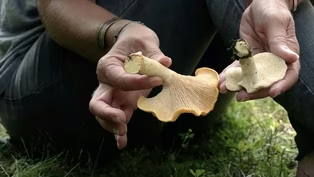 New
NewFast Forage: Hedgehog Mushroom
Video has Closed Captions
Clip: S17 Ep4 | 3m 24s | Forager Nicole Zempel explains introduces us to the Hedgehog Mushroom. (3m 24s)
An Inspirational Hunt and Prairie Pothole Day
Video has Closed Captions
Preview: S17 Ep4 | 30s | Host Bret Amundson hunts ducks with John Kriesel and goes to the 42nd Prairie Pothole Day. (30s)
 New
NewVideo has Closed Captions
Clip: S17 Ep4 | 12m 1s | Host Bret Amundson invites John Kriesel on a duck hunt in western Minnesota. (12m 1s)
Video has Closed Captions
Clip: S17 Ep4 | 10m 3s | We visit Kandiyohi County for Prairie Pothole Day, a unique fundraiser for waterfowl habitats. (10m 3s)
Providing Support for PBS.org
Learn Moreabout PBS online sponsorship
- Science and Nature

Explore scientific discoveries on television's most acclaimed science documentary series.

- Science and Nature

Capturing the splendor of the natural world, from the African plains to the Antarctic ice.











Support for PBS provided by:
Prairie Sportsman is a local public television program presented by Pioneer PBS
Production sponsorship is provided by funding from the Environment and Natural Resources Trust Fund and Shalom Hill Farm. Additional funding provided by Big Stone County, Yellow Medicine County, Lac qui...