
January 1, 2026 - PBS News Hour full episode
1/1/2026 | 57m 46sVideo has Closed Captions
January 1, 2026 - PBS News Hour full episode
Thursday on the News Hour, dozens are killed in what Swiss leaders call one of the worst tragedies in their history. As wealth becomes more concentrated among the richest Americans, how a new class of billionaires is seeking outsized political influence. Plus, why even those who aren't sports fans should pay attention as college football teams are about to enter another wild phase.
Problems playing video? | Closed Captioning Feedback
Problems playing video? | Closed Captioning Feedback
Major corporate funding for the PBS News Hour is provided by BDO, BNSF, Consumer Cellular, American Cruise Lines, and Raymond James. Funding for the PBS NewsHour Weekend is provided by...
Support provided by:

January 1, 2026 - PBS News Hour full episode
1/1/2026 | 57m 46sVideo has Closed Captions
Thursday on the News Hour, dozens are killed in what Swiss leaders call one of the worst tragedies in their history. As wealth becomes more concentrated among the richest Americans, how a new class of billionaires is seeking outsized political influence. Plus, why even those who aren't sports fans should pay attention as college football teams are about to enter another wild phase.
Problems playing video? | Closed Captioning Feedback
How to Watch PBS News Hour
PBS News Hour is available to stream on pbs.org and the free PBS App, available on iPhone, Apple TV, Android TV, Android smartphones, Amazon Fire TV, Amazon Fire Tablet, Roku, Samsung Smart TV, and Vizio.
Providing Support for PBS.org
Learn Moreabout PBS online sponsorshipLISA DESJARDINS: Good evening.
I'm Lisa Desjardins.
Geoff Bennett and Amna Nawaz are away.
On the "News Hour" tonight: Dozens are killed in what Swiss leaders call one of the worst tragedies in their history.
As wealth becomes more concentrated among the richest Americans, how a new class of billionaires is seeking outsized political influence.
And college football teams are about to enter another wild phase.
Why even those who aren't sports fans should pay attention.
STEWART MANDEL, "The Athletic": I don't think it's ideal for anybody, including the players and their education, to be able to transfer to four or five different schools over the course of their career.
(BREAK) LISA DESJARDINS: Welcome to the "News Hour."
Some 40 people are dead and more than 100 injured, many seriously, after a fire tore through a bar in the Swiss mountain town of Crans-Montana on New Year's just hours after midnight.
Authorities have ruled out a terror attack, but the cause of the fire is still under investigation as the Swiss face a devastating scene.
This was the scene outside Le Constellation, where Swiss authorities say a massive blaze broke out in a packed and popular ski resort bar just after 1:30 a.m.
on New Year's Day.
SAMUEL RAPP, Witness (through translator): There were people screaming and then people lying on the ground probably dead.
LISA DESJARDINS: Many had gathered there to ring in the new year, when the celebration turned suddenly to chaos.
NATHAN HUGON, Witness (through translator): I'm still in shock.
I can't comprehend what happened.
I saw people being resuscitated.
I saw people completely burned.
I saw people dying.
LISA DESJARDINS: Today, as investigators combed through the rubble.
Officials said it will take days to identify all of the victims and that it is still too early to determine the cause of the fire.
But officials say flames likely triggered a sudden back draft explosion.
Eyewitnesses described a rush of people trying to escape a basement bar through a narrow bottleneck at the top of the staircase.
LAETITIA PLACE, Fire Survivor (through translator): The first stairs are pretty easy to get through since they're wide and all that.
But after that, there's a small door where everyone was pushing.
And so we all fell.
We were piled on top of each other.
Some people were burning and some were dead next to us.
LISA DESJARDINS: In the early morning hours, casualties quickly filled local hospitals and some of the injured had to be flown by helicopter or jet to other cities, where doctors raced to stabilize the burn victims.
Those who were there described a desperate scene.
NATHAN HUGON (through translator): I saw people pushing each other, falling down the stairs in a frenzy to escape.
Some were being trampled.
And I know that some couldn't get out and unfortunately died inside.
LISA DESJARDINS: Only adding to the sense of tragedy, most of the victims were young people.
Swiss President Guy Parmelin called it one of the worst disasters in his country's history.
GUY PARMELIN, President of Switzerland (through translator): The events that took place in this public establishment last night constitute a disaster of unprecedented and horrifying scale.
Behind these numbers are faces, names, families, destinies brutally cut short or forever shattered.
LISA DESJARDINS: This morning, as a procession of vans made their way toward the scene of the blaze to transport bodies, the small town was still in shock.
Residents and first responders alike are struggling with hard questions and simple disbelief.
Also today, New York City swore in its new mayor, Zohran Mamdani.
In his first address, he pledged to govern -- quote -- "expansively and audaciously."
SEN.
BERNIE SANDERS (I-VT): I, Zohran Kwame Mamdani... ZOHRAN MAMDANI (D), Mayor of New York City: I, Zohran Kwame Mamdani... SEN.
BERNIE SANDERS: ... do solemnly swear... ZOHRAN MAMDANI: ... do solemnly swear... LISA DESJARDINS: Vermont Senator Bernie Sanders administered the oath of office at a ceremony outside City Hall.
The independent senator from Vermont, a self-described Democratic socialist, is one of Mamdani's political heroes.
The new mayor is the first Muslim to hold the office and at 34 is the youngest in generations.
Mamdani ran on a platform of affordability, pledging free childcare and buses for New Yorkers.
He has become a lightning rod for conservative critics, though he vowed to stick to his beliefs.
ZOHRAN MAMDANI: I was elected as a Democratic socialist and I will govern as a Democratic socialist.
(CHEERING) ZOHRAN MAMDANI: I will not abandon my principles for fear of being deemed radical, because, no matter what you eat, how you pray or where you come from, the words that most define us are the two we all share, New Yorkers.
LISA DESJARDINS: Today's celebrations came after Mamdani was officially sworn in as mayor just after midnight last night in a private ceremony at a decommissioned subway station near City Hall.
In Iran, growing protests over the economy have now turned fatal, with at least six people reportedly killed.
Images from inside Iran have been hard to come by, but eyewitness videos this week show scenes like this one of protesters trying to force their way into a government building in the southern Fars province.
The protests come as the country's inflation rate has spiked, driving merchants to the streets in Tehran and other cities.
They're the biggest since 2022, when the death of 22-year-old Mahsa Amini while in police custody triggered nationwide demonstrations.
Russian officials say a Ukrainian drone strike killed 24 people and wounded at least 50 others in a Russian-controlled part of Ukraine's Kherson region.
Moscow claims that three drones hit a cafe and hotel in the town of Khorly on the Black Sea coast.
Ukrainian officials insist they only target military sites.
The attack comes amid a ratcheting up of violence between the two sides, even as diplomats try to move forward on peace talks.
Millions of Americans are facing higher health care costs today after enhanced tax credits connected to the Affordable Care Act expired overnight.
A battle over the subsidies led to a 43-day government shutdown this past fall.
A House vote is expected later this month, but its outcome is uncertain.
Separately today, new restrictions on so-called SNAP benefits are taking effect in five states, including Indiana, Iowa and others.
They limit beneficiaries from buying soda, candy and other items.
In California, a new wider ban on plastic bags at grocery stores and other retailers has gone into place.
And, in Virginia, a new law requires social media companies to limit the amount of time kids under 16 spend on their platforms to one hour per day, though questions remain over enforcement.
And, of course, with the new year comes the latest batch of American artistic creations entering the public domain.
(SINGING) LISA DESJARDINS: The original Betty Boop first appeared in 1930's "Dizzy Dishes," meaning her 95-year copyright maximum has expired.
And thus images of the iconic Jazz Age flapper can be used or adapted freely.
She's joined by Blondie, whose first comic strip also debuted in 1930, plus a trio of detectives, including the teen sleuth Nancy Drew, Sam Spade, who featured in Dashiell Hammett'S "The Maltese Falcon," and Miss Marple, the Agatha Christie creation who solved her first mystery in "Murder at the Vicarage," along with a number of songs, films and others.
Still to come on the news hour: a National Geographic Explorer on his globe-spanning journey on foot; the young CEO of Red Lobster joins our podcast to discuss leading the company after bankruptcy; and we explore the Scandinavian concept of hygge and its growing popularity in the U.S.
Many New Year's traditions are meant to bring prosperity in the months to come, but America's relationship to wealth is, in a word, complicated.
Last year saw the return of a billionaire to the Oval Office, and President Trump stacked his inner circle with other wealthy individuals, including former adviser Elon Musk, Commerce Secretary Howard Lutnick, and Education Secretary Linda McMahon, all successful business people who are billionaires.
This solidified seats at the table for the ultra-rich after a presidential campaign season that saw the wealthiest 100 Americans spend over a billion dollars on federal elections, according to a Washington Post analysis.
But, as billionaires' influence has grown, so too has Americans skepticism.
In a recent Washington Post/Ipsos poll, 58 percent of respondents said billionaires spending on campaigns is bad for the country.
As we begin this midterm election season, we take stock of the intersection of money and politics with Washington Post reporter Beth Reinhard.
Beth, you cite some staggering statistics in your research here and reporting.
In 2004, you found the richest Americans, the 100 Americans who were the richest, spent $46 million on elections.
That was a peak at that time.
But, by 2024, that had ballooned to over $1 billion.
Now it accounts for one in every 13 dollars spent in the election.
How did we get here?
BETH REINHARD, The Washington Post: Yes, it was a pretty staggering increase.
There's a few reasons that we're seeing this outpouring from the billionaire class.
One obvious reason is the billionaire class has grown.
Forbes counted 902 billionaires in the United States this past year.
That's more than in any other country in the world.
And that's twice as many as there was just a little more than a decade ago.
So the billionaire class is much bigger and it's much wealthier.
If you're a billionaire, spending literally hundreds of millions of dollars on election is really just change in your pocket.
They basically can spend what too many of us just seems like unlimited money.
And there's other reasons too.
I mean, a big one is the rulings by both the Supreme Court and other federal courts that have really loosened the reins on campaign finance regulation.
And billionaires are often turning to super PACs.
They can give unlimited amounts to these organizations.
And those in turn are spending record-setting sums on politics.
LISA DESJARDINS: It is unquestionably a lot of money.
But you also looked into where it's going, and you found some 80 percent of the money in the last election went to Republicans.
That's a big shift.
Can you explain how you figured that out?
And, also, what's happening here?
BETH REINHARD: Right.
So we looked at the 100 richest Americans in the country, according to Forbes.
So that's a slice of the billionaire class.
And we found that 80 percent of their spending in the 2024 election did go to Republicans.
And a big part of that is the tech industry.
We know that the tech industry in the last few years has created extraordinary riches for a certain amount of people.
And while Silicon Valley in the past was traditionally more liberal, it has shifted sharply to the right.
We saw that in Elon Musk.
He's sort of the biggest, best example of that.
Elon Musk, the richest man in the world, he used to lean Democratic.
We know he heavily, heavily spent on behalf of Trump and other Republicans, nearly $300 million in 2024.
And many others in the tech industry shifted with him.
And so these richest Americans are currently gravitating toward Trump's Republican Party.
LISA DESJARDINS: What do billionaires get out of this?
BETH REINHARD: That's a good question.
I mean, we talked to a few billionaires, which, maybe not surprisingly, they're not the easiest group to get on the phone.
But what some of them told us that they liked about Trump is they feel that he is obviously a businessman.
He had never held elected office before coming president.
They like that he has this sort of distaste for government, this view of the deep state, as Trump calls it, of this bureaucracy.
He has radically dismantled that regulatory structure, especially during his second term.
And businesspeople like that.
LISA DESJARDINS: You know, courting wealthy donors is nothing new in America, and especially the richest donors in politics.
Is this the scale that's different?
Or is there something else bigger that has shifted here?
BETH REINHARD: It's both the scale and sort of the brazenness of it under Trump.
I mean, Trump is someone who has always surrounded himself with wealthy people and enjoyed the trappings of wealth and never sort of shied from it.
He's flung open the doors of the White House to billionaires like we have never seen before.
We saw an unprecedented number of billionaires sitting on stage at his inauguration.
It's just much more open and in your face and, like you say, the scale is more than we have ever seen before.
And I think it's just going to keep going in this direction.
There's expected to be trillionaires in the next decade.
And so I think we have really reached a point of no return here.
LISA DESJARDINS: Last year in Wisconsin, Elon Musk tried to affect the state Supreme Court there.
He lost with voters.
Can you help us, as we're heading into this midterm election, where politicians talk so much about the middle class and working class, what are the pros and cons of having billionaires on your side?
BETH REINHARD: I think anyone in politics who's being candid will acknowledge that, if you have access to a billionaire, it makes you very attractive as a candidate.
But the Musk example shows that there are limits and that there can be a backlash.
When Zohran Mamdani, who like his sort of mentor Bernie Sanders, started lashing out at billionaires, saying they shouldn't even exist, we saw billionaires band together in New York City to try to block him from getting elected New York City mayor.
And they lost.
And, in Wisconsin, like you said, there were protests against Elon Musk spending some $20 million on a Supreme Court seat.
So, while billionaires are having this influence, politicians are more dependent than ever, there are limits to their influence.
There are times when it reaches a point where it becomes sort of a negative thing to have billionaires spending on your behalf.
LISA DESJARDINS: Beth Reinhard of The Washington Post, thank you so much.
BETH REINHARD: Thank you.
LISA DESJARDINS: New Year's Day has long been synonymous with college football.
This year, that includes championship playoff games.
But it's also a key week for the future of those teams.
Starting tomorrow, the window opens for players to transfer to other schools through the so-called portal.
It's part of what some have called a Wild West in college sports, where universities can now pay players millions of dollars through a system abbreviated as NIL.
To help us understand this reshaping of college sports and what it means for athletics, I spoke recently with Stewart Mandel, editor in chief of college football coverage for "The Athletic."
Stewart Mandel, thank you for joining us.
Two things are happening right now, the name, image and likeness changes, which mean that colleges can pay athletes in some cases millions of dollars, but also the opening of the transfer portal, which is later this week.
Do we know how these two things are going to play out?
STEWART MANDEL, "The Athletic": Well, this is the first cycle since the NCAA v. House settlement that allows schools to directly pay their athletes up to $20.5 million.
And so the way it's supposed to work when the portal opens is those deals don't need to be approved by anybody.
But if you're going to offer a player an NIL deal from a third party, that is supposed to require approval from this new organization called the College Sports Commission.
But a lot of people are skeptical that that will actually work.
LISA DESJARDINS: So it seems like there's a real Wild West here.
There's a question of if these rules can be broken, who will find loopholes around these rules.
And there's also for coaches a lot of frustration.
I want to play a recent rant from the Arkansas basketball coach, John Calipari.
He's talking about all the transferring happening by these students who may transfer from school to school to school.
He uses a Northeastern word that means essentially a sham.
And here's what he said.
JOHN CALIPARI, University of Arkansas Men's Head Basketball Coach: It's fugazi, fugazi,because they're getting 400, 500, 800, a million, and they're not pros.
So now they have to go get a job after four stops.
No college degree.
LISA DESJARDINS: Fugazi, he says.
What do you see as the ups and downs for star college players from this system?
STEWART MANDEL: I get why coaches are frustrated.
They have to reset their roster every single year.
They don't know which guys they will be able to hold on to, which guys will go in the portal.
But I think coaches are consumed by basketball.
They're not necessarily following court cases.
Everything that has happened here in the last five years in terms of not just players being allowed to be paid, but players being allowed to transfer freely, has been the result of an unfavorable court decision against the NCAA.
So I get it.
I don't think it's ideal for anybody, including, as Coach Calipari mentions, the players and their education, to be able to transfer to four or five different schools over the course of their career.
But one judge in West Virginia a couple of years ago ruled that restricting the players' movement is an antitrust violation.
And so the NCAA is pretty much powerless right now to put any of those kind of rules in place.
LISA DESJARDINS: Now, one example that's been getting a lot of attention this week is Iowa State and their football team.
It does look like they're going to have a lot of players transferring and that they will be left with a smaller team at its core.
Someone who has paid attention to this is Texas Senator Ted Cruz, who posted on X that this was, in his words, a crisis.
And he also said that Congress needs to act.
What could be Congress' role here exactly?
I know there's been a lot of debate this year.
STEWART MANDEL: Well, first of all, Senator Cruz neglected to mention that Iowa State's coach left for Penn State.
So that's why a lot of players are leaving.
There is a bill that's been sitting in the House for most of this year called the SCORE Act that would give the NCAA an antitrust exemption to put in the kind of rules that these coaches want.
But it's unclear if it's ever going to come to vote.
It's been stalled several times.
If it does come to vote and it passes, obviously, it would still need to be passed in the Senate.
And I think that's where Senator Cruz comes in, because he might take the reins.
He's been very interested in this issue for a couple of years and would probably be one of the leaders to try to get it through the Senate.
Right now, it's unclear if or when it's ever going to even come up for vote in the House.
LISA DESJARDINS: The mechanics of all of this are incredibly complicated, and that's why it's a bit of a Wild West, as you're saying.
But it may be a big picture question for you.
These athletes are now potentially making millions of dollars.
That's just a few of them that are hitting that mount.
But it's not clear.
But are they really professionals now?
What's the difference between these college athletes and professionals?
STEWART MANDEL: Well, if you're basing it just on the amount of money they're making, yes, a lot of them are professionals.
But the big difference is, they do still need to go to class.
They do need to be enrolled at a school.
There are certain requirements you need to hit to be eligible to play.
And then the hot-button issue that's been going on for years is the issue of whether they should be considered employees.
They are not considered employees.
They are -- the term you always hear as student athletes.
But there is certainly pressure.
In fact, that's one of the reasons for that congressional act is to try to prevent what might be the logical next step, where the athletes become employees, they can collectively bargain.
Then, yes, it would start to very closely resemble professional athletics.
LISA DESJARDINS: How significant is this time right now for college sports?
STEWART MANDEL: Since 2021, when NIL first came into existence, these past four years, there's been more change, more fundamental change in college athletics than in the past 50 or 60 years before that.
And the scary thing is, it's still not all resolved.
There's still going to be many years ahead of kind of litigating these issues and what the future of college sports should look like.
So it's very much a national pastime in flux, right down to some of the most basic rules?
So, yes, it's a very pivotal time, especially for the commissioners and the athletic directors and the presidents, who are really -- have been really kind of putting all their eggs in Congress to bail them out of this situation.
LISA DESJARDINS: Stewart Mandel, thanks for trying to help us get our bearings.
We appreciate it.
STEWART MANDEL: Thank you.
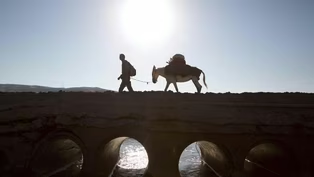
LISA DESJARDINS: In the last two years, National Geographic Explorer Paul Salopek traversed the Chinese countryside, marched along South Korea's demilitarized zone, and fended off grizzly bears in Alaska.
And he's done it on foot.
Now his expedition from Africa to the tip of Southern America -- of South America crosses into the Western Hemisphere.
Stephanie Sy checks in on his adventures to date.
STEPHANIE SY: Paul Salopek is more than halfway done with his journey dubbed the Out of Eden Walk.
His path began in the Great Rift Valley of Ethiopian 2013, winding through the Middle East and Asia before crossing the Pacific Ocean for Alaska.
Salopek's dispatches for National Geographic along the way bring readers with him stride for stride on this unprecedented trek.
And Paul joins us now.
Paul, welcome back to the "News Hour."
The last time we spoke was about two years ago.
You were winding your way through the Middle Kingdom, a 2.5 year walk through China.
What were the main takeaways, if you can give them in a few moments?
PAUL SALOPEK, Fellow, National Geographic: You know, it was 2.5 years, more than 4,000 miles.
This is much, much longer than the distance between Los Angeles and New York.
It's like walking actually from Chicago to Paris, from basically tropical rain forest at the foot of the Himalayan Mountains to the snowy forests of Manchuria near Russia.
So I covered all these different landscapes, big cities, high mountains, empty valleys, the deserts, and just sheer diversity of China really came through.
And it allowed me as a journalist to kind of get out of the bubble that many of us travel in when we go for quick, short hits to places like China and talk to ordinary people every single day.
It was quite a privilege.
STEPHANIE SY: Let's move on to the next parts of your journey, which take you to South Korea and then Japan, where, again, you're walking in the rural countryside, but I sense such a theme of emptiness and isolation and loneliness.
Were those your main takeaways from that region?
PAUL SALOPEK: It really was.
When I took a ferry boat from Northern China into South Korea and then another ferry into Japan, one of the most startling kind of discoveries for me was just how empty the countryside is.
The depopulation of the countryside in South Korea and Japan, as a product of hyper-urbanization and hyper-globalization, was just astonishing.
When I walked through the rural parts of Honshu, the main island, I one day walked almost 25 miles and saw three people.
I had to go back to my methodology of camping and going across the deserts of Central Asia or the deserts of Saudi Arabia.
I had to start carrying food.
I had to start thinking about sleeping out in a sleeping bag because there were no lodging.
It was kind of spooky.
It was like walking through almost a postapocalyptic rural landscape.
STEPHANIE SY: You leave Asia, and one of the rules of this journey is you can't get on motorized transit, right?
You can't take planes, trains and automobiles, but you can take ships.
And you end up on a container ship heading to Alaska.
So talk about the experience of being on a container ship.
PAUL SALOPEK: That's -- that was a first for me.
I mean, and the reason -- the whole reason -- I need to add why I'm on a container ship going 5,000 miles across the North Pacific - - is that following the pathways of the ancient first peoples who populated the world.
I got stymied at the Russian border with China.
I couldn't go through Russia because of Russia's invasion of Ukraine.
So that old Siberian migration route into Alaska was closed.
So the alternative was taking a ship across the Pacific.
A container ship took me for 11 days between Yokohama, Japan, to a tiny port in British Columbia and Canada called Prince Rupert.
We were traveling at about 15, 16 miles an hour, moving something like 4,000 containers of everything you can imagine.
And it was like a glimpse, Stephanie, of looking behind the scenes at how globalization works.
Who are these seafarers who move all of our stuff, all the clothes that we're wearing, all the stuff in our homes, the cars that we drive?
Moves on these giant moving warehouses.
This ship was 300 meters long.
That's like four city blocks.
It was colossal.
STEPHANIE SY: You have to tell me what the Lost Coast of Alaska was like and what the most remarkable moments there were.
PAUL SALOPEK: What I have said, Stephanie, before is that this is kind of a walk of a lifetime, a journey of a lifetime, in which there are walks of a lifetime inside of it.
And one of them was the Lost Coast, the outer coast of Alaska.
And where's that?
It's that long stretch of exposed coastline and that little kind of finger of Alaska that stretches out of the main chunk of it.
I think it was about 300 miles of empty wild beaches, of spruce forests coming down to wild surf, of glaciers spilling into inlets, of seeing grizzly bears, seeing moose on the beaches.
I never imagined these wild animals being on beaches, and there they were.
And it's also kind of soberingly, on a more serious note, beyond the kind of natural wonder and the joy of knowing that there are these landscapes still left on the planet, is, it's incredibly dynamic due to the climate change crisis.
These glaciers are melting.
It's changing the course of rivers.
It's affecting the ecology of salmon that migrate up the rivers.
As one of the experts that I talked to said: "This is the geography, Paul, of the future, right here."
It's kind of the laboratory of what's going to happen in different ways around the world.
STEPHANIE SY: So you're back in the Western Hemisphere, Paul.
And is it true that the last time you were in the U.S.
was a decade ago?
If that is the case, what are your reflections upon returning?
It's been quite a lot happening in the last decade.
PAUL SALOPEK: The last time I was in the U.S.
was December of 2012.
And that was like just before Obama was sworn in the second time, right?
Twitter had just gone public, when it was called Twitter back then.
It's both kind of exhilarating, but also a bit strange.
I have told my editors I feel a little bit like, I don't know, a guy who's been -- who's come back from, like -- like Rumpelstiltskin, come out, come awake under the tree after a lifetime, right, and the world has changed around him.
STEPHANIE SY: And where are you off to next?
PAUL SALOPEK: So I'm hunkered down for the winter, waiting for the worst of the winter storms to pass.
And my winter base is in Gustavus near Glacier Bay National Park in Southeastern Alaska.
In the springtime, the plan is to kind of do something very different.
After walking, I don't know, about 18,000 miles, I plan to get into a sea kayak and sea kayak about 1,000 miles south to Vancouver and the U.S.
border.
As archaeologists are discovering, the people I'm following, the first discoverers of the world back in the Stone Age, did use watercraft.
And I'm going to try to follow their pathway now.
I will be paddling in and out with paddling partners, instead of walking partners.
So that's the plan in the spring.
STEPHANIE SY: Well, we look forward to reading all of your future dispatches on your walk and on your canoe, Paul Salopek.
You can read all of Paul's writings and see his videos at outofedenwalk.com.
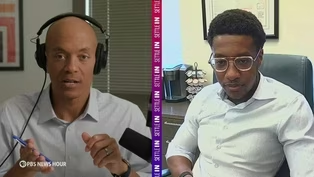
LISA DESJARDINS: In the latest episode of our new video podcast, "Settle In," Geoff Bennett sat down with the CEO of Red Lobster, Damola Adamolekun.
They discuss how the young executive is trying to build on the legacy of Red Lobster while turning the seafood chain around after bankruptcy.
Here's an excerpt of their conversation.
GEOFF BENNETT: At 36 years old, you are one of the youngest, if not the youngest CEO in the industry, one with only few Black leaders in that space.
How do you navigate the expectations that come with being a visible first or only?
DAMOLA ADAMOLEKUN, CEO, Red Lobster: It's tricky, especially because the jobs that I have taken are so hard, right?
I took Red Lobster out of bankruptcy.
It's not a -- it'd be simpler if it was a business that was running well already and it was about managing and growing.
This is about like a turnaround.
So it's very high stakes and it's very high risk in terms of the outcome of the business.
People care about what happens to Red Lobster a lot more than a lot of other companies, which can be a positive.
And I try to use that as a positive.
But then, also, it makes it higher profile for me.
Hi.
I'm Damola, CEO of Red Lobster.
That's just something that, in my mind, it's not about me.
It's about the business.
It's about the team members and the restaurants.
But then I get outside of my office and a lot of people want to talk about me, which is OK.
I don't mind it, but it doesn't change what I need to do or what we need to do as a business.
I answer questions honestly and I get back to thinking about the people who work here.
GEOFF BENNETT: Yes.
To your point about Red Lobster being such a well-known brand, it is very much a part of Americana.
I think everybody of a certain age has a Red Lobster story.
I would go to Red Lobster with my family after church or on big milestone occasions.
How do you now as CEO walk this line between leveraging nostalgia and updating the brand for a younger audience or for a different audience to make it relevant in a new way?
DAMOLA ADAMOLEKUN: Yes, it's -- you need to do both and it needs to be balanced, right?
Because you do have a core group of people that have loved this brand for a long time.
And I like to start with the core.
And then you expand the tent, so that becomes kind of where could we be better to bring in new consumers and younger diners and new guests that haven't tried us before, right?
And so an example of that is, we fixed a lot of things that were already on the menu when we started, right?
There was an issue with the tartar sauce.
There was questions around certain products that we needed to improve.
And we did that, while maintaining the things that people loved the most, like the Cheddar Bay Biscuits, et cetera.
GEOFF BENNETT: When you were announced as the CEO, I saw on social media, all over social media, people were going to Red Lobster in many ways to support you because they were invested in your success.
WOMAN: Support a Black-owned CEO.
So come with us to try the new Red Lobster Seafood Boil.
GEOFF BENNETT: Did you see any of that?
And I wonder, how did that make you feel?
DAMOLA ADAMOLEKUN: Yes, we saw some of that.
And it's really an inspiring thing.
It's motivating.
I think it is partially because of me, but I think these are people that have loved Red Lobster a lot of times in the past or used to frequent Red Lobster and more or less gave up on it, right?
And I think what I have represented to these people is hope that it can come back and be as good as they remember, right?
So it's something I appreciate and I don't take for granted, and I think speaks to the strength of the brand as much as anything, which, is there a chance it could be what I -- what they grew up with or what they recall from the last time they came?
Earlier this month, four Americans were honored with new works placed at the Smithsonian National... As this holiday season comes to a close and parts of the country face frigid temperatures, this New Year's, we wanted to take a moment and explore a concept of comfort, warmth, and joy that began in Scandinavian countries but has recently spread to America.
Our Deema Zein has this story about the art of hygge.
DEEMA ZEIN: In the bitter cold of a Minnesota winter, Ingebretsen's Nordic Marketplace offers an oasis of coziness, fuzzy blankets, socks and sweaters, a plethora of coffee mugs and lots and lots of candles.
ANNA BLOOMSTRAND, Ingebretsen's Nordic Marketplace: We really think of this space as our home.
DEEMA ZEIN: Anna Bloomstrand's great-grandfather started Ingebretsen's as a small corner market in the 1920s.
ANNA BLOOMSTRAND: Folks still think of us as a space where people can come and explore items that connect them to their cultural heritage.
We like to try to highlight that and make it easy for people to explore the culture even if they're not Scandinavian.
DEEMA ZEIN: In recent years, that's meant leaning into a Scandinavian concept with growing popularity in the U.S.
It's called hygge.
SARAH RICHARDSON, Ingebretsen's Customer: Hygge is very near and dear to my heart.
It means creating a warm environment, snuggling in, reading books, sitting by the fire.
DON FRIEND, Ingebretsen's Customer: To make home a warm and happy place.
BARBARA SHATERIAN, Ingebretsen's Nordic Marketplace: Hygge also means -- it's kind of like simplifying things, stepping back, letting things not be great.
DEEMA ZEIN: Claus Andersen is a professor of Scandinavian studies at the University of Wisconsin-Madison.
Originally from Denmark, where hygge is part of the national identity, Andersen defines the term as pleasant togetherness.
CLAUS ANDERSEN, University of Wisconsin-Madison: It comes with this air of happiness, of contentment, of having a more balanced life.
DEEMA ZEIN: Andersen says the idea took on its current meaning in the late 19th century, after Denmark lost about a third of its territory in a war with Austria and Prussia.
CLAUS ANDERSEN: The motto in the country became what outwardly has been lost inwardly should be gained.
So people got together with their backs to the world and say we're good enough the way we are.
DEEMA ZEIN: He says hygge gained popularity in the U.K.
around 2015, when the country was debating its exit from the European Union.
CLAUS ANDERSEN: The year after is when it came to the U.S., is where you saw the hygge books exploding, you saw the first social media posts, and that, of course, was at the time of Donald Trump's election to his first presidency.
So I think these moments, right, both in Denmark, in the U.K.
and in the U.S.
where you sort of turn you back to the world is where hygge then comes to play.
DEEMA ZEIN: Hygge was a runner-up for word of the year in 2016.
Now there are millions of hygge posts across social media with scenes of fireplaces, steaming mugs, people snuggled under warm blankets.
CLAUS ANDERSEN: This idea that we post the moment, right, is antithetical to the idea of hygge, because, when we are on social media, we are not paying attention to the people we're with.
We're not engaged in pleasant togetherness.
We're more interested in staging it.
DEEMA ZEIN: So here's what Andersen does.
CLAUS ANDERSEN: We have what we call afternoon snack, where even though the kids are older now, right, they're around the house, we're all busy.
And then, at one point during the afternoon, we all sit down together.
And being there, right, being together for those minutes, right, just breathing, seeing each other and just insisting on this is important because we're together, that's all that matters, that is an instance of hygge.
DEEMA ZEIN: And while he says hygge is inherently anti-materialistic, he points to one item that can really help, candles.
CLAUS ANDERSEN: It's something that creates a certain intimate atmosphere.
It makes you want to sit down and stay at the dining table maybe for two, three minutes longer than you would have otherwise.
DEEMA ZEIN: Do you think it's possible for Americans, living in the busy lifestyles that they do, where it's a very go, go, go society, do you think that hygge is possible here?
CLAUS ANDERSEN: Yes, but in a different way, right?
I know that there are many who want to embrace some of these things that they associate with hygge.
But, of course, the things that the social welfare in Denmark provides, free health care, day care, generous welfare benefits if you lose your job, that takes the worry out of everyday life or a number of things.
It's not something you find here in the U.S.
So there might still be some challenges for Americans to fully embrace the concept.
DEEMA ZEIN: Back in Minneapolis, Anna Bloomstrand says Ingebretsen's is trying to spread the spirit of hygge here.
ANNA BLOOMSTRAND: I just love making like a nest for people to come in and have something warm to drink and have it be pretty and calm and feel warm.
We try to do that here too, but it's a store.
So we can't do it that well.
We're more of a hardware store for those things.
But, I mean, I think it resonates because it's what people really need and want this time of year, for sure.
DEEMA ZEIN: And, as 2026 begins, a resolution of hygge, with its presence, comfort and togetherness, may just be what we need.
For the "PBS News Hour," I'm Deema Zein.
LISA DESJARDINS: Earlier this month, four Americans were honored with new works placed at the Smithsonian National Portrait Gallery in Washington, D.C.
They're this year's recipients of the Portrait of a Nation Award for their transformative contributions to American history and culture.
One of them is Temple Grandin.
She's not only transformed animal welfare around the world.
She's also impacted the public perception of people with autism.
John Yang has this second looked as part of our Canvas series and our ongoing coverage of the intersection of arts and health.
DAVID LENZ, Artist: She's a giant.
I mean, she is a legend.
JOHN YANG: Artist David Lenz painted the portrait of Temple Grandin.
DAVID LENZ: I wanted people to come into the museum and see a beautiful portrait of a person who's done amazing work, who also happens to have autism.
JOHN YANG: It depicts Grandin wearing her trademark outfit, an embroidered shirt and bolo tie.
And of course, she's on a cattle farm surrounded by livestock.
DAVID LENZ: They have very beautiful eyes.
It's easy to see that these are warm blooded feeling animals that are worthy of our humane treatment.
JOHN YANG: The humane treatment of livestock has been Grandin's life's work.
As a child, she didn't speak until she was nearly four.
The doctors who diagnosed her with autism recommended putting her in an institution.
Her mother refused.
Now Grandin considers her unique mind her greatest strength.
Her perspective was key to her groundbreaking redesign of cattle handling facilities to eliminate things that could frighten or unnerve livestock.
Today, her principles guide the way nearly half of cattle in North America are handled.
She's also helped ease anxiety for people with autism.
As a teenager, she designed a squeeze machine to gently apply a calming pressure like a giant hug.
She based it on a device she saw on a cattle farm to hold livestock in place for vaccinations, health checks and the like.
TEMPLE GRANDIN, Professor of Animal Science, Colorado State University: When you walk back by him, you got to do kind of a quick motion.
JOHN YANG: Grandin has a Ph.D.
in animal science and is a professor at Colorado State University.
TEMPLE GRANDIN: And who wants to let this one out?
JOHN YANG: She was the subject of an award winning HBO movie.
WOMAN: I could see the world in a new way.
I could see details that other people were blind to.
JOHN YANG: and was on Time's list of the 100 people who most affect our world.
And she's written more than a dozen books.
Her talks and book signings draw big crowds.
She says her story demonstrates the importance of having different kinds of thinkers.
A message highlighted by the presence of her portrait in the National Portrait Gallery.
It will be on view there until next November.
JOHN YANG: Earlier, I sat down with Temple Grandin.
I asked her what she thought of her portrait.
TEMPLE GRANDIN: I think it's absolutely gorgeous.
I was so happy when I first saw it this beautiful.
I kind of like the kind of misty rainbow in it, really like that.
Our experiment station cattle look just great in that.
JOHN YANG: How did it feel when they told you were going to go into the National Portrait Gallery?
TEMPLE GRANDIN: Like, you got to be kidding.
I think it's like some of the Nobel Prize winners, they can -- when they get the call from Sweden, they just can't believe it.
I almost couldn't believe it going, you got to be kidding.
JOHN YANG: Now explain why there are cattle in this portrait.
TEMPLE GRANDIN: Well, cattle is what I have worked with.
I've worked on designing facilities for cattle.
I've worked on developing animal welfare guidelines, teaching people in the industry how to use them.
I started out in the feed yards in Arizona back in the early seventies.
Handling of cattle was dreadful, and I worked on designing better facilities.
I also wrote a lot of articles just on how to on cattle behavior, how to design things.
I saw that cattle handling as something you could fix.
Now, today, cattle handling is greatly, greatly improved.
The livestock associations have training materials.
You have to have both good equipment and the management.
Good equipment makes good handling easier.
And you have top management in a place that insists on handling cattle and other animals right.
Large customers like McDonald's and other large customers are auditing animal welfare.
Handling has really improved, and that's something I'm very proud of, the improvements I've seen in that.
JOHN YANG: I know you don't want to be known specifically or mostly for being someone with autism, but I've also heard you say that it helped you in your work with cattle and livestock.
TEMPLE GRANDIN: Well, I'm an extreme object visualizer.
Everything I think about is a picture.
So the very first work I did with cattle is I got down in a chute to see what cattle were seeing.
They'd stop at a shadow, they'd stop at a reflection, they'd stop at a pickup park next to the facility.
And visual distractions affected their behavior.
Now, at the time that I did this, in my 20s, I thought everybody was a visual thinker.
And it was kind of shocked to me when I found out that they weren't.
In my latest book, Visual Thinking, I discussed the research on object visualizers.
Like me, then you have more mathematical pattern thinkers then you have word thinkers.
Problem with us object visualizers is we can't do higher math.
But I worked with people that were undiagnosed autistic.
They had big machine and welding shops, and they were inventing and patenting mechanical devices.
And I'm very concerned that these people are getting screened out of our educational system.
JOHN YANG: In this case, different is a strength.
TEMPLE GRANDIN: Yes.
JOHN YANG: How does that play into how you talk to young people with autism, how you talk to families who may have children with autism?
TEMPLE GRANDIN: Well, autism goes all the way from Einstein and Bill Gates to somebody that never learns to speak.
I learned to speak by age 4.
I was good at art.
My ability in art was always encouraged.
Object visualizers are good at art, mechanical animals, and photography.
So things that object visualizers are good at.
Terrible at abstract math.
Can't remember it.
But I worked with all these shop people that had built and installed equipment for me.
They couldn't do algebra, and they're not getting replaced.
Who do you want fixing the hydraulics that steers your airplane or my airplane?
I want that object visualizer.
I don't care about the algebra, but I want the steering to work on that plane.
JOHN YANG: Do you think the fact that there is so much discussion about autism, is that a good thing?
TEMPLE GRANDIN: Well, there's a lot of things that are good.
I'm a big proponent of developing strengths because you can get an autistic object visualizer like me, non-mathematician or you can get a mathematician, an extreme mathematician.
And those kids are not being developed.
I've been getting feedback from teachers that they make them just do the same boring little math in fourth grade.
They get bored and then they turn into behavior problems when they need to be challenged with more advanced math.
And you want to take the strength and build on it.
If the autistic person is an extreme mathematician, let's develop that they're an extreme object visualizer.
I'm going to really push towards the mechanical.
JOHN YANG: families with children who are diagnosed with autism.
They may think it's a horrible thing, but what do you tell them?
TEMPLE GRANDIN: Well, when a child is like under age five, I looked very severe when I was two and a half.
I was very lucky to get into very good early education.
This is essential.
I was taught language.
I was taught the ability to wait and take turns at games and taught basic skills like getting dressed, brushing my teeth, basic skills.
And this early education is really, really important.
I'm seeing too many kids put on two year wait lists.
We when they're three years old.
That is really bad.
And the other thing, mother had high expectations with some accommodations.
When I was five, I remember going on a ferry boat, flinging myself on the floor, screaming when the horn blew.
Well, we're going to go on that ferry but you can ride in the cabin underneath away from the horn.
Accommodation was made but we are going to go on that ferry.
That's the high expectation.
JOHN YANG: Have you thought about what you, how you want like to be remembered, what you want your legacy to be?
TEMPLE GRANDIN: Right now one of the big things I've been working on is recognizing the importance of object visualizers.
And I'm worried about them getting screened out.
Okay.
I went up to community college and they're doing a two year factory maintenance degree and requiring calculus and algebra.
Well, you're going to screen out the very best mechanic for keeping a factory running.
JOHN YANG: So is being a visual thinker your superpower?
TEMPLE GRANDIN: Yes, being a visual thinker.
You say the extreme visual thinkers.
And I've talked to a lot of photographers too.
Very good photographers can't do higher math, drawn to photography, they can excel in that.
Very good with animals because animals are sensory based thinkers, but also very good with mechanical things.
I tell business people, plain and simple, we need the skills and the one thing where A.I.
is not going to replace who's going to fix an elevator or make sure the waterworks work or make sure the hydraulics works on a plane.
I just talked to a science teacher and her dad was cooking.
Airplane mechanic couldn't do any, any higher math.
He fixed some hydraulic problem on a Boeing airplane and Boeing put it in every one of their airplanes because he could just see how the hydraulics works.
We need these thinkers.
Now where we need our mathematical engineers.
Let's take something like a spaceship.
The mathematician tells the thruster when to thrust, but the visual thinker has to make sure it's put together properly.
You see, there's two parts of engineering here, the mathematical part and what I call the clever engineers that often don't get enough credit.
JOHN YANG: Temple Grandin, thank you very much.
TEMPLE GRANDIN: Thank you for having me.
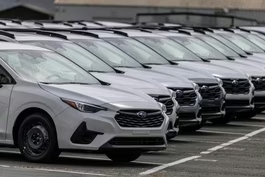
LISA DESJARDINS: If you're looking to buy a new car in the new year, you might notice the prices seem to be higher than in the past.
Most notably, there are fewer budget cars on the market.
PBS News digital producer Cecilia Lallmann talks with two experts about why that is.
CECILIA LALLMANN: In 2017, there were 36 vehicle models for sale in the U.S.
for less than $25,000.
This year, according to Cox Automotive, there are only five.
So where did all the cheap new cars go?
Here are four things to know.
One, you would think, in this economy, people would be snapping up cheap new automobiles, but Sean Tucker of Kelley Blue Book says Americans' buying habits have changed.
SEAN TUCKER, Managing Editor, Kelley Blue Book: In November, cars priced over $75,000 outsold cars priced under $30,000.
And that's a relatively new phenomenon.
CECILIA LALLMANN: But the phenomenon is tied to consumer demand, says Christian Seabaugh, features editor with "MotorTrend."
CHRISTIAN SEABAUGH, Senior Features Editor, "MotorTrend": Automakers have realized that the subcompacts, the traditional entry-level cars that we always think of just weren't moving.
And so they have pivoted it away with the SUV, small SUVs and stuff.
CECILIA LALLMANN: And a bonus to meeting consumers where they are, bigger profit margins.
SEAN TUCKER: Most SUVs these days are made on the same platform as cars are.
The cost of actually building one is relatively similar, and they're able to sell them successfully for a higher price.
CECILIA LALLMANN: Two, tariffs aren't to blame yet.
American car companies like GM and Stellantis say that, so far, production cost increases from President Trump's tariffs have largely only cut into profits, but eventually they will raise prices.
SEAN TUCKER: They can't afford to absorb the hit forever.
It's a question of when somebody finally makes the move.
Then I think they all will.
CECILIA LALLMANN: But tariff policies on vehicle imports could spell trouble for some existing cheaper models.
When GM brought back a redesigned Chevy Trax in 2024, it had a price tag under $22,000.
More than $200,000 of the vehicles sold in the first year on the market.
But: SEAN TUCKER: The tariffs kind of threw a wrench into that.
To save money, they built it in South Korea.
And so just after they introduced the new one that was far more attractive, its price went up dramatically due to tariffs.
CECILIA LALLMANN: And let's not forget inflation.
CHRISTIAN SEABAUGH: Even with the cars that have had price increases, it's hard to say how much of the price increases are tariffs, how much of it are just cost.
Everything costs more.
CECILIA LALLMANN: Three, can lawmakers help bring down prices?
In early December, President Trump announced a rollback of fuel emissions standards, stating this will help make cars more affordable.
DONALD TRUMP, President of the United States: The action is expected to save the typical consumer at least $1,000 off the price of a new car.
CECILIA LALLMANN: And the Senate Commerce Committee is holding a hearing in January focusing on how some safety standards, like automatic emergency braking and rear seat alarms, are driving up vehicle prices.
But Tucker doubts either move will make a significant dent in prices.
SEAN TUCKER: Back in June, they stopped enforcing the fuel economy standards.
So chasing -- changing a standard that you don't enforce has pretty limited impact anyway.
Were they to remove some of those restrictions on safety that enables the automakers to remove a few sensors and such, that would bring costs down a bit, but nowhere close to what they're discussing.
CECILIA LALLMANN: One policy that did reduce vehicle prices, E.V.
incentives.
Some entry-level subcompact E.V.s like the Chevy Bolt and Nissan Leaf start below $30,000.
If you bought an E.V.
manufactured in North America with the Biden era $7,500 tax credit that's now been rolled back by Trump, the final price could have been below $25,000.
Those incentives and other investments in E.V.s did lead to battery costs coming down, and rolling back these incentives will also likely hinder American car companies competing on a global level.
SEAN TUCKER: The pressure globally is on, can you build an inexpensive E.V.?
And the pressure in the United States is now on, can you return to gas-powered cars?
It's a real challenge for them.
CECILIA LALLMANN: But it could also push American companies to shift back towards affordable new models.
CHRISTIAN SEABAUGH: Not having that, in theory, will drive automakers to focus more on the entry-level.
And instead of fitting all these cars with bells and whistles, like self-driving systems and whatnot, they will focus more on the traditional basic car.
CECILIA LALLMANN: But Tucker says this is easier said than done.
Creating new affordable vehicles takes time.
SEAN TUCKER: If Ford were to wake up today and say, we need to move back into the subcompact market and start making inexpensive cars, the first ones would roll off the line in five or six years.
CECILIA LALLMANN: Four, so, in this current market, what are some sub-$25,000 vehicles our experts would recommend?
CHRISTIAN SEABAUGH: Some of our favorite cars in that price range would probably be the Nissan Sentra.
Kia K4, it's a Sudan that's quite good, the Subaru Crosstrek.
So, there's a lot of great options.
SEAN TUCKER: I am a fan of the Hyundai Venue and the Kia Soul below the $25,000 line.
CECILIA LALLMANN: However: SEAN TUCKER: Both of those are somewhat endangered and that I'm not certain they're going to be built for the 2027 model year.
CECILIA LALLMANN: For PBS News, I'm Cecilia Lallmann.
LISA DESJARDINS: That's the "News Hour" for tonight.
I'm Lisa Desjardins.
Amna Nawaz will be back in this chair tomorrow.
On behalf of the entire "News Hour" team, thank you for joining us.
Damola Adamolekun joins Geoff Bennett on ‘Settle In’
Video has Closed Captions
Damola Adamolekun joins Geoff Bennett for our ‘Settle In’ podcast (3m 27s)

Fire at Swiss bar during New Year's kills about 40
Video has Closed Captions
Fire at Swiss bar during New Year's celebration kills about 40 (2m 37s)
National Geographic explorer on his walk around the globe
Video has Closed Captions
National Geographic Explorer Paul Salopek on his trek around the globe on foot (7m 20s)

New class of billionaires solidifies outsized influence
Video has Closed Captions
How the new class of billionaires solidified outsized political influence (7m 26s)

Player pay, transfers put college sports in new territory
Video has Closed Captions
Player pay and transfer portal put college sports in new territory (6m 38s)

What Hygge can teach Americans about comfort and happiness
Video has Closed Captions
What the Scandinavian concept of hygge can teach Americans about comfort and happiness (5m 52s)
Why it’s getting harder to find a new car under $25,000
Video has Closed Captions
Why it’s getting harder to find a new car under $25,000 (4m 51s)
Providing Support for PBS.org
Learn Moreabout PBS online sponsorship
- News and Public Affairs

FRONTLINE is investigative journalism that questions, explains and changes our world.

- News and Public Affairs

Amanpour and Company features conversations with leaders and decision makers.












Support for PBS provided by:
Major corporate funding for the PBS News Hour is provided by BDO, BNSF, Consumer Cellular, American Cruise Lines, and Raymond James. Funding for the PBS NewsHour Weekend is provided by...