
January 2, 2026 - PBS News Hour full episode
1/2/2026 | 57m 46sVideo has Closed Captions
January 2, 2026 - PBS News Hour full episode
January 2, 2026 - PBS News Hour full episode
Problems playing video? | Closed Captioning Feedback
Problems playing video? | Closed Captioning Feedback
Major corporate funding for the PBS News Hour is provided by BDO, BNSF, Consumer Cellular, American Cruise Lines, and Raymond James. Funding for the PBS NewsHour Weekend is provided by...
Support provided by:

January 2, 2026 - PBS News Hour full episode
1/2/2026 | 57m 46sVideo has Closed Captions
January 2, 2026 - PBS News Hour full episode
Problems playing video? | Closed Captioning Feedback
How to Watch PBS News Hour
PBS News Hour is available to stream on pbs.org and the free PBS App, available on iPhone, Apple TV, Android TV, Android smartphones, Amazon Fire TV, Amazon Fire Tablet, Roku, Samsung Smart TV, and Vizio.
Providing Support for PBS.org
Learn Moreabout PBS online sponsorshipAMNA NAWAZ: Good evening.
I'm# Amna Nawaz.
Geoff Bennett is away.
On the "NewsHour" tonight:# President Trump threatens to## intervene in Iran if the regime cracks down# on protests sparked by economic turmoil.
Canceled performances and plummeting ticket# sales roil the now renamed Kennedy Center.## We speak with the man President Trump# handpicked to lead the institution.
And why this flu season is so bad and# what you can do to protect yourself.
ANDREW PEKOSZ, Johns Hopkins University:# Even if you're in a part of the country## that's starting to experience a rise in# influenza cases, not a bad.. get vaccinated because it'll protect you# against the tail end of the flu season.
(BREAK) AMNA NAWAZ: Welcome to the "News Hour."
President Trump today threatened to intervene# in Iran if the regime kills peaceful protesters,## which it has already done.
Over the past six days,# demonstrations that started in Tehran have spread## throughout the country.
The Iranian government# has cracked down, as it has in the past.
Protests in Iran are now in their sixth day.# What began as a response to skyrocketing## inflation has now transformed into# a national call for systemic reform,## expanding from Tehran's Grand Bazaar to# nearly 17 provinces across the country.## At least 44 people have been arrested so# far, Including Kurdish activist Mahsa Zarei.
And at least eight people have been killed,# including a 15-year-old child.
In the streets,## protesters chant "Death to the dictator."
And# students have now joined the demonstrations.## As in recent uprisings, young# Iranians are on the forefront.
Iranian President Masoud Pezeshkian# says he has -- quote -- "tasked the## minister of interior to hear the legitimate# demands of protesters through dialogue."
Meanwhile, Iran's Foreign Minister Abbas# Araghchi and President Trump traded statements.
Trump posting this morning -- quote -- "If# Iran violently kills peaceful protesters,## which is their custom, the United# States of America will come to their## rescue.
We are locked and loaded and ready to go."
Araghchi responded, calling Trump's# statement "reckless and dangerous."
For more on the protests, we turn now to two# people who follow developments in Iran closely.## Roya Boroumand is the co-founder and executive# director of the Abdorrahman Boroumand Center.## That's a nonprofit promoting human rights and# democracy in Iran.
And Holly Dagres is a senior## fellow at the Washington Institute for Near East# Policy.
That's a think tank in Washington, D.C.
Welcome to you both.
And, Holly, I will begin with you# be.. demonstrations in Iran before.
How# do these protests today compare to## those we have seen in the past in terms of# the scale?
And, also, what sparked them?
HOLLY DAGRES, Senior Fellow, The Washington# Institute for Near East Policy: Well, these## protests are significant.
They're the largest# since the 2022.. And while they were triggered by# a different event, in the economic## one related to the collapse of the Iranian# rial against the U.S.
dollar on December 28,## the grievances of the Iranian people taking# to the streets are very much the same,## which is systemic mismanagement,# corruption, and repression.
And, for them, they see that all their woes and# problems are with the Islamic Republic itself.
And## that's why you're seeing all these anti-regime# trance coming from the people, because they## believe that the Islamic Republic needs to go.# And they felt this way for a very long time now.
AMNA NAWAZ: Roya, what about you?
As you watch# these unfold, what stands out to you about how## the protests are evolving, especially the fact# that they're coming online now just a few years,## as Holly noted, after those 2022 Woman, Life,# Freedom protests after the death of Mahsa Amini?
ROYA BOROUMAND, Co-Founder and Executive Director,## Abdorrahman Boro.. The intensity of the repression of the 2022# protests and following the 2022 .. that one would expect people to need a few years# before forgetting and recovering before coming out## in the streets.
So it is early, if you will, based# on the experience we have from previous years.
But, at the same time, the situation,# the economic situation is so bad.
The## inflation is so bad, and so many people# are living under the poverty line that## these outbursts are not surprising in that sense.# And the fact that they happen more in areas where## the people are much more vulnerable economically# and socially is also significant, I think.
AMNA NAWAZ: Holly, Roya mentioned there the# brutality of the crackdown to those 2022 protests.
Are you worried and do you expect that we# will see the same from the Iranian regime## this time?
And, also, are there demands from the# protesters that this regime can actually meet?
HOLLY DAGRES: Well, we have seen the brutality of## the Islamic Republic for 46 years.# We talked about the 2022 uprising.
And the U.N.
fact-fighting mission at# the time found that the Islamic Republic## had committed crimes against humanity# against the protesters during Woman,## Life, Freedom.
So they do have that# ability to crack down on in same manner.
And one of the tools of repression that the# Islamic Republic uses is mass executions.
We## have seen that, in 2025, they had the highest rate# of executions in over a decade with 200 -- 2,045.## And so this is a tool that they use to silence# dissent and exactly what they will be doing.
And in terms of addressing the needs of the# protesters, we have seen President Masoud## Pezeshkian tweet on X, which is blocked by# the Islamic Republic, and Iranians have to## use circumvention tools to get online, that# they would meet the needs of the protesters.
But the truth is, their needs cannot# be met by the clerical establishment## because they have not had opportunity# for years to make changes and they## have not.
And Iranians believe that# reform has been dead for a long time.
AMNA NAWAZ: Roya, what about the# reaction that we have seen from the U.S.,## specifically from President Donald Trump# threatening U.S.
intervention if peaceful## protesters are killed?
Is that kind of# response something that protesters want## to see?
And you think there's a real# possibility there for U.S.
action?
ROYA BOROUMAND: Statements by# a U.S.
president matter a lot.
And they matter, in the sense that you also have# to understand that the battle that the Iranians## are fighting is a battle that is physical in# the street, in which they have their lives to## offer and some stones probably.
But the state has# resources and has arms and has foreign support.
And, in that sense, when leaders of# democracies pay attention to what's## happening, it strengthens the morale of the# population.
So it has to be clear what the## statement of the president means.
Does# this mean that they're going to bombard## somewhere?
Does this mean that the endgame# would be to overthrow the Islamic Republic?
I think these are very sensitive times.# Iran has passed laws to punish with## deaths very peaceful activities# that are related to protests,## are related to information about protests# as acting in coordination with a foreign## state and a hostile state, basically# can lead any action to the gallows.
So, in that context, these kind of statements# have to be not vague and very clear about what## consequences the leaders of a country will# face if they continue to shoot people.
But## attention to victims is good.
That is something# that the state doesn't want, because the state## wants to say to the people fighting in the# streets that you are alone, no one cares.
AMNA NAWAZ: Holly, I will# give you the last word here.
How do you look at the threats made by President## Trump?
And do protesters want to# see some kind of U.S.
intervention?
HOLLY DAGRES: It's really hard to interpret what## the Trump administration actually wants# to do with any action, if at all any.
And I think that if they were not to act on# their words and there was a mass crackdown,## this could very much be similar to the# Obama administration's red line for Syria.## So, I mean, it's a really mixed bagged# about how the president wants to respond.
But we've also seen precedent where he has# responded by assassinating being Quds Force## commander Qasem Soleimani, January 3 being# its six-year anniversary, attacking the## country's nuclear facilities.
So he's a real# maverick when it comes to this sort of thing.
AMNA NAWAZ: Holly Dagres and Roya Boroumand,# we thank you so much for joining us.
(CROSSTALK) ROYA BOROUMAND: .. AMNA NAWAZ:## We begin the day's other headlines in Switzerland.
Investigators say they believe sparklers# started the deadly fire inside a ski resort## bar packed with people ringing in the new# year.
At least 40 people were killed and more## than 100 injured when Le Constellation# bar I Crans-Montana went up in flames.## Officials say the handheld sparklers# were placed on champagne bottles and## raised too close to the ceiling, which# was coated with sound dampening foam.
BEATRICE PILLOUD, Valais, Switzerland, Attorney# General (through translator): These are birthday## candles that you can buy in shops and .. they can be used in enclosed or confined# spaces, the investigation is ongoing.
AMNA NAWAZ: Authorities are also looking into# safety measures on site like fire extinguishers## and proper escape routes.
Meanwhile, a memorial# has been set up in town to honor those lost,## even as the painstaking task of# identifying the victims continues.
Many were in their teens and 20s.
For# this mother wanting to learn the fate## of her 16-year-old son, the weight is agonizing.
LAETITIA BRODARD-SITRE, Mother of# Missing Fire Victim (through translator):## It's unimaginable to tell ourselves that we# will live without our children, that our child## has burned in a fire on New Year's Eve.
We don't# know how and when they will be identified.
We gave## our DNA.
Now it's a question of waiting long# hours to try to know where our children are.
AMNA NAWAZ: The majority of those who were# injured are Swiss nationals.
Others are from## neighboring France and Italy and elsewhere# in Europe.
Six have yet to be identified.
In Mexico, a 6.5-magnitude earthquake struck# outside the resort city of Acapulco today,## leaving at least two people dead.
The quake struck## as President Claudia Sheinbaum was giving# her first press briefing of the new year.## She called for calm and exited the# room with aides and journalists.
Elsewhere, footage shows cars# shaking as the tremor struck,## while eyewitness video caught parts of buildings# falling to the ground.
In Acapulco itself,## tourists and workers evacuated hotels# and found themselves on the streets.## Mexican authorities reported at least# 500 aftershocks after the initial quake.
Ukrainian President Volodymyr Zelenskyy has# named the country's military intelligence## chief as his new chief of staff.# Zelenskyy says the appointment## of General Kyrylo Budanov is meant to# emphasize Ukraine's focus on its security,## defense and diplomatic efforts.
Budanov is one of# Ukraine's most recognizable wartime figures and## has frequently warned of Russia's long-term# intentions towards Ukraine and the region.
Also today, two Russian missiles struck# a multistory building in Kharkiv in## Northeastern Ukraine.
At least 19 people# were injured, including a six-month-old baby.
The FBI says it's thwarted a potential New Year's# Eve attack in North Carolina, arresting a man who## had allegedly pledged loyalty to the Islamic State# group; 18-year-old Christian Sturdivant has been## charged with attempting to provide material# support to a foreign terrorist organization.
Officials say Sturdivant shared his plans to# attack a fast-food restaurant and a grocery## store with undercover FBI agents.
A search of his# home uncovered further evidence of his intentions.
RUSS FERGUSON, U.S.
Attorney For Western# District of North Carolina: They found## hammers and knives hidden under his bed.
They# found .. detailed his attack.
He was preparing for# jihad and innocent people were going to die,## and we are very, very fortunate they did not.
AMNA NAWAZ: According to court documents,## Sturdivant faces up to 20# years in prison if convicted.
We have an update now on a story we reported# last month on tariffs.
The Trump administration## is now backing off plans to impose steep levies on# Italian-made pastas.
Italy's Foreign Ministry says## the U.S.
will now impose tariffs of between# 2 and 14 percent on more than a dozen pasta## producers.
That is a far cry from the 92 percent# rate that the U.S.
had threatened in October,## which would have come on top of the existing# 15 percent on most European Union imports.
The Commerce Department says that the lower## rates come after Italian exporters had# addressed concerns about unfair prices.
Tesla is no longer the world's# bestselling electric vehicle maker,## as sales declined for the second straight year.# The automaker says it delivered 1.64 million## vehicles in 2025.
That's down 9 percent from# 2024.
And that lags behind Chinese rival BYD,## which sold more than two million# vehicles to take the top spot.
Analysts say that Tesla suffered# from ongoing consumer backlash## over CEO Elon Musk's political# activity, plus the expiration of a## $7,500 E.V.
tax credit.
Tesla shares fell# around 2.5 percent following the news.
As for the broader markets, stocks on Wall Street# posted an uneven start to the new trading year.## The Dow Jones industrial average added more than# 300 points.
The Nasdaq ended just a touch lower,## slipping about six points.
The S&P 500# posted a modest gain of around 13 points.
Still to come on the "News Hour": what's behind# a dangerous spike in flu cases this year; plus,## David Brooks and Jonathan Capehart weigh in on the# latest news and they look ahead to the new year.
First, a takeover of leadership, then a# renaming as the Kennedy Center became the## Donald J. Trump and John F. Kennedy Center for the# Performing Arts, and now canceled performances.
Amid all that, ratings for the televised Kennedy# Center Honors, hosted by the president himself,## showed a big drop in viewership, and overall# ticket sales are reportedly way off.
In short,## the turmoil continues at one of the# nation's preeminent arts centers.
Senior arts correspondent Jeffrey Brown# begins our update.
It's part of our Art in## Action series exploring the intersection of art# and democracy and part of our Canvas coverage.
JEFFREY BROWN: Chuck Redd on the vibraphone,# he was scheduled to perform with his band at## the Kennedy Center on Christmas Eve,# but decided to cancel the concert.
Within days, others followed, including# The Cookers, a jazz ensemble scheduled## for New Year's Eve show.
In a statement,# the group said they remain committed to## music that -- quote -- "reaches across# divisions, rather than deepening them."
Also canceling a January performance,# Alabama folk singer Kristy Lee, stating:## "When American history starts getting# treated like something you can ban, erase,## rename or rebrand for somebody else's ego, I can't# stand on that stage and sleep right at night."
And the New York dance company Doug Varone# and Dancers canceled a planned April show.## The moves followed the mid-December renaming of# the Kennedy Center and after President Trump's## appointment of a new board and leadership# last February, naming himself as chair.
At that time, prominent artists, including# Renee Fleming and Ben Folds, resigned from their## positions at the Kennedy Center.
And others,# including Rhiannon Giddens, canceled shows.
In response to the recent# cancellation by Chuck Redd,## Center president Richard Grenell# threatened a $1 million lawsuit.
Earlier this week, I spoke with choreographer and## dancer Doug Varone and asked# about his decision to cancel.
DOUG VARONE, Doug Varone and Dancers: It wasn't# an easy decision, and it was, I felt, a long time## coming.
We watched all the changes that occurred# when the Trump administration took over the## Kennedy Center, the releasing of the bipartisan# board, the firing of many employees, including## the entire dance staff.
Yet I still believed# that bringing the art was important for us.
The Kennedy Center has always stood for excellence# in the arts, was named after President Kennedy.## And he believed that the arts were at the center# of all of our culture, all of our nation.
Renaming## it Donald Trump Center, it seems to go completely# against every principle and every mission that## the center stands for.
I couldn't put myself# or my dancers into that building right now.
JEFFREY BROWN: But where is the balance# for you in bringing your art to people,## which is presumably what you# do, what it's all about... DOUG VARONE: Absolutely.
JEFFREY BROWN: ... people at the Kennedy... DOUG VARONE: Well, you know,## I -- in the conversations that I have# had over the.. I sort of have always believed# that the art should be paramount.
It was the reason why we didn't# cancel a long time ago, that## the power and the truth of the art was# what I wanted to put on the Kennedy## stage.
And the audiences that would come to# it would hopefully take that strength away.
But it is this act from this president# that has pushed me off the cliff## and has made it impossible for me to do that.
JEFFREY BROWN: A statement we received# from the Kennedy Center accuses you and## others who have canceled of doing# this for political differences and## of failing to meet the basic duty of a# public artist to perform for all people.
What's your response to that?
DOUG VARONE: I think that he probably has not# done this research on myself and my c.. We have been performing nationally and# internationally for the last 40 years.## Many of our international tours have been# supported by the State Department under## presidents both Democratic and Republican.
I am# honored as an artist to bring my work all over## this country to red states, blue states,# rural, urban areas, and to have that art## be part of a dialogue of how we talk about our# differences and share the way we live and think.
I have been dedicated to# that for the past 40 years.
JEFFREY BROWN: You will take a financial hit from# this.
What's the impact on you and your dancers?
DOUG VARONE: We will be losing about# $40,000 from this engagement.
And that## equals about three weeks of work for# my dancers.
So I will have to let## them go in April, unless we can find# some monetary form to replace that.
That's not good.
It's not good## allowing my dancers to go back on unemployment# in these really tenuous economic times.
JEFFREY BROWN: And what kind of# response have you had from them,## from others around the world,# and from the other arts groups?
DOUG VARONE: Well, the dancers were part# of this decision.
Everyone supports it.## We have had a tremendous outpouring of support# from the dance community, from other artists## from all around the world, actually, people# I have never met, people who have never seen## the dance company itself congratulating us on our# integrity to pull out at this particular moment.
So I'm proud of the decision that we have made.
JEFFREY BROWN: And have you# heard from the Kennedy Center?## And do you anticipate legal action from them?
DOUG VARONE: I do not anticipate legal action.
The# dance companies that were part of the presenting## series this year all included a clause in our# contracts that allowed us, at our discretion,## if we felt that our reputation was being# affected, to pull out without cause.
So that is in our contract.
If they want to## legally take us to task for that, I'm# happy to have lawyers look at that.
JEFFREY BROWN: All right, choreographer and# dancer Doug Varone, thank you very much.
DOUG VARONE: Thank you.
AMNA NAWAZ: And joining me now from Hermosa Beach,# California, for an e.. Grenell.
He's president of the newly renamed# Trump-Kennedy Center.
Last February, he was named## interim president by the board that was appointed# by President Trump.
Grenell also served in Trump's## first term, including as ambassador to Germany# and acting director of national intelligence.
Ambassador Grenell, welcome to the# "News Hour."
Thanks for joining us.
RICHARD GRENELL, President, Kennedy# Center: Thank you for having me.
AMNA NAWAZ: I want to begin by just giving you#.. there from Doug Varone, from others# in the piece reported by Jeff Brown,## a number of artists who chose to cancel or# pull out of performances, citing both the## president's takeover of the board and also the# renaming of the center.
What's your response?
RICHARD GRENELL: Well, first of all, I would note# that, in the entire package and in the questions,## there wasn't a single question about# the finances of what's going on.
And I have noticed at PBS, for instance,# you all haven't covered any of the finances## in terms of the situation that the# Kennedy Center has found itself.
The## Trump-Kennedy Center is in a very different# position than the previous center was.
And I would say that we have a# phenomenal situation financially## with the current Trump-Kennedy Center,# because President Trump is a phenomenal## fund-raiser.
And what we have been able# to do is look at ticket sales, donors,## as well as corporate sponsors, and come up with# a holistic approach to how you look at the arts.
When I arrived at the Kennedy# Center, the then-Kennedy Center,## we were paying staff with debt reserves.
Now, I# understand that there's a lot of reporters who## don't understand finance and who don't understand# what paying for staff with debt reserves mean.
But it seems to me that reporters who# are interested in the full story should## look at the full story of what's been# happening in the arts.
I don't quote## The New York Times that often, but just# about two months ago, The New York Times## did a front-page story saying that Broadway# was dying, ticket sales were in the tank.
This is a phenomenon that's# been going on for decades.## Arts centers are struggling.
And the only way that# you can go forward and have an arts institution## that's financially secure is to look at the# holistic aspect.
At the Trump-Kennedy Center,## we have 19 unions.
It's incredibly# expensive to go and put on performances.
We cannot have unpopular programming that doesn't# pay the bills.
What I said when we came -- and,## by the way, I didn't cancel a single show at# all at the now Trump-Kennedy Center.
I simply... (CROSSTALK) AMNA NAWAZ: Well.. RICHARD GRENELL: When you look at ticket sales# -- when you look a.. at donors and you look at corporate sponsors, you# have to come up with revenue-neutral programming.
We live in a world where you have to think# about finances.
We don't have unlimited funds.
AMNA NAWAZ: I appreciate that response.# And I want to ask you more about both that,## the programming and the finances, because,# as you have noted, there's been a lot of## reporting around the ticket sales.
There have# been specific ticket sales windows that were## reported on The Washington Post that, at# one point, the ticket sales in September## and October were at a 43 percent unsold rate,# as compared to just 7 percent the year before.
RICHARD GRENELL: Not true.
AMNA NAWAZ: That's not true, you're# .. RICHARD GRENELL: It's not true.
AMNA NAWAZ: OK, .. RICHARD GRENELL: So, here is... AMNA NAWAZ: If I may, let me.. a different revenue model, is what I'm hearing.
So# are ticket sales down?
Is that confirmed or not?
RICHARD GRENELL: Well, first of all, let me just# say this.
I find it to be outrageous that PBS is## not reporting on the phenomenon that arts# institutions have been having for decades.
Now, I do note... AMNA NAWAZ: Ambassador, I will say,## we have expansive arts programming#.. (CROSSTALK) RICHARD GRENELL: That's not what I said.# You may have e.. but you don't consider the finances.
But let me just note one thing.
The previous# chairman of the now Trump-Kennedy Center is## David Rubenstein, and I understand# that he's given you millions and## that the room that you're sitting in is# named after David Rubenstein.
So I don't## begrudge you that you can't go after# a big donor and say that his financial## management of the then-Kennedy Center was# something to look at.
You can't touch that.
I get that, because he's a very big donor.
AMNA NAWAZ: Ambassador Grenell, let# me make clear this.. with any of our donors or the fact that the studio# is named for David Rubenstein.
Please continue.
(CROSSTALK) RICHARD GRENELL:.. When you -- when I arrived# at the then-Kennedy Center,## we had no money in the bank, and we# -- again, we were paying staff with## debt reserves.
That's immoral.
You cannot run an# institutional.
Let me give you one more example;## 94 people were employed in the development# department, which is how you raise money.
Since President Trump has arrived at the now# Trump-Kennedy Center, we have raised more than## $130 million, blowing away all other fund-raising,# and that's corporate donors who are coming back## because they trust the programming.
We have got# the Stuttgart Ballet and the Vienna Philharmonic.
We -- I will give you -- the individual that# you just interviewed, I will give you that we## cannot do programming that loses money.
He# was losing money.
The $40,000 that he was## talking about was what we were paying him, and# he didn't have ticket sales that were proper.
Again, though, I didn't cancel# him because he was scheduled by## the previous regime, who had a different criteria.
AMNA NAWAZ: Understood.
RICHARD GRENELL: My criter.. have arts institutions that lose# money because you have programming## that is woke or not popular.
We need popular# programming to sustain arts institutions.
AMNA NAWAZ: Ambassador, your# team has -- I understand.
And your team has made it .. in this Trump-Kennedy Center.
You pointed out# -- and your team, rather, in a note to us... RICHARD GRENELL: We have a# lot of artists that want to... AMNA NAWAZ: Mira.. For those artists who are pulling out# themselves, citing the renaming of the center,## citing the fact that the president took# over the board and made himself chairman,## are you saying that all of those performances# were losing money for the Kennedy Center?
RICHARD GRENELL: No.
I don't# really understand that question.
What I'm saying is, we have changed the# programming so that, with ticket sales,## you have to combine donors and corporate# sponsors.
In today's world, let me just## educate you about arts institutions.
No art# institution is able to pay for programming## with ticket sales alone.
That's not how the# future is going to be for arts institutions.
It's extremely expensive.
You need to have donors# in corporate America who come forward and say,## we like this programming, we# want to write a big check,## and we want to support it.
Again, we have# 19 unions at the Trump-Kennedy Center,## and it is incredibly difficult to pay for# any programming with just ticket sales alone.
AMNA NAWAZ: The fact that... RICHARD GRENELL: So all I'm telling you is that we are in great financial shape# since President Trump came.
AMNA NAWAZ: Yes.
RICHARD GRENELL:.. AMNA NAWAZ: Yes.
RICHARD GRENELL:.. AMNA NAWAZ: You have made that point, sir.
RICHARD GRENELL: And we're# going to blow the fund-raising## records off the doors.
We're just# raising more than we ever have.
AMNA NAWAZ: The fact that the viewerships were the# Kennedy Cent.. some 35 percent in terms of viewership# -- this was the Honors that President## Trump himself said he handpicked most# of the honorees.
He hosted himself.
Does that -- as a steward of this institution,## does all of this, the backlash, the# headlines about artists pulling out,## the fact that so few people paid attention# to the Honors, does that worry you?
RICHARD GRENELL: Well, let me# challenge you on that again,## the biased fact that you just# thought that you were giving.
If you go to CBS, they will tell you that the# CBS Trump-Kennedy Center Honors this year tied## for number one in its demographic.
I looked# at the numbers for PBS' "News Hour" last year.
AMNA NAWAZ: That is separate from the fact# that the numbers dropped from last year,## which is what I asked in my question, sir.
(CROSSTALK) RICHARD GRENELL: No, no, this is -- no, this is what I'm trying to say to# you, if you will understand this.
TV viewership, year after year, is dramatically# going down.
Your programming has lost a ton of## viewers.
CBS, ABC, NBC every year are losing# viewers.
More people are going online.
So all I## can tell you is, is that this year, CBS said that# the Honors tied for number one in the demographic.
AMNA NAWAZ: So, the drop in viewership# does not bother you, is what I'm hearing.
(CROSSTALK) RICHARD GRENELL:.. and we were the most popular for that# night.
That was on a Wednesday night.
What you're trying to compare is# apples and oranges to a Sunday night,## which is different, which was last# year, when there were a lot more## viewers on television.
In case you don't# realize, television is a dying medium,## and every single year, if you look at the# numbers, viewers are dropping dramatically.
I have got nephews and nieces who won't even# watch television because they're just doing## things on their phone.
So the digital content is# different, and you didn't quote that, because,## digitally, President Trump, the Trump-Kennedy# Center, and the Kennedy Center Honors this year,## which is now the Trump-Kennedy# Center honors, did phenomenally well.
AMNA NAWAZ: How did they do# online?
Can you give us a number?
RICHARD GRENELL: Well, I would just refer# you to CBS.
Don't take my numbers.
CBS is## saying that it was tenfold compared to what# any other year that they compared it to.
So, digitally, it really took off.
AMNA NAWAZ: Ambassador Grenell, there# is so much to talk about here.
And,## as I mentioned, we do cover the# arts quite a bit.
So I will just## say we do welcome you back any time# as we continue our coverage of this.
But while I have you, I do want to ask you# about another part of your previous portfolio,## and that was related to Venezuela.
I# know that you did work on the Venezuela## file earlier in the year for President# Trump.
You have met with Nicolas Maduro.
Holistically, when you look at the# actions of this U.S.
government,## what do you think the goal of the policy# is?
Is it to remove Maduro from power?
RICHARD GRENELL: Well, look, I work# for President Trump, and on this issue,## I'm going to give him maximum flexibility, and# I'm not going to say anything about the policy.
AMNA NAWAZ: OK.
Ambassador Ric Grenell is currently president# of.. We thank you for joining us.
Please# do come back and join us again soon.
RICHARD GRENELL: I definitely# will.
Thanks for having me.
AMNA NAWAZ: We are entering peak flu season,# and a new flu variant known as subclade K is## spreading quickly across the country, driving# a sharp rise in illness and hospitalizations.
Public health officials say this# current wave may last for weeks to come.
William Brangham has the latest.
WILLIAM BRANGHAM: That's right, Amna.
Just this week, according to the CDC, f.. and jurisdictions.
That's nearly double from# the week before.
More than seven million people## nationwide have been infected, and over 3,000# have died so far this season.
Only about a quarter## of adults and just 17 percent of children# have received the flu shot as of November.
So, for more on the variant and what# to look out for this flu season,## I'm joined by Andrew Pekosz.
He's a virologist at# Johns Hopkins Bloomberg School of Public Health.
Andrew Pekosz, thank you so much for being here.
We know flu is a shape-shifter.
It's why we# have to design a new vaccine every single year.## But this particular strain, this subclade# K, is proving to be quite a challenge.## Tell us a little bit about it.
Is it# more contagious?
Is it more dangerous?
ANDREW PEKOSZ, Johns Hopkins University: Yes,# well, the first thing we know about this subclade## K virus, which is part of a larger group of# viruses we call H3N2 viruses, is, we know that it## has mutations at a couple of what I call hot spots# on the virus that are the targets of your immune## system and that can generate those protective# antibodies that minimize infection and disease.
So, this clade K virus has changed from# the viruses that circulated last year.
And,## importantly, it also has changed based# on the vaccine that was distributed## earlier this fall and is still available.
So# we think that the first thing that's going## on with this clade K virus is, more people are# susceptible because it's found a way to evade## that preexisting immunity in the population that# is induced by either infection or by vaccination.
WILLIAM BRANGHAM: So is that why we are hearing# reports that the current flu shot that people## can get at the drugstore is considered not# as effective against this particular strain?
ANDREW PEKOSZ: Yes, this year is# what we call a mismatch between## the vaccine strain and the circulating virus.
We know there's a few mutations that will# cause some of that vaccine-induced immunity## to not recognize the currently circulating# virus.
And what usually results from that is,## we end up seeing a drop in the vaccine# efficacy, particularly against infection.
Now, it's important to note that, even in a# year when there's a mismatch of this sort,## we oftentimes still see a signal of protection# against severe disease that's associated with## vaccination.
So just because there's a mismatch# in this clade K virus doesn't mean you shouldn't## take the vaccine.
If you haven't gotten the# vaccine already, still a good idea to take it.
WILLIAM BRANGHAM: It's still --# there's still time to get some## protection out of it for the rest of this season?
ANDREW PEKOSZ: Yes, the influenza vaccine# takes about two weeks for you to generate a## strong immune response to it.
Flu seasons usually# last anywhere from four to six weeks or longer.
So, even if you're in a part of the country that's# starting to experience a rise in influenza cases,## not a bad idea to go get vaccinated because## it'll protect you against the# tail end of the flu season.
WILLIAM BRANGHAM: I want to ask you a# question about public health messaging.
Recently, Dr.
Mehmet Oz, who runs the# Center for Medicare and Medicaid Services,## one of the most prominent doctors in the Trump# administration, was on TV and he was asked about## flu prevention.
And he ticked off a whole slew# of things that people should do, getting more## exercise, getting more sunlight, eating well,# taking vitamin D, sneezing into your elbow.
The only thing he said about the vaccine,# the flu shot, was something like,## we know it doesn't always work# that well and it's controversial.
What do you make of that as a messaging strategy?
ANDREW PEKOSZ: Well, certainly,# the healthier that you are,## the better are you will be# at fighting off an infection.
But there's nothing really controversial about# the influenza vaccine.
We know that it works.## We know that it's safe.
It does vary from# year to year in terms of its efficacy.
But## that's primarily because we have to choose# a flu vaccine six to nine months before our## flu season in order to have enough time to# manufacture enough vaccine to distribute.
And with this clade K variant, for# instance, it emerged after the vaccine## was chosen for the Northern Hemisphere last# February.
So there really was no chance for## us to make a better matched flu vaccine# because of that -- manufacturing issues.
So, again, the vaccine works.
It could# be better, but certainly it works.
And## there's no reason why most individuals# shouldn't take the influenza vaccine.
WILLIAM BRANGHAM: So who is most# at risk from this flu right now?
ANDREW PEKOSZ: Well, everyone can get infected,# but, when it comes to that severe disease, we're## seeing a typical pattern, which is, individual# -- young individuals, pediatric populations,## kids under the age of 11, are one prime# area that is suffering from severe disease.
And then individuals over the age of 65 are# also suffering from more severe disease.
Now,## it's important to note that right now the data# is saying that we're seeing a lot of flu cases## and a proportionate rise in the amount of severe# cases.
So, we're not seeing any data so far that## says the clade K variant is more dangerous to# people than other H3N2 viruses that we have seen.
It's just that more people are susceptible.# And, therefore, we will be seeing more cases## and a corresponding or proportionate# rise in the number of severe cases.
WILLIAM BRANGHAM: Do we know why some areas# seem to be having bigger outbreaks than others?
ANDREW PEKOSZ: Yes, we think that, every year,# influenza, particularly here in the U.S.,## it appears in different states at# slightly different times of the year.## New York was unfortunate to be one of the first# states that really got hit by this clade K virus,## and so we have seen the most experience# in the U.S.
in New York in terms of how## quickly that virus can spread# and how many cases it can cause.
Over the last two weeks, we have# seen many states that have gone## from basically no cases or very few# cases to a very high number of cases.## And we will probably see the rest of the country# see the same thing over the next two weeks## or so.
So it's not uncommon to see influenza# appear in different states at different times.
Sometimes, that's just bad luck.
That's# where the virus lands first and starts## spreading first.
And then it moves from# that area into other parts of the country.
WILLIAM BRANGHAM: All right, that is Andrew Pekosz## of Johns Hopkins Bloomberg# School of Public Health.
Thank you so much for being here.
ANDREW PEKOSZ: My pleasure.
AMNA NAWAZ: 2026 is expected to be an# eventful year, both at home and abroad.
For more on what's ahead and to# look at this past week of news,## we turn now to the analysis of# Brooks and Capehart.
That is New## York Times columnist David Brooks# and Jonathan Capehart of MS NOW.
Great to see you both.
JONATHAN CAPEHART: Happy new year.
AMNA NAWAZ: Happy new year.
DAVID BROOKS: .. AMNA NAWAZ: All right, let's# kick this of.. the ongoing Russian war in Ukraine.
We# have seen a lot of headlines this wee.. and I need to start there because that war# is about to mark four years in February.
We saw the new year begin with a massive# Russian drone barrage in Ukraine,## hundreds of strikes in that country.
We# saw President Zelenskyy and President## Trump meet at Mar-a-Lago last weekend,# say there's progress on a peace plan.
This week, we saw special envoy Steve# Witkoff continue to hold calls with## Zelenskyy and other European officials.# And in his own New Year's address,## Zelenskyy said that the peace# plan is 90 percent ready.
So, David, when you take all# of this and you look ahead,## do you see progress being made?
Is# 2026 the year that the war ends?
DAVID BROOKS: Possibly, but# I'm -- color me skeptical.
I mean, this is the year we will find out# whether the international community can## respond with -- effectively when one nation# tries to conquer another.
And, unfortunately,## what the Trump administration has done recently# has been pressuring Zelenskyy to make concessions,## slow-walking the weapons we have been providing# for them, putting him in a tough position.
He makes some concessions.
And then,# in theory, we give him, in turn,## security guarantees.
And it's supposed# to be like Article 5 of the NATO treaty,## security guarantees of some# number of years, 15 or 20 or 30.
AMNA NAWAZ: Article 5, an attack# on one is an attack on all.
DAVID BROOKS: Yes, attack on -- if the -- if Putin# attacks Ukraine, then we're at .. AMNA NAWAZ: Right.
DAVID BROOKS: Th.. troops or airports -- or airplanes, well, I'd# ask you to talk to people who've done business## with Donald Trump before, because he will# break that.
That is a purposeless guarantee.
And Putin didn't like the way NATO was stretching# eastward anyway.
Why would he accept Ukraine## to have an effective NATO guarantee?
He will# not accept this.
One of the things that it's## reminding people of is, at the end of the Clinton# term, the second Clinton term, he really wanted## to have a peace with Israel and Palestine,# which was absolutely the right thing to do.
But Yasser Arafat was never interested# because he didn't think Israel was a## country.
Vladimir Putin does not think Ukraine# is a country.
And so you can't argue people## into a peace they do not want to have.
So I'm# extremely dubious that this is going to work.
AMNA NAWAZ: Jonathan, are you any more# optimistic about what's ahead in this year?
JONATHAN CAPEHART: No, especially picking# up on something David just talked about,## that you said at the very beginning# about the international community## being able to help Ukraine, or I can't# remember exactly what you thought.
But I immediately wrote down, how does the# international community, and particularly the## Europeans, how do they respond to all of this# and come to Ukraine's aid without an effective## partner in the United States, without an effective# partner in the president of the United States?
To David's point, Donald Trump, President Trump,# is not the most reliable negotiator.
If he tells## you at 9:00 that this is the deal, by 9:15, it# could be something completely different.
And so,## in the end, I will be keeping my eye on# whether the Europeans can stand on their own,## and on their own in a way that can effectively# help Ukraine without any kind of solid## commitments or assistance from the United States.
AMNA NAWAZ: When you step back and# look at this war for just a moment,## because there's been a lot of questions about# to whom President Trump has been listening,## right -- he changes his tack based on# the last phone call he had, it appears,## sometimes, and also the amount of influence that# President Putin clearly has over the process.
Is there credit to be given to# the White House here, David,## at least for keeping talks going, for keeping# some kind of process on some sort of rails?
Is## that something they should be given credit for?
DAVID BROOKS: Yes, I think they# really want peace.
I think Trump## genuinely wants peace.
And I think he's# obtuse about who Vladimir Putin is.
I think, as we saw in the Oval# Office months and months ago,## he's morally uninvolved in the# stakes of this contest.
Like,## Zelenskyy is a democratically elected leader# whose country was invaded.
And he just doesn't## seem like there's one side that's kind# of on the side of right in this war.
But I do think they have tried hard.
I do think# all the envoys, Jared Kushner, all these guys,## Witkoff, all these people who've been# there are probably sincerely motivated.## I just don't think you can have# peace with Vladimir Putin.
And so,## to me, it's a characterological# misdiagnosis of who this person is.
JONATHAN CAPEHART: I just wonder if President# Trump really wants peace or surrender,## or is there a distinction?
Does he# see a distinction between the two?
AMNA NAWAZ: In terms of what# Ukraine is willing to concede to?
JONATHAN CAPEHART: Right, or -- no, what he wants.
I mean, David just said, they're really# pushing hard for peace.
And, sure,## but at what cost?
Does it require# -- would peace require surrender## on Ukraine's part of territory already# taken by Putin, taken by the Russians... AMNA NAWAZ: Yes.
JONATHAN CAPEHAR.. Ukraine would have to take in# order for there to be peace?
AMNA NAWAZ: They say the plan's 90 percent# there.
We will see in the weeks and months ahead.
I do want to turn to some of the political# pressures President Trump has been managing## here at home as well, because he did issue# his first two vetoes of his second term this## week.
Both are bills, we should point out,# that passed Congress unanimously.
One was## funding a clean water pipeline in Colorado,# the other protected tribal land in Florida.
And you have probably seen# there have been some lawmakers,## including Republican Colorado# Congresswoman Lauren Boebert,## who suggested that the vetoes could have been# some kind of political retaliation.
She was one## of the only Republicans to sign a petition that# forced a vote on releasing the Epstein files.
And a very strong Trump ally, a former elections# clerk official in Colorado, is still in prison## in her state, in Colorado, convicted of state# crime, so his federal pardon does not apply.
Jonathan, I will come to you first on# this.
Do you believe the president is## vetoing unrelated bills for political retribution?
JONATHAN CAPEHART: Gee.
Yes.
(LAUGHTER) JONATHAN CAPEHART: Yes, I do.
From the reporting I saw, this -- the# bill that he vetoed, that water project,## $555,000, so not even a drop in the bucket of# federal spending.
But, also, let's not forget## that Congresswoman Boebert was that one member# of Congress back in November who was called to## the White House Situation Room and talked to# about her signature on that discharge petition.
She left and said, no, I'm still -- I'm not# removing my name, I'm still doing this.
So... AMNA NAWAZ: That was the petition# to release the Epstein files.
JONATHAN CAPEHART: To release -- yes, I'm# sorry.
Yes, to release the.. AMNA NAWAZ: Yes.
Yes.
JONATHAN CAPEHAR.. could I not view that as retaliation?
How# could she not view that as retaliation,## even though she asked the question rhetorically?
AMNA NAWAZ: David, what do you make of this?
DAVID BROOKS: One thing I like about# Donald Tru.. (LAUGHTER) DAVID BROOKS: It's not.. In the other case, the Florida case,# it was extending rights to a tribe of## Native Americans whose name I will# now will not try to pronounce.
But## he said it out loud.
He said, this group of# people has opposed my immigration policies.
AMNA NAWAZ: Yes.
DAVID BROOKS: An.. And so it's not only retribution,# though.
It's the cash register.## How do you get people to give you money so you can# have Lee Greenwood perform at the Kennedy Center,## for example?
It's you give them, people# who give what you -- who do what you want,## you give them reward.
People who don't# do what you want, you punish them.
So you have to have the cards# and leverage.
So it's not only## retribution.
It's about leverage.
It's# about doing things not only in this regard,## but in all sorts of regards, that will# punish people who oppose Trump policies.
AMNA NAWAZ: Well, what about Congress' role?# These were unanimous bills in Congress.## Do you see Republicans moving# to override those vetoes, David?
DAVID BROOKS: Again, I have been waiting.
I# mean, we have seen some profiles in courage## microscopically around the Republican# Party, but not so much in Washington.
(LAUGHTER) DAVID BROOKS: There have been a few cases.
AMNA NAWAZ: Yes.
DAVID BROOKS: An.. are Marjorie Taylor Greene and Lauren# Boebert.
These are the hardcore.
Like,## they are out there doing what they want# to do.
And God bless them, I guess.
But I don't see this getting... AMNA NAWAZ: Jonathan?
JONATHAN CAPEHART: Congress has .. Trump took the oath of office.
So I don't see# Congress doing anything to roll this back.
And,## if they do, great, I would love for them to prove# me wrong, Speaker Johnson, if you're watching.
AMNA NAWAZ: Well, look, it's our first# time getting to sit down and chat in## 2026, which promises to be a very, very busy year.
I'm going to ask a very dangerous# question, which is whether either## of you care to look ahead and make a bit# of a prediction in terms of what's ahead## in terms of the big stories you think# we will be paying most attention to or## one we don't even see coming around the# corner just yet.
Who wants to go first?
JONATHAN CAPEHART: Jump ball.
Go, David.
(LAUGHTER) DAVID BROOKS: No, you go first.
JONATHAN CAPEHART: Oh,.. Look, I am a perennial optimist.
We are# rolling into a midterm election year where## my optimism demands that I see a future where# Democrats retake the House, suddenly turn the## engine of the Article I powers of the House# back on with oversight and accountability,## that -- finally doing things to# not just rein in this president,## but to also exercise their powers# as a co-equal branch of government.
That is what I'm looking forward to# in this year.
And also I'm looking## forward to the American people making their# voices heard at the ballot box in November,## but throughout the weeks and months ahead# as things happen in their communities and## in their states that they like or don't like# and take to the streets and make sure that## people are watching and people know that they# either like or don't like what's happening.
AMNA NAWAZ: David?
DAVID BROOKS: Ye.. out what the A.I.
effect does on the labor# markets.
It'll be the ye.. why China is beating the world in industry# after industry and what are the effects of that.
I agree with Jonathan, the Democrats will# agree to take the House.
But I would say the## thing I'm most interested in and most excited# about is that 2025 was a pretty bad year for## those of us who sit around talking about# politics, but it was OK for the economy.## The last quarter three growth rate was 4.3# percent, but socially it was a very good year.
So we saw suicide deaths down.
We saw violent# crimes down.
We see opioid addiction down.
We see## obesity down.
We see social isolation# down, social media use down.
So a lot## of the damage that happened to the fabric# of American society over the last 10 years,## people are beginning to respond, and# they're beginning to figure stuff out.
So longevity was going down.
Now longevity is# going back up again.
And so I think America## is socially healing.
And those are# the things you can extrapolate from,## because those trends are not just blips.
Those# trends, I think, are longstanding.
And we could## see 2026 as a year of more political# depression.
Don't get too cheered up.
(LAUGHTER) JONATHAN CAPEHART: No, I was going to say.
DAVID BROOKS: Bu.. AMNA NAWAZ: Here's to a little# more social healing for us all.
David Brooks, Jonathan# Capehart, thank you to you both.
JONATHAN CAPEHART: Thanks, Amna.
DAVID BROOKS: Thank you.
AMNA NAWAZ:## And be sure to watch "Washington Week# With The Atlantic" tonight right here## on PBS.
Moderator Jeffrey Goldberg# and Thomas Friedman of The New York## Times discuss why 2026 could be a# dangerous year on the world stage.
And watch "PBS News Weekend" tomorrow for a look## at San Francisco's lawsuit# over ultra-processed foods.
And that is the "News Hour"# for tonight.
I'm Amna Nawaz.
On behalf of the entire "News Hour" team, thank# you for joining us, and have a great weekend.
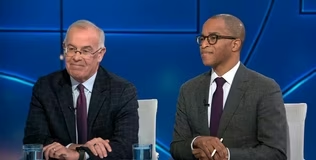
Brooks and Capehart on chances of peace in Ukraine
Video has Closed Captions
Brooks and Capehart on chances of Ukraine-Russia talks leading to peace in 2026 (12m 22s)
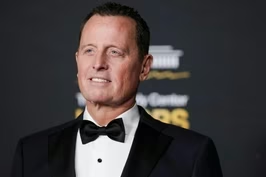
Grenell defends Trump's Kennedy Center takeover
Video has Closed Captions
'We cannot have art institutions that lose money': Grenell defends Kennedy Center takeover (11m 12s)
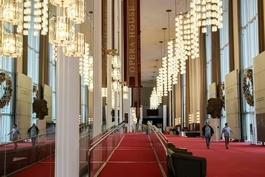
Kennedy Center faces cancellations after Trump's name added
Video has Closed Captions
Kennedy Center faces artist cancellations, drop in ticket sales after Trump's name added (6m 50s)
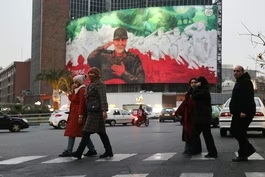
Trump threatens to intervene if Iran kills protesters
Video has Closed Captions
Trump threatens to intervene in Iran if regime continues to kill protesters (8m 35s)
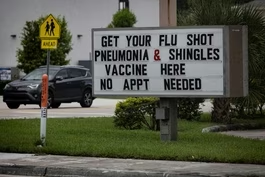
Why the flu season is bad and how you can protect yourself
Video has Closed Captions
Why the flu season is so bad and how you can protect yourself (7m 29s)
Providing Support for PBS.org
Learn Moreabout PBS online sponsorship
- News and Public Affairs

FRONTLINE is investigative journalism that questions, explains and changes our world.

- News and Public Affairs

Amanpour and Company features conversations with leaders and decision makers.












Support for PBS provided by:
Major corporate funding for the PBS News Hour is provided by BDO, BNSF, Consumer Cellular, American Cruise Lines, and Raymond James. Funding for the PBS NewsHour Weekend is provided by...