
January 7, 2026 - PBS News Hour full episode
1/7/2026 | 57m 46sVideo has Closed Captions
January 7, 2026 - PBS News Hour full episode
Wednesday on the News Hour, a woman is shot and killed by an ICE agent in Minneapolis, igniting protests in a city targeted by the Trump administration's immigration crackdown. U.S. forces seize two more tankers linked to Venezuela as part of President Trump's plan to take control of the nation's oil industry. Plus, communities struggle to rebuild, one year after the devastating Los Angeles fires.
Problems playing video? | Closed Captioning Feedback
Problems playing video? | Closed Captioning Feedback
Major corporate funding for the PBS News Hour is provided by BDO, BNSF, Consumer Cellular, American Cruise Lines, and Raymond James. Funding for the PBS NewsHour Weekend is provided by...
Support provided by:

January 7, 2026 - PBS News Hour full episode
1/7/2026 | 57m 46sVideo has Closed Captions
Wednesday on the News Hour, a woman is shot and killed by an ICE agent in Minneapolis, igniting protests in a city targeted by the Trump administration's immigration crackdown. U.S. forces seize two more tankers linked to Venezuela as part of President Trump's plan to take control of the nation's oil industry. Plus, communities struggle to rebuild, one year after the devastating Los Angeles fires.
Problems playing video? | Closed Captioning Feedback
How to Watch PBS News Hour
PBS News Hour is available to stream on pbs.org and the free PBS App, available on iPhone, Apple TV, Android TV, Android smartphones, Amazon Fire TV, Amazon Fire Tablet, Roku, Samsung Smart TV, and Vizio.
Providing Support for PBS.org
Learn Moreabout PBS online sponsorshipGEOFF BENNETT: Good evening.
I'm Geoff Bennett.
AMNA NAWAZ: And I'm Amna Nawaz.
On the "News Hour" tonight: A woman is shot and killed by an ICE agent in Minneapolis, igniting protests in a city targeted by the Trump administration's immigration crackdown.
JACOB FREY (D), Mayor of Minneapolis, Minnesota: I have a message for ICE.
To ICE, get the (EXPLETIVE DELETED) out of Minneapolis.
GEOFF BENNETT: U.S.
forces seized two more tankers linked to Venezuela as part of President Trump's plan to take control of the nation's oil industry.
AMNA NAWAZ: And California communities struggle to rebuild one year after the devastating Los Angeles fires.
PEGGY HOLTER, Palisades Fire Victim: It's better than it was a year ago, in the sense that it doesn't look horrible, but you're reminded of what you've lost.
(BREAK) AMNA NAWAZ: Welcome to the "News Hour."
State and local officials in Minneapolis are outraged tonight after an Immigration and Customs Enforcement agent shot and killed a woman there.
Federal officials accuse that woman of trying to run over officers with a vehicle, claiming the shooting was in self-defense.
GEOFF BENNETT: The city's mayor says the video tells a different story.
Liz Landers starts our coverage.
And a warning: The video in this report is disturbing.
LIZ LANDERS: The incident unfolded in seconds, a maroon SUV approached by a federal law enforcement vehicle, agents telling the female driver to get out of her car, pulling on the door handle.
The SUV reverses, then moves forward.
(GUNSHOTS) LIZ LANDERS: Shots are fired, and the vehicle barrels into parked cars across the street.
Shocked bystanders rushed to the car to try and provide aid.
The driver, who Minnesota officials identified as a 37-year-old woman, was killed.
WOMAN: Dude, you shot her!
LIZ LANDERS: A Minnesota senator said she was a U.S.
citizen.
At an event along the Texas border, Homeland Security Secretary Kristi Noem said the ICE agent acted in necessary self-defense.
KRISTI NOEM, U.S.
Homeland Security Secretary: It was an act of domestic terrorism.
A woman attacked them and those surrounding them and attempted to run them over and ram them with her vehicle.
An officer of ours acted quickly and defensively shot to protect himself and the people around him.
LIZ LANDERS: The president also weighed in from social media.
"It is a horrible thing to watch," Trump said.
"The woman screaming was obviously a professional agitator and the woman driving the car was very disorderly, obstructing and resisting, who then violently, willfully and viciously ran over the ICE officer."
No officer appeared to be run over, but some who saw the video from a different angle, including the president, argued the ICE officer's life was in danger from the vehicle.
A witness who saw the shooting unfold said he saw it differently.
AIDAN PERZANA, Witness: My interpretation at the time and still is that the person was trying to get away, and there was definitely space to get - - to drive forward without hitting anybody.
I did not think that -- at the time, I did not even think there was a risk of her hitting anybody.
JACOB FREY (D), Mayor of Minneapolis, Minnesota: There's sowing chaos on our streets and, in this case, quite literally killing people.
LIZ LANDERS: Minneapolis's Democratic Mayor Jacob Frey shared that doubt.
JACOB FREY: They are already trying to spin this as an action of self-defense.
Having seen the video myself, I want to tell everybody directly, that is bull (EXPLETIVE DELETED).
LIZ LANDERS: Today's shooting comes as Minnesota faces a massive immigration crackdown, with plans to deploy some 2,000 agents and officers.
DHS called it -- quote -- "the largest immigration operation ever," and it is tied in part to allegations of fraud involving Somali residents.
Minnesota has the biggest Somali-American population in the country.
Mayor Frey had these words for the growing immigration enforcement presence in the city.
JACOB FREY: And I have a message for ICE.
To ICE, get the (EXPLETIVE DELETED) out of Minneapolis.
PROTESTERS: Shame!
Shame!
Shame!
LIZ LANDERS: Hundreds gathered at the scene and angry protesters heckled agents,the residential neighborhood where the shooting occurred just a mile or so from where George Floyd was killed by police in 2020.
Minneapolis has long been a target of President Trump since that time, during his first term, when riots and protests broke out in the city after Floyd's murder.
Minnesota's Governor Tim Walz said this was a pattern from the Trump administration.
GOV.
TIM WALZ (D-MN): Do not take the bait.
Do not allow them to deploy federal troops into here.
Do not allow them to invoke the Insurrection Act.
Do not allow them to declare martial law.
Do not allow them to lie about the security and the decency of this state.
GEOFF BENNETT: The Minnesota Star Tribune is now reporting that the mother of the woman who was killed has identified her as Renee Nicole Good.
For more, we're joined now by Minneapolis Police Chief Brian O'Hara.
Thank you for being with us.
And you said just yesterday that the way ICE had carried out their operations, the intense emotions surrounding all of this made unrest or tragedy almost inevitable.
And now that is precisely what has happened.
How do you square that warning with what unfolds?
BRIAN O'HARA, Minneapolis, Minnesota, Police Chief: Well, unfortunately, the reality of conducting law enforcement is, every time our police officers leave the station and go out into the street, there is risk that something tragic can happen.
And we know very clearly, as we -- I have been saying for several weeks, is, there is a very heightened risk when activity is being conducted, enforcement activity is being conducted on the street when situations are very tense and things are very emotionally charged.
And so that's why I just think it's very important that we ensure that an investigation occur transparency -- transparently.
I think we owe that to the deceased person and their family, as well as to the community, who clearly have been very concerned.
And there's just been a lot of questions, not so much specifically about whether or not federal law enforcement -- federal laws are enforced, but, more specifically, how that enforcement is being conducted.
GEOFF BENNETT: Well, based on what you have seen and learned so far, what is your assessment of what transpired in that fatal shooting?
CHIEF BRIAN O'HARA: So the information that I have is very preliminary and is the same as what is available in open sources.
But I can tell you this much.
In my career as a police officer for many decades now, law enforcement training has been trying to de-escalate whenever possible and trying to avoid getting police officers into these types of situations with drivers who are taking off and trying to prevent situations where law enforcement may be in the path of a vehicle, trying to avoid these things in the first place.
And so that has very clearly been where professional law enforcement has been going in this country for many years.
GEOFF BENNETT: It's your officers who've had to deal with the immediate aftermath of all of this.
What's the plan for how you intend to handle protests and demonstrations in the days ahead?
CHIEF BRIAN O'HARA: Well, our officers have been doing an incredible job day and night around the clock, and it's been heightened for the last several weeks.
And, quite frankly, many times, our officers come to scenes trying to protect life, trying to preserve the peace, and they often then become the object of people's hate and vitriol and frustration over how things are happening in the street.
So we will continue to be staffed up.
We will be ready to go around the clock.
But, more importantly, we are asking everyone in our community and all of our public officials to please allow people to exercise their right to peaceably assemble and express frustrations, but express those frustrations lawfully and peacefully, and not further subject this community to destruction or any further tragedy.
Today was a tragedy.
Let's be clear.
I don't think, no matter which side you're on, the loss of a human life is a tragedy.
And in this type of situation, no one wins.
GEOFF BENNETT: Minneapolis Police Chief Brian O'Hara, thanks again for your time this evening.
We appreciate it.
CHIEF BRIAN O'HARA: Thank you.
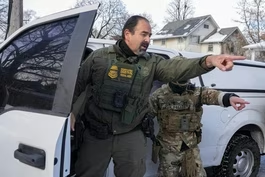
AMNA NAWAZ: For more analysis, I'm joined now by John Sandweg, who served as acting ICE director under President Obama.
John, welcome back to the show.
Thanks for being with us.
JOHN SANDWEG, Former Acting ICE Director: Yes, thanks for having me.
AMNA NAWAZ: So, as you have seen, DHS is saying that the ICE agent here was acting in self-defense.
The mayor of Minneapolis, others have dismissed that after they saw the video.
Have you yourself watched the video?
What's your assessment of what happened here?
JOHN SANDWEG: I think the videos - - I have seen two videos now, and I think both of them raise troubling questions here.
But I think what concerns me is this rush to judgment, really on both sides, but I did find the DHS statement particularly irresponsible.
This requires an investigation.
This -- the video certainly raises concerns as to whether or not the officer had a reasonable basis to believe his life or the life of his fellow agents were in either serious danger of death or bodily injury.
But these videos are not -- they're not the entire story and they can be misleading.
And so I think what will concern me is that we have all these people making these immediate rushes to judgment without first conducting a formal investigation, getting the facts we need and then drawing our conclusions based on a thorough assessment of what exactly happened.
AMNA NAWAZ: You mentioned that DHS statement.
It was very long and detailed, definitively coming out in defense of the ICE agent's actions.
What questions do you think need to be answered now to figure out what exactly happened here?
JOHN SANDWEG: Well, first of all, I will tell you, I spent five years at DHS working for a secretary.
And whenever something like this happens, the initial information you get is just not accurate.
You get all sort of people doing their best to provide quickly information to the department's leadership.
And, just unfortunately, it just tends not to be -- you get this misleading or wrong information in the outset.
So I think that what's frustrating in part, and where I find that statement really irresponsible, is that you know better when you're in those positions to make rush, snap judgments based on that initial reporting.
But, secondly, Amna, look, this -- the videos certainly raise all sorts of questions, including, where was the officer located as the car started to take off, right?
What caused the officer to get into that position?
What was the distance between the officer and the -- and the driver of the vehicle or the vehicle itself, right?
What angle did the bullets come in?
These are all questions are going to form that basis.
Now, Amna, the analysis is from that of the agent himself.
Did he have a reasonable basis to believe that his life or his fellow agents' lives were in jeopardy, right?
That's the critical question.
But, again, although those videos absolutely raise troubling questions in that, and I think call all the more reason for us to have an investigation, they're not -- they're not alone sufficient.
We're going to need to get more data than that to draw any real conclusions.
AMNA NAWAZ: As you know, DHS often points out that ICE agents operating in Minneapolis and other places face protesters and people videotaping them.
There's also been concerns about how quickly ICE has been staffing up to meet the demands of the president's mass deportation campaign.
Does any of that, you think, potentially play a role here?
JOHN SANDWEG: No, absolutely.
I mean, one of the big questions I have here is, how experienced was this particular agent engaged in the shooting, right?
Was this one of the new hires?
We know a couple of things.
We know the department's lowered their standards for hiring of ICE agents.
We know they have shortened the training.
So I think critical questions here will be, did any of that have an impact or play a role in this shooting or really in any of the use of force incidents?
At the end of the day, this is about training.
This is about training and experience, right?
And when you're putting officers on the street where you have lowered the standards and you have shortened the training, you increase dramatically the risks of incidents like this.
And I will say one other thing too is that this mass deportation mission, it's created a supercharged environment.
And the tactics that ICE has had to adopt as a result of the administration's call for them to increase the number of arrests has created more vulnerabilities for the agents themselves and raised the tensions.
And I do think, unfortunately, that climate, that climate where we have these agents confronting these protesters and there's aggression and this kind of zero tolerance towards anybody who obstructs or gets in the way of the ICE mission, certainly, that kind of plays a role here as well.
But, again, this is why we need an investigation.
We need to interview the officers involved.
And all of that will inform what happened here and what do we need to do differently to prevent some like this happening in the future.
AMNA NAWAZ: All right, that is former Acting ICE Director John Sandweg joining us tonight.
John, thank you.
Always good to speak with you.
JOHN SANDWEG: Thank you very much.
AMNA NAWAZ: The Trump administration escalated its pressure on and control of Venezuelan oil today, seizing two oil tankers and declaring it intends to -- quote -- "indefinitely sell the country's oil.
Nick Schifrin reports.
NICK SCHIFRIN: A middle-of-the-night capture in the Caribbean.
The U.S.
military posted this video of U.S.
forces seizing the Sophia, a sanctioned Panama-flagged super tanker carrying Venezuelan oil.
Just hours before, U.S.
forces seized another tanker they'd been pursuing for two weeks after it slipped through the U.S.
Caribbean quarantine.
The Marinera recently changed its name and claimed to be Russian-flagged, and Russian TV showed this footage from its deck.
A Russian ship and submarine provided an escort, but did nothing to stop the U.S.
capture.
It's a tale of two tankers and of global U.S.
pressure on Venezuela's most valuable asset.
The U.S.
military said the Sophia sailed without its transponder, part of a Venezuelan shadow fleet, and is now being escorted to the U.S.
The Marinera met its fate about 5,000 miles away, just south of Iceland, with the help of British armed forces.
The U.S.
envisions total control over the extraction and sale of Venezuelan oil forever, starting with crude already produced, as energy Secretary Chris Wright laid out today.
CHRIS WRIGHT, U.S.
Energy Secretary: We're going to market the crude coming out of Venezuela first, this backed-up stored oil, and then indefinitely, going forward, we will sell the production that comes out of Venezuela into the marketplace.
NICK SCHIFRIN: Venezuela has the largest oil reserves in the world, which the U.S.
helped extract beginning a century ago.
But the country only produces a fraction of its capacity, and Venezuela's former leader Hugo Chavez kicked out some us and other foreign energy companies.
CHRIS WRIGHT: So, in the long run, create the conditions that the major American companies that were there before, maybe that weren't there before, but want to be there, will go in.
The resources are immense.
This should be a wealthy, prosperous, peaceful energy powerhouse.
That's the plan.
IAN RALBY, Auxilium Worldwide: The U.S.
is essentially declaring domestic legal rights over a foreign state without being the official occupying power or declaring itself the sovereign power.
So, we're in a very unusual place here, and it's not entirely clear what that means.
NICK SCHIFRIN: Ian Ralby is founder and CEO of the nonprofit Auxilium Worldwide and focuses on maritime security.
IAN RALBY: Previously, the oil industry in Venezuela had been nationalized and run by PDVSA, the state-owned oil company.
This is now sounding like the U.S.
government is going to serve as the state-owned oil company or overseer of extraction.
It is unclear, though, what this actually means in practice and whether actual oil companies are really part of this plan or not.
NICK SCHIFRIN: That's because the U.S.
cannot yet guarantee a Venezuela in which American companies feel confident to spend billions in necessary investment.
IAN RALBY: There needs to be a degree of stability for oil extraction and for a marketplace participation.
And that is not right now what we see on the ground in the reality of Venezuela.
NICK SCHIFRIN: To try and speed up investment, today, White House Press Secretary Karoline Leavitt said the U.S.
would roll back Venezuelan sanctions selectively.
KAROLINE LEAVITT, White House Press Secretary: We obviously have maximum leverage over the interim authorities in Venezuela right now.
And the president has made it very clear that this is a country within the United States -- the Western Hemisphere, close by the United States, that is no longer going to be sending illegal drugs to the United States of America.
NICK SCHIFRIN: The other Western Hemisphere target of the Trump administration this week, Greenland.
The world's largest island has been part of a Kingdom of Denmark since 1721.
Today, it's a self-governing territory inside the NATO ally.
It is also geographically in the Americas and a critical missile defense site, the shortest route between the United States and Russia.
And it's rich in rare earth minerals and potential offshore oil and gas, which is why, last night, the White House released a statement that included -- quote -- "The president and his team are discussing a range of options to pursue this important foreign policy goal.
And, of course, utilizing the U.S.
military is always an option at the commander in chief's disposal."
Today, the U.S.'
top diplomat emphasized diplomacy.
MARCO RUBIO, U.S.
Secretary of State: If the president identifies a threat to the national security of the United States, every president retains the option to address it through military means.
As a diplomat, which is what I am now, and what we work on, we always prefer to settle it in different ways.
NICK SCHIFRIN: The threat has sparked enormous European concern, but also criticism, as voiced today by European Council President Antonio Costa.
ANTONIO COSTA, President, European Council: The European Union cannot accept violations of the international law, whether in Cyprus, Latin America, Greenland Ukraine, or Gaza.
NICK SCHIFRIN: The U.S.
has long considered NATO the world's most successful alliance, but the White House today had to reiterate its support for Article 5 to our Liz Landers.
KAROLINE LEAVITT: We're always going to be there for NATO, even if they have not done right by the United States of America.
NICK SCHIFRIN: And so, once again, President Trump disrupted global relations, only to try and provide reassurance.
But the alliance is today skeptical and still worried.
For the "PBS News Hour," I'm Nick Schifrin.
AMNA NAWAZ: And "News Hour" has learned senior administration officials today told members of Congress the proceeds from the sale of Venezuelan oil would not go into the U.S.
treasury, but to private banks.
That's according to five bipartisan congressional officials who spoke to our Lisa Desjardins and Nick Schifrin.
The Energy Department today acknowledged the money would go into -- quote - - "globally recognized banks to guarantee the legitimacy and integrity of the ultimate distribution of proceeds."
Energy Secretary Chris Wright told CNN the funds would go to -- quote -- "the interim authorities" in Venezuela.
However, the White House disputed our reporting and told us no final decisions have been made.
We start the day's other headlines with the growing political tensions over fraud schemes in the state of Minnesota.
REP.
JAMES COMER (R-KY): No, you all have failed.
REP.
SUMMER LEE (D-PA): We have done nothing.
You have had the gavel, Mr.
Comer, who barely do hearings on anything that actually... (CROSSTALK) AMNA NAWAZ: At a sometimes contentious hearing on Capitol Hill today, the House Oversight Committee heard from Republican state lawmakers who claimed that state officials resisted efforts to address systemic financial wrongdoing.
Committee Chairman Republican James Comer said the fraud was rampant.
REP.
JAMES COMER: Minnesota social services, which are funded by you, the American taxpayer, are being ripped off.
The breadth and depth of this fraud is breathtaking.
And I fear that this is just the tip of the iceberg.
AMNA NAWAZ: The issue has become a lightning rod for President Trump and many top Republicans, who point to the involvement of members of Minnesota's Somali community in carrying out pandemic era fraud schemes.
Today, Democratic Representative Summer Lee pushed back.
REP.
SUMMER LEE: Republicans have cherry-picked a blue state and an immigrant population, vulnerable to demonize.
To be clear, Minnesota is not the only state with a fraud problem.
To truly tackle waste, fraud and abuse, we need to approach the issue with a scalpel, not a mallet.
AMNA NAWAZ: Minnesota Governor Tim Walz called today's proceedings a show hearing.
Chairman Comer has threatened to subpoena Walz, as well as Attorney General Keith Ellison, to force them to testify about the ongoing probe in their state.
A GOP spokesperson said today that neither Democrat has confirmed that they will attend a hearing scheduled for February, though they still have several weeks to do so.
Florida Governor Ron DeSantis is calling for a special session of the state's legislature in April to redraw its congressional maps.
At a news conference today, DeSantis said the session is aimed at getting out ahead of a Supreme Court ruling that bars discrimination in voting systems.
The governor says at least one or two districts in Florida could be affected.
The state joins a nationwide redistricting effort ahead of this year's midterm elections.
Republicans currently hold 20 of Florida's 28 congressional seats.
Nick Reiner's arraignment hearing and the killing of his parents was delayed today after his high-profile attorney was replaced by a public defender.
Alan Jackson did not say why he asked the court to leave the case.
His departure comes as Reiner faces two counts of first-degree murder in the deaths last month of actor-director Rob Reiner and his photographer wife, Michele Singer Reiner.
Nick Reiner has not entered a plea and is being held without bail.
A new arraignment hearing is scheduled for February.
The Pittsburgh Post-Gazette is shutting down with its final edition due in may.
The family-owned company that runs the paper, Block Communications, pointed to mounting losses, saying it's lost $350 million over the past 20 years.
It also cited a recent court ruling that would have required the paper to operate under what it called an outdated labor contract.
In a statement, the company said it's proud of its service to the city, adding -- quote -- "We deeply regret the impact this decision will have on Pittsburgh and the surrounding region."
Overseas, Iran's military chief is warning of preemptive military action against what he called rhetoric against the Islamic Republic.
His comments come as economic protests intensify across the country, including this demonstration in the Southern Iranian port city of Bandar Abbas.
In recent days, President Trump has said the U.S.
is -- quote -- "locked and loaded" if Iran kills protesters.
Israel's Prime Minister Benjamin Netanyahu has also praised those demonstrating.
Today, Army Commander Amir Hatami warned the two leaders against intervening in Iranian affairs.
AMIR HATAMI, Iranian Army Commander in Chief (through translator): Today, there are no doubts about the hostility of the U.S.
president and the criminal prime minister of Israel toward the Iranian nation.
They allow themselves to meddle in this internal affair of ours.
They tweet.
They talk.
They have been enemies throughout history.
AMNA NAWAZ: Separately today, Iran's government began paying its citizens around seven U.S.
dollars a month to help offset the rising costs of everyday essentials.
But the nation's shopkeepers warn that prices are continuing to rise.
Back in this country, Warner Bros.
Discovery is rejecting the latest takeover bid from Paramount.
Instead, the company is telling shareholders to stick with the plan to sell its streaming and studio businesses to rival Netflix for about $72 billion.
The announcement is the latest roadblock for Paramount boss David Ellison and his billionaire father, Larry Ellison, who'd offered to provide around $40 billion in financing for the deal.
Warner Bros.
shares ended slightly higher after the news.
Elsewhere on Wall Street, stocks ended mixed.
The Dow Jones industrial average lost 466 points.
The Nasdaq managed a slight gain of nearly 40 points.
The S&P 500 ended lower for the first time in four sessions.
Still to come on the "News Hour": we speak with Democratic Leader Hakeem Jeffries and Republican Don Bacon; the long rebuilding process one year after the devastating Los Angeles fires; and new dietary guidelines are set to bring changes for school lunches and the food industry at large.
Let's get two views now from Capitol Hill on the day's developments.
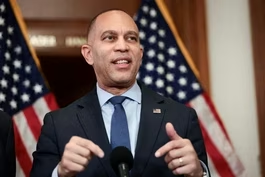
First up, Representative Hakeem Jeffries of New York, leader of the House Democrats.
I spoke with him this afternoon and started by asking his assessment of what happened in Minneapolis today.
REP.
HAKEEM JEFFRIES (D-NY): There is no evidence that has been presented to justify the shooting of an unarmed woman, resulting in her unnecessary death.
Kristi Noem, the so-called secretary of homeland security, is a stone-cold liar who has zero credibility on this issue or on any other issue.
And what we need, as I believe the governor has indicated, is a full and complete investigation.
This rogue ICE agent who pulled the trigger should be criminally investigated to the full extent of the law, including for demonstrating a depraved indifference to human life.
AMNA NAWAZ: As you know, there are ICE officers deployed in multiple places across the country as part of the president's immigration crackdown.
What's the role for federal lawmakers like you to ensure that justice is served here in Minneapolis, but also that this doesn't happen in any other community?
REP.
HAKEEM JEFFRIES: Well, the president's extreme immigration policies have been a complete and total failure.
That's why the American people across the country have been rejecting them.
The president promised that the Department of Homeland Security and ICE would be targeting violent felons.
They're not targeting violent felons.
They are targeting and deporting, in some cases, American citizens and certainly individuals who have been part of these communities in some cases for decades.
And Congress should step forward and reassert our authority.
Unfortunately, Republicans, who control the House and the Senate temporarily for the time being, have functioned like a reckless rubber stamp for Donald Trump's extreme agenda, as opposed to being part of a separate and co-equal branch of government.
AMNA NAWAZ: I want to ask you about our other big story today, which is the escalation related to Venezuela.
We saw U.S.
forces seize two more Venezuelan oil tankers.
We also saw the U.S.
energy secretary say that the U.S.
will control Venezuelan oil sales indefinitely.
In any of the briefings you have received on Venezuela, have you gotten a clear sense of what the U.S.
mission is in Venezuela and the timeline for how long we will be involved there?
REP.
HAKEEM JEFFRIES: The briefings have been unpersuasive and have left me and other members of Congress with more questions than answers.
It's not clear what the strategy is moving forward.
The one thing I do know is that the future of Venezuela should be decided by the Venezuelan people, nobody else.
It doesn't appear that the Trump administration has a plan to effectuate that.
We also know that this notion that the United States is going to run Venezuela is completely and totally ridiculous.
The Trump administration doesn't even know how to run the United States of America effectively.
We also need to step forward as a Congress to ensure legislatively that no additional military action is taken absent explicit congressional authorization.
We know the Constitution is very clear that the power to declare war, matters of war and peace, are solely within the jurisdiction of the Congress, the Article I branch of government, and this out-of-control administration needs to be reined in.
AMNA NAWAZ: Well, as you know, the White House has argued that they did not need congressional approval for what they called targeted and limited military action in Venezuela.
And you have seen since the president and other officials have threatened more unilateral action in other nations, Colombia and Cuba and Mexico and Greenland.
And, on that, my colleague Lisa Desjardins asked House Speaker Mike Johnson today if military force in Greenland requires congressional approval.
He said it depends on what that is.
He went on to say: "Congress has a responsibility to declare war .
think there is no scenario where we'd be at war with Greenland."
What do you say to that?
REP.
HAKEEM JEFFRIES: The Republican majority has been nothing but compliant as it relates to Donald Trump's extreme agenda.
And so I don't expect that we'd hear anything out of Republican leadership.
But what we do know is that, whether it's aggression that's militarily executed against Greenland or Panama or Colombia or Mexico or any other country in the Western Hemisphere, it requires explicit congressional authorization.
As it relates to the situation in Venezuela, let's be clear about something.
This was not a law enforcement operation.
We have heard all manner of different excuses as to why they have gone into Venezuela.
First, we heard it was about narcotrafficking.
Then we heard it was about the fact that we needed to expel the Chinese, the Russians and the Iranians.
Then we heard that, well, this is about oil.
I mean, at the end of the day, what is clear is that it appears to be a power grab by the administration without any plan to prevent us as a country from getting involved in another endless foreign war that costs the lives of American men and women in uniform.
AMNA NAWAZ: Well, Leader Jeffries, if you believe the military action was unconstitutional, as you seem to be indicating here, what can you do about it?
I mean, the president has lamented earlier in this week to other Republicans that he was worried Democrats would try to impeach him if they lose in the upcoming midterms.
Would you try to do that?
REP.
HAKEEM JEFFRIES: Well, what we have to do is deal with the issue that's in front of us right now.
And that's to make sure that no further military action can be taken without explicit congressional approval by introducing a war powers resolution that we believe has a chance to pass the United States House of Representatives, if we can secure just a handful of Republicans to join our effort and reassert congressional authority on behalf of the American people to prevent the expenditure of billions, if not trillions of dollars in another failed foreign war.
AMNA NAWAZ: Do you believe you have Republican support for that?
REP.
HAKEEM JEFFRIES: We certainly have the support of Congressman Thomas Massie from Kentucky.
We had gotten the support in a previous effort to restrain the administration on the Venezuela issue from Congressman Don Bacon.
And we're hopeful that we can secure the support of just a few more Republicans.
And if in fact we do that, then the House can act.
And we know that the Senate is planning to act on a war powers resolution tomorrow that has a chance of passing that chamber as well.
AMNA NAWAZ: Leader Jeffries, a lot more to talk about, with health care subsidies, a funding deadline ahead.
We hope you come back so we can cover those topics as well.
That is House Democratic Leader Hakeem Jeffries joining us tonight.
REP.
HAKEEM JEFFRIES: Thank you much.
Look forward to it.
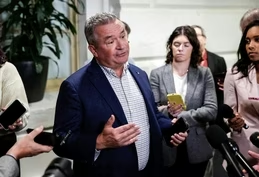
GEOFF BENNETT: And for perspective from the other side of the aisle, we turn now to Congressman Don Bacon, whom Leader Jeffries mentioned.
I spoke with a Nebraska Republican and retired Air Force brigadier general earlier today.
Congressman Don Bacon, welcome to the "News Hour."
REP.
DON BACON (R-NE): Thank you.
GEOFF BENNETT: On the matter of Venezuela, you were among the lawmakers briefed today by the administration on the Maduro operation.
Did you get the answers you needed and what outstanding questions do you still have about how the White House is approaching Venezuela?
REP.
DON BACON: Maybe two parts to my answer.
First part, they gave us details of the operation.
It was extraordinarily complicated, lots of moving parts, Special Forces, 150 different aircraft.
And it had to be synchronized to the minute, or to the second almost in many cases.
And it was brilliantly performed and executed by our military, so a lot of pride as a 30-year Air Force guy.
Now, the bigger question, what do we do next?
And I would say the administration is vague right now what to do next.
I worry that we're propping up the vice president, who did not win the election.
She was part of the illegitimate government with Maduro.
She's part of the Maduros' team.
Now there were elections in Venezuela, and a guy named by Gonzalez won handily, almost 70 to 30 percent, right, a huge win.
And Machado, what was the person supposed to be on the ballot, but her name was taken off by Maduro, and then Gonzalez ran in her spot, these should be the people that we should be looking to running the government down the road.
If this is a short-term time frame to have the vice president, Rodriguez, in, OK,I understand it, but the long-term plan should be trying to get Venezuela to the rightfully elected leaders.
I think there's been too much emphasis by the administration on oil.
I think most Americans don't see regime change should be defended by talking about getting their oil and controlling their oil.
Should be more about putting the rightfully -- rightful people in charge.
And then we can let the oil industry take care of itself.
GEOFF BENNETT: On the matter of the timeline, what some lawmakers took away from today's briefing was that there is now this road map for a years-long American presence in Venezuela, so that, in other words, after Iraq and Afghanistan, the U.S.
may be nation-building again.
Was that your impression?
REP.
DON BACON: Well, it was vague.
I will say that.
There was not a lot of detail but how long we're going to try to get the rightfully elected leaders.
They talked about different phases.
But the eventual -- the last phase is to put in the rightfully elected people, make it -- get a legitimate government put back in.
But there was a lot of detail on timing on that.
I do think most Americans do not want to run Venezuela.
GEOFF BENNETT: Big picture, the president has put Colombia, Cuba, Mexico, Iran, Greenland on notice.
You have described the notion of taking over Greenland by the U.S.
military as appalling and really dumb.
Zooming out, do you see a strategic through line here, or is this just the administration governing by pressure point and provocation?
REP.
DON BACON: Well, we don't want to be the bully.
And I think, to some degree, we're coming off that way.
I -- Venezuela is a unique situation, because they had Maduro.
Colombia, it's maybe a little bit of a problem, because a lot of the cocaine has come out of there, but the government is rightfully elected.
I met the president of Mexico in Mexico City this summer.
And she wants to work with our country to beat these cartels.
And there's ways we can do it, but she does not want American forces in Mexico.
She doesn't want American airpower going after them, but she could use our intelligence.
Now, this thing with Greenland is appalling.
They are in NATO.
They govern themselves, so they're under the protection of Denmark.
Denmark's a NATO ally.
We used to have five bases in Greenland.
We have one right now.
Greenland would welcome our friendly requests to have more basing rights there, to do more mining and economic investment in Greenland.
They would love that.
But threatening Greenland is counterproductive.
It's counterproductive to Denmark.
And, by the way, all the European countries see it and they hate it.
And these are our allies.
NATO is the best alliance in the history of mankind.
GEOFF BENNETT: Do you think President Trump's Greenland threats are part of a broader effort within the administration to dismantle NATO, something that he has talked openly about?
REP.
DON BACON: Well, they surely undervalue NATO.
Now, I -- one of the things that stands out at me is, there's a lot of talk about United States to control the Western Hemisphere, spheres of influence.
Europe and Russia, you guys can fight it out.
And Europe and China will have the Asia sphere of influence.
But that -- this is 1800s type of thinking.
And it went away in 1939, when Nazi Germany invaded Poland.
And after World War II, we realized spheres of influence, we're better than that.
America is the leader of the free world.
We can't do it by ourselves.
We got to have good friends.
We can't counter Russia, China, Iran on our own.
But with our allies, we can.
GEOFF BENNETT: Given that this is such a foundational and existential issue, why aren't more Republicans speaking up like you are?
REP.
DON BACON: I'm not sure.
But I think a lot of them tell me, Don, it's better to talk privately with the White House.
Of course, I don't have President Trump on my speed dial.
I have a different view.
I mean, I had someone tell me yesterday, I respect him: "Don, if you were in a company, would you do this publicly?
Would you just go and have a private chat?"
And I'd go: "Yes, I would if I'm in a company."
When I'm in a military unit, I did the same thing.
But I'm a representative of the Second District of Nebraska.
I represent 700,000 people.
I want the constituents to know that some of this stuff is unacceptable.
But it's particularly Greenland, right?
Our voters deserve to know where we stand on this.
GEOFF BENNETT: Congressman Don Bacon, Republican from Nebraska, good to speak with you.
Thanks for making time for us.
REP.
DON BACON: Thank you.
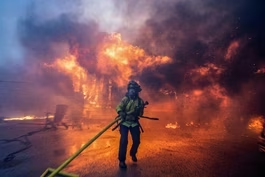
AMNA NAWAZ: Today marks one year since wildfires set parts of Los Angeles ablaze, killing 31 people.
And there's still anger and pain over the response to those fires.
Just yesterday, the chief of the Los Angeles Fire Department admitted that a report on the department's response had been watered down to ease criticism of top brass, including decisions made initially about staffing and deployment.
In two of the hardest-hit areas, Altadena and the Pacific Palisades, residents are grappling with the long process of trying to rebuild their homes and their communities.
Stephanie Sy has our report on what life is like now.
STEPHANIE SY: In the Pacific Palisades, the scale of rebuilding hasn't come close to the scale of destruction.
The number of rebuilding projects under way is in the low hundreds, but more than 6,000 structures were burned in this area a year ago, when a ferocious wind-whipped fire consumed some of the most expensive real estate in the country.
PEGGY HOLTER, Palisades Fire Victim: It was chaos, but weird chaos, like a war.
STEPHANIE SY: Peggy Holter, a former TV news producer, is no stranger to conflict zones.
She never imagined she'd see her own city, its schools, houses of worship, and neighborhoods in embers.
PEGGY HOLTER: Lots of people were leaving their cars.
There were piles of just rubble.
It was horrible.
It was like the apocalypse.
STEPHANIE SY: She's one of the more than 100,000 Angelenos who were displaced by the fires last January.
WILLIAM BRANGHAM: So your place was right here?
PEGGY HOLTER: Right here on the corner.
STEPHANIE SY: The "News Hour" first met Holter a few weeks after the fires, her townhouse, which she bought in 1977, reduced to rubble.
PEGGY HOLTER: It just seems like there's a blank in my future.
STEPHANIE SY: In June, an Army Corps of Engineers crew cleared the wreckage from her condominium complex.
Today, going back to the site, Holter wonders at how quickly nature rebounded, when rebuilding for the majority of displaced fire victims has been slow, held up by a web of bureaucracy, insurance claim delays, and rising material and labor costs.
Construction is starting to speed up; 14 percent of homes destroyed here have received rebuilding permits, according to a recent L.A.
Times analysis.
PEGGY HOLTER: We have really, really, really made progress.
STEPHANIE SY: Holter's homeowners association is planning to apply for a permit in coming months.
What's it like to be at this spot a year on?
PEGGY HOLTER: It's better than it was a year ago, in the sense that it doesn't look horrible.
It's kind of serene in its own way, but you're remind ed of what you have lost.
STEPHANIE SY: Holter suspects some of those losses could have been avoided.
She is one of more than 3,000 Palisades Fire victims now suing for alleged failures by state and city agencies.
PEGGY HOLTER: The reason I felt that it was important to be part of it is that it's important for the city and the county and the state to know that they can't be sloppy about stuff like this.
STEPHANIE SY: They allege the fact that a major reservoir which serves the Palisades was offline undergoing repairs affected firefighting capabilities just as demand was overwhelming water supplies.
PEGGY HOLTER: I was furious, as was everyone, because how can you have something like that with 115 million gallons of water in it and then have it be empty?
STEPHANIE SY: The lawsuit also alleges firefighters failed to follow proper procedures after containing an earlier fire set by an arsonist in a state park.
It reignited six days later.
JON BROWN, Palisades Resident: Our town burned for days after that fire was rekindled.
It's almost more enraging to understand that maybe there could have been some anticipation of it.
STEPHANIE SY: Recently, questions have swirled around whether state policies protecting endangered plants may have hampered firefighters, preventing them from bringing in bulldozers to fully extinguish the initial fire.
State officials have repeatedly denied those claims.
EMEKA CHUKWURAH, Altadena Resident: We were kind of just left to fend for ourselves, you know?
STEPHANIE SY: Meanwhile, in Altadena, about 35 miles east of the Pacific Palisades, survivors of the Eaton Fire like Emeka Chukwurah are also critical of the early response.
EMEKA CHUKWURAH: I would think in this country that there would be a greater response to this level of disaster.
STEPHANIE SY: The unincorporated city relied on L.A.
County and city resources when hurricane-force winds blew the fire's embers from the San Gabriel Mountains into Altadena's heart.
Evacuation orders didn't go out in West Altadena until five hours after the flames began to threaten the area.
Chukwurah and his father, Onochie, owned a store selling African goods that burned down.
Today, it's just an empty lot.
ONOCHIE CHUKWURAH, Altadena Resident: What do you think you miss the most about the shop, you know?
EMEKA CHUKWURAH: Just the ambience.
ONOCHIE CHUKWURAH: The ambience.
STEPHANIE SY: But the community spirit of their shop, called Rhythms of the Village, lives on.
They have distributed supplies to fire victims.
And the festivals and drumming circles they once held at the store continued this past year at different temporary venues.
EMEKA CHUKWURAH: The drumming is the heartbeat of the community, the heartbeat, you know?
STEPHANIE SY: Here in Altadena, more than 9,000 structures were burned.
But the Eaton Fire threatened much more than that.
And for the last year, residents have been fighting for this community's history and identity.
Since the 1960s, Altadena represented an opportunity for Black families.
Less restrictive redlining laws meant homeownership and the creation of generational wealth.
EMEKA CHUKWURAH: Altadena was almost 42 percent African American.
That was what was closing the wealth gap for us here.
STEPHANIE SY: In 2023, about 80 percent of Black Altadenans owned their homes, nearly double the national average.
But even before the fires, the Black population had dropped to 20 percent, with gentrification and rising home values.
Concerns about unscrupulous investors taking over are the talk of the town these days.
EMEKA CHUKWURAH: People capitalize on devastation.
It's bad, you know?
STEPHANIE SY: And some residents feared the disaster worsened inequalities.
A recent study found nearly seven in 10 of severely fire-damaged homes in Altadena show no signs of rebuilding, with Black and Asian homeowners most likely to remain stalled.
EMEKA CHUKWURAH: Everybody I know was impacted by this.
So even if you kept your home, you have survivors' guilt.
STEPHANIE SY: Chukwurah's home was spared by the fire.
But even getting his shop up and running has been tough.
Lease prices for commercial spaces have shot up.
Can you not afford to rent a store or a retail space because of that fact?
EMEKA CHUKWURAH: I think so.
I have to weigh that up and see if it's sustainable for me to reopen and pay double what I was paying.
STEPHANIE SY: He's raised more than $100,000 through GoFundMe and is seeing if they can get support from nonprofits.
EMEKA CHUKWURAH: In a place where Black businesses maybe weren't as strong as they once were, it was -- it's important for us to have a presence.
So, us being here, even though we welcome everybody, our people felt like, oh, that's our home, that's our place.
STEPHANIE SY: At least,he says, that heartbeat remains strong, with music a central rallying cry.
Strength is also something that Peggy Holter eventually found in herself.
Having had no insurance at the time of the fire, she did not get a payout to replace her belongings.
But a year out, as we're talking, a change in outlook.
PEGGY HOLTER: This stuff is not so important now.
STEPHANIE SY: Your whole face just lit up because you realized something.
PEGGY HOLTER: Yes, that's true.
Well, I think the lesson is, your happiness doesn't depend on things.
It's pretty simple, really.
But you realize, when it's all taken away, you still can be very happy.
STEPHANIE SY: The condo complex is still an estimated two years from being rebuilt.
And, this time, it's being designed with all new fire-resistant materials.
For the "PBS News Hour," I'm Stephanie Sy in Los Angeles.
AMNA NAWAZ: The Trump administration released new dietary guidelines today that will shape everything from school lunches to medical advice.
GEOFF BENNETT: The new guidance puts a bigger emphasis on eating more protein and dairy, something Health Secretary Robert F. Kennedy Jr.
has long sought.
But the administration also held on to some traditional and mainstream guidelines.
William Brangham has more.
WILLIAM BRANGHAM: Jeff, during a press conference at the White House, Secretary Kennedy literally turned that traditional food pyramid upside down to mirror what he and other Trump officials said Americans should eat.
That's significantly more protein and dairy, numerous servings of fruits and vegetables and other healthy fats, all of that at the top, and fewer whole grains down at the bottom.
Some of the other specific recommendations, less added sugar, that children should not eat added sugars until they are 10 years old, three servings of dairy a day, including whole milk, rather than low-fat, fewer processed foods, period.
And, controversially, it removed recommendations to limit alcohol consumption.
These guidelines are updated every five years.
And Secretary of Agriculture Brooke Rollins said today's guidance had one basic principle.
BROOKE ROLLINS, U.S.
Secretary of Agriculture: Thankfully, the solution is simple and should be noncontroversial, eat real food.
We are finally putting real food back at the center of the American diet, real food that nourishes the body, restores health, fuels energy, and builds strength.
WILLIAM BRANGHAM: But these new recommendations are getting mixed reviews from nutrition experts and medical associations.
So, to help break down this new guidance, we are joined again by Lindsey Smith Taillie.
She's a nutrition epidemiologist and co-director of the Global Food Research Program at UNC Chapel Hill.
Lindsey, so nice to have you back on the program.
Let's get your overall broad-brush take on these guidelines.
What do you like?
What don't you like?
LINDSEY SMITH TAILLIE, Nutrition Epidemiologist, University of North Carolina at Chapel Hill: Thank you so much for having me.
I think there's a lot to like in these guidelines and also a number of items to be concerned about.
In terms of what to like, I think the overall focus on eating real food is great and really landmark progress in the U.S., where we know that the majority of our diets come from ultra-processed foods that are linked to an array of chronic diseases.
And so having this very clear, simple guidance to eat real food, I think is enormously helpful, both for policymakers and for your everyday consumer.
On the other hand the guidelines also contain a number of items, such as the increased recommendation for meat and dairy and the elimination of the alcohol guideline, that are quite concerning.
WILLIAM BRANGHAM: It's striking to me that the idea that the federal government is only now saying to people, eat real food, like, how is it that we have taken this long to say something so simple?
LINDSEY SMITH TAILLIE: I think there are a number of reasons.
First of all, from a scientific perspective, it's only been in about the last decade or so that we have really thought of food in this particular way, where we're looking at almost a non-nutritional dimension, processing, how was the food actually made and packaged and distributed?
So that is new.
I think the other thing that is the reason why we haven't done this before is conflicts of interest.
So when you look at who is on the Dietary Guidelines Scientific Committee and who funds their research, in the past, those scientists have been funded by organizations that produce ultra-processed foods.
And I think that has a lot to do with what kind of guidelines you see in the previous guidelines and then also today.
WILLIAM BRANGHAM: So I want to double back to what you were saying before about what seems to be a real heavy focus on meat and dairy.
If you just look at that pyramid itself, in the upper left corner, it's chicken and beef and steak and cheese and hamburger.
Where do you think that is coming from?
And what is it that troubles you about that.
LINDSEY SMITH TAILLIE: Yes, absolutely.
So I think there are two things that are troubling to me about that.
The first is that this is really in conflict with what the recent Dietary Guidelines Committee of Scientists recommended, and also that this is something that could potentially be very harmful for the environment, because we know that beef production in particular is responsible for the majority of food-related environmental harms.
So that's part one.
And then I think the second thing that goes along with what I was saying earlier about conflicts of interest is that RFK Jr., one of his main stances that we were also excited about is that he promised to get rid of conflicts of interest from the dietary guidelines, things like this ultra-processed food conflicts of interest that I was talking about earlier.
But what we see when we look at the scientists who created this report is that the majority of them have recent financial ties to the beef and dairy industries.
And so we still have the same question of, is this actually based in gold standard scientific evidence, or is this essentially food industry propaganda that is kind of coming from the federal government?
WILLIAM BRANGHAM: Secretary Rollins in that announcement today said that this guidance will have a particularly big impact on school lunches, what's served to children in schools.
How so?
LINDSEY SMITH TAILLIE: So, right now, school lunches have no guidelines around their processing levels.
And so this guideline at a very high level, this guideline of eating real foods, could have profound effects, because the majority of school lunches are coming from ready-to-eat, ready-to-heat and highly processed sources.
And then I think the other major shift in the guideline is really on added sugar.
The government was actually just in the process for the first time of implementing an added sugar guideline.
But this new recommendation is much more strict than previous recommendations.
And so if it gets implemented in schools, we can imagine seeing things like reductions in sweetened, flavored milks for example or all the refined grains that are in school lunches.
WILLIAM BRANGHAM: All right, Lindsey Smith Taillie of UNC Chapel Hill, always great to talk to you.
Thank you so much.
LINDSEY SMITH TAILLIE: Thank you so much for having me.
GEOFF BENNETT: And that's the "News Hour" for tonight.
I'm Geoff Bennett.
AMNA NAWAZ: And I'm Amna Nawaz.
On behalf of the entire "News Hour" team, thank you for joining us.
Communities struggle with rebuilding a year after LA fires
Video has Closed Captions
A year after the devastating LA wildfires, communities struggle with rebuilding (8m 49s)
Ex-ICE chief: Rush to judgment after shooting irresponsible
Video has Closed Captions
Ex-ICE chief calls DHS rush to judgment after Minneapolis shooting ‘irresponsible’ (4m 19s)

Experts divided over new federal dietary guidelines
Video has Closed Captions
Why experts are divided over the new federal dietary guidelines (6m 7s)
GOP's Bacon: 'Too much emphasis on oil' after Maduro removal
Video has Closed Captions
GOP Rep. Bacon says Trump placing 'too much emphasis on oil' after Maduro's removal (6m 21s)
Jeffries: Trump 'needs to be reigned in' after Venezuela
Video has Closed Captions
Trump 'needs to be reigned in' after Venezuela action and Greenland threats, Jeffries says (7m 12s)
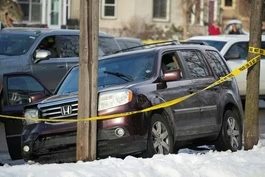
Minnesota leaders clash with feds after ICE shooting
Video has Closed Captions
State, city leaders clash with feds after deadly ICE shooting in Minneapolis (3m 53s)
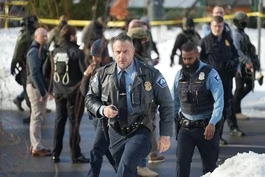
Police chief urges lawful, peaceful response to ICE shooting
Video has Closed Captions
Minneapolis police chief urges ‘lawful, peaceful’ response to ICE shooting (4m 6s)

White House says U.S. will control Venezuelan oil industry
Video has Closed Captions
White House says U.S. will control Venezuelan oil industry 'indefinitely' (6m 9s)
Providing Support for PBS.org
Learn Moreabout PBS online sponsorship
- News and Public Affairs

FRONTLINE is investigative journalism that questions, explains and changes our world.

- News and Public Affairs

Amanpour and Company features conversations with leaders and decision makers.












Support for PBS provided by:
Major corporate funding for the PBS News Hour is provided by BDO, BNSF, Consumer Cellular, American Cruise Lines, and Raymond James. Funding for the PBS NewsHour Weekend is provided by...