
July 13, 2026 - Full Show
7/13/2026 | 26m 50sVideo has Closed Captions
Watch the July 13, 2026, full episode of "Chicago Tonight."
Chicago’s police superintendent is set to retire this week — what comes next? And a task force explores the challenges facing domestic violence survivors.
Problems playing video? | Closed Captioning Feedback
Problems playing video? | Closed Captioning Feedback
Chicago Tonight is a local public television program presented by WTTW
WTTW video streaming support provided by members and sponsors.
July 13, 2026 - Full Show
7/13/2026 | 26m 50sVideo has Closed Captions
Chicago’s police superintendent is set to retire this week — what comes next? And a task force explores the challenges facing domestic violence survivors.
Problems playing video? | Closed Captioning Feedback
Where to Watch Chicago Tonight
Chicago Tonight is available to stream on pbs.org and the PBS app.

WTTW News Explains
In this Emmy Award-winning series, WTTW News tackles your questions — big and small — about life in the Chicago area. Our video animations guide you through local government, city history, public utilities and everything in between.Providing Support for PBS.org
Learn Moreabout PBS online sponsorship>> Hello and thanks for joining us Chicago tonight.
I'm joined of non this brand is Freeman has the evening off.
Here's what we're looking at.
The head of Chicago's Police Department is retiring this week.
What's the process like for replacing him?
>> In just 6 months, we have reduced domestic murders by 53% and doubled the rate at which protective orders have served.
>> And a task force details.
The challenges facing domestic violence survivors in Cook County.
First off tonight, the summer heat is moving in in Chicago.
Officials are asking residents to prepare.
>> Temperatures are expected to climb into the Mid 90's this week with high heat conditions Tuesday and Wednesday.
The city is reminding residents to stay hydrated.
Check on neighbors and use cooling centers available across Chicago.
In the Chicago Fire Stadium Project is moving forward today after City Council committee okayed 425 million dollars to subsidize the project.
The area's tax increment financing or TIF districts will be used to subsidize a 22,000 seat stadium located in the South Loop.
The stadium itself broke round back in March 6 months after City Council gave it the green light indicating the subsidy was a foregone conclusion.
The funds will be used to connect the stadium to the city street grid repair the river wall improve nearby metro tracks and fund an underground parking garage.
According to the plans, a public plaza will be built on top of the garage in 6 acres of Parkland will be open to the public.
A final vote by the full city cop.
A fine double by city Council is set by Wednesday.
There's a new four-legged member of the Cook County State's Attorney's office today.
States attorney Eileen O'Neill, Bourke store in Ruthie, a 2 year-old golden Retriever has a new escort facility dog Ruthie will provide support to victims in witnesses in cases involving domestic violence, assault and abuse.
She's a second comfort dog in the program following months of specialized training >> these animals can make some of the worst days of people's lives just a little bit easier.
But we have also seen a huge benefit for our own employees.
Being a Cook County State's attorney is not a job for the faint of heart.
>> And we're back with more right after this.
>> Chicago tonight is made possible in part by the Alexander and John Nichols family.
The Pope Brothers Foundation.
And the support of these donors.
>> Domestic violence cases of become more deadly in recent years.
A new Chicago and Cook County Task force as improving coordination between courts in law enforcement is critical.
But advocates say without more funding, many survivors will struggle to get the help they need.
Joining us now to talk about this is Cook County Commissioner Donna Miller, whose district includes parts of the south and southwest suburbs.
Amy FOX executive director of life Span a group that provides legal advocacy services to victims of domestic and violence.
And Sarah Brown, a survivor of domestic abuse.
Thank you all for joining us on this very important topic.
Now, I want to start off now.
The task force was created at the beginning of the year at a time when we know homicides in the city, we're dropping.
But domestic related fatal shootings were up.
Commissioner Miller, why do you think we saw an increase in domestic violence at this at that time at that time?
we think that there is increased just because people reporting it may be more often finding out about this services and resources that were available in coming forward.
We've had so many brave people come forward to tell their stories.
I had a hearing last year.
>> That lasted about 7 and a half hours long.
We heard from victims of domestic violence and they told their stories and we hope that that encourages others to not only tell their stories but to get resources and help available to them.
And we know it's not always easy to come up front tell your story.
Sarah, want to go to your survivor of intimate partner abuse.
>> Can you share some of your story shares how with my views a wee.
The incident happened with my son was 6 and a half months old.
>> through the journey of 5 taking the next steps to kind advocate for my own south as well as my son and make sure we're protected.
We just kind of been in the loop hole of the court system is started off with temporary restraining order.
My permanent restraining order was declined.
when the battle within the domestic relations court started that has been ongoing for 9 and a half years.
seems like there have challenges along yes, it has been.
>> And I want I want to talk about the task force report.
One of overarching conclusions is that there's no single agency responsible for protecting survivors once again to the system.
They could be interacting with a variety of local police sheriffs office state police, multiple courts.
Miller, what's the impact of that fragmentation for victims?
>> Well, that's one of biggest issues that we've heard from victims.
They don't know where to go and they don't have all the same resources at all.
That courthouse is there here in Cook County.
That's what we want to streamline.
We want to make sure not only is their transparency throughout the courts, but we also want to make sure victims no matter where they go, they can get help.
They can get questions answered and they have people on site to answer those questions.
When you come into court, it takes a lot to get yourself there and bring your children with you your family with you.
And we want to make sure when they make that brave step that we're there to help.
started to feel that.
>> I did.
I feel the assistance now.
It was a very lonely journey.
actually feel that mild paperwork.
I did not get any assistance when I initially filled out for restraining order, even throughout domestic relations court system.
That process was very hard to navigate a long.
And so for me, it was kind of like, okay, we'll I feel I don't read victimized through this whole entire process.
Again, something that I didn't think was even possible.
How center would just say is a task force very essential.
I believe that beyond my story.
I think other stories was heard, which kind of came up with awfully work parking conversations that was very impactful as well as the executive meetings that different presentations that was hailed things that I learned even through that that that was very essential because it just opened the door right for conversation for collaboration.
it was very good to see, you know, and or governmental bodies Arkansas.
Governor, that's awesome.
And may want to bring you in.
Now.
You said the lifespan is turning away roughly 60% of people seeking help because you don't have the capacity to help everyone who was in need.
What challenges does lifespan and other organizations face when trying to properly serve people who victims or survivors.
Sure.
Yes.
When people request legal services from life spanned represents survivors and family law on immigration.
>> About 60% of the people who request services.
We don't have the capacity to serve them.
So we do have the capacity because we don't have the funding.
We have 8 full-time family law attorneys and we still have to turn away 60% of people who contact us and it really comes down to funding or lack thereof.
feel like to know you have turn people away and it's devastating.
So to make those hard decisions, but also to know that we turn them away.
But we've no way to refer them to.
So they we know that then they're going to navigate the systems that are even complex for attorneys to navigate all in their own.
And that not only is it frustrating and complex, but it bodown to the safety of them and their children.
So lives are at stake.
Commissioner, what are your thoughts?
Well, resources are need to be expanded.
We hope that that's something we can change in the future.
We have the report from the task force identifying several key items areas of improvement.
Some are small incremental changes, but some are big changes that might take.
>> Time to do.
But the good thing is identifying them on the front them.
And right now as we're going through, you know, a tough budget cycle.
We do have to make sure that we're going to be putting resources in the areas that where it's needed to help save lives and improve victims circumstances.
And talking about that, I want to talk about the recommendations that we saw in the report.
Some of them say.
>> A recording every hearing and provide free transcripts, expanding free legal help stop jailing a threatening survivors over court cost make mediation safer and improved technology virtual access.
Know, Commissioner Miller, why is a quarter form such an important part of this conversation?
Well, because we when we heard at that 7 and a multiple victim state that in the court, they weren't getting answers.
They had to come back to court.
They didn't know why they didn't have access to information Wednesday attended court.
Sometimes they were not allowed to even bring people to court with them.
And so all of these things, we just have to greater transparency over.
Some of these are very easily fix problems.
And we did work every diferentes sticks every different part of the county on this.
And they participated in a task force which shows their willingness to want to make these changes.
And now we just have to implement them.
And we think we have the ability to do that.
do see people coming in with the same needs.
>> 100%.
I don't think any survivor if they were to read that report or any domestic violence worker would be surprised by the systemic failures that addressed you think it's taken this long?
I think that that really people think that there may be quick fix.
They want immediate results mean this is a complex multi system.
Really crisis.
And there is no one easy fix.
It takes a combination of comitted meaningful, systemic change.
But also while that changes taking place that survivors have services so that they can continue to seek safety.
While the system's correct themselves.
And, Sara, you mentioned it a little bit, but you have an active case of domestic relations court for 9.
>> And a half years now, what's been keeping your core for nearly a decade and a lot of the rotation of Jazz's.
had a total of 8 appointed taxes to my case.
It has been a lack there of the quite reporting now East homages is appointed.
They're trying to figure out my case.
that was definitely turbulent as well as attorney fees.
So individuals that are attorneys, that's a point on the case for.
sorry.
Yale's as well as our representative CEOs.
a lot of that proponent is related to fees that the in you know, is very problematic for me being pro se litigant in my case.
Also rating is up for you there for a strike.
That would just it's a reality for many others.
Absolutely.
And being continuously threatened with jail time for not paying these costs.
I would have no idea about that.
Probably average person has no idea that yes, have to go through that.
Yes, you're already went through a rice.
>> So I can imagine having to go through that exactly is even harder for you.
Exactly.
Is a complete yeah.
Or movie.
And so for me throughout you know, I can even pinpoint.
>> From the recommendations, I believe that think the biggest thing for me is the transparency and and getting the court recordings into massive relations as any big city court is in other courts in also having that Avalible, I think will help also just kind overall attention to what's happening in the courtroom.
is very important.
And Commissioner Miller, the task force told so within 6 months of its a nation initiation.
>> Domestic violence, murders have decreased by 53%.
Would you attribute that decline to?
Well, we attribute that to climb basically to hire.
>> Engagement from the different departments.
They have more knowledge.
They're focused on it And so if we can do that in the 6 month time period, imagine what we can do.
It better resources, greater transparency, more focused over a longer period of time and make it consistent.
We don't want to have just a six-month pics.
We want to have a consistent fix that last throughout time.
>> Amy, as you mentioned, there's so much Lt victims and survivors have to jump over just to receive the help that they need.
How is your work impacted by those barriers?
Well, you know, it our work impacted every single day because we're committed to helping survivors.
And so have to turn away survivors because we are spending our time and necessarily navigating those systems on behalf of our clients.
So the longer it takes, the more barriers we have to try to overcome the more systems that we have to try to integrate.
It's time consuming so we could help so many more survivors things were more streamlined.
People are held accountable.
There is transparency.
So I do believe I going in the right direction.
Absolutely.
I think the conversation continuously happening.
Cut, you know, coverage happening today.
>> I had not even seen this amount of coverage about the topics.
hopeful that, you know, these conversations are being had lost a journalist locally, you because this is something that I think side only people that are battling, you know, within his core system is giving them hope he's given me hope will keeps, you the individuals that I've talked to people that has inbox me, people that has followed up because we spoke with several survivors are Leon.
And just I'm saying thank you, Sarah, for being our voice.
How does that make you feel whole?
You last week at the hearing for the city of Chicago's is like a tap, the kind of clothes I can't wait until Wednesday for the Cook County hearing.
You know, just because this is a chapter that, you know, even though I don't have closure in my case.
>> My whole goal.
>> Was to make sure the next woman didn't have to go through what I went through and talking about that for a woman who's going through domestic violence abuse.
What would you tell They're watching this.
>> And they're scared to say anything.
Is for you.
>> you have to if it's not for you, when you have a child is for your So beyond that moment getting through and saying, you know what, I have a story.
I can I can reach out to someone reaching out to someone I think is the first thing being able to tell your story and and trusting someone to tell that story.
I think that's another thing in Gazin because sometimes it's all I know the message that that happens.
And, you know, I maybe they won't believe me.
And I think that's a other component.
Part of that mental thing.
And it's like not just a story.
Just tell you a story.
Just tell your story.
Meanwhile, I want to end with you.
What else would you like to see from lawmakers and officials to help victims and survivors?
>> Of domestic abuse?
Well, on top of the recommendations made by the task force, what we really need is long sustained funding from both Cook County Chicago in Cook County and they have not funded domestic out services until 2023.
And that was largely because of COVID relief funding and that money.
Now he's gone away.
And so Cook County needs to step up and they need to fund at least at the level that they did when we had the COVID funding at that time, Chicago stepped up last year.
They met those funds and I think Cook County could prioritize it in their budget as well.
Thank you.
Thank everybody for your input.
Thank you, sir, for sharing a piece of your story.
Thank you.
Thank you.
Kim.
Up next, the hunt for Chicago's new top cop begins a look at the process right after this.
>> The >> search for a new top cop cut top cop is on.
That's because Chicago Police Superintendent Larry Snelling is retiring this week after a 30 year career with the force, including 3 years leading the department, his election was the first to involve the Comey.
The community Commission for public safety and accountability or C C P C a a civilian body established to provide oversight of the police.
Joining us now with the commission's Pratt is the commission's president Rimmel Terry, thank you for joining us.
Terry, I want to start off as we know so 10 a slowing is last day.
Is this week.
I want to ask you looking back on his tenure, how would you assess his leadership?
It would do you see as his biggest accomplishments?
>> I would say on one of our shared priorities when we think about Superintendent Snelling has been strengthening relationships between the police department and the city's district counselors.
We passed policy that allow for that to be so and as well as under superintendent selling, we seeing more consistent engagement between district commanders and district counselors, which is a very important piece as well as the wider community.
And as you already know, every year we as a commission established certain performance goals for the superintendent and Superintendent Snelling has always really embrace that process.
And he's always make himself available publicly to discuss the progress on them.
So those are things that we really fine, very important.
Some of the biggest accomplishments as well as a lot of the success that we've heard around his ability to complete portions of the consent decree.
>> What would you say are some unfinished challenges?
>> I would say that this is the city of Chicago.
We are the 3rd largest city in this country and the second largest police department in so when we think about policing in this country, the next superintendent will be asked to do a lot at once.
You have to focus on reducing crime, you'll have to continue police reform.
You have to build trust with communities as well as lead a department of thousands.
So we're really just looking for someone who can balance all of those things because that is the nature of the job.
>> You have your work cut out for you in an earlier this year.
The commission requires Snelling to explain why use of force complaints had increased since 2022, are you satisfied with the department's response and what more needs to happen to reverse that trend?
>> I think we're still waiting to hear back about a lot of that.
That part of the goal has not been completed.
And so we're still allowing the department to do the work that they need to and they are.
And in terms of assessing the data so that we can have the clear response related to if there any concerns that we need to be aware of and put in the proper solutions to address them.
>> I want to talk quickly about Midway Blitz now Superintendent Snelling addressed Acpd response, 2 Midway blitz at a ccps a meeting in April.
Let's take a listen.
>> We talk about city We talk about trust >> And I'm not what well versed what >> What here to do No the ordinance and the law.
With him >> From what he said, what would you say?
How did Midway blitz effect community police relations know we saw the videos and it seemed to be some tensions and in some of the neighborhoods.
>> Yeah.
One thing we've learned over the past last few years and course, in recent times as it relates to the midway blitz situation here on the ground is that community will tell us what's important to them in what we've done is create space.
So back in January, we had an initial conversation, a public hearing on those concerns.
And because of that feedback, we created a strategic priority for the commission.
And it really has been to work with the department to understand what is happening as it relates to the welcoming city ordinance.
And so when we think about not only the work of Superintendent Snelling, he's now retiring, but this future superintendent search will really want to understand how those who are looking to be in that position will implement the plan of both existing CPD policies and any guidance that has received from the mayor's executive order.
>> I want to talk about the consent degree were to CPD still have work to do on the consent degree and what should the next superintendent tackle first?
>> Yeah.
So as we already know, the consent decree is the road map constitutional policing and it lays out the different were forms.
There has been a lot of success.
I attended a meeting.
I think it was in the 6th district that was being led by Maggie Hickey, who is the Independent Monitor and she was sharing how she has seen a lot of success under Superintendent Snelling of achieving more is such a short 10 year.
And so we want to learn from her.
What has been the success so that we can ensure that the candidates vying for this opportunity are in alignment with that, we can see even more success under their tenure.
>> L, what are you will see looking for in the next superintendent?
>> I'm looking for someone to again continue to be a bridge builder and have similar success is that we've seen under superintendent snowing what we've learned the first time around back in 20 23 is that the people really care and they want to be heard.
And so we're looking for someone who can maintain all of those relationships.
Not only within the department, but with the various stakeholders and shareholders who care about public safety and accountability in the city of Chicago.
>> Can you remind what is the process for picking a new superintendent?
>> So starting July 16th, we launch 120 day process.
>> Where we will began with doing a series of listening sessions across the city of Chicago.
We will also began to meet with the different policing.
>> Unions as well as other policing experts.
We will also be reaching out to different affinity groups and elected officials, everyone to really hear what they have to say about what has worked will and what are some of the things that need to be considered for the next superintendent and by November 12, we will have to provide 3 nominees to the mayor for consideration.
>> You know that the final question that I want to ask is what lessons to learn from the last super intendent search that will shape this next one.
>> Yeah, it would be the feedback, right?
We got a lot of feedback from broad range of perspectives.
And again, the importance of people wanting to be heard and wanting to be engaged and holding on to those lessons and ensuring that we are just asked Transparent, we're just as forthcoming.
And we're just as engaged with all of the stakeholders in this time around as well.
>> It seems Chicago engagement from the residence is very important.
>> Yes, it is definitely very important.
And we encourage everyone to stay tune, be engaged and tell other people because this is a very important job.
But we know how important public safety is to the city of Chicago.
And we want everyone to know that they have a space to be heard and influence this process.
>> Well, thank you so much for military for your insight.
Thank you so much.
Back to wrap things up right after this.
>> W T Tw News coverage of policing and police reform is supported by the Joyce Foundation.
>> And that's our show for this Monday night.
Stay connected with our reporters and what they're working on by following us on Instagram at W T Tw Chicago and join us tomorrow night at 5, 30 10.
And a stomach bug is popping up across the country, including in Illinois.
What to know about the outbreak and how to prevent getting it.
Now from all of us here, Chicago tonight, I'm joined at Non this.
Thank you for watching.
Stay healthy and safe.
Good night.
>> Closed captioning is made possible by Clifford and Clifford Law offices, Chicago, personal injury and wrongful death that contributes to
 New
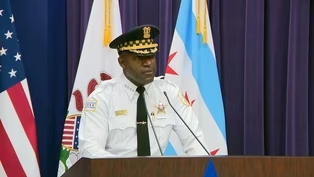
NewChicago's Top Cop Is Retiring. What's the Process for Choosing His Successor?
Video has Closed Captions
CPD Supt. Larry Snelling has spent more than three decades with the department. (8m 15s)
 New
NewNew Report Details the Challenges Facing Domestic Violence Survivors
Video has Closed Captions
A Chicago and Cook County task force says coordination between the courts and police is critical. (13m 27s)
Providing Support for PBS.org
Learn Moreabout PBS online sponsorship New Episode
- News and Public Affairs

Top journalists deliver compelling original analysis of the hour's headlines.

- News and Public Affairs

FRONTLINE is investigative journalism that questions, explains and changes our world.
 New Episode
 New Episode
 New Episode
 New Episode
 New Episode

 New Episode
 New Episode
Support for PBS provided by:
Chicago Tonight is a local public television program presented by WTTW
WTTW video streaming support provided by members and sponsors.