
Juneteenth
Clip: Season 49 Episode 24 | 7m 13sVideo has Closed Captions
Juneteenth | Episode 4924/Segment 1
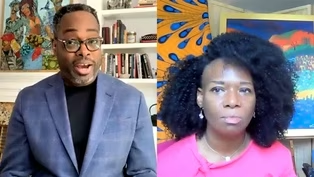
This year marks the 156th anniversary of Juneteenth. The holiday celebrates the end of slavery in the united states, and it is often referred to as “freedom day.” The Charles H. Wright museum of African American history is heading up a three-day series of virtual and in-person events here in Detroit. Stephen got all of the details on the “Juneteenth Jubilee Freedom Weekend” from Neil Barclay.
Problems playing video? | Closed Captioning Feedback
Problems playing video? | Closed Captioning Feedback
American Black Journal is a local public television program presented by Detroit PBS
Juneteenth
Clip: Season 49 Episode 24 | 7m 13sVideo has Closed Captions
This year marks the 156th anniversary of Juneteenth. The holiday celebrates the end of slavery in the united states, and it is often referred to as “freedom day.” The Charles H. Wright museum of African American history is heading up a three-day series of virtual and in-person events here in Detroit. Stephen got all of the details on the “Juneteenth Jubilee Freedom Weekend” from Neil Barclay.
Problems playing video? | Closed Captioning Feedback
Where to Watch American Black Journal
American Black Journal is available to stream on pbs.org and the PBS app.
Providing Support for PBS.org
Learn Moreabout PBS online sponsorshipSo let's talk about Juneteenth and what kind of celebration we're gonna have at the Charles H. Wright.
Yeah, it's gonna actually be really incredible.
We joined with a couple of our corporate sponsors, Chase and T-Mobile and ten other museums around the country to kind of create this nationwide celebration of Juneteenth, which will air on the 19th, actually, around the noon hour.
But the idea was to get these organizations together and to script a really small, maybe five, seven minute excerpt that focuses their city's particular African-American history, as it relates to issues of freedom and this sort of emancipation theme that is in he Juneteenth celebration and this sort of notion of what freedom means today.
We use the "Lift Every Voice and Sing" song as an inspiration for that, and each individual museum selected a word or a theme from that song to create their five minutes excerpt, so it's really kind of getting to be a really exciting look at 10 different cities, their celebrations of Juneteenth, et cetera.
But here in Detroit there's even more fun to be had.
We're gonna be doing a screening of "Concrete Cowboy".
That's gonna happen on Friday, actually, the day before Juneteenth, the official celebration of Juneteenth.
It's gonna be downtown, a collaboration with the downtown partnership.
And then at noon, on Juneteenth day, we'll have a weekend dedicated to promoting quality education, economics, community engagement, black-owned businesses, and it will be along the Livernois, Avenue of Fashion, where a stroll will include a day of shopping discounts, health and wellness activities, pop-up artists, DJs and more, all of that can be found on thewright.org.
So it's kind of a national celebration, which will be mostly online, but then here both at the museum and down on Livernois as kind of a celebration throughout the city.
Juneteenth is something that grew up as African-American in this community you've heard maybe a little about, but it seems as though it's not as widely recognized as some other celebrations, some other historical celebrations, but it's getting there.
I think as we think about emancipation, freedom, even our 4th of July celebrations that happen a few weeks after this, we have to remember when it was that the African-Americans, in particular people of color, found out that they were actually free, and that was really the moment of celebration for our culture, right?
So as most people know the story was that soldiers came to Galveston, Texas two years after the emancipation proclamation to let people know that they were actually free, but they had been free for two years technically, right?
But we're just finding out about it, so this is a moment that we all need to remember about freedom, how we find out about our freedoms, what it means to us, right?
It's a great moment of reflection at that moment in history at that time in history.
So it is becoming a bigger deal, I think it's why we wanted to get other museums involved in this celebration, right?
And we hope to grow it every year, so there are more and more and more participants.
Talk about some of the things that will be common among the other museums, and what kind of other museums are participating?
Yeah, there'll be everything from musical celebrations, panels, symposiums, kind of symposium talks, conversations, things like that.
We'll be doing some of that at the museum itself on the 19th as well, and those will be common themes, I think, throughout what everyone is doing.
The Juneteenth, of course, letting people know what the actual day is about in terms of really talking about that moment in history in Galveston and how that then kind of permeated throughout the African-American culture at the time.
And what are the kinds of other museums?
The Wright is such an unusual thing for us to have here in Detroit, most people don't have a museum of African-American history, so who's gonna be participating?
Yeah, I was just looking at the list earlier.
It's like, the American Black Holocaust Museum in Milwaukee, the Amistad Research Center in New Orleans, The August Wilson Center in Pittsburgh, which I'm the founding director of actually, the California African-American Museum in Los Angeles, the Wright, the Harvey Gantt in Charlotte, the Historic Mitchelville Freedom Park in Hilton Head, the National Civil Rights Museum in Memphis, the Underground Railroad Freedom Center in Cincinnati, and the Northwest African American Museum in Seattle, so really a good cross section of museum that are participating.
Yeah, so we haven't talked much since the very beginning, I think, of the pandemic was maybe the last time I caught up with you.
I wonder if you can catch us up on the things that have changed, maybe, because of the pandemic, and I guess what you're looking forward to as the world starts to open back up.
What can we look forward to at the Wright?
Yeah, I mean, we're really kind of excited about the future for the Wright, what's coming up.
We used the time to do some planning, some introspection to think about how we were structured, the kinds of things we wanted to do moving forward, get our house in order.
We were named, post pandemic, as one of America's Cultural Treasures by the Ford Foundation.
That put us in August's company, actually, of 20 institutions around the country.
It did come with a seven figure gift, (chuckles) so that was exciting.
It allows us to really think broadly about the role of the Wright and organizations like it in the future.
So it's a really good time for us, you know?
We're going to be unveiling all of our Fall programs at once later this summer, probably around the African World Festival, which does return in hybrid format to the Wright Museum and around the museum in addition to around the country, I mean, around the country, around the city, in virtual format as well.
So those are exciting developments, and yeah, we're just really excited about what's happening.
We're looking forward to sharing it with folks in the weeks and months to come.
Video has Closed Captions
Clip: S49 Ep24 | 13m 13s | The Tulsa Race Massacre | Episode 4924/Segment 2 (13m 13s)
Providing Support for PBS.org
Learn Moreabout PBS online sponsorship New Episode
- News and Public Affairs

Top journalists deliver compelling original analysis of the hour's headlines.
 New Episode
- News and Public Affairs

FRONTLINE is investigative journalism that questions, explains and changes our world.

 New Episode
 New Episode
 New Episode
 New Episode
 New Episode
 New Episode
 New Episode

Support for PBS provided by:
American Black Journal is a local public television program presented by Detroit PBS