
Living with Auditory Processing Disorder
Season 2025 Episode 8 | 26m 46sVideo has Closed Captions
Fly family; Ask the Experts; Difference Maker disability advocate/attorney Areva Martin.
A Houston family learns how their son Brock’s classroom struggles revealed auditory processing and ADHD challenges — and a new way of understanding him. Experts share strategies for supporting auditory processing differences. Plus, meet Difference Maker Areva Martin.
Problems playing video? | Closed Captioning Feedback
Problems playing video? | Closed Captioning Feedback
A World of Difference is a local public television program presented by WUCF
Living with Auditory Processing Disorder
Season 2025 Episode 8 | 26m 46sVideo has Closed Captions
A Houston family learns how their son Brock’s classroom struggles revealed auditory processing and ADHD challenges — and a new way of understanding him. Experts share strategies for supporting auditory processing differences. Plus, meet Difference Maker Areva Martin.
Problems playing video? | Closed Captioning Feedback
How to Watch A World of Difference
A World of Difference is available to stream on pbs.org and the free PBS App, available on iPhone, Apple TV, Android TV, Android smartphones, Amazon Fire TV, Amazon Fire Tablet, Roku, Samsung Smart TV, and Vizio.
Providing Support for PBS.org
Learn Moreabout PBS online sponsorship(upbeat music) >>Welcome to "A World of Difference: Embracing Neurodiversity."
I'm Darryl Owens.
We've all encountered that seemingly aloof child, the one who, when spoken to, offers only a blank stare, his thoughts drifting into the cosmos.
It's easy to assume he didn't hear you.
But for millions of children and adults, hearing isn't the problem, processing what they hear is.
Auditory processing disorder doesn't show up on a standard hearing test.
It hides in plain sight, in classrooms, conversations, and everyday expectations, where bright, capable students are too often mislabeled as inattentive, unmotivated, or not trying hard enough.
For families, finally naming the challenge can feel both unsettling and illuminating.
But understanding opens doors.
With the right tools and training, parents can help their child connect, communicate, and feel far less lost in the social woods.
On this episode, we meet the Fly family, whose son Brock's slipping performance in the classroom provided the breadcrumbs that led to an APD and ADHD diagnosis and to a new understanding of how he takes in and interprets the world.
Next, national experts share practical strategies for supporting children with auditory processing differences.
And we meet our latest difference maker, an attorney, media expert, and changemaker whose national leadership in neurodiversity advocacy has expanded access, awareness, and dignity for families navigating disability.
But first, we travel to Houston, Texas, to meet the Fly family.
For years, Brock Michael Fly thrived as an honor roll student.
But in eighth grade, he found it more difficult to master complex courses.
After testing for accommodations, the culprit was identified: a combo diagnosis of auditory processing disorder and ADHD.
For the Flys, the diagnosis didn't lower expectation, it reshaped them.
With advocacy and school partnership, they reframed success, focusing on access, understanding, and Brock's confidence.
(lighthearted music) (grinder whirring) >>I was falling sleeping in class a lot, and this was in kindergarten, and I got held back in kindergarten because I was falling asleep in class and I wasn't paying attention.
Even though I passed my final exam, I just didn't have the curriculum I needed to go into first grade.
>>What we experienced often was Brock not responding or acknowledging quickly.
And there were times that we were left wondering whether or not he even heard us or if it was selective hearing.
>>Something I recall when he was very young, and he was in private school then as well, and he would get in trouble for something and we'd talk about it after school.
And his explanation quite often was, "My bad brain made me do it."
>>We took him for hearing tests a few times, and everybody said that he was fine.
And then finally, the therapist, the doctor, was able to diagnose audio processing delay, which for both of us was like, "Oh!
Now we get it."
>>Yeah.
>>So if someone's talking and I'm in the conversation, but they're not talking directly to me, I'll, after they finish, I'll be like, "What'd you say?
What?
Can you repeat that?"
And they're gonna be like, "Oh, I forgot," or, "I've moved on from that."
It's like your brain, audio processing delay.
So the audio is delayed to process to your mind.
So it's just a delayed reaction or delayed response where you just get the answer or the talk after a while.
>>Once we had him tested, easy street.
We moved him to Xavier Academy and they immediately knew what to do with him.
So he has gone from making Fs to high 80s and 90s.
And he's excelling extremely well.
>>How are ya?
>>I'm good.
>>Auditory tasks were definitely a challenge for him.
And when you're in a classroom where you're getting a lot of auditory input, it makes it really hard to focus, to recall directions, and to be able to follow through without some type of help or assistance.
And so I worked with Brock, helping him to understand that he had to have visuals in front of him for a while.
And that even though he felt bad because he was compensating and he was trying to come up with these methods, it was the best thing he could ever do because he didn't realize that he was realizing his own skills.
He was recognizing what helped him, and he actually problem solved it.
And some of his compensations were awesome.
I was really surprised.
And I told him, I said, "The fact that you can do that is really gonna help you later in life and in your pursuits that you want, your sports, all those things."
>>Because he's ADHD and super hyper, we keep him busy, and it's been quite a chore sometimes trying to stack two or three activities up after school just to keep him going and exhausting him naturally.
>>Boredom is a real issue.
You know, trying to keep him focused on something to exhaust him has been challenging.
>>He's two belts away from a black belt in mixed martial arts.
He's in jiu-jitsu.
He has done tap dance, hip hop.
He enjoys golf.
He's done lacrosse, basketball, soccer.
>>I love riding my bike.
I ride bikes maybe 25 miles a day or every other day.
I am in love with bikes.
>>So Brock started at Humphreys School of Music and Theater when he was six years old.
And he loved being on stage, so we were like, okay, well, maybe this is something he will enjoy.
And he ended up doing most of the school plays.
And it was his agent who found this casting call and said, "I really think that Brock would do good at this."
And that's how he ended up in this stage play called "Incident at Vichy."
>>I don't use audio.
I use player's actions.
So the characters, if they move to a different spot, I'll know that's when, oh, okay, my bit's coming up just now.
So they'll move, I know, oh, okay, I'm talking now.
Or I'll use the end of one of their lines to indicate that, okay, it's my turn.
>>Brock came in with a very different energy than we usually see from a lot of our younger actors.
And right away, we knew when he walked in the door that he had the look and the feel and his... The first time he read the lines, I was taken by the focus that he had and the way that he approached it.
You know, I work with a lot of actors.
And sometimes actors in general are cut from a cloth of difficult to focus.
So we didn't, I mean, he fit right in with us.
>>I appreciate everything that my parents have done.
>>He's taken on the world a whole different dimension.
And I just enjoy bracing myself and watching him move along, and we'll see.
I think he's really gonna do well.
It's just giving him all the tools and teaching him to be patient.
(gentle music) (lighthearted music) >>Next, our expert panel helps us better understand auditory processing differences and how families and schools can support students whose brains work differently with sound.
(bright music) Julie Dunlap is a learning specialist at Beacon College, the nation's first accredited college or university dedicated to educating students with learning and attention issues.
And she's a master's trained speech language pathologist with 22 years of clinical experience supporting neurodiverse children, teens, and college students.
She helps families and educators understand learning differences, build self-advocacy skills, and create practical strategies for success in school and life nationwide today.
Susan Fitzell is a nationally recognized neurodiversity speaker, educator, and author of 16 books on learning and motivation.
With more than 30 years of experience and as a neurodivergent parent herself, she helps families and schools better understand how differently wired brains learn, communicate, and thrive when supported the right way.
Kim Zajac is a speech language pathologist and audiologist with 30 years of professional experience.
As an architect of access, she integrates design thinking, technology, and collaboration to ensure access and inclusion.
As a K-12 educator, national speaker, and thought partner, Kim serves to create transformational learning and life experiences.
And we're gonna begin our conversation with Julie Dunlap.
Many parents sense something's off long before there's a label.
From your work with teens and college students, what early signs at home or in school suggest that this is not just not paying attention?
>>Thank you, Darryl.
That's a great question.
Parents do struggle to recognize and make sure that they understand the signs when they have them.
Some of the things they might notice with their children, they come home from school exhausted because they've had to work so hard to understand what's going on in the classroom.
In addition, they might ask "What?"
a lot whenever you give them a direction or say something to them.
You might see meltdowns during homework time or times that they have to work on things from the class.
You're gonna see inconsistent attention.
Like, they're able to focus really well on the things that they enjoy and are into, like their video games and YouTubes and things like that, but when it comes to following a directive or information that they're not as familiar with or comfortable with, it's gonna be a really hard struggle for them to remain focused.
Then you also might see behaviors in the classroom.
They might be acting out a little bit, but if they have a one-on-one session and individualized attention, then that behavior is not present.
>>So, Susan, parents often hear, "They heard you, they just aren't listening."
How do you help families understand the difference between they won't listen and they can't process what they're hearing?
>>I think one of the things we need to remember is if a child has auditory processing difficulty, which mimics ADHD, so a lot of times we think they're not paying attention, they're not focused on us, they're not listening like they're supposed to, but in reality, they can't.
It's, they're not, they may not even hear what's coming at them.
And that could be because of background noise, they can't hear in background noise.
It could be because they're really focused on one thing and they blocked everything out so they can focus.
Cognitive overload, it's too much at once.
I mean, I'm also, I also have central auditory processing disorder, so I can totally relate.
Even now today, in the gym, if the trainer, with all the background noise and the rock and roll music, says, "Hey, you know, I want you to do 20 reps," and if he gives me four or five instructions in a row, I can't do it.
He's gotta give me one at a time or I'm not going to be able to remember what he said because I need a visual, I need a chart, I need a flow chart, I need tools.
It's not deliberate, it's just the brain can't hold it all together.
And sometimes we need to physically do something in order to remember it.
So I think it's just we have this expectation that everybody should be able to focus and pay attention.
But depending on how our brains are wired, that may not be the case.
We're not all going to get all the signals clearly from our auditory processing and the way our brain works.
It may mean that we need some other real strategies to kinda help us get there.
>>Well, Susan, thank you so much for sharing your personal experience with APD.
Kimberly, you've worked closely with middle schoolers and high schoolers who are dealing with auditory processing challenges.
What are some of the common concerns that parents have that end up, ultimately, being tied to auditory processing disorder?
>>I really love that we're bringing the parent perspective into the fold here.
Our parents are receiving the learners we work with all day long at home at the end of a very long and busy day at school.
And so one of the things I hear the most about is when students arrive home, they almost reach a point of listening fatigue, where the capacity of their system to continue to listen and process auditory information reaches its limit, right?
It's sort of a capacity-and-demand situation and there's just no more reserve left for the extra things that extend beyond the school day.
And that's very challenging for parents receiving their students home because they want to talk and listen and hear about the day and what learning had occurred and what was something that was exciting for the student and maybe what was more challenging?
And so this is sometimes tricky for our parents to sort of work with and figure out how to get on the other side of it in a positive way for everyone.
Another thing that I hear, and myself, I have encountered as a parent of two young ladies, is selective hearing.
Parents will sometimes say, "You know, my students come home from school and it seems like, you know, they only want to listen to what they're interested in."
And so what this really is signaling, again, it pairs with that auditory fatigue.
They've been working at high demand all day long.
And their home, that is their comfort zone, it's where they can let their guard down.
And really it's not necessarily reflective of avoidance per se.
I believe that there's actually a component there that's related to a temporal processing limitation.
And so, like, physically, the body signals itself to slow down.
And so that's where the selectivity comes into play.
Another thing, I think, also comes into play for parents is describing students as being vague communicators.
You know, I ask them how their day was at school and I don't really get much, and I get a lot of filler and sort of non-specific responses.
And again, I think this comes down to really being a showing of the temporal processing challenges that our students with auditory processing disorders face.
It's difficult for them to tune into all of the details and to remember with specificity in any moment what might have been covered across the span of a seven-hour school day.
So, parents work very hard with their students to support their learning, and these are definitely some areas that can pop up at home that are need of support.
And that is what we hope to do at school, is to provide students and parents with what they need to be successful in overcoming these challenges.
>>All right, thank you.
So, Julie, parents often say that mornings and homework are the hardest, most difficult times.
What are some simple changes that parents can implement at home that can ease frustration for children who have difficulties processing instructions, spoken instructions?
>>Right.
Well, it's always great to add as many modalities of that information input as possible.
We're just speaking to our students, our children, and expecting them to remember and recall everything.
That message isn't getting in.
We also need to have a way for them to see this and maybe even use visual schedules to do that.
As a child, young children, you might wanna start those visual schedules with pictures and then move into more of word-based schedules, eventually moving to where they can utilize a calendar on their phone or a calendar on their refrigerator to do lists that way that they can see them regularly.
You also wanna make sure that your child is understanding what you're asking them to do and that they're hearing all the directions and you're not gonna just say, "Did you understand me?"
Because that's not really gonna get to the point of the conversation.
You might want them to repeat back the things that they need to do to make sure that they did get everything.
Another thing that we want to do is we want to model and use these supports ourselves so that we make it seem more normalized.
Like, I don't have such a different way of doing things as everybody else.
I know that I need these supports, but I know a lot of people do too.
And that makes it easier for children to understand and to model your behavior.
>>Watch the full Ask the Experts segment on our website at awodtv.org if you wanna learn more about this topic.
You can also watch or listen on Facebook, YouTube, or on your favorite podcasting platform.
(bright music continues) Now let's meet our latest difference maker.
When Areva Martin's son was diagnosed with autism, she joined the countless parents searching desperately for answers.
What she found instead were barriers, systems that were confusing, unresponsive, and too often indifferent.
As she learned to fight for her son, she realized thousands of families were facing the same roadblocks.
So, the Harvard-educated civil rights attorney, talk show host, and CNN contributor became both bulldozer and waymaker.
She built Special Needs Network from a mother's need into a national force for autism advocacy.
Today, as her son thrives at age 26, Areva, author of "The Everyday Advocate: Standing Up for Your Child with Autism," continues that work, not just as an advocate but as a mom who never stopped listening.
(upbeat music) >>Ooh, let's get ourselves a snack.
I realized that Marty's development was different.
Mm.
You like it?
>>Yes.
>>What is it?
>>Watermelon.
>>Yeah, watermelon.
And then this day, this one day that I'll never forget happened, and that was the day that we were called in for an appointment after all of the assessments had been done by the developmental pediatrician.
And it was on that day that she told us that, based on the test that she had conducted, based on her evaluation, based on her observation, everything pointed to Marty being autistic, being on the autism spectrum.
And my husband Ernest and I just cried.
We had so many questions for the doctor and she had so few answers.
We both are lawyers, both, you know, trained in evidence and in science and are both, you know, like things black and white.
And this was the complete opposite.
There were no easy answers, not a lot of responses, and... But we left that office just committed to doing everything we could to help our son.
I had become a full-time advocate again without identifying myself in that way.
I was convinced that Marty shouldn't be in a segregated classroom, a special education classroom, that he should receive support for his disability but in a general classroom, what they call an inclusive classroom.
They fought me, and they refused, initially, to do that.
And I sued the school district and we won, and he was able to gain placement in that classroom.
And I can remember vividly, his grown adult first-grade teacher refused to talk to Marty.
He was so angry and so petty and so narrow-minded that he literally isolated Marty and set such a horrible example for the kids in that classroom, for the other parents.
And that did nothing but strengthen my resolve.
Then at some point, it became clear to me that what I was experiencing wasn't an aberration, it wasn't just my family, that there were hundreds, if not thousands, of families who experienced something very similar.
And that's what led me to starting the nonprofit Special Needs Network.
(tambourines ringing) Special Needs Network is a 501c nonprofit, California-based but with a national footprint, that I started when Marty was still very young.
Despite feeling so overwhelmed and, clearly, nobody's expert, I had more information than a lot of these parents.
And what also became clear to me is that I had the ability to find out the answers, to get the answers to a lot of these questions.
And so that's what I did.
I started, you know, I went back to my law firm and I told the lawyers in my firm, I said, "Look, we're gonna start a disability rights practice.
We're gonna become experts in disability rights."
Fast forward to today, we have over 500 employees, we have six locations throughout the state of California, we have an eight-figure budget, and we are serving tens of thousands of families throughout the state of California.
We are one of the state's premier organizations working at the intersection of disability rights and social justice, really focused on underserved communities.
I am the founder though and president of Special Needs Network, and I'm so, so excited to see all of you here and to welcome you to Camp JPAC.
Special Needs Network has always been this organization that sees a problem and solves a problem.
That's what we're good at.
We see problems, we solve problems.
We see holes and we step in, we fill the gap, we fill the void when there is something lacking in our community.
So we saw this problem, we saw the kids weren't able to go to summer camp.
I was paying some exorbitant amount for Marty to go to a summer camp.
There were so many other families that we served through Special Needs Network that didn't have those kind of financial resources to pay for summer camp.
So I said, "You know what?
We'll just create our own summer camp."
We have now grown this camp.
In a typical summer, we get upwards to 200 kids.
>>I have been telling her story for as many times >>I have been telling her story for as many times as I run into somebody.
I always encourage them to try JPAC, that they are not just for special needs, they're fully inclusive.
And I just really, never having met her except for today, appreciate so much, everything that she has done for our population.
We need more people like her that are willing to see a need and step out on faith and not get scared to find out where that can lead.
>>We're such strong believers in the notion that kids with special needs should not be isolated, that kids with special needs should not be isolated, should not be segregated, but that they should have the full experience as any other child.
(bright music) >>Congratulations, Areva Martin, for making a difference.
And that does it for this episode of "A World of Difference: Embracing Neurodiversity."
I'm Darryl Owens.
Thank you for being a part of our world.
See you back here next time.
You can watch episodes of "A World of Difference" on the Beacon College Facebook and YouTube channels and on the show's website, awodtv.org.
The website also provides tip sheets and other resources for your parenting journey.
You can watch the show from the PBS app, available on your favorite streaming device, and you can listen on your favorite podcasting platform.
Thank you for watching and supporting "A World of Difference."
(upbeat music) (pensive music) (upbeat music)
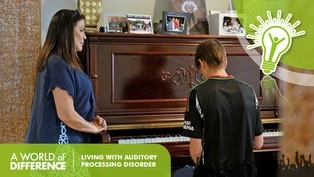
Living with Auditory Processing Disorder | Preview
Preview: S2025 Ep8 | 30s | Watch a preview of the next episode of A World of Difference: Embracing Neurodiversity. (30s)
Providing Support for PBS.org
Learn Moreabout PBS online sponsorship













Support for PBS provided by:
A World of Difference is a local public television program presented by WUCF