Maryland by Air
Maryland by Air
Special | 57m 6sVideo has Closed Captions
Experience the wonders of the Free State on a soaring aerial tour you won't soon forget.
Experience the wonders of the Free State from its picturesque western hills to its bustling metropolitan areas to its thundering shoreline and pastoral farmlands. This breathtaking new program shot entirely from the air, includes an inspiring musical score and is narrated by legendary Marylander and "Iron Man" Cal Ripken Jr.
Problems playing video? | Closed Captioning Feedback
Problems playing video? | Closed Captioning Feedback
Maryland by Air is a local public television program presented by MPT
Distributed nationally by American Public Television
Maryland by Air
Maryland by Air
Special | 57m 6sVideo has Closed Captions
Experience the wonders of the Free State from its picturesque western hills to its bustling metropolitan areas to its thundering shoreline and pastoral farmlands. This breathtaking new program shot entirely from the air, includes an inspiring musical score and is narrated by legendary Marylander and "Iron Man" Cal Ripken Jr.
Problems playing video? | Closed Captioning Feedback
Where to Watch Maryland by Air
Maryland by Air is available to stream on pbs.org and the PBS app.
♪ [ propellers whirring ] ♪ [ propellers whirring ] ♪ HUNTER HARRIS: When we leave the ground, it's an unbelievable feeling.
The beauty of it turning into the sun, it's just unimaginable.
It's beautiful!
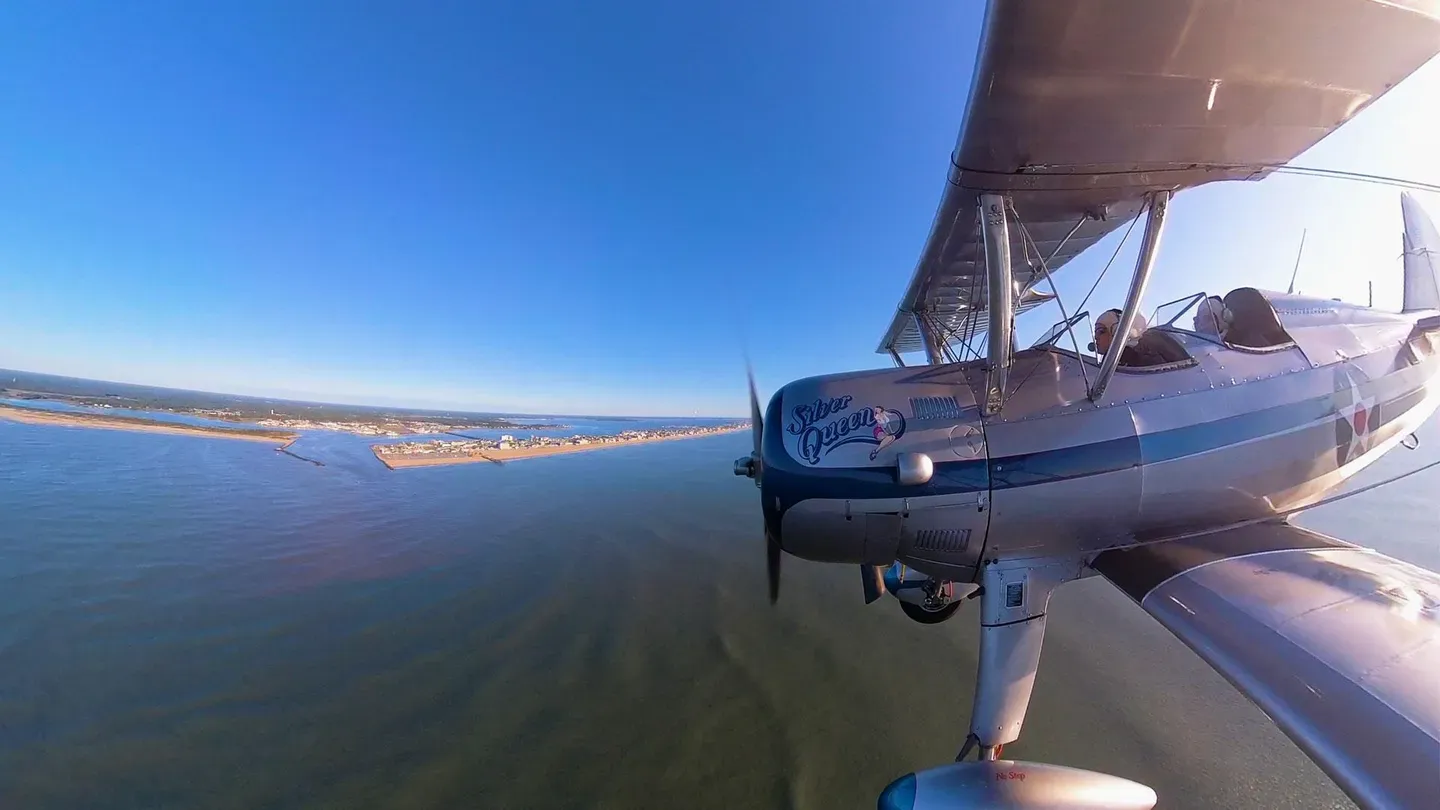
♪ Whenever Hunter Harris flies aloft in his World War II-era biplane, he beholds a place of splendor - of landscape and water.
In it, battles have been fought... [ cannon fire ] industries born, and America built.
Wild adventure has been sought out and found within her embrace.
From wild, pristine beaches to the earth's oldest mountains, follow us as we climb into the sky and enjoy wondrous views, heroic landmarks, towering achievements, revered icons, timeless traditions, miraculous rhythms of nature.
It's all "Maryland By Air".
"Maryland By Air" is made possible in part through the support of the MPT Foundation New Initiatives Fund, established by Irene and Edward H. Kaplan, and by, Frank Islam and Debbie Dreisman honored to support Maryland Public Television and "Maryland By Air" with pride in America and the beautiful state of Maryland.
and by -- University of Maryland Global Campus is an accredited public state institution, founded to fulfill the needs of adult learners and military service members.
Students gain skills that could help lead to career success.
Learn more about how UMGC can help you achieve your goals.
And by... I'm Eric Stewart, a Maryland native and realtor focusing on seniors in Maryland, DC, and Virginia, who are interested in selling their home and right-sizing to a smaller residence or retirement community.
Learn more at EricStewartGroup.com.
♪ ♪ NARRATOR: Maryland ... is born here on the windswept Atlantic coast.
Wild waves rhythmically crash and splash onto sandy shores at Assateague Island.
The marshscape looks untouched, almost pristine, as it did to the native Algonquian tribes, and when European settlers first laid eyes on it.
They'd set out from from England's Isle of Wight, royal charter in hand, to settle the distant land that would be the Maryland colony.
Legend has it that here on Assateague, the wild ponies that still call the island home, are descendants of horses that survived a long-ago Spanish shipwreck.
These wild horses graze away their days, eking out meager meals of marsh grass and salt meadow hay, bravely surviving on this remote windswept coast just as their ancestors have done for 350 years.
♪ NARRATOR: Further north, watching the breakers, the day unfolds in the quiet solitude of sunrise.
Interrupted not by the rhythmic whisper of gentle waves, but by the early morning awakening of Ocean City, one of the great beach playgrounds in the East.
Only 7,000 strong off-season, the town swells to more than 340,000 as fun-seekers from near and far descend on the boardwalk and beaches, the bars and the boats to ride, sun, swim, and fish.
[ lifeguard whistle ] OC, as it's known, is famous for its beach patrol - a network of expert swimmers who protect beachgoers, allowing them to relax and safely enjoy the sun and surf.
The lifeguards perform drills to stay in tip-top shape, so they are ready at a moment's notice to face the mighty ocean, its crashing surf and rip currents.
It's estimated that the beach patrol goes to the rescue more than 2,000 times in a summer season.
Looking down from the Silver Queen - it's plain to see that Ocean City hugs the lower tip of Fenwick Island, a skinny spit of sand that stretches northward all the way into Delaware.
Once, Assateague and Fenwick were one, but a savage hurricane in 1933 sliced through the barrier island.
The new Ocean City inlet was suddenly a perfect port, and this once remote fishing village transformed into a summertime paradise.
Maryland's Eastern Shore with a character, history and mystery, all its own.
45 square miles of pristine wetland.
From the air, the Blackwater National Wildlife Refuge is a strange and striking vision.
Marshy creeks and rivers teeming with birds, fish, and muskrat, bending, curving, and cutting their way through spongy earth toward Chesapeake Bay.
It was through these muddy, buggy, snake-filled marshes that Eastern Shore native Harriet Tubman, one of the most famous conductors of the Underground Railroad, rescued enslaved people by guiding them out of Maryland and secretly walking north to freedom.
The Bucktown General Store, where as an enslaved child, Harriet Tubman endured a severe head injury when she was hit with a heavy weight thrown by an angry overseer.
Tubman escaped slavery, then came back to lead her family and friends to freedom.
They crossed the Transquaking River, right here at Bestpitch Ferry, then followed creeks and streams toward Underground Railroad connections into the North.
Between 1850 and 1860, Harriet Tubman helped more than 70 freedom seekers escape bondage on Maryland's Eastern Shore.
♪ Further up the shore, near the town of Easton, a stately plantation house stands on the banks of the Wye River, as it has since well before Frederick Douglass was a boy.
Douglass arrived in 1824, and it's here that the enslaved seven-year-old worked for the Lloyd family.
The Lloyds were plantation owners who, since the 1650s, grew tobacco, corn, and wheat, the harvests shipping out from landings along Lloyd Creek.
Too young for the fields, Frederick Douglass was sent to work in the great house.
He wrote in his autobiography about the brutality of life at Wye House.
From here, he was sent to Baltimore and worked in the shipyards, then escaped slavery by running north.
Frederick Douglass went on to become a prominent abolitionist and a leader for African American civil rights in the 19th century.
♪ Maryland is a state with a special shape - two landmasses, the Eastern Shore and Western Shore in Allegheny Mountains, holding Chesapeake Bay in a geographic embrace.
Flying over it from one end to the other reveals an ever-changing landscape.
In the east, flat coastal plain, just a few feet above sea level.
In the middle, the rolling hills of the Piedmont Plateau.
And in the west, thick forests and ancient peaks of the Blue Ridge Mountains.
♪ At the heart of the state, Chesapeake Bay, the largest estuary in North America.
It's mostly shallow, on average, only 21 feet deep.
But as this enormous body of water pushes its way inland, it etches into the land a jagged shoreline, more than 11,000 miles long.
The creeks and rivers that feed it meander far, hidden nooks and crannies are prized for secret coves they form - favorite hideaways for weekend sailors and fishermen.
But the Chesapeake is perhaps best known for its oysters and crabs.
Maryland Blue Crab is said to taste unlike any other blue crab caught anywhere in the world, so delicate and sweet.
The oyster is a slightly salty, plump mollusk, and a delicious treat.
Every year, watermen harvest hundreds of thousands of bushels of them in Maryland waters.
♪ Heading west across the great expanse of the bay, turning up the St.
Mary's River, we see the Maryland Dove at sail.
♪ The newly built replica, making its maiden voyage under a full escort and water cannon salute, is a floating reminder of Maryland's humble beginnings when, in 1634, settlers sailed up the Chesapeake Bay in a ship just like it.
♪ Maryland's founders were Catholic, and the Dove was one of two ships that brought them to St.
Clement's Island, their first foothold in the colony.
They only stayed here a few weeks, then sailed on to build a more permanent settlement at St.
Mary's City, Maryland's first capital.
St.
Mary's was Maryland's capital for 61 years, and colonists left plenty of evidence for archaeologists to unearth.
In 1990, the graves of Chancellor and Governor Philip Calvert and family were found buried in lead coffins - a remarkable discovery in the place where Maryland began.
NARRATOR: Flying on, we see a remarkable geological phenomenon the Calvert Cliffs, bordering the western edge of Chesapeake Bay for 24 miles.
The cliffs are a portal into what Maryland once was - a shallow sea teeming with exotic creatures many of them now extinct.
Fossil hunters come here to test their luck.
But today, paleontologists from the Calvert Marine Museum are on a research expedition, hoping to find the skeletal remains of animals that were entombed in this ruddy mud.
Spotting a bone fragment, they get to work, brushing and scraping, unearthing something that's actually common here - the skull of a long-snouted dolphin from the Miocene epoch 15 million years ago.
♪ Since the first one was built in 1792, lighthouses have guided ships toward port on their way into Chesapeake Bay.
The bay is shallow and usually calm, but some of its waters are treacherous.
To aid navigation through the shoals and narrows, more than 70 lighthouses were built around the bay to warn ship captains of the danger.
They come in several shapes.
Near Calvert Cliffs, standing sentinel, is Cove Point Lighthouse, a conical brick tower rising up from a sturdy foundation on land with a beacon high on top.
In the 1940s, men stormed these very beaches from Higgins boats, training for the decisive D-Day invasion of Normandy in World War II.
Baltimore Harbor Light marks the bay's vital shipping channel.
It was built using a caisson foundation, enormous cast iron cylinder filled with concrete, sunk into the bottom of the bay with a lighthouse on top.
Flying north to the top of the Chesapeake, Turkey Point Light at Elk Neck State Park has the unusual history of having four female keepers, a rarity for the United States Lighthouse Service.
Fannie Mae Salter was the last keeper to tend Turkey Point Lighthouse.
No other lighthouse in Maryland is more famous than Thomas Point Light, one of the most photographed lighthouses in the world.
It's a screw-pile design- a spider's web of iron legs screwed into the bay's mud, holding up a keeper's cottage and navigational beacon.
This revered symbol of Maryland and jewel of Chesapeake history still guides ships home.
♪ Annapolis: Maryland's capital city and cradle of American history.
It was here in 1783, in the State House, that Continental Army Commander-in-Chief George Washington resigned his commission and established civilian control over the U.S.
military.
This astonishingly selfless act, along with his surrendering of political power as President in 1797, set the United States apart from other nations by guaranteeing the peaceful transfer of power after elections.
♪ The Maryland State House is the country's oldest state capitol building still in use.
Its decorative acorn atop its roof holds a 28-foot lightening rod designed by Benjamin Franklin, still intact.
♪ Annapolis is also home to the United States Naval Academy, a four-year undergraduate university that trains students, known as midshipmen, to be officers in the United States Navy and the Marine Corps.
Annapolis Harbor - for centuries, lined with maritime warehouses, symbols of wealth and prosperity.
Today, the busy streets and small-town charm belie a grim piece of history.
Annapolis was once a busy slave trade port, and human beings were bought and sold at the foot of Main Street, on what is now the City Dock - a painful reminder of Maryland's role in the Atlantic slave trade.
♪ Annapolis is America's sailing capital.
Around here, sailing is in the blood.
And when winds are fair, captains vie for supremacy, racing sleek-hulled boats with high-tech sails in the waters off Annapolis Harbor.
On the other side of the bay, sloops and schooners gather for Chestertown's Tall Ships Festival.
This grand parade of wooden replicas are reminders of the old ones that once plied the Chesapeake when water was a superhighway, and travel aboard such lumbering ships was the fastest way to go.
♪ Boats are everywhere on the Chesapeake Bay, and every year, some of the smallest come to show off here on the banks of the Miles River, where the Mid-Atlantic Small Craft Festival is underway.
The Eastern Shore hamlet of St.
Michaels is steeped in maritime history.
Baltimore Clippers were built in shipyards here in the 19th century, some used by War of 1812 privateers.
Today, it's home to one of the nation's largest gatherings of big-hearted sailors who race in dimunitive craft.
♪ One special kind of racing requires unusual skills and these hiking boards that the crew must shuffle from one side to the other just to keep the boat afloat - and sometimes they don't.
The time-honored practice of log canoe racing is a Chesapeake tradition that began around 1840 and draws some of the bay's finest sailors.
Built for speed, log canoes were used to catch and quickly deliver oysters to market.
Legend has it that winners of the race get a cup as a prize.
Losers get a ham skin - they say to grease the bottom of their boat.
♪ Chesapeake Bay is a vital maritime highway, leading ships from the Atlantic to the most inland port on the East coast - Baltimore.
The bay also opens to ports of the Mid-Atlantic, the Northeast, and the world.
Ships filled with goods from around the globe are sailed to the Chesapeake.
They haul their cargo under the twin spans of the Chesapeake Bay Bridge, which connects Maryland's Western Shore with the Eastern Shore.
When the first of the two spans was built in 1952, it was the longest continuous overwater steel structure in the world.
It was regarded as a remarkable feat of engineering at the time, with a graceful curve and a slender slope that lends the bridge a special elegance, making it lovely to look at.
♪ Sailing north out of Baltimore, ships can reach Delaware Bay, then the Atlantic by way of the Chesapeake and Delaware Canal.
Only 14 miles long, it slices through the Delmarva Peninsula, cutting down the 300-mile journey around the coast, saving shipping time and money.
What started in 1824 as a narrow ditch with horses and then steam engines towing barges through grew and expanded.
Today, the Chesapeake and Delaware Canal can accommodate many of the world's largest vessels.
♪ Baltimore: A colonial city, major inland seaport, an illustrious shipbuilding hub.
The old city was founded in 1729 and grew up around a safe natural harbor, becoming a booming port of call.
That harbor is now a waterfront oasis, home to cultural attractions like the National Aquarium, which explores our undersea world, and the Maryland Science Center, with hands-on exhibits that spark the imagination.
The Baltimore Basilica, the first Catholic cathedral built in the United States, opened in 1821.
It was designed by Benjamin Henry Latrobe, Thomas Jefferson's architect of the U.S.
Capitol, and is Latrobe's masterpiece in Maryland.
The funeral of Declaration of Independence signer Charles Carroll was held here in 1832.
More than just a fine building, the basilica is a reminder that Maryland was founded on the principle of religious liberty and is a place where people of all faiths can worship freely.
♪ Flying north over the heart of Baltimore's busy Charles Street, Mount Vernon Place, where four grassy parks intersect at the monumental celebration of the country's first president, George Washington.
Artisans laid the cornerstone on July 4, 1815, and completed it in 1829.
From high atop this Doric column, Washington has a commanding view of the George Peabody Library, named one of the world's most beautiful.
Inside, books, preserved in exquisite architectural splendor, where ornamental balconies frame tiers of crowded stacks rising five stories toward the skylight.
More than 300,000 volumes on art, archaeology, and science.
First editions by Charles Darwin, H.L.
Mencken, and Edgar Allan Poe.
A cathedral of books right in the heart of the city.
♪ Fort McHenry National Monument and Historic Shrine - birthplace of our national anthem.
On September 13, 1814, American lawyer Francis Scott Key watched the fort's overnight bombardment by the British Navy, then the world's foremost superpower.
When the smoke cleared the next morning, the British had failed to take the fort or Baltimore.
Commemorating this pivotal victory for the Americans in the War of 1812, he wrote his enduring poem that later became the anthem that, to this day, celebrates American bravery and national resolve.
Night falls on the brave city.
Just beyond the Inner Harbor, a sound rings out - the Star-Spangled Banner, sung in traditional Baltimore Baltimore style at Oriole Park at Camden Yards, home of my beloved Orioles baseball team since 1992.
CAL RIPKIN, JR: I played my whole career, including 2,632 consecutive games in an Orioles jersey.
It was a dream come true to play in this stadium with a design so groundbreaking and reminiscent of baseball's earlier days that its opening is considered a milestone event in the history of baseball.
I'll never forget the night I broke Lou Gehrig's record for consecutive games played in this beautiful ballpark.
♪ Today, whenever a player whacks a ball over the fence, It ignites a sparkling display around the yard.
[ fireworks crackling ] ♪ The Baltimore Ravens are serious players in the National Football League, competing at a beautiful stadium just west of the Inner Harbor.
When the modern-day gladiators emerge from the tunnel onto the gridiron, and especially when they reach the end zone and score, the coliseum erupts in a pyrotechnic Ravens-purple celebration.
♪ [ fireworks crackling ] ♪ Baltimore was at the forefront of the revolution in American transportation.
Commemorating that proud history, the circular museum of the Baltimore and Ohio Railroad.
Inside the roundhouse, roundhouse, locomotives and rail cars tell the B and O's story.
Like this 20-ton machine from the 1850s, believed to have secretly taken Abraham Lincoln from Baltimore to Washington on the way to his inauguration.
Railroading in America was born in Baltimore in 1828, when the first stone was laid for the new B and O rails, which ran 13 miles west to what was then called Ellicott's Mills.
Today, passengers can ride along that line in a more modern coach, running the very route where the nation's first mile of commercial track was laid.
From Baltimore, the steel rails stretched west, Connecting town after town, City after city.
Soon the rails reached Cumberland, Queen City of the Maryland Mountains, and symbol of mighty rail's heyday when steam trains were king.
The Western Maryland Scenic Railroad leaves Cumberland Station, carrying sightseers through the rugged Allegheny Mountains.
Along the way, it glides through the steel truss bridge over the National Road, America's first federally-funded highway.
At one point, it chugs through a 900-foot-long tunnel bored through Piney Mountain.
It's a throwback to the days when powerful locomotives drove American exploration and expansion.
From the mountains of Maryland, steel rails continued rolling west.
By 1869, the Transcontinental Railroad was complete, joining Americans from coast to coast.
Rails that began in Baltimore had spanned the continent.
Before railroads were even conceived, George Washington had a dream to build a Chesapeake and Ohio Canal that would connect the eastern United States with the Ohio River, opening the way for commerce and exploration.
Washington was a land surveyor as a young man, mapping the Potomac River watershed all the way out to the western frontier.
It was too difficult to haul heavy wagon loads over the Allegheny Mountains.
So in 1785, he created a company to float goods on barges across the mountains.
Work began in 1828, nearly 30 years after George Washington's death, on the canal that was intended to stretch to Pittsburgh over rocky, rising topography.
Building it would eventually require 74 locks, 11 aqueducts, and the 3,000-foot-long Paw Paw Tunnel, a massively expensive proposition.
It took 14 years to blast this passage through Sorrel Ridge, but doing so was necessary.
The tunnel eliminated the need to navigate the Paw Paw Bends, a notorious stretch of undulating horseshoe curves in the Upper Potomac.
It wasn't until 1831 that the canal finally opened, and by 1850, it reached as far west as Cumberland.
But that was as far as it would ever go.
By then, it was obsolete.
Railroads had an iron grip on American transportation, and the idea of using canals for commerce faded.
Now, the canal and its towpath are preserved by the National Park Service.
At mile marker 60, the canal intersects the town of Harpers Ferry - a place where Maryland, Virginia, and West Virginia meet, and the Potomac and Shenandoah Rivers converge.
There is a stunning view of it from this rocky outcrop called Maryland Heights that Thomas Jefferson called "perhaps one of the most stupendous scenes in nature."
There is history here - dramatic history about turning points in the American story.
The most famous is about John Brown, an abolitionist who knew slavery was an evil that needed to be ended in any way possible, even through violence.
Brown's bold 1859 raid on the federal arsenal here failed to spark a Southern slave revolt.
But three years later, 16 miles to the north, John Brown's prophecy that slavery would only be purged by bloodshed came true on Maryland's soil.
At Antietam, the bloodiest day in the American Civil War.
The National Cemetery is a solemn reminder of the sacrifice.
On September 17, 1862, nearly 23,000 men fighting for the Union and the Confederacy were killed or wounded near Sharpsburg, Maryland.
On these farm fields and meadows, in the nearby apple orchard, a savagely fought battle.
Here, in a simple farm lane known as the Sunken Road, nearly 5,000 men on both sides were killed or wounded in brutal combat.
Civil War photographer Alexander Gardner captured the scene after the battle.
They called it Bloody Lane.
Not far away, another infamous clash at Burnside Bridge, named for Union General Ambrose Burnside.
Here is where a standoff between Union and Confederate troops ended with another 600 casualties.
Not far from Antietam battlefield, one of the more unusual Civil War sites - Gathland State Park.
Gathland was the home of George Alfred Townsend, a Civil War journalist.
Townsend wanted to memorialize the bravery of war correspondents who reported from the battlefield, so he built this monument in tribute.
From the same site, the Battle of South Mountain was waged between forces for the North and South - an important clash in an all-consuming war that would decide the nation's destiny.
♪ Autumn.
The days shorten, shadows lengthen, and summer's heat gives way to cool breezes, traveling the back roads of Frederick County reveals rustic covered bridges basking in fall sunlight.
The 101-foot-long Utica Mills Bridge over Fishing Creek dates from circa 1850.
The first Loy's Station Bridge was built in the mid-1800s.
It was badly damaged by fire in the 1990s but thankfully rebuilt, and today, it's as handsome as ever.
Roddy Road Covered Bridge, a replica of the one originally built in the 1850s, is a short 40 feet long.
In early America, bridges were covered for a very practical reason - to shield the structure from sun, snow, and rain, protecting the wood from decay and lengthening the life of the bridge.
The covered bridges of Frederick County are all on the National Park Service's National Register of Historic Places.
It's fun peeking into the past and admiring their charm, but even more fun to drive through.
♪ ♪ Though the center of the state is heavily developed, agriculture continues to be the number one commercial industry in Maryland - a driving force behind its economy and culture.
Large-scale poultry production on the Eastern Shore demands large amounts of soybeans from regional farmers, and they deliver.
Dairy and cattle farms still dot the landscape in rural Frederick city.
Harvest time means long days in the fields, gathering in crops.
Farmers here plant a lot of wheat.
Maryland is known for its soft red winter wheat, prized by bakers for making cookies, pretzels, and pastries.
♪ ♪ And Maryland vineyards have become popular and profitable operations.
The first known vines were planted all the way back in 1648, more than 100 years before Maryland became a state-winemaking roots that go winemaking roots that go surprisingly deep.
While hands pick the juicy fruit, people seek adventure in Maryland's great outdoors.
Maybe it's the sense of freedom or the thrill of catching a breeze.
Who hasn't yearned to be like a bird, to fly?
There's a long tradition of hang gliders launching themselves from towering cliffs at High Rock, the colorful outcropping near Maryland's border with Pennsylvania.
They strap on a giant wing, mount a precipice, and when the wind rises... Three, two, clear!
They take a leap of faith.
♪ ♪ On a clear day, hang gliders can see for miles.
It's an endless view looking down the great Appalachian Valley at South Mountain.
Whoo!
♪ ♪ One account from an early settler suggests that, long ago, herds of bison numbering in the thousands might have journeyed through this expansive valley on their annual migrations.
♪ ♪ Out west in the Maryland Panhandle, slicing a gash deep into the wilderness canyon - the mighty Youghiogheny River.
The river is usually tame, but when water is released from the nearby dam, it becomes a raging torrent and a paddler's dream.
The Youghiogheny River falls at the exhilarating rate of 100 feet per mile.
The dramatic drop causes a series of intense rapids with names like "Powerful Popper," "Triple Drop," and Meat Cleaver."
The Youghiogheny River is world-renowned, and elite paddlers come here to conquer its nearly continuous rapids -20 of them in a five-mile stretch, one more challenging and harrowing than the next.
♪ ♪ Back east, at Chesapeake Bay, those who know spot it easily - the telltale V-shaped formation of squawking geese flapping their way along what's known as the Atlantic Flyway.
The flyway runs right through Maryland, and it's one route migratory birds take as they move south to winter in warmer places.
It just so happens, Maryland is one of the flyway's best stopovers for migrating geese and over 40 species of duck and other waterfowl.
All seeking marshes to settle in and refuel before setting out again on their journey.
♪ [ whimsical music ] Canada geese fly in tight formation.
We think they fly this way because it's more efficient.
The front bird breaks the headwind, so those trailing can draft along the airflow.
They honk to communicate and take turns flying as lead bird, so the flock doesn't tire during the long migration.
It's an ancient Maryland ritual.
♪ [ whimsical music ] ♪ Finally, Maryland's crisp autumn colors fade.
♪ The beauty of a mountain forest under a blanket of snow.
Here at Muddy Creek Falls, where the frosty Youghiogheny River squeezes through rocky gorges, and these old-growth forests of hemlock and white pine brace against the cold, just as they've done for nearly 400 years.
The plunging thermometer locks a western Maryland lake into an abstract waterscape - nature's art that is best viewed from above.
♪ Maybe it's the nippy air or the memory of making angels in the snow.
What else would cause these trailblazers to leave hearth and home and head to the frigid woods for what they call winter fat biking?
Fat bikers love to find secret trails and make fresh tracks through the new-fallen snow.
Pedaling with extra-wide tires is a vigorous workout, one that keeps riders toasty warm.
Over 3,000 feet high, up to 100 inches of annual snowfall - to ski the 700-foot vertical drop at Wisp Mountain, slicing down at heart-thumping speeds, carving turns with crystalline spray, is the annual wintertime quest of the downhill skier.
Winter snows melt away.
In the warming breeze, Maryland blossoms into a beautiful bouquet.
Here at the state's flagship college, it's the seeds of knowledge that blossom and grow.
Founded in 1856, the University of Maryland is a preeminent national center for scientific research and higher learning.
Perched outside McKeldin Library, the campus mascot, Testudo, the diamondback terrapin.
Long ago, the meat from this humble turtle was considered a gourmet food, found on many a Maryland menu.
Today, terrapin is a protected species and the official state reptile.
[bugle plays "Call to the Post"] Tradition runs deep, especially in Maryland horse country.
Since 1873, Preakness Stakes, the middle leg of horse racing's Triple Crown, has been run right here at Pimlico, the second oldest racecourse in the nation.
The Maryland Five Star is a newcomer to the state in the equestrian sport called eventing, where horse and rider are tested in three phases: dressage, cross-country, show jumping.
Here in cross-country, they navigate a rugged four-mile course, sprinting the undulating terrain and jumping the 28 obstacles.
It's a test of the courage and stamina of the horse and the special relationship between horse and rider.
♪ Summertime in the mountains of Western Maryland, that means Deep Creek Lake, where speedy watercraft and spray in your face define summertime.
Wakeboarding is one of the fastest-growing water sports in the world.
They use special boats that cause gnarly wakes, perfect for aquatic acrobatics.
Even a seasoned pro, performing over-the-top aerial feats, can sometimes make an epic splash.
Deep Creek is the largest freshwater lake in Maryland.
Today, more than a million visitors come here to skim and even surf its idyllic waters.
♪ As the sun sets beyond the far western reach of the state, we bid adieu to the Silver Queen and her crew, our trusty tour guides who have flown us from eastern sea to mountainous west.
Discovering Maryland's unparalleled natural beauty and urban charms.
Her hallowed history... and hidden secrets... all as seen from above, in "Maryland By Air".
"Maryland By Air" is made possible in part through the support of the MPT Foundation New Initiatives Fund, established by Irene and Edward H. Kaplan, and by, Frank Islam and Debbie Dreisman, honored to support Maryland Public Television and "Maryland By Air" with pride in America and the beautiful state of Maryland, and by... University of Maryland Global Campus is an accredited public state institution, founded to fulfill the needs of adult learners and military service members.
Students gain skills that can help lead to career success.
Learn more about how UMGC can help you achieve your goals.
And by... I'm Eric Stewart, a Maryland native and realtor focusing on seniors in Maryland, D.C., and Virginia, who are interested in selling their home and right-sizing to a smaller residence or retirement community.
Learn more at EricStewartGroup.com.
"Maryland By Air" is available on DVD for $18 or on Blu-ray for $24.
A companion photo book is also available for $35.
To order, please visit MPT.org/mdbyairorders or call 410-581-4281.
♪ [ propellers whirring ] ♪ [ propellers whirring ] ♪













Support for PBS provided by:
Maryland by Air is a local public television program presented by MPT
Distributed nationally by American Public Television