
Mexico: A Death in the Desert
Clip: Season 2004 | 18m 36sVideo has Closed Captions
The tragic story of a migrant farmer’s journey to the U.S. in the scorching heat.
Like many men from Oaxaca, Mexico, Matias Juan Garcia Zavaleta crossed the U.S.-Mexico border regularly each spring to work in California during harvest time and returned in the fall. He used his earnings to build a home and take care of his family. When an early frost destroyed Garcia's own crops he was left with no choice but to cross again in 2003, but this time the crossing turned fatal.
Problems playing video? | Closed Captioning Feedback
Problems playing video? | Closed Captioning Feedback
Funding for FRONTLINE is provided through the support of PBS viewers and by the Corporation for Public Broadcasting. Major funding for FRONTLINE is provided by the Ford Foundation. Additional funding...
Mexico: A Death in the Desert
Clip: Season 2004 | 18m 36sVideo has Closed Captions
Like many men from Oaxaca, Mexico, Matias Juan Garcia Zavaleta crossed the U.S.-Mexico border regularly each spring to work in California during harvest time and returned in the fall. He used his earnings to build a home and take care of his family. When an early frost destroyed Garcia's own crops he was left with no choice but to cross again in 2003, but this time the crossing turned fatal.
Problems playing video? | Closed Captioning Feedback
Where to Watch FRONTLINE
FRONTLINE is available to stream on pbs.org and the PBS app.

Inside the Scam
Follow scams as they unfold — and examine tactics used to manipulate victims. A collaboration between FRONTLINE and The Associated Press.Providing Support for PBS.org
Learn Moreabout PBS online sponsorship♪ ♪ (bus rattling) >> LOMONACO: The bus ride from Mexico City had taken six hours.
I came here to Oaxaca to piece together the life of a dead man.
Back in Arizona, I'd reported on the increasing number of migrants who have died trying to cross into the United States.
But I knew so little about any of them.
(women singing in Spanish) In Agua del Espino, I found a village of Zapotec Indians mourning the loss of one of its sons.
>> (speaking Spanish) >> LOMONACO: He was one of nearly 400 migrants who died along the border last year.
>> (speaking Spanish in background) >> LOMONACO: This night marks the anniversary of his death.
(brass band playing) His name was Matias Garcia.
He was 29 years old.
(band continues) >> IGNACIA (speaking Spanish): ♪ ♪ >> LOMONACO: Matias was the oldest of five children.
When he was eight years old, he left school to work in the fields with his father.
At 16, Matias started leaving his village in Southern Mexico to work in California.
>> MAN (speaking Spanish): >> LOMONACO: Matias left each spring, but he would return every fall.
>> ISIDRA (speaking Spanish): >> LOMONACO: Matias' wife, Isidra, feeds the family with the corn and beans they grow.
The money he earned in the north helped build their home and clothe the family.
It sent his sons Juan and Elias to school.
Two years ago, Matias decided he would stop crossing.
>> ISIDRA: (man speaking Spanish) >> LOMONACO: This is Matias in a home video taken in 2002.
That spring, he began growing chiles so he could make enough money to support his family without going north.
But an early frost that fall destroyed the crop overnight.
It left Matias in debt.
He had to cross again.
This time, he would take a cousin with him and his 18-year-old brother, whom we'll call Serafin.
It would be Serafin's first trip north.
>> SERAFIN (speaking Spanish): ♪ ♪ >> LOMONACO: The men set out on May 28, 2003.
>> IGNACIA: >> LOMONACO: Their mother wanted them to avoid a three-day bus ride and save their strength for the journey.
She convinced them to borrow money so they could fly just south of the border.
(vehicle horn honking) They spent the night in Sonoyta, a popular crossing point along the Mexico/Arizona border.
Like most migrants, they hired a coyote, or smuggler, to guide them.
He told them to buy two gallons of water each.
>> SERAFIN: >> LOMONACO: On Friday, May 30, it was 104 degrees.
The group started walking at 5:00 in the afternoon to avoid the worst of the desert heat.
The men walked all night.
They crossed more than 20 miles.
(insects buzzing) After sunrise, the heat rose quickly.
It was too hot to continue walking.
They rested in what little shade they could find.
In the summer, the desert floor can reach up to 170 degrees.
The men barely slept.
They ate tortillas they brought from home.
They each had less than one gallon of water left.
♪ ♪ The journey north wasn't always so difficult.
For years, most Mexican migrants entered the United States from Tijuana.
Matias' uncle made the trip many times.
(men singing in Spanish) >> (speaking Spanish): >> LOMONACO: In 1990, Matias first went north through Tijuana.
Four years later, the U.S.
entered the North American Free Trade Agreement.
At the same time the U.S.
opened the border to trade, it made it harder for people to get across with a new strategy called Operation Gatekeeper.
The Border Patrol reinforced the old fence with a series of walls between Tijuana and San Diego.
They hoped to push migrants east, into the desert.
They thought the rugged terrain would act as a natural barrier and discourage people from entering the country illegally.
But it didn't.
Hundreds of thousands of migrants began crossing the desert, first in California, then in Arizona.
♪ ♪ Matias Garcia had crossed the desert before, but usually in April.
But this time, he couldn't raise enough money to hire a coyote until mid-May.
The delay pushed his journey into the hottest part of the year.
>> SERAFIN: >> LOMONACO: By 7:00, the men ran out of water.
A few hours later, Matias collapsed.
>> SERAFIN: >> LOMONACO: Serafin and his cousin carried Matias for several hours.
They were trying to make it to highway 85 in southwestern Arizona.
>> SERAFIN: (police radio running) (microphone beeps) >> A42, 10-8.
(sniffs) >> LOMONACO: Sheriff's Deputy Michael Walsh works along the border.
He found the men that night.
They were trying to flag down help.
>> Well, I was just doing routine patrol.
I guess it was probably around, like, 2:15, 2:30 in the morning.
As I pulled up, I would say the person that was flagging me down was standing right where my vehicle is at right now.
(radio continues) I could see that he was visibly upset, he was crying.
As I kept walking, I was then able to see that there was a third subject, which was lying on the ground.
His head was up in this area, his feet were in that direction.
His head was on the second subject's lap.
I looked at the person that was lying on the ground, and you could, I could see that he was deceased.
>> LOMONACO: It wasn't the first time Deputy Walsh had found the body of a migrant in the desert.
>> Mostly you just find skeletal remains out in the desert.
With this one, there's a lot more emotion, you know, family emotion involved in it.
So it's a lot different.
You have a name, you know, with the person.
You know, you know that he had a brother, you know, his cousin.
They, you know, obviously were close.
They were visibly upset when he passed away.
>> LOMONACO: The men had walked 32 miles.
Matias died 40 yards away from the highway they'd hoped would take them to California.
(rooster crowing) >> (whistling) >> IGNACIA: >> LOMONACO: A week later, Matias' body was sent home.
But his family believes that his spirit is still in the desert.
His mother says he visits her in her dreams.
"Mamá, tengo sed.
¿Tienes agua?"
"I'm thirsty," he says.
"Do you have any water?"
The day after Matias died, Serafin and his cousin were deported and released in a nearby border town.
Within hours, they crossed back over the border and started walking through the desert again.
>> SERAFIN: (branches breaking) >> LOMONACO: After walking for two more days, they got a ride to a small farming town outside of Fresno, California.
Men from Agua del Espino have been working here for decades.
>> SERAFIN: >> (laughing and talking softly) >> LOMONACO: Back in the village, Matias' widow suffers, too, trying to be strong for her sons.
>> ISIDRA: >> (speaking Spanish) (all blowing) >> ISIDRA: (woman singing in Spanish) (song continues) >> LOMONACO: At a memorial service, his aunt sings of the family's loss.
(song continues) Matias was one of more than 200 migrants that died in the Arizona desert in 2003, their names published in a local newspaper.
(women begin singing) In the ten years since the U.S.
tightened its border policy, more than 3,000 people have died.
(song continues) A year after Matias' death, his family is struggling to make it without him.
His father hasn't worked in the U.S.
in years.
That will soon change.
>> REY (speaking Spanish): >> LOMONACO: The year of mourning has kept him in the village, but he says he must leave now.
He will go north this summer, the deadliest time to cross.
♪ ♪ ♪ ♪
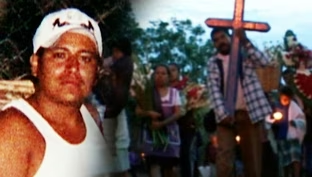 Now Playing
Video has Closed Captions
Clip: S2004 | 18m 36s | The tragic story of a migrant farmer’s journey to the U.S. in the scorching heat. (18m 36s)
Video has Closed Captions
Clip: S2004 | 21m 3s | A 2004 examination of India’s AIDS crisis through the eyes of girls and women sold into sex work. (21m 3s)

"Is Wal-Mart Good for America?" - Preview
Preview: S2004 Ep16 | 55m 9s | An eye-opening look at the power and influence of the world’s largest company. (55m 9s)

Preview: S2004 Ep15 | 31s | An inside look at the business and science of selling us on what we want. (31s)
Providing Support for PBS.org
Learn Moreabout PBS online sponsorship New Episode
- News and Public Affairs

Top journalists deliver compelling original analysis of the hour's headlines.
 New Episode
- News and Public Affairs

Today's top journalists discuss Washington's current political events and public affairs.
 New Episode
 New Episode
 New Episode
 New Episode
 New Episode
 New Episode
 New Episode



Support for PBS provided by:
Funding for FRONTLINE is provided through the support of PBS viewers and by the Corporation for Public Broadcasting. Major funding for FRONTLINE is provided by the Ford Foundation. Additional funding...