NHPBS Presents
Murder in a Nutshell
Special | 57m 9sVideo has Closed Captions
Explores Lee's odd, isolating childhood, scandalous divorce, tumultuous career as a criminalist.
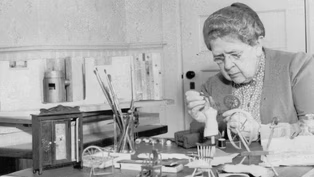
The enigmatic and ever mysterious, Frances Glessner Lee, is affectionately revered as the Patron Saint of Forensics. But outside the criminal justice system, very few people know she was one of the greatest crusaders for criminal justice of all time. Despite the fact that women were not widely accepted in the realm of science and criminology in the 1930s,
Problems playing video? | Closed Captioning Feedback
Problems playing video? | Closed Captioning Feedback
NHPBS Presents is a local public television program presented by NHPBS
NHPBS Presents
Murder in a Nutshell
Special | 57m 9sVideo has Closed Captions
The enigmatic and ever mysterious, Frances Glessner Lee, is affectionately revered as the Patron Saint of Forensics. But outside the criminal justice system, very few people know she was one of the greatest crusaders for criminal justice of all time. Despite the fact that women were not widely accepted in the realm of science and criminology in the 1930s,
Problems playing video? | Closed Captioning Feedback
How to Watch NHPBS Presents
NHPBS Presents is available to stream on pbs.org and the free PBS App, available on iPhone, Apple TV, Android TV, Android smartphones, Amazon Fire TV, Amazon Fire Tablet, Roku, Samsung Smart TV, LG TV, and Vizio.
(suspenseful music) - I felt like I was this detective and I found the most fascinating subject in the world.
Frances Glessner Lee is a pioneer of forensic medicine in the United States, and she is the creator and mastermind behind the incredible Nutshell Studies.
- She was totally born in the wrong time, but maybe she was born in the right time to help the whole field.
- It would be one thing just to be a millionairess, she was not a dilettante.
She was the real deal.
She knew her stuff and she was regarded as one of the foremost criminologists of her time.
- She's trying to live in a society that has certain norms for her.
She's trying to raise children in that, and she has this other passion inside of her that has to be stifled and how frustrating.
- She should be known as the patron saint of forensic medicine of forensic science as we know it today, because there truly was nothing going on in the States as we know what a medical examiner is now.
- She did such a service to our field and people still don't know who the heck she is.
It infuriates me.
- Criminal investigation, she turned that around and made it a much better thing for all of us today.
And I think it's kind of gotten lost.
People still don't get it.
They don't get what she's done.
(dramatic music) (police radio beeps ) - Who actually found him?
(person speaking indistinctly) (siren howling) - There's a sign of a struggle.
- Maybe blood coming from the baby's room and the kitchen... - And drag marks from this area.
- Rifle.
- There's no shell casing in here that I can see.
(ceremonious orchestral music) [Narrator] Frances Glessner Lee came of age in an era where women, especially women of means, were expected to know their place.
She was to marry well, have children, and play the part of the gracious Chicago socialite.
Yet this heiress to the International Harvester fortune had murder on her mind.
By the time Frances was a grandmother, she stopped doing what was expected of her and took the forensic world by storm.
(gentle violin music) Born in Chicago in 1878, Frances' family built a home on Prairie Avenue on what was once known as Millionaires Row.
The residents were among Chicago's wealthiest, such as George Pullman of Pullman Rail Cars and department store mogul Marshall Field.
Yet it was the Glessner's home that was the most talked about mansion on the block.
- It created this uproar in the neighborhood because it diverged from this more Victorian gingerbread house sensibility.
People described it as a fortress.
It was described by one architect as pathologically private.
- John Jacob Glessner in particular wanted to keep his private life safe from his work world and from the city that was growing around them.
So there was an intense need for them to have a safe place to raise the family.
[Narrator] The outside of the Glessner's home reflected in part the sentiment inside, especially for the children.
Frances and George, her older brother by seven years, grew up mostly isolated from other children.
- When she was a child, she was of course educated at home.
She read Latin and Greek, pretty sure she could speak French and German and she could understand enough Italian to carry on a conversation.
(bright gentle music) [Narrator] Without the opportunity to make any friends of her own, Frances' parents hired one for her.
Violetta Scharf accompanied Frances on social outings and traveled with her to the family's summer estate, The Rocks in Bethlehem, New Hampshire.
(wind blowing) (crows cawing) - The Rocks Estate originally was started by John Glessner because his son suffered from hay fever and respiratory problems.
So they came up vacationing and then eventually decided to move up and buy 2,000 acres.
(gentle music) [Narrator] Frances spent her summers at The Rocks with Violetta and her pets, playing house in her own little cabin, putting on performances and tagging along with her big brother.
When Frances was 13, George invited his Harvard friend, another George, George Magrath, to The Rocks.
George Glessner was studying law and George Magrath was studying medicine, and together they reveled in how the two worlds intersected.
Frances was fascinated by their stories of criminal investigations and murder trials, making her wish she too could go to Harvard, even though Harvard at the time had a strict men-only policy.
(pensive music) - She was probably a little bit frustrated not having that opportunity 'cause women of means and of that statute did not go to school.
They were home taught.
And the brother went from home teaching to Harvard.
- She was very upset when she was not allowed to go to college and her brother George was, and her father said, "No, a woman's place is in the home."
She never forgave her father for not letting her go to college.
(birds chirping) - Having read a lot about Frances, and I have heard that her parents disapproved of her interest in forensic science and didn't want her to go to medical school, I have not found that to be the case.
What was very clear to me was that the only thing that would have meant something to her was a degree from Harvard.
(pensive music) [Narrator] Instead of attending college, Frances attended music lessons, concerts, theater and a reading club.
She also did charitable work for the Red Cross and cultivated socially acceptable feminine pastimes, such as knitting, lacemaking, and creating miniatures.
- Frances Lee first started making miniatures in 1912.
(gentle orchestral music) At that time, she created a miniature Chicago Symphony Orchestra, all 90 members of the orchestra with music stands and instruments and a stage.
- And each individual was modeled after the person that she was creating.
So they all looked different and that didn't get a whole lot of love in her family.
[Narrator] When Frances turned 19, she had a coming out party that also served as the formal announcement of her engagement to 30-year-old Blewett Lee, a friend of her brother's and the son of a Confederate lieutenant general.
- Once he comes into the picture, he's a part of the family on a regular basis.
He's here for dinner, they are going to concerts on a regular basis.
There was a relationship that developed very quickly, and although Blewett was an up and coming attorney and was doing well for him himself, he certainly could not provide the lifestyle that she was accustomed to.
[Narrator] The Glessners' gave their children side-by-side town homes just down the block from them on Prairie Avenue, and they all vacationed together at The Rocks.
The early years of Frances and Blewett's marriage appeared happy, they had a son, John, and soon a daughter, Frances.
However, after the birth of Baby Frances, the couple separated.
They did reconcile long enough to have a second daughter, Martha, in 1906.
But then Frances decided to separate permanently.
A scandalous move for a Victorian socialite.
- Initially, when she was divorced, the family sided with Blewett, so that was quite difficult for her.
[Narrator] After the divorce, Blewett faded from the Glessner's lives, moving back home to Mississippi and later Georgia, where he became an authority in early aviation law.
Curiously, Blewett had also developed a deep interest in spiritualism, defending fortune tellers and psychic mediums in the court of law.
- His desire to help folks that had less than he, I think, was what really drove him.
And it's a shame that he does get somewhat pushed aside 'cause he really was a genuine, caring, very bright man.
He did find happiness in the end, and so I'm grateful for that.
- I never heard her mention her ex-husband at all.
My mother, of course, kept in contact with him.
He remarried.
Why, I did remember one occasion, I think grandmother asking my mother, you know, how your father was or something.
But that's the only thing.
No, I, she had... I don't think she had any interest in the romantic side of life.
(melancholic music) - Based on the stories that I've heard, Frances was such a renegade, you know, they wanted her to be a socialite and she didn't want to be.
And then getting separated, then getting divorced.
I think for the Glessner side of the family, it was just not the thing to do.
Which again, if you've watched "Downton Abbey" and you watch one of the daughters wanting to be a newspaper person and one wanting to be a nurse, you can see the similar things in those social circles is just unacceptable.
- A lot of the time that she lived under that, I'm gonna say the thumb or under her family was 'cause she really didn't have money.
She never worked.
She had no means of support.
She had to depend on her parents for everything.
- She went through the motions.
She married well, she set up her own household, but at some level didn't please her, didn't satisfy her.
It wasn't gratifying.
There weren't a lot of avenues that were open to women in general.
She was sort of a prisoner in a gilded cage.
It was, you know, and it took a while for her to be able to come into herself and be comfortable doing what she wanted to do and to heck with whatever anybody else thought.
(gentle orchestral music) [Narrator] To put some distance between her and the stigma of divorce, Frances and her children eventually left Chicago, moving around to several different cities, including Santa Barbara, New York, and Boston.
Each summer, they rejoined their extended family at The Rocks.
However, Frances purchased a camp about an hour away to provide a little Glessner family buffer.
The camp was a private getaway for herself and her children, where they explored in nature, performed impromptu musicals, and escaped the formality of everyday life.
- She wanted to teach her children different things and do it in different ways than was conventional.
So she would spend a lot of time with them.
[Narrator] According to her son, John, their adventures together at the camp summer after summer were among the happiest memories of their lives.
(gentle music) By the 1920s and '30s, Frances' children were grown, starting families of their own and no longer had time for the camp.
Frances spent time in Chicago and Boston before taking up permanent residency at The Rocks.
There, she opened a successful antique shop doing much of the meticulous restoration work herself.
(siren howling) She also developed an interest in listening in on police radio channels.
Frances deciphered their codes while forming her own theories on crimes under investigation.
Her hobbies were on the verge of merging when tragedy struck again and again.
First with the death of her brother, followed by the death of her mother, daughter, Frances, and her father.
Their deaths took a heartbreaking toll, leaving Frances in charge of her family's affairs.
(birds chirping) - One thing that really hasn't changed over the years is the view from here.
The mountains are forever, I guess.
It's in clouds most of the time.
(gentle music) - When the families started to argue, I think it was after George died.
So you had Alice and Frances who apparently both did not get on with each other.
And we know from the maps, they split the estate in two.
One took one half, one took the other.
And then right above the formal gardens, the lower formal gardens, they planted a row of conifer trees.
And it was said that either side of the family wouldn't go either up to the buildings or down to the cottage.
And they didn't, it was like a line drawn in the sand and it was called the spite fence.
And you just could not go up and down there.
So there was quite a lot of bad blood between the families as it split.
- Trees were planted between the two houses (person laughing) 'cause they didn't wanna see each other and the kids weren't allowed to play together anymore.
- Right?
And rows of hedges just to separate... - The two houses.
- The two- - I mean, you could look in the windows from one house to the next and all of a sudden they were just two totally separate entities.
- Never knew what the whole problem was.
- Gram never said.
But generally, it's been my experience that people with money argue about money.
So I'm sure it was related to that.
[Narrator] Once Frances took over The Rocks Estate, she developed a reputation that made her a bit of a pariah in her small New Hampshire town.
- My granddad, in respect to Frances, always said that she was a very stern lady, but he had a great respect for her.
My grandmother did not like her at all, and I don't really know the reason for that.
But... she didn't like her.
- She could be as charming and witty, engaging as anyone you'd ever met in your life one moment and the next moment you just didn't want to be around her, you know?
- She would come up in the morning after the houseman had done dusting and polishing and stuff like that, find a vase that had been moved a half an inch and she'd move it back to where it was.
She knew exactly where everything should be, right.
And mutter under her breath something incompetent.
- To the other side of the family, she was known as Aunt Tarantula because she could be not vicious, but I presume very matter of fact.
And she would just tell people how it is.
- She was witty, shy, intimidating, sort of full of contradictions.
She could put you under the carpet in three words.
She had a great sense of humor, except if it was about herself.
- She was such a complicated woman.
I think that people see really only one side of her, which was that sort of determined and maybe more aggressive focused portion of her.
But there was such a beautiful, soft part of her, and she had a really wonderful sense of humor.
I think that's lost that there was a whole woman there.
A really unique, remarkable, complicated person.
(gentle music) [Narrator] Frances's life took an unexpected turn when she rekindled her friendship with the enigmatic Dr.
George Magrath, her brother's friend from Harvard.
She often wintered in Boston where Dr.
Magrath was frequently in the headlines for his controversial career as a medical examiner, one of the first in the nation.
While they were both recuperating from serious illnesses at the Philip House, a private care residence, they spent many late nights discussing the details of grizzly murders and how criminals would continue to get away with murder unless the coroner system was completely overhauled.
- George Magrath would tell stories about death investigation and the fact that he thought death investigators should have more medical training and the state of affairs for coroners and death investigators was so terrible.
And so he inspired in her a desire to do something about that.
- Basically, what was happening in those days was still a coroner system.
You know, coroners were appointed.
They were left over from the old English law.
When death occurred, they would be the ones who would hold the coroner's inquest and determine death.
But first and foremost, they were an elected person.
Often, they weren't medically trained.
They could have been barkeeps, they could have been the local dogcatcher.
And for the most part though, a lot of 'em were funeral directors.
So it was a way to get into the business as being the town coroner as well as being able to redirect business to your own funeral home.
[Narrator] Confident she could revolutionize death investigation, Frances used her sizable inheritance to establish the Department of Legal Medicine at Harvard Medical School, the first program of its kind in the United States.
- She donated over 1,000 books, very valuable medical texts.
She set up a chair and named George Magrath as the first chair for that.
[Narrator] Shortly after the department became fully operational in 1938, George Magrath died.
Another devastating blow for Frances.
Yet his death deepened her resolve to carry out their shared mission.
Frances also designed and led the Harvard Associates in Police Science Seminar Series to introduce police officers to legal medicine, also known as the forensic approach to investigating, a relatively new concept at the time.
Police learned how pathologists and medical death investigators use science to solve cases with more accuracy than a typical coroners inquest.
For the attendees who came from all over North America, Frances created an atmosphere to foster lasting relationships among officers and medical professionals.
She provided attendees with cigarettes and permitted them to take off their suit coats if it was a warm day.
No seminar series would be complete without an elaborate banquet hosted by Frances at the Ritz-Carlton in Boston.
(gentle music) - When she started the seminars in Boston, same way the seminars were conducted then are sort of kind of the way we do it now.
They're here for the week.
We still do a banquet, not as like her banquet.
What I have read about her banquet, she actually had Ritz-Carlton buy a set of dishes for $8,000 that she only used for the seminar.
- Grandmother supervised the floral arrangements, open bar, but only two drinks per person, cigars for the men after dinner.
- In one of her letters, she wrote that that was one of her favorite things to do, was those seminars.
To her, I think she found that respect and found that society, that place she fit in, the place where her voice was heard without having to scream it.
(suspenseful music) [Narrator] Frances knew that all the science in the world could never replace the nuanced art of observation.
So she created an extraordinary miniature world of murder and intrigue that Frances named The Nutshell Studies of Unexplained Death.
- She came up with this idea of making these models.
20 in total.
18 of them are at the medical examiner's office in Baltimore, and they're made after actual homicide, suicides, and accidental deaths.
And they were made from actual crime scenes, but they're all composites.
So everything happened, but not exactly the way that we see them.
So sometimes she would want to show bloody footprints and breaking and entering, so she would combine these cases together.
They're at a scale of an inch to a foot, which is the traditional dollhouse scale.
And there's an astounding level of precision and detail in these models.
Like pencils write, whistles blow, there's a miniature stereoscope that actually works.
You can open and close doors.
on each doll, there's undergarments.
There's things you can't even see with your eye, like mice living in walls.
They're like visual masterpieces.
There's this combination of something that's delicate with something that's so brutal.
The way that she's playing with expectations and combining these things that we've never seen together that is so compelling.
- The point of them was to assist police officers in thinking their way through investigations.
It wasn't to solve the little crimes that she set up in the dollhouses, it was to process evidence, to look at all the evidence and to identify what was there so that they didn't make hasty decisions.
You have to think your way through it behaviorally as well as the physical evidence that's involved.
And a lot of police officers told her that they had become better investigators as a result of being forced to really think their way through these studies.
- This window's open slightly right here in the front.
You see it?
- Mm-hm.
- What's it say about that?
- Well, there's a sewing machine right in front of the window.
- I mean, her motto was, "Convict the guilty, clear the innocent, and find the truth in a nutshell."
And she really liked that idea that you could contain everything you needed right there.
- In terms of the obsessiveness of the model, it was completely justified because if something was incorrect, then the police officer would see that and they would question the credibility of her, of these models, and they wouldn't take them seriously.
So there's something about suspending disbelief.
I'd love how you can get lost in these details.
And I think it's the same thing with a real crime scene.
Sometimes it's hard to separate the details of life from the details of death and whether or not they're related.
So when you're looking at the models and you don't know what happened, it's really interesting because everything takes on this heightened significance.
- All the details that she has put in there helps you find the truth.
She had to be so meticulous to make sure you were gonna find it.
She wanted people to be objective.
So she put objective clues in there so that people would get the right answer.
If you as a medical examiner go into an autopsy with preconceived notions or prejudice, or you as a detective go in with preconceived notions or prejudice, you are not to find that evidence, you're gonna find what you want to find.
- My father was called to come up to Mrs.
Lee to help build some book cases.
She says, "Ralph, do you think you could make miniature models that we could send down to Harvard Medical School to teach the state police the best way to be correct and find out the true answers?"
[Narrator] Frances and her carpenter, Ralph Mosher, built the Nutshells on an average of about two per year, with each Nutshell costing as much as $135,000 in today's money.
- Everything about the Nutshells is way more complicated than you thought.
These were constructed during wartime, and so there were material shortages.
Every little piece was precious to acquire anything was a struggle.
She needed a motor for a lathe and had to go to the War Requisitions Board and fill out the paperwork just to order, you know, one little thing.
I read some correspondence that a friend of hers had given her a spool of half-used spool of wire and she wrote a thank you note that went, "Oh my God, thank you.
You have no idea how precious this is for my Nutshell Studies."
(gentle music) - She was really the mastermind behind them.
You know, she would draw blueprints.
Time and money were irrelevant.
Everything just had to be done correctly.
They used dental tools because it was so precise and small.
She was very much involved in figures themselves and she was also always frustrated that they weren't as realistic as she wanted.
She would knit the clothing for the victims using a magnifying glass, and she would only work for a few minutes at a time before her eyes would fatigue.
So I think of it as sort of lavishing love onto these deadly scenes.
She would get dollhouse furniture, but a lot of times it wasn't exactly what she wanted.
So it would be like reupholstered with a certain type of material.
She also had different companies where she would commission them to make certain paintings or reproductions.
- There was a painting of The Rocks that she did and incorporated it as part of the crime scene.
She would make the silverware herself and that was some of the silversmithing.
So it was actually really silver that she was using.
That's all handmade with her silversmithing talent.
[Narrator] From around 1944 to 1952, Frances and Ralph completed 20 Nutshells with plans underway for more when Ralph unexpectedly died.
- When my dad passed away, he was about 50 years old and he had a heart attack.
So I got outta the service.
Mrs.
Lee called up, she says, "Alton, do you think you could do the same work your dad did?"
Well, I said, "I'd try."
It ended up like teamwork, and she'd help me out and I'd help her out and we'd almost like have a meeting and vote on which one wanted to do it which way.
And it generally ended up her way.
But it was good.
(gentle music) - And the best story Alton told was how he made a rocking chair for her, which was a copy of one on the Swedish porch.
He said, "All of a sudden," you know, "you'd hear the elevator going and out would come Frances and she would walk in and she went over to the rocking chair."
- She says, "Alton, can you push that?
The original rocket chair?"
So I pushed it.
- And she counted how many times it rocked.
- She said, "Huh.
That went back 17 times," she said.
She looks over at the little one here.
She says, "Now, Alton, I want you to push our chair."
She, you know, it was not my chair but our chair.
So I gave it a shove.
"Hmm," she says, "you know, you didn't do too bad.
It went 15 times."
- She was very particular.
And Alton said several times that she would come in, look at something and it wouldn't be in her mind correct.
And she would just crush it and he would start again.
- I like the chair rails.
- Oh yeah.
Around the wall.
- Yeah.
- And they have on the little door handles.
- And working doors and... - The shade.
- shade.
- Don't pull the shade down.
- I'm not gonna pull it down.
- I know.
- You'll probably rip it.
- Fall apart on me.
- Yeah.
- It's painstaking work too.
No nails, all screws.
- And the doors.
- Wish my doors open that smoothly.
- The doors don't even squeak.
- I know.
(person laughing) - Gram said to me once she thought she was obsessive compulsive.
- But I think that's probably what made her so good at what she did.
- Well she was... - Her attention to detail.
- She didn't suffer fools gladly.
That's for sure.
- No, that's for sure.
- Yeah.
- Absolutely.
But just I think, you know, being obsessive compulsive, just it put her focus totally on what she was doing and able to get down to the level of detail that she did.
(gentle music) - She would go out to the morgues and ride-alongs with police officers, so she understood decomposition and all the colors needed (laughs) to make a doll look dead.
And so then she would decide how she would kill each one.
She'd stab or shoot or hang or, you know, whatever it was.
And depending on how long that doll laid around, then stages of decomposition would set in.
So she'd paint the right colors.
- She, I can remember she says, "Alton," she came up in that elevator again and she loved that elevator.
She come up, she says, "Alton, I'm gonna take you to the morgue today."
Well, I thought I didn't quite know, thought I almost gave, who wants to go to the morgue?
So geez, she goes up, she goes over to the cook, she says, "Pack us up two lunches."
You know, no, that was all right.
I always liked to eat, but not in a morgue.
(laughs) But anyways, she was the hardest thing.
They take these like skill saws and cut these bodies up and she'd sit there, darned if she wouldn't pick out her lunch and start eating.
[Narrator] Frances' commitment to her craft extended to using aging techniques within the dioramas to make them appear more authentic to mirror actual crime scenes.
She also knitted dolls clothes with straight pins while using scraps from her own clothes with the perfect amount of wear to accurately reflect the doll's backstory.
And because she was such a perfectionist, she added details that most people would never see, like graffiti on the jailhouse wall, a hidden light switch, and intricate background scenes.
- In the "Dark Bathroom" Nutshell, there are water stains, the sink has leaked in the past.
There are mineral deposits that are along the bathtub.
There's the schmutz that's along the wall from the heat register, and the toilet is in the corner, and where the feet would be, there's a worn spot.
And you know, Frances probably never used a bathroom like that in her life.
(melodic opera music) [Narrator] Precise and hauntingly beautiful, her tiny dystopian world eloquently conveys the horror, tragedy and intrigue of unexplained death.
- We see the home as this deadly terrain.
There's this predominance of female victims.
12 out of 18 of the victims are women.
The women were mostly killed in the home, you know, by people that they were intimate with or a family member.
And that's true to real life.
- It happened to women, it happened in places where they should be secure and safe, and they're not.
- Many of these people are marginalized.
They depict alcoholics, prostitutes, people who are on the fringes of society.
And she approached them not just depicting their life but to with such empathy for their way of life and their situation in their homes.
[Narrator] Craft work, especially for women, has a long tradition of being a voice for those who struggle to be heard.
Themes of isolation, vulnerability and oppression radiate from The Nutshells.
By disclosing the dark side of domesticity, Frances subversively sent the message to police that they needed to investigate all cases without prejudice.
- I do believe that she had a deep sense of justice, that people were still getting away with murder.
I think that she felt an affinity for the victims in these cases, - Frances's parents were civic and cultural leaders.
And Frances Glessner Lee made these within that same mindset of wanting to contribute to society.
You know, she wanted to make things better and she wanted to make a lasting contribution.
(siren howling) [Narrator] The Nutshells are now housed at the Office of the Chief Medical Examiner of Maryland, where they remain teaching tools.
- We have a lot of cases each day, but there's not a day passes that there's not one of those Nutshells that correlates with something we have at autopsy downstairs.
- On the 19th, she comes here for whatever reason, to meet somebody, the horseplay, to do whatever, they do whatever they're doing.
It goes bad.
She's beaten.
- So maybe she was held captive?
- Well, and that's possible.
Although this looks like, you know, she may have just came in to visit.
- To me, the most disturbing, it's the "Parsonage Parlor."
It's a difficult scene to take in because of it's so graphic in nature, but it's also important to teach the students saying not to just focus on one thing, look around the room, and there's something on a chair there that you have to look at.
Does that thing on the chair that looks like it has flies on it and rotting match with that beautiful young lady who's laying there.
And that's the one clue you might miss because you're just gonna focus on the horror of what's on her body and not look around the room.
[Narrator] For The Nutshell narratives Frances often used actual cases, some infamous and others more obscure.
If they could be easily misinterpreted and misruled, all the better.
In "Dark Bathroom," a young woman in a boarding house was entertaining gentlemen callers, before the sound of running water woke another resident.
In "Kitchen," a husband came home to a freshly baked cake and a dead wife.
In "Three-Room Dwelling," all the doors are locked from the inside, but some windows are open just a bit.
Just enough to rouse suspicion.
- The models are so interesting to me always because this combination of fact and fiction.
Yes, they were based on real crime scenes, but she's also inspired by crime fiction stories.
And you see a sense of her love of Sherlock Holmes.
I mean, she was raised on the classics, but later on in life, she became interested in that type of literature where you can understand, it's almost like a profile of a character.
You understand a sense of setting.
There's these like larger romantic and dystopian ideas of home that are at play within the scene.
[Narrator] The first Nutshell Frances created was inspired by a case of Dr.
Magrath's about an insurance claim, a widow, and a misplaced bucket.
(suspenseful music) Eben Wallace often threatened to take his own life whenever he and his wife got into an argument.
It was the same thing every time.
He ran off to the barn, stood on an overturned bucket, put a noose around his neck, and waited for her to talk him down.
Except, after one argument, he couldn't find the bucket.
So he used a packing crate that broke under his weight.
- With the box being broken like that, my first thought, oh, would be he tried.
It was one of his pretend maneuvers and it actually broke and he fell through it and it happened.
So it may have been an accidental suicide.
(laughs) [Narrator] This Nutshell case asks you to consider whether the wife may have had it with his histrionics and hid the bucket, hoping he would use the crate, leading him to make good on his promise.
- You'd wanna recreate this box perhaps using the same kind of wood, and then have somebody of the same weight as him stand on it to see if it would break, you know, and have somebody look at the box.
Because if there's something wrong with that box and you know, if she set it up and damaged it on purpose knowing he's going to go out there and do this, then we're looking at a possible homicide.
[Narrator] If homicide is ruled out, the story doesn't end there.
A ruling of an accident means Eben's wife receives a life insurance payout.
But if his death is ruled a suicide, she will not.
The solutions to this Nutshell, as well as all the others, are well-guarded secrets because the investigations are ongoing.
(pensive music) In the 1940s and '50s, the novelty of The Nutshells started gaining notoriety, with Frances being featured in magazines and newspapers.
And with it came fan mail.
But she also received desperate cries for help.
Inmates and psychiatric patients wrote to Frances alleging inhumane treatment, false imprisonment, and crimes committed by hospital and prison staff.
- [Announcer] "The Betty Crocker Service Program."
So here she is, your Betty Crocker.
- Even the producers of the Betty Crocker radio show wanted in on Frances' mystique, inviting her to be a guest on Betty's show, "Magazine of the Air."
A segment that featured women of distinction.
Frances politely declined.
(pensive music) Frances Glessner Lee went on to become the first woman in the American Academy of Forensic Sciences and was made an honorary police captain in the New Hampshire State Police with full rights and privileges.
From that moment on, she was affectionately known to many as Captain Lee.
- She was issued a badge and she was issued a gun.
She did not keep the gun, but she did keep the badge and she had power of arrest throughout the state.
I think that was probably the proudest thing that she ever, to be recognized like that.
(gentle music) [Narrator] Frances considered herself a crusader of criminal justice and this meant that no one was above suspicion.
Whether it was the kitchen staff at the Ritz-Carlton in Boston or her neighbors near The Rocks that had questionable gatherings.
She wrote to FBI director J. Edgar Hoover to alert him to some possible anti-American activity.
Over the years, Frances met with Hoover and corresponded with him.
He always replied with gratitude and commended her for being a good patriotic American, while at the same time keeping an open FBI file on her.
- Don't think you're gonna walk out on me.
Not now.
It isn't as easy as that.
Well... Well, say something.
(gun firing) (dramatic music) [Narrator] Hollywood took notice of the magic-like storytelling offered by forensics, leading to Frances and Samuel Marks of MGM conspiring to make a murder mystery movie.
Inspired by an actual case, the murder of Irene Perry in Dartmouth, Massachusetts, "Mystery Street" was filmed at Harvard's Department of Legal Medicine in 1950.
- The murder was (indistinct).
[Narrator] In the film, a detective teams up with Boston PD and a Harvard doctor to identify skeletal remains.
Much like police procedural shows of today, forensics provided the crucial break in the case.
- By the way, Pete, you'll have to go back and look for some more bones and sift the sand to a depth of, oh, at least a foot.
- What for?
- She's not all here.
- She?
- Oh yes, definitely a lady.
That was easy.
For example, let's take a look at John.
You'll notice that like most men, his head size is larger in proportion to the rest of his body.
He also has a little more jaw.
A woman's bones on the other hand are lighter, smaller, and with less pronounced muscular attachments.
I suppose you'd like to know her age.
- I also like to know her height, weight, occupation, and the name and phone number of the person who murdered her.
- I think we can answer all those questions.
Except for last.
[Narrator] The author of the Perry Mason novels, Erle Stanley Gardner, was also struck by the rich storytelling potential of forensics.
Gardner received special permission to attend one of Frances' seminar series and soon became a regular and a close friend.
In her later years, Frances' eyesight, hearing, and mobility started to fail.
But this didn't stop her from supervising Alton Mosher on The Nutshells while playing an active role in her biannual seminar series.
- She's amazing.
You know, she really was, and she did it and to the point where she couldn't work any longer, the doctor told her her eyesight was going and that was it.
She couldn't keep working on these dollhouses, but she continued to write letters to all the police officers who had come to the seminars to encourage them and to keep their attention on the need for, you know, the medical education in the coroner system.
I mean, she continued that till she died.
And to me, it's amazing that she could have dedicated her entire life to something like that.
- She put a mobile home on the lawn 'cause she was in a wheelchair, and that's where she would spend most of her day.
People would take her out there and then she could do her work to do a CSI on one floor.
You know, Frances believed that's why she was there, that she really wanted to be able to teach people about crime scene investigation.
And I think she just kind of closed herself off from the world at The Rocks.
As you said, she was a very private person and she just wanted to be able to teach people.
[Narrator] Frances was quite proud of her work with Harvard, describing it in a letter.
"I have accomplished a good deal considering that in 1930 the world in general had very little idea of what legal medicine was all about.
I feel that great strides have been taken in the 20 years since the beginning of the department."
But she also expressed frustration with interdepartmental politics and her conviction that the Department of Legal Medicine didn't live up to its potential.
"For me, it's been a long, discouraging struggle against petty jealousies, crass stupidity and an obstinate unwillingness to learn.
Chief amongst the difficulties have been that I never went to school, that I have no letters after my name, and that I was placed in the category of a rich woman who didn't have enough to do.
This has been a lonely and rather terrifying life."
(people chattering) In her final years, she relied on her daughter, Martha, for help with the seminars while she continued to mentor young police officers, many of them referred to her as "Mother" and regarded her as an astute criminologist.
True to her nature of keeping everyone guessing, near the end of her life, she converted to Catholicism after having spent a lifetime as an agnostic.
- I remember when she passed away, the funeral in Littleton, New Hampshire.
Of course, it was January '62.
There were more police there than you could shake a stick at.
There were police there from England.
There were probably police from every province in Canada and many of the eastern states.
The Royal Canadian Mounted Police sent a whole contingent being led by a major.
And it was quite a sight 'cause they were in their red tunics and what have you.
And the Littleton police led the procession into the church and church was packed and it was all cops.
[Narrator] Erle Stanley Gardner wrote a fitting tribute to Frances that was published in newspapers across the nation.
"The cause of legal medicine suffered a great blow at her passing.
And yet for years the country will benefit because of her dogged and unwavering determination to find solutions by persistence, diplomacy, charm, and, if all else failed, by a downright brawl.
She was a wonderful woman."
(jaunty music) - The Nutshells were at Harvard University until Frances Glessner Lee died in the early 1960s.
And when she died, the funding to Harvard was cut off and Harvard discontinued the program.
So they were up in the air for a while.
And Dr.
Russell Fisher, who was the Chief Medical Examiner here in Maryland, he had a connection to Frances and offered to take over The Nutshells and the homicide seminar.
(car whooshing) Dr.
Fisher brought The Nutshells to Baltimore and they were located in the old facility at Pratt and Penn Street until this building, the new building was open in 2010.
So they're presently here now.
- Look at the look at the stained glass window.
(bright music) - [Narrator] 18 of the original 20 Nutshells arrived safely at the Maryland Medical Examiner Office.
But one Nutshell that showed a crime scene before and after it was compromised was accidentally crushed beyond repair.
And another Nutshell, "Sitting Room and Woodshed," was missing for about 50 years.
(traffic whooshing) - Quite honestly, I did not know that there was a missing Nutshell.
And when I went to work at The Rocks, which was about 10 years ago in looking in the big room at the office where we work, which was the tool barn.
In the back room on a table under the eaves was this Nutshell.
So I asked Nigel basically what it was, because, actually, 10 years ago, I didn't know much about The Nutshells myself.
And it was indeed a Nutshell Study from Frances.
And we decided that this would be a good place for it to be here on loan from the society.
(suspenseful music) [Narrator] The deceased, Eugene Black, was known as the town drunk.
In fact, his drunken reputation was so well established that the town doctor took one look at him and determined cause of death was acute alcoholism.
Black's daughter told police she was upstairs (guns firing) listening to a western radio show with a lot of shooting and was unaware of any commotion downstairs.
A male boarder who lived above the woodshed, claimed he found Black passed out on the couch with a .22 caliber rifle within his reach.
Out of concern, he hung the rifle back where it belonged and left Black to sleep it off.
Did the border know more than he let on?
Was the daughter's statement a little too convenient?
Was the doctor too hasty in determining cause of death?
The point of this Nutshell was for investigators to not let what they know keep them from what they should know.
Frances and Alton started other Nutshells, but never finished them, leaving a few mysteries unsolved.
- Yeah, the one in the office had left The Rocks and somebody arrived, I can't even remember who now, but somebody arrived with it one day and said, "We bought this at an antique store up in Lancaster."
- The log cabin kiosk at The Rocks, there's also a Nutshell up there.
- that one I found in the farmhouse itself.
They made really intricate boxes to carry them around in and wooden boxes.
And I opened that up and found that one, which was amazing.
So that one was almost completed.
So we put that on display where we are.
- We have a multitude of materials that she used for her Nutshells that were found in a trunk at The Rocks and we brought them here.
And so we have a lot of things that she knitted with her little common pins.
We have some dolls that were obviously not part of a Nutshell, but were going to be, rugs and furniture and little charms that she used.
(pensive music) - I didn't really fully appreciate what her legacy was all about until I was in my middle to later 20s.
To this day, it blows my mind to think that she had such an impact on crime scene investigation to a lack of a better term.
- She changed the shape of it.
- You don't realize the impact that she really had.
- That she changed history.
- Yeah.
- Well, the fact that her models are still being used today tells you just how exact they are.
(people chattering) - I would describe her as being eccentric.
Nobody in this community really knew who she was.
And I think that makes people think that you are a bit different, eccentric.
If you don't come down off the hill and join the people, then you don't come down off the hill and join the people.
So there's something a little different about you.
And I think that many people thought that she was a stern woman.
And I just don't think people understood her, because they didn't know her.
And I don't think she wanted to be known.
- To me, eccentric means crazy.
But she was anything but that.
Maybe the OCD came into play there or something, but and she was doing something that women typically didn't do in that day.
- And that could be why people thought she was eccentric.
- Right.
- But- - There was sanity behind everything she did.
- Right, yeah.
- Well, the world was not ready for Frances Glessner Lee at all.
But that's what I love is she made them ready.
She was so unusual and remarkable for her time period.
But even I think if you dropped her into the world today, she would still be remarkable and amazing.
- She was an extremely demanding person with very, very high standards.
And I think that the highest standard that she set was for herself.
- She was a really fascinating woman, brilliant woman.
And her contribution to forensic medicine can be sort of felt today.
- When you look at somebody of that social class and a lady doing something in the '40s that was that far ahead of her time, to be able to do that was fantastic.
- She's the mother of forensic science.
The Nutshells are ultimately pretty much an asterisk in her life.
It's what she's known for now.
But what she actually did was so much more than that.
- I think she certainly changed the history of forensics and science and criminology, but I also think she changed the world for women.
- I think her biggest contributions are paving the way for women in this field, such that people will listen to us.
'Cause this field, until about a few years ago, it was a male-dominated field.
And detectives, the field to this day, there are very few female detectives.
I think she'd be upset with that.
She's made me a better medical examiner.
I've always had a meticulous type of personality.
But when I was studying her Nutshells and the way she went about creating them and how she did it, you know, to the precise measure she did, I thought, "Well, I can't let this lady down.
I can't let the deceased down."
- Making death investigation a profession and really elevating the homicide detective to a well-trained, scientifically based professional.
She changed all that and she made it systematic.
She made it a scientific discipline.
It's no overstatement to say that she changed the course of history.
- That totally looks a lot different.
- Yeah, but the (indistinct).
- When I started learning more about her, she inspired me.
You know, it's just, she's an inspiration.
I don't wanna say she was repressed, but you know, couldn't go to college.
She had to follow a norm.
And when she broke out of that, it was almost like coming into her own and, you know, wanting to do what the boys do and, you know, be part of their world.
- That's probably why she was so exacting in her work, so she would be taken seriously.
I mean, once... - Good point, yes.
- the guys who looked at the stuff, saw she knew what she was doing, she was accepted in, they couldn't deny it, you know?
I mean, just because she was a woman was no longer an issue.
- She was so ahead of her time that it's taken a while for people to recognize and fully realize what she did.
And I hope that people continue to research her, find different ways to be inspired by what she did.
- Here was an old lady that had more money than she knew what to do with.
She knew what to do with money.
Yeah.
People like that, you don't run into people like that today.
(pensive music)
 New
NewMurder in a Nutshell (Preview)
Preview: Special | 30s | Frances Glessner Lee is affectionately revered as the Patron Saint of Forensics. (30s)
Providing Support for PBS.org
Learn Moreabout PBS online sponsorship










Support for PBS provided by:
NHPBS Presents is a local public television program presented by NHPBS