
Museum of Detroit Electronic Music, pioneering women DJs, techno legend Carl Craig
Season 54 Episode 20 | 26m 46sVideo has Closed Captions
Ahead of the Movement Festival, we’re featuring conversations about Detroit’s techno scene.
We’re featuring the latest on plans for a techno museum in Detroit. Plus, a conversation with two women DJs about the city’s popular electronic music scene. Also, we’re sitting down with Detroit techno pioneer Carl Craig to discuss the history of Black music history.
Problems playing video? | Closed Captioning Feedback
Problems playing video? | Closed Captioning Feedback
American Black Journal is a local public television program presented by Detroit PBS
Museum of Detroit Electronic Music, pioneering women DJs, techno legend Carl Craig
Season 54 Episode 20 | 26m 46sVideo has Closed Captions
We’re featuring the latest on plans for a techno museum in Detroit. Plus, a conversation with two women DJs about the city’s popular electronic music scene. Also, we’re sitting down with Detroit techno pioneer Carl Craig to discuss the history of Black music history.
Problems playing video? | Closed Captioning Feedback
How to Watch American Black Journal
American Black Journal is available to stream on pbs.org and the free PBS App, available on iPhone, Apple TV, Android TV, Android smartphones, Amazon Fire TV, Amazon Fire Tablet, Roku, Samsung Smart TV, LG TV, and Vizio.
Providing Support for PBS.org
Learn Moreabout PBS online sponsorship- Just ahead on "American Black Journal", we'll get the latest on plans for a techno museum here in Detroit.
Plus two women DJs talk about the city's popular electronic music scene, and we'll have a conversation about black music with Detroit techno pioneer, Carl Craig.
You don't want to miss today's show.
"American Black Journal" starts right now.
- [Narrator] Across our Masco family of companies, our goal is to deliver better living possibilities and make positive changes in the neighborhoods where we live, work, and do business.
Masco, a Michigan company since 1929.
Support also provided by the Cynthia & Edsel Ford Fund for Journalism at Detroit PBS.
- [Narrator] The DTE Foundation is a proud sponsor of Detroit PBS.
Through our giving, we are committed to meeting the needs of the communities we serve statewide to help ensure a bright and thriving future for all.
Learn more at dtefoundation.com.
- [Narrator] Also brought to you by Nissan Foundation and viewers like you, thank you.
(bright upbeat music) (bright upbeat music continues) - Welcome to "American Black Journal", I'm your host Stephen Henderson.
It's almost time for the Annual Movement Festival at Detroit's Hart Plaza.
More than 115 electronic music artists are gonna take over the stage on Memorial Day weekend.
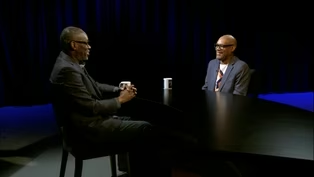
Meanwhile, plans are underway for the creation of a museum that will preserve and celebrate Detroit's really important legacy as the birthplace of techno and hip-hop culture.
It's called the Museum of Detroit Electronic Music.
Joining me now is the museum's Founder and Executive Director, Adriel Thornton.
Welcome back to "American Black Journal".
- Thank you, thank you, thank you for having me.
- Yeah, so we are getting ready for Movement.
We were talking before about just how this is not an event like other events in the city where it happens in a place and you gotta go to that place to be part of it.
Movement now takes over the city and almost the region in terms of where people are, and what they're doing, and who's hosting what, and what you can do.
I mean, it's four or five days now of- - Yeah.
- Of just fun.
- Yeah, I mean, it really starts the week of, you know?
- Yeah.
- You know, Movement is the Memorial weekend, you know, that Friday, Saturday... Saturday, Sunday, Monday, but it is definitely, you know, starting way before that, you know, with the events, and showcases, and parties, you know, from basically Monday through, you know, from that Monday, the week before.
- The next Monday, right?
- Yeah.
You can't, really, you can't book a place.
- Yeah.
- You know, I mean, there's programming all over the city, so it is actually really quite incredible.
- Yeah, yeah.
When you think about the origins of Movement, of course, I think you have to think about the origins of techno.
They kind of moved together through our history here.
But in 2026, I'm always curious sort of what people think about what that means now and maybe how it's different than it was when you and I were young men.
(both laugh) Was starting.
It does feel different in many ways.
- Yeah, you know, I think that one of the things is, you know, when you really look back down at the sort of origins of it.
You know, I was a kid, and my older cousins and brothers and stuff, we're really that group of young black high school kids who were really the ones who really adopted this first.
- Yeah.
- And who were listening to it.
And, you know, I remember hearing my, like I said, my older cousins listening to this... What was called progressive at the time.
- Yeah, right, right.
- And also on the radio, you know, you had The Electrifying Mojo and then later on The Wizard AKA Jeff Mills.
- Yeah.
- Who were starting to play this stuff, but also on the scene.
- Right, right.
- On WGPR, and then later "The New Dance Show".
But then it was... That was really inner city black music.
- Yes.
- And, you know, that's what you heard at backyard barbecues or someone's basement party, you know?
And again, it wasn't really necessarily defined as techno at that point, but it was just some get down.
- Yeah, right.
- Music.
But you really think about it is really odd in a sense that like this music that was, you know, inspired by like Kraftwerk, and George Clinton, and the whole Parliament-Funkadelic thing, and Prince was, really, was shouldn't avoid tear, really did.
- Yeah.
- You know?
I'm actually happened to be friends with Ralph Hooter from Kraftwerk, and he actually told me, he's like, "We did not set out to make dance music."
- Yeah.
- They were just playing with synthesizers and drum machines.
- Just noise.
- Yeah, they were just making noise, and they were like shocked when, you know, Mojo started playing it.
And then there was this city in the US who was like, just all about it and like dancing to it and making it happen.
And that was Detroit.
- Yeah.
- You know, so it was kind of an anomaly, but thank God, right?
- Yeah, yeah.
And those roots, because now, it's so much bigger, right?
It's everywhere, it literally is all over the world, but those roots are important.
And that's what you're trying to, I think, really celebrate and commemorate in the idea of this museum.
And that's really important to us here.
- Exactly, so, you know, the idea that this musical genre that was created here by African-American teenagers has impacted the world in ways that we still are trying to process.
- Yeah, right.
- You go other places in the world and Detroit is literally a genre, Detroit techno was a genre of music.
- Right, right.
- You go in a record store, there's a Detroit techno section.
And we are now, you know, 40 years later recognizing that we need to capture stories.
We need to highlight folks.
We need to make sure that we, as a city, are protecting that legacy.
- Yeah.
- While paying, you know, Amish to what's happening now, and they're preparing for the future, right?
So the Museum of Detroit Electronic Music, AKA MODEM, seeks to do all of that.
- Yeah.
- Right?
We want to make sure that we honor and preserve the history.
There's a lot of people still in this city who don't necessarily know that Detroit was created here.
- That we did all of that.
- Or that techno was created.
- Yeah.
- And that the branches of that, of those roots have seeped through all the electronic music.
So, you know, our impact on hip-hop event.
- Yeah.
- You know, when you talk about a producer like J Dilla.
- Yeah, right.
- One of his electronic music songs, what of his techno songs called "Plastic Dreams" was like huge around the... Like one of the biggest songs ever, right?
But he was also one of the most revered hip-hop producers- - Yes.
- On the planet.
- Yes.
- His mentor and the person who taught him what to do was Amp Fiddler.
- Yeah, right.
- Who also crossed those lines, right?
So that's why for me, it was important to say that it was electronic music so that we could cover all of that.
- We could get everything.
- We could get everything.
- Yeah.
- And so it really, really is important, I think, to have a physical institution, a physical place where DPS students can come and see pictures and learn history and say, "Oh, my God, those people look like me."
- Yeah, right.
- Yeah.
- Right.
This happened where I'm growing up.
- Yeah, and it happened... This guy was from my neighborhood.
- Yeah, right.
- And so I could potentially do that too, you know?
Certainly, folks like, you know, Warren Atkins, Rick Davis, you know, when they created Cybotron, were not doing it to have a legacy 40 years later.
- Right, right.
- You know?
They were just being- - You never think about that.
You're just thinking about, "Hey, this sounds interesting.
- Yes, yes.
- And it was a creative outlet.
I can make this noise go with this other noise.
- Exactly.
- Now I gotta be, and- - [Adriel] Exactly.
- I mean, it's an incredible sort of genre in terms of the creative force behind it, right?
- 100%, And, you know, these cats were... Quite a few, at least at the beginning, were actually really trained musicians.
- Yes.
- You know, playing bass, or guitar, or drums.
And when this new technology came out, this was like, oh, wait, let's play around with this.
They still had the musical knowhow.
- Yeah.
- But really wanted to try interpret it a little differently.
So they really weren't experimenting.
- Yeah.
- And creating something that really they didn't have a basis for, right?
This wasn't like they wanted to sound like.
- Right.
- Somebody else.
- Right.
- They were creating something that was really different and new, but that happened to be something that people, especially in their generation, resonated.
- Yeah, yeah.
- Right?
It resonated with them.
- Yeah.
- And so, I mean, again, when you think about, not a happy accident, I don't wanna say it was an accident, but when you really think about like what really happened back then, it was super creative.
- Yes.
- It was underground, and it was something that, again, I think spoke to the African-American youth in the city of Detroit.
- Yeah.
- In a way that other stuff was not.
- Yeah, yeah.
So we're still looking for a place for the museum, but we've got about a minute left, talk about timeline.
- Yeah, so, you know, starting June, we're probably gonna start our front-facing fundraising campaign online, crowdsource it.
We are actively looking for sponsors and foundational support.
- Yeah.
- Actually hoping that the city will support it in ways, but we are having to... We are looking for a new location.
We were part of a project that got canceled.
- Yeah, right.
- Or pause.
- Yeah.
- And so we are looking for perhaps a place that is more central that maybe makes a bit more sense, right?
- Shouldn't we be with the other museums in town?
- Yeah, you know, I- - I mean, that's not a- - That's not a bad idea.
(both laugh) - Yeah, right.
Adriel, it's always good to catch up with you.
Thanks for being here.
- Likewise, thank you so much for having me.
- Absolutely.
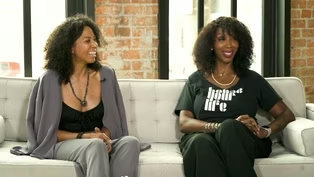
DJ Minx and DJ Holographic are two pioneering women on the Detroit techno.
See, both are scheduled to appear at this year's Movement Festival.
Contributor Micah Walker from BridgeDetroit had a chance to talk with both women about their musical influences and their personal coming out stories.
- Detroit is known as the birthplace of techno.
Adding to that legacy, DJ Minx, a legend in the city's techno scene, and DJ Holographic, who's learning from those who came before her.
How did the two of you meet?
- Ariel and I met through, of course, music.
And being two black women from Detroit playing this thing called techno in house music.
- Yeah.
- And me being mentorish.
Once I know about a young lady doing some music, I gotta meet them.
So I went to a party where she was just to meet her specifically.
- I love that.
- [Micah] Holographic looks up to Minx, and the two have formed a bond for music.
- I'm super honored to get to know her more and more every day.
And I'm trying to... I can't remember the first time I met you, but I know how many times I've heard of you.
I had so many people say like, "If you don't know me, you don't know nothing yet."
And I was like, "You're right."
And it just uplifted me to see you because I knew I'm in the right place at the right time.
- Both of you performed at Movement this year.
You've been there several times, what makes each time so special?
- I would say each time is so special 'cause I've been going since I graduated high school, and I've been going every summer, every year.
The Hart Plaza and being the heart of the city of Detroit to hear music that African-Americans made, house music, techno, it just, it's gratifying.
For this past year, oh, my God, it was like the best one.
I got to play a really fun, phenomenal sap, then I gotta see some of my favorite artists, like Terrence Parker, and I got re-inspired, and getting to dance and express myself and seeing my other family.
'Cause that's what it is, Movement is like another family.
- Absolutely, Movement is like a family reunion every year.
And a lot of people around the world actually know that.
- [Micah] Minx has been a fixture at the Movement Festival for more than 20 years.
- I have a stage every year, so I do a house show life stage.
And we bring in artists that a lot of them haven't played Movement or been there before.
But the elevating of these, not only artists, period, but LGBTQ community that come in, they play and they dance with us, it's like building another family on top of the one we already have.
- What were some of the music that you grew up listening to?
- (indistinct) Michael Jackson.
- Diana Ross, son.
- Diana Ross.
- Yes, The Jacksons, Marvin Gaye.
- Aretha Franklin.
- Yep.
- A lot of Michael Jackson for me.
At 18, I started listening to Prince.
And then the radio.
It's the radio that really raised me for music here in Detroit.
- Electrifying Mojo.
- How has that shaped the music you're making today?
- First of all, with us talking about the Electrifying Mojo, he was on WGPR and he introduced me to a lot of the music that I still play today, because this music is timeless as well.
He played a lot of Prince.
He played a lot of tracks that no one else played on different stations like The B-52s and Visage, "Frequency 7" stuff.
He played a lot of New Wave.
And this is stuff you hear right now that's being produced by house music DJs using the same samples.
- Yeah.
- And put... We can still play that music today.
- How do the clubs like the Music Institute help you realize that you want to be a DJ?
- Going to the Music Institute and seeing those people dance like they cared about nothing in the world and them... It just being such a togetherness at this place, that was a feeling that I wanted to deliver.
I saw the DJ at the Music Institute and he would be getting down.
I was like, "Oh, I think I can be a DJ."
But realistically, it was my mentor that pushed me to say, "Well, if you wanna be a DJ, be a DJ."
The first thing I thought was, "Nope, I'm a woman, I can't do that."
So then I started hearing about the women that were DJing.
Like there was the (indistinct) and there was Cahan, rest her soul, and Serena Tyler.
And I just, you know, started practicing and realizing that it is something that I as well could do.
- I worked at nightclub called Necto when I was 20, and I used to be in Nectarine Ballroom where Jeff Mills was The Wizard, like long ago.
And then he had a residency there, and I would hear the DJs perform there every night and hear how he would get people to come to the dance floor, but also let them go to chat and mingle with other people.
So I can see like there was an art to it, and I just wanna be a part of that.
- [Micah] DJ Minx and DJ Holographic shared their coming out journeys as queer artists as well.
In 2021, Minx came out publicly on Instagram saying in the post, "So here I am.
Minx, DJ, producer, mama, partner, lesbian, friend."
- I've got friends that thought it was a bad idea for me to come out.
I've had a husband, I have daughters, and I looked like the, I guess, homebody that people wanted to see out there DJing.
But just constantly hearing that it wasn't a good idea to let people know that, you know, I lived the way I lived, so I had to get over that finally and just... ♪ Let it go ♪ When I actually did come out, the phone calls that I got like at that moment, like the post went up, I'd sat, and my managers were all like, "We're gonna be up."
But people that read the post were calling me.
Holy smoke, I cannot believe it.
I love you so much, thank you for doing this.
One person said, "You know, you just helped me.
I just came out."
Or you let it be known that it can be done.
And like an entire world opened up.
- Even with my family, like I came out in a weird way of being bi, and people also, even the community, in our community are not the nicest to bi.
But it was still that moment of when I told my family this, this is where it got kind of weird 'cause I expressed it to my mother.
It was a whole 'nother topic that we were having and then it came up slightly to this topic of being, okay, this is when I'm gonna be vulnerable with you.
We're talking about something else, but I'm gonna be vulnerable with you and honest here about me liking this girl at school.
But I don't know she fully understood or like was willing to make the next move because I don't know, there was no book on the conversation, but she was listening.
And then, of course, she told her mom, which is my grandmother, and my grandmother just said, which really made me very happy that she said like, "As long as you meet someone that respects you."
And that was really nice, 'cause that means I got like reinforcement there.
I played in majority only queer places in my first five years of DJing.
So there was not a conversation of like coming out.
I'm like I'm here.
(laughs) - Yeah.
- I'm here, I'm here and I'm queer.
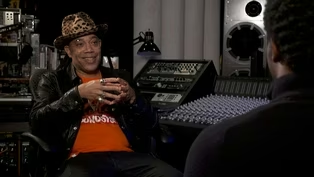
- Well, the headliners at this year's Movement Festival is Detroit techno pioneer, Carl Craig.
Every year during Black History Month, he hosts a video series on Instagram titled "All Black Vinyl".
Contributor Bryce Huffman of BridgeDetroit talked with Craig about the importance of celebrating black music history.
- Why did you start your "All Black Vinyl" series and what does that medium for music mean to you personally?
(Craig hums) - During COVID, it was just hell.
(Craig laughs) - Yeah.
- And, you know, everybody was doing streaming, but not really streaming with meaning.
Of course, George Floyd and all the things that were going on at the time had such a big impact.
But I really felt that there needed to be something that I could do that had meaning.
And for Black History Month, it made sense to do a project that was about the music, about the music that is good music, but that's music that's done by whether it's people from Detroit or people from outside of Detroit that would celebrate Black History Month.
So "All Black Vinyl" just seemed to be an obvious thing for me, and it was a lot of fun to do it.
You know, instead of it being something where I would sit there and mix records for a day or something, I liked the concept of doing one a day, and I got so many people from not only inside of the United States, but outside of the United States that we're looking forward to seeing the next day that I would do a post.
See, there's Miles up there - What about the (indistinct)- - You've been collecting vinyl for years now.
How big is your collection?
And is there one record that stands out as very important to you on a personal level?
- I can always say like, oh, yeah, you know, we got all this records in stock and stuff.
Yeah, I got, you know, 50,000 records, 100,000 records.
No, it's not like that.
It's something that I don't pay attention to collecting for the sake of collecting records.
I buy it because I love the music and I want the music.
So I don't have a Fela Kuti record or a number of Fela Kuti records because that was the trend.
I have 'em because I just like the music, you know?
The music that stands out, really, the most to me, Marcus Belgrave, "Vibes from the Tribe" from Phil Ranelin, you know, the Detroit stuff.
♪ Motown ♪ ♪ And from Detroit ♪ (upbeat music) - When you go through records that you haven't listened to in a while, is there an appreciation for the recording process, the artistry that goes into making the albums that you kind of rediscover?
- Those records that were being done in the '50s, and the '60s, and even the '70s, the process of making 'em and the care of making 'em was incredible, and it's so much different than when you're using a laptop, you know?
Or, I mean, MPCs sound great and stuff, but, you know, to have the guys in the studio going straight to tape, mixing console, left, right, center, boom, you're there.
- Now, jazz, techno, hip-hop, R&B, these are all genres that have been covered on the show and all genres that are really important to black history, especially music history.
Tell me, was there a genre that you think sounds best to you when it's recorded on vinyl?
(Craig hums) - You know, there was a whole Disco Sucks movement that happened in, what was it, 1979 in Chicago.
It was a baseball game between Detroit and Chicago.
(laughs) Was it the White Sox versus the Tigers where they blew up all those pieces of vinyl.
And disco might've sucked because of all the novelty that happened with it, but a lot of those records are recorded so well, they sound incredible.
You know, there's records from Barry White that just sound enormous on the sound system.
Moody Man, he's been playing The Isley Brothers at his gigs mixed with Thundercat, and The Isley Brothers record sounds monstrous on the sound system.
("Vertigo" by Stacey Pullen plays) - As a lifelong student of black history, is there any record or group of records that you think newcomers to this history just have to listen to to fully appreciate the strides that have been made?
- You gotta go to the roots.
With black music, you have to listen to Billie Holiday, you know, you have to hear "Strange Fruit".
You have to hear the political records, the Nina Simone stuff.
You have to know that music in the same way that you have to know Elvin Jones' records, or Count Basie, or Duke Ellington, or Miles Davis, or going into the blues of Muddy Waters and Howlin' Wolf.
You have to go all the way down through it.
You have to understand why shiny suits were worn on stage.
You have to understand the Chitlin' Circuit.
You have to understand why James Brown got on because he was impersonating Little Richard, you know?
It's like the knowledge and the history is really important.
That's right, "All Black Vinyl", once again.
Enjoy yourselves.
- That's gonna do it for us this week.
You can find out more about our guests at americanblackjournal.org, and you can connect with us anytime on social media.
Take care, and we'll see you next time.
(upbeat music) - [Narrator] Across our Masco family of companies, our goal is to deliver better living possibilities and make positive changes in the neighborhoods where we live, work, and do business.
Masco, a Michigan company since 1929.
Support also provided by the Cynthia & Edsel Ford Fund for Journalism at Detroit PBS.
- [Narrator] The DTE Foundation is a proud sponsor of Detroit PBS.
Through our giving, we are committed to meeting the needs of the communities we serve statewide to help ensure a bright and thriving future for all.
Learn more at dtefoundation.com.
- [Narrator] Also brought to you by Nissan Foundation and viewers like you, thank you.
(bright music)
 New
NewDetroit techno legend Carl Craig celebrates Black music on vinyl
Video has Closed Captions
Clip: S54 Ep20 | 6m 9s | Every year during Black History Month, Carl Craig hosts a video series called “All Black Vinyl.” (6m 9s)
 New
NewA look at the upcoming Museum of Detroit Electronic Music
Video has Closed Captions
Clip: S54 Ep20 | 10m 18s | Plans are underway for a museum that preserves Detroit’s legacy as the birthplace of techno music. (10m 18s)
 New
NewTwo women DJs reflect on their careers in Detroit’s techno scene
Video has Closed Captions
Clip: S54 Ep20 | 7m 58s | Contributor Micah Walker from BridgeDetroit talks with them about their musical influences and more. (7m 58s)
Providing Support for PBS.org
Learn Moreabout PBS online sponsorship
- News and Public Affairs

Top journalists deliver compelling original analysis of the hour's headlines.

- News and Public Affairs

Today's top journalists discuss Washington's current political events and public affairs.












Support for PBS provided by:
American Black Journal is a local public television program presented by Detroit PBS