
New Evidence That Roman Life Continued After the Empire's Fall
Clip: Season 23 Episode 3 | 3m 1sVideo has Closed Captions
New dating shows a Roman villa mosaic was laid in the 5th century, reshaping post-Roman Britain.
Long thought to have been abandoned after 410 AD, Roman villas like Chedworth were believed to mark the end of a lavish Roman lifestyle in Britain. But new radiocarbon dating of a finely crafted mosaic reveals it was laid in the late 5th century, challenging this long-held view.
Problems playing video? | Closed Captioning Feedback
Problems playing video? | Closed Captioning Feedback
SECRETS OF THE DEAD is made possible, in part, by public television viewers.
New Evidence That Roman Life Continued After the Empire's Fall
Clip: Season 23 Episode 3 | 3m 1sVideo has Closed Captions
Long thought to have been abandoned after 410 AD, Roman villas like Chedworth were believed to mark the end of a lavish Roman lifestyle in Britain. But new radiocarbon dating of a finely crafted mosaic reveals it was laid in the late 5th century, challenging this long-held view.
Problems playing video? | Closed Captioning Feedback
Where to Watch Secrets of the Dead
Secrets of the Dead is available to stream on pbs.org and the PBS app.
Buy Now
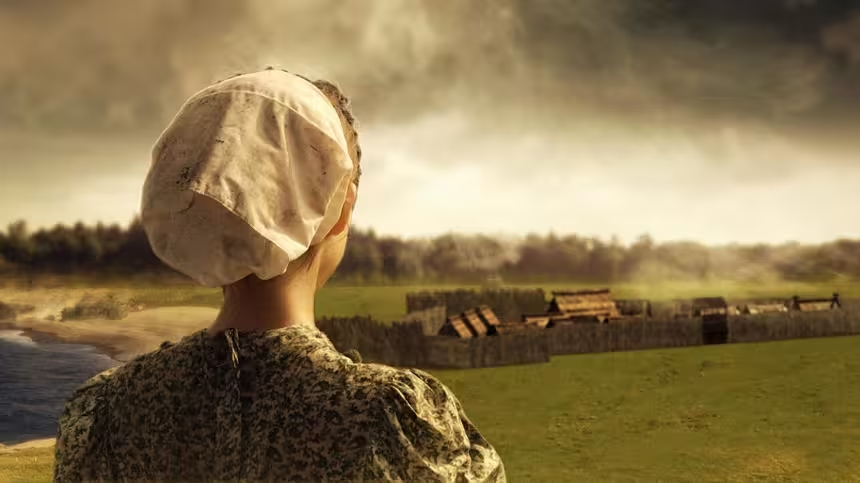
Providing Support for PBS.org
Learn Moreabout PBS online sponsorship-So, the traditional view of the end of Roman villas like this is: around 410, the Roman army had left, the monetary economy had collapsed, and people couldnt afford to keep the villas going and so they abandoned them, just like that.
410, thats the end.
-Chedworth is one of more than 40 luxury villas that have been located across the Cotswolds and around Cirencester.
If Cirencester was a city that prospered even after the Romans left, villas like it would have continued to thrive.
But no evidence of a post-Roman lavish lifestyle has been found until now.
-So, which room is this?
-This is the room, this is room 28, and this is where we've got this mosaic.
-National Trust archaeologist Martin Papworth investigated a mosaic in the north wing of Chedworth Villa that surprised everyone.
-What we were setting out to do was to show the mosaic off and record it digitally.
-Now reburied to protect and preserve it, the mosaic is as finely crafted as others found elsewhere in the surrounding area.
-But there were lots of little bits of charcoal, tiny little twigs of charcoal, which is nice.
-Nice for dating, yes.
-Yeah, very nice for dating, it was like a gift really.
-Yes, yes.
-But I really did expect these little twigs to give me a date of late 4th -Late 4th century, yes.
-The radiocarbon dates showed that a new, expensive mosaic was installed in the late 5th century long after the villa wa supposed to have been abandoned.
-Thats where we took th radiocarbon dates, just there.
We came back and we took more samples.
The other two hit the nail on the spot, both the same.
-The beautiful patterns and intricate figures, dating to the late 5th century indicate that people here lived a Roman way of life much later than previously thought.
Other villas in the area are now being re-examined to look for new radiocarbon evidence.
-What your evidence shows is that it didnt all come to an end in the early 5th century -No.
-It carried on.
-It's not quite what it was, but they're holding on, like a fading country house.
They're commissioning a new mosaic, so theyve got some money to make it.
And, presumably, the fact we have mosaicists laying a mosaic in the late 5th century means that they must'v had enough work to keep going.
-Surely, youve got a town -Yes.
- where, where specialis craftsmen still have workshops.
They're still taking work from wealthy people out in the countryside.
The countryside is still a reasonably peaceful plac where they can ply their trade.
-We can imply that Cirencester must still be going.
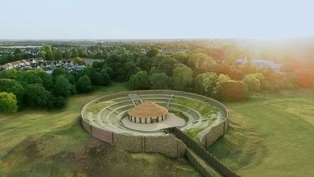
Discovered Ruins May Have Inspired the Round Table
Video has Closed Captions
Clip: S23 Ep3 | 3m 1s | New evidence suggests an amphitheater became a stronghold linked to Arthur’s Round Table. (3m 1s)

How the Sword in the Stone May Have Begun
Video has Closed Captions
Clip: S23 Ep3 | 1m 53s | Iron smelting at a temple site may have inspired the legend of King Arthur’s sword, Excalibur. (1m 53s)
Preview | The Quest for Camelot
Video has Closed Captions
Preview: S23 Ep3 | 32s | A professor seeks to prove Arthurian legends have roots in actual British history. (32s)
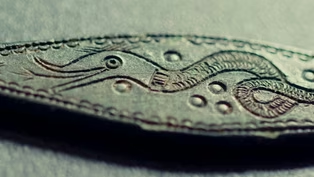
A Roman Dragon's Possible Link to King Arthur
Video has Closed Captions
Clip: S23 Ep3 | 2m 10s | A Roman military belt bearing a dragon design may hint at the military roots of King Arthur. (2m 10s)
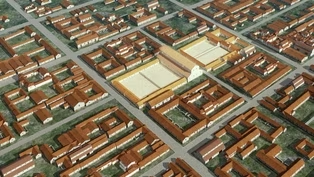
Was This City the Real Camelot?
Video has Closed Captions
Clip: S23 Ep3 | 2m 53s | Did Cirencester remain the center of a prosperous post-Roman kingdom in the time of King Arthur? (2m 53s)
Providing Support for PBS.org
Learn Moreabout PBS online sponsorship













Support for PBS provided by:
SECRETS OF THE DEAD is made possible, in part, by public television viewers.