
New York Always Finds a Way to Reinvent Itself
Clip: 9/21/2026 | 3m 19sVideo has Closed Captions
Writer Adam Gopnik reflects on New York’s remarkable resilience and its ability to reinvent itself.
New York City has endured waves of crime, 9/11, a devastating pandemic, and countless other upheavals... and time and again, the city has found a way to recover. New Yorker writer Adam Gopnik reflects on what makes New York so resilient — its diversity, history and remarkable ability to reinvent itself — and why the city’s pluralism gives him hope for its future.
Problems playing video? | Closed Captioning Feedback
Problems playing video? | Closed Captioning Feedback
Corporate funding for NEW YORK: A DOCUMENTARY FILM "Shadows of the Past" and "The Future of Cities" was provided by Hudson River Trading. Major funding was provided by the American...
Support provided by:

New York Always Finds a Way to Reinvent Itself
Clip: 9/21/2026 | 3m 19sVideo has Closed Captions
New York City has endured waves of crime, 9/11, a devastating pandemic, and countless other upheavals... and time and again, the city has found a way to recover. New Yorker writer Adam Gopnik reflects on what makes New York so resilient — its diversity, history and remarkable ability to reinvent itself — and why the city’s pluralism gives him hope for its future.
Problems playing video? | Closed Captioning Feedback
Where to Watch New York: A Documentary Film
New York: A Documentary Film is available to stream on pbs.org and the PBS app.

Ric Burns Talks to THR
Director and co-writer Ric Burns speaks with The Hollywood Reporter about the two new installments in his NEW YORK: A DOCUMENTARY FILM series, which have been in the works for more than a decade.Adam Gopnik: Well, look, the future in New York-- and that's one of the things that makes it addictive-- is always unknowable.
If someone had said to me in 1980, "By 2020, the problem of violent crime "and of a crime epidemic will be largely vanished, "New York will have a lower crime rate, "a lower murder rate than it's had "since the beginning of the 20th century," you wouldn't have called that person an optimist.
You would have called them a surrealist.
It just wasn't gonna happen.
But then if they had said, "But there will be "a massive pandemic, larger even than the Spanish Flu, "which will entirely shut down the city, "including all of Broadway, every jazz club, every museum, "in a way that's never happened before, each restaurant, for a year," it would have been equally hard to credit that.
The city has rebounded again and again and again from things that seemed to be utterly fatal blows, and whether it was the crime wave of the 1960s and '70s or a world historical insult like 9/11, every time New York has undergone that kind of fundamentally transformational trauma, it lingers in memory, it lasts in scars... but I think that scars are better than wounds, and New Yorkers' wounds tend to heal remarkably quickly.
That process of self-healing and of recovery has been astoundingly persistent.
[Thunder rumbling] You know, cities are, more than anything else on Earth-- more than coral reefs, more than forests, more than anything else-- are self-emerging and self-sustaining forms.
And no place... I say this as a big statement, but I say it with confidence-- no place in the history of the Earth has remade itself more resiliently, more persistently than this-- than this small stretch of city.
[Horns honking] ♪ I'm emotional about it because it's home, but also because the values that New York has incarnated-- inadequately, insufficiently, with great friction and difficulty over the years-- are the values, as I wrote once, of verticality, meaning the possibility of lots of people being together; of variety, meaning many, many kinds, not trying to drive each other out, but trying to learn from and co-exist; and finally of plurality.
It's the most plural city that you could possibly find.
It's plural in its current constitution, but it's also got the incredible pluralism of its history-- that it's been more different in more times than any other city I can think of, and we accept its remaking of itself again and again.
We don't try and cling onto the old New York the way people cling onto the old Paris or the old London.
So, the multiple-- the plural pluralisms of New York is what gives me hope.
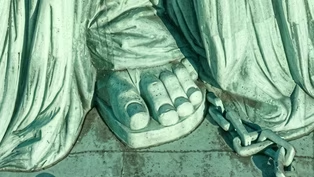
Video has Closed Captions
Trace New York’s turbulent decline and rebirth in the last decades of the 20th century. (31s)
Providing Support for PBS.org
Learn Moreabout PBS online sponsorship












Support for PBS provided by:
Corporate funding for NEW YORK: A DOCUMENTARY FILM "Shadows of the Past" and "The Future of Cities" was provided by Hudson River Trading. Major funding was provided by the American...