
Breaking down U.S. strikes and the conflict in Nigeria
Clip: 12/26/2025 | 10m 25sVideo has Closed Captions
Breaking down U.S. strikes on ISIS in Nigeria and the complicated conflict there
President Trump said that he delayed U.S. military strikes in Nigeria until Christmas Day to deliver a message to groups he alleges are targeting Christians. The Nigerian government praised the attacks and said it provided the U.S. with the necessary intelligence. Nick Schifrin discussed more with former Amb. J. Peter Pham, the special envoy for the Sahel Region during Trump's first term.
Problems playing video? | Closed Captioning Feedback
Problems playing video? | Closed Captioning Feedback
Major corporate funding for the PBS News Hour is provided by BDO, BNSF, Consumer Cellular, American Cruise Lines, and Raymond James. Funding for the PBS NewsHour Weekend is provided by...
Support provided by:

Breaking down U.S. strikes and the conflict in Nigeria
Clip: 12/26/2025 | 10m 25sVideo has Closed Captions
President Trump said that he delayed U.S. military strikes in Nigeria until Christmas Day to deliver a message to groups he alleges are targeting Christians. The Nigerian government praised the attacks and said it provided the U.S. with the necessary intelligence. Nick Schifrin discussed more with former Amb. J. Peter Pham, the special envoy for the Sahel Region during Trump's first term.
Problems playing video? | Closed Captioning Feedback
How to Watch PBS News Hour
PBS News Hour is available to stream on pbs.org and the free PBS App, available on iPhone, Apple TV, Android TV, Android smartphones, Amazon Fire TV, Amazon Fire Tablet, Roku, Samsung Smart TV, and Vizio.
Providing Support for PBS.org
Learn Moreabout PBS online sponsorshipWILLIAM BRANGHAM: Welcome to the "News Hour."
President Trump said today that he# delayed American military strike.. in northwest Nigeria until Christmas Day# to deliver a message to groups he alleges## are targeting Christians in that country.# Meanwhile, the Nigerian government praised## the attacks and said it provided the# U.S.
with the necessary intelligence.
Nick Schifrin is here with the details -- Nick.
NICK SCHIFRIN: William, the area that# the U.S.
bombed in Nigeria is near the## border of neighboring Niger and a part# of Western Africa that suffered from## cross-border terrorism.
Northern Nigeria# has suffered from violence for years.
And while the president describes this# as focus on protecting Christians,## the violence in Nigeria and the groups# committing it are far more complex.
In the Gulf of Guinea, a Tomahawk missile flies to# an area never before struck by the U.S.
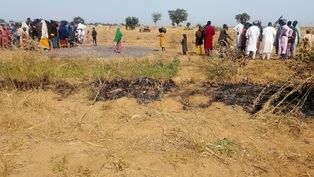
military,## Northwest Nigeria, where locals picked# up debris as nearby flames kept burning.
By day, the grass was scorched and police# cordoned off an impact site.
This missile,## at least in this remote rural# area, apparently killed no one.
NUHU UMAR JAGO, Nigerian Resident: There# was no loss of life and no loss of property.
NICK SCHIFRIN: A U.S.
military official tells# "PBS News Hour" a ship off Nigeria's coast## fired more than a dozen Tomahawks at two ISIS# training camps.
Local security analysts say the## missiles hit in at least four locations,# all in Nigeria's northwest Sokoto state.
The area has been plagued by a group known as# Lakurawa that claims affiliation with ISIS Sahel## and exploits poor local governance and access to# terrorist groups that operate in Niger and Mali.## Nigeria declared them a terrorist organization,# but locals say they're connected to bandits and## criminals, who've intimidated local residents,# most of whom are Muslim, preaching radicalization,## kidnapping hundreds of girls and young boys in# an attempt to control and exploit the population.
YUSUF TUGGAR, Nigerian Foreign# Minister: This is what we have## always been hoping for, to# work with th.. NICK SCHIFRIN: Today, Nigerian Foreign# Minister Yusuf Tuggar told Channel TV## that Nigeria provided the U.S.
intelligence.
YUSUF TUGGAR: It is a joint operation# and it is not targeting any religion.
NICK SCHIFRIN: But, last night, President Trump# wrote that the targets were -- quote -- "ISIS## terrorist scum in Northwest Nigeria who# have been targeting and viciously killing## primarily innocent Christians at levels not# seen for many years and even centuries."
And today, he told Politico the strike was# supposed to take place on Christmas Eve,## but he said: "Nope, let's# give a Christmas present."
NINA SHEA, Center for Religious Freedom Director,# Hudson Institute: The government doesn't help the## Christians.
They're not protecting them.# They're not protecting their villages.
NICK SCHIFRIN: Nina Shea directs the# Hudson Institute's Center of Religious## Freedom.
She and 30 other advocates,# Christian organizations and think tanks## wrote a letter in October to President# Trump saying the Nigerian government## "demonstrably tolerates relentless aggression# uniquely against Christian farming families."
NINA SHEA: Local Christian leaders# are telling us that they are## trying to cleanse the land of Christians, that# they are establishing the land for Islamic rule.
NICK SCHIFRIN: In reality, Nigerian# violence is more complex.
For years,## Islamist terrorists have plagued Northern and# Northeast Nigeria.
The best known is Boko Haram.## They have targeted the Nigerian military and# violently opposed female education.
It's bombed## mosques.
Boko Haram also targeted Christians,# as I saw in 2015 in the eastern city of Mubi.
Outside the nearby Church of the Brethren,# the damage is everywhere.
Inside,## high above the podium, the fire set by Boko# Haram almost erased the cross from the wall.
ELIA USMAN, Church of the Brethren: When these# people landed in Mubi, they will ask you,## are you a Christian or a Muslim?
When you# say you're a Christian, they will shoot you.
NICK SCHIFRIN: But that's the northeast, far# from today's target.
And then there's the map.## Most Nigerian Muslims live in the north.
Most# Christians live in the south, and in the middle,## the two groups overlap, as do tribes,# farmers and herders, who can clash violently.
For decades, nomadic herders, almost all# of whom are Muslim, have fought farmers,## most of whom are Christian, over# land disputes and scarce resources.## The independent conflict monitor# ACLED tells "PBS News Hour" last## year's data show a rise in Christian# fatalities, mostly in Central Nigeria,## but the vast majority of the incidents were over# land disputes, not targeting because of religion.
YUSUF TUGGAR: You can see how all these things# are interconnected.
So when you try to reduce it,## you just say, oh, no, it's Muslims# killing Christians in Nigeria,## you see how you can get it completely wrong.
NICK SCHIFRIN: And for more perspective on# the U.S.
strike against targets in Nigeria,## we turn to former Ambassador Peter Pham.
He# was U.S.
special envoy for the Sahel region## during the first Trump administration.# He's now a distinguished fellow at the## Atlantic Council and sits on the boards of a# number of companies doing business in Africa.
Ambassador, thanks very much.# Welcome back to the "News Hour."
J. PETER PHAM, Atlantic Council:# Good to be with you, Nick.
NICK SCHIFRIN: Explain who is being# target.. is a group called Lakurawa connected to# terrorists in the Sahel in Western Africa,## but also criminals known as bandits in Nigeria.
J. PETER PHAM: Well, the group that was# referred to in the piece, Nick, Lakurawa,## is a good example, almost a classic one# of the cure being worse than the disease.
They originally originated as# self-defense groups in an area## where the Nigerian government and some of# the neighboring countries were unable to## provide protection for local communities.
So# they set up their own self-defense groups.
Unfortunately, over the years, these# groups, their ambitions grew.
And in## the case of Lakurawa, in Sokoto state# and some of the neighboring states,## as well as in Mali and Niger, they have# grown to establish dominion over areas of## territory where the government is -- quite# frankly, it doesn't run and is excluded.
And they have been increasingly imposing upon# the people they were -- started to protect a## harsh vision of Islam and a hard-line vision,# and increasingly kidnapping young people to## fill up their ranks.
So they have become, in# effect, the disease they were there to fight.
NICK SCHIFRIN: And I don't want to conflate# these groups.
The analysts I speak to says## it's not Lakurawa, it's not these bandits# in the northwest who are traditionally## killing Christians.
We see that more in the# northeast and the central area of Nigeria.
J. PETER PHAM: That's very much where# the conflicts between farmer-herders,## between Muslims or those motivated or agitated by## extremist interpretations of Islam# and Christians have occurred.
So I'm not privy to -- I'm a former government# official.
I'm not privy to any current## intelligence on this.
So I can't speak to why the# targeting occurred in Sokoto.
Certainly, it's a## mystery to me.
There are a couple other places I# would have picked to hit extremists in Nigeria.
NICK SCHIFRIN: So let's drill into that.
What impact, if any, could this have,## this strike in Northwest Nigeria,# on violence against Christians?
J. PETER PHAM: As far as I'm aware# of, a very limited impact.
What does## do is send a signal that the U.S.# is willing to act in this area.
But what concerns me is the fact that# all the reporting I have seen on this## has emphasized -- including Nigerian# Foreign Minister Tuggar's statements,## this was coordinated with the Nigerian# government.
And I agree with my friend Nina Shea.
Part of the problem here is actually not# all parts of the Nigerian government,## but certain parts of the# Nigerian government are suspect.
NICK SCHIFRIN: Well, we have also seen# inability by the Nigerian government,## as you were referencing before, to# govern some of these spaces, whether## the northwest, the northeast or some of these# farmer-herder conflicts in the Central Plains.
I mean, how much of this is about# -- how much of the root causes is## about the government not being able# to have governance in these areas?
J. PETER PHAM: Yes it's a matter of,# where does something start and where## something end?
There's certainly# an incapacity or lack of capacity,## but there's also a lack of political will# to put the resources necessary to that.
And in some cases -- one has to# be brutally honest here.
There's## also certain politicians in Nigeria have# their own agendas and their own political## alliances with extremists.
And you sort# of get a mixture of all that.
It's a very## complex situation that doesn't give# -- lend itself to easy solutions.
NICK SCHIFRIN: Absolutely.
And so in that sense, .. or not, that could actually help protect Nigerian# Christians, could get at this lack of governance?
J. PETER PHAM: Well, first, I think# calling attention to it is very,## very important.
Calling it out has# forced the Nigerian government to## take stock of what it is and is not# doing.
So that in itself is effective.
Secondly, I would say that important also in# this is also to be -- is operational security.## Again, I'm not privy to current planning,# but I certainly, if I were still in there,## I'd be very, very hesitant at sharing# and coordinating if -- what the Nigerians## are claiming is was happening with this# coordination, I'd be very suspect about that.
NICK SCHIFRIN: And the Nigerian government,# as we heard the foreign minister say,## this violence is not about# any particular religion, and,## in fact, the majority of victims# of violence in Nigeria are Muslim.
But we heard President Trump# say this is about protecting## Christians.
So in the time we# have left, about 30 seconds,## do we know anything about why those two# narratives are so different right now?
J. PETER PHAM: I think a lot of# it has to do with it's a matter## of perspective.
Both Muslims and# Christians are suffering because of## this violence.
And where the political will# is in this in Nigeria is the real question.
Is there political will to address# the challenges to both communities,## and is there a double agenda# on the part of certain people?
NICK SCHIFRIN: Well, but, again, on the# political will, it seems like so far,## in the past, at least, the Nigerian government# has struggled with that political will.
J. PETER PHAM: Very much so,# both in will and in resources.
NICK SCHIFRIN: Ambassador Peter# Pham, thank you very much.
J. PETER PHAM: Thank you.
British panto blends holiday tradition with Muslim culture
Video has Closed Captions
British panto production blends holiday tradition with Muslim culture and humor (3m 48s)
Brooks and Atkins Stohr on Trump's return and its impact
Video has Closed Captions
Brooks and Atkins Stohr on Trump's return and its impact on the country (11m 32s)
Film critics name their picks for the year’s best
Video has Closed Captions
Film critics look back at 2025 and name their picks for the year’s best (8m 48s)
Imran Ahmed on Trump's threat to deport him over censorship
Video has Closed Captions
Imran Ahmed on Trump's threat to deport him over 'censorship' for countering online hate (6m 30s)
White House pushes to dismantle climate research center
Video has Closed Captions
White House pushes to dismantle leading climate and weather research center (7m 44s)
Providing Support for PBS.org
Learn Moreabout PBS online sponsorship
- News and Public Affairs

FRONTLINE is investigative journalism that questions, explains and changes our world.

- News and Public Affairs

Amanpour and Company features conversations with leaders and decision makers.












Support for PBS provided by:
Major corporate funding for the PBS News Hour is provided by BDO, BNSF, Consumer Cellular, American Cruise Lines, and Raymond James. Funding for the PBS NewsHour Weekend is provided by...