
Night in Newark
Special | 12m 29sVideo has Closed Captions
Middle school students in Newark grapple with Elie Wiesel's harrowing Holocaust memoir.
Night in Newark focuses on the insights of thirty students in Paris Murray's 7th grade classroom at Northstar Middle School in Newark, New Jersey. Their close reading of Elie Wiesel's classic Holocaust memoir explores the themes of freedom, memory and survival.
Problems playing video? | Closed Captioning Feedback
Problems playing video? | Closed Captioning Feedback
Support for American Masters is provided by the Corporation for Public Broadcasting, AARP, Rosalind P. Walter Foundation, Judith and Burton Resnick, Blanche and Hayward Cirker Charitable Lead Annuity Trust, Koo...
Support provided by:

Night in Newark
Special | 12m 29sVideo has Closed Captions
Night in Newark focuses on the insights of thirty students in Paris Murray's 7th grade classroom at Northstar Middle School in Newark, New Jersey. Their close reading of Elie Wiesel's classic Holocaust memoir explores the themes of freedom, memory and survival.
Problems playing video? | Closed Captioning Feedback
How to Watch American Masters
American Masters is available to stream on pbs.org and the free PBS App, available on iPhone, Apple TV, Android TV, Android smartphones, Amazon Fire TV, Amazon Fire Tablet, Roku, Samsung Smart TV, and Vizio.
Buy Now

A front row seat to the creative process
How do today’s masters create their art? Each episode an artist reveals how they brought their creative work to life. Hear from artists across disciplines, like actor Joseph Gordon-Levitt, singer-songwriter Jewel, author Min Jin Lee, and more on our podcast "American Masters: Creative Spark."Providing Support for PBS.org
Learn Moreabout PBS online sponsorshipMore from This Collection
Explore new documentary shorts about artists who defy the odds to create remarkable work. This ongoing series from American Masters showcases cultural trailblazers through short-form storytelling.
Video has Closed Captions
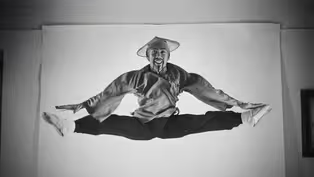
The story of George Lee, a pioneering Asian dancer who later became a Vegas blackjack dealer. (30m 48s)
Providing Support for PBS.org
Learn Moreabout PBS online sponsorship(bell rings) - Good afternoon.
Good afternoon.
I'm gonna start chapter one of "Night" by Elie Wiesel.
We're gonna learn about Elie's family and sort of his introduction to Judaism, like who he is as a person and we're gonna slowly transition into this like ominous mood of the Holocaust sort of brewing in the background.
Let's open up to chapter one.
And this is our five to six weeks to really focus on Elie Wiesel I met him in 1941.
I was almost 13 and deeply observant.
Raise your hand if you're 13 in here.
Look at you.
So, in a lot of ways this is a story that could relate to us.
Let's keep going.
Kids know that six million people who are Jewish died and were killed and so they have some context about like, how Hitler came to power.
They have some context about what it means to practice Judaism and some general ideas about what the world was going through around World War II.
- Regular normal Germans that were sophisticated and intelligent, they conformed with Hitler.
- Six million Jews were murdered because of the fact that they were deemed as genetically inferior due to the fact that maybe they weren't fully German or that they had disabilities.
- The shadow of Judaism is an easy target.
We already know that, like in the text there was the day of like broken cloud glass, I forgot what it's called.
- Kristallnacht.
That is such an, such important moment.
Daniel, tell us what that was.
- Many Jewish buildings were destroyed and like, they arrested many Jewish people and like- - Wait, why would they do that?
I don't know, why would they burn their buildings?
- They wanted to erase Jewish ideas completely, - [Paris] Completely.
- And take Jewish memory away.
- Our kids are 90, over 90% free and reduced lunch, which means most of our students are at or below the poverty line.
They have really rich mindsets and they're able to understand our disposition.
How is a mood of being in the ghettos different from the mood of children playing in the street?
How did the mood change in ghettos?
- Back then ghettos also described something negative that still, they still mean something negative to this day.
- They're really trying to see are we similar to Wiesel?
Would we react in that way?
Can we imagine it?
Most of us cannot.
How did normal people get to this point where a tragedy like this could happen?
- The Nazi, they controlled everything.
Everybody hearing the same thing all at the same time.
So, if everybody heard the same thing all at the same time, they would all think, oh, since he's doing it, I should do it.
- People were ignorant to the ideas that they were just killing innocent people that they didn't know.
- Most of our students are from Newark, live in Newark.
Although our crime rates have gone down quite a bit, we still have pretty high crime rate.
A lot of what happens is not even on the news.
And so our students come from backgrounds that are not, they've never experienced anything like the Holocaust, but the context of sort of under brewing tones of violence in a lot of ways, the undertones are similar.
How did they get from Seget to this camp?
- They were in their homes and then they started to put them in the train so that they could go to the extermination camp.
I didn't really know about the Holocaust.
I didn't really know much until I got here and started reading the book.
- What are all the things they did to break Wiesel down?
- When he arrived he was tattooed and dehumanized.
- Can we blame the guard then?
- Can't fully blame the guards.
They're being influenced to do this.
- Hitler, he was like kind of a priest to them and they were below him so they had to listen to everything that he said.
- [Paris] I see some folks ready to jump into and disagree.
- I think that people were cowards at that time because they had no beliefs themself and what they needed.
So, I think they followed Hitler and ran with him because that's what they needed at that time.
- [Paris] Please pick up on page 29.
- In a fraction of the second, of a second, I could see my mother sit my sisters (indistinct) to the right.
- [Paris] Stop right there.
What just happened?
- Elie and his sister, his mom are being separated and he's only there with his dad and the other male Jews.
- [Paris] Where are they?
- They are right at the crematorium.
They just left.
He's kind of traumatized by the flames 'cause he was like seconds away from death, but at the last second they were turned away.
- [Paris] Pick up on page 34, Khyan.
- Never shall I forget that night, the first night in kids that turned my life into one long night seven times.
Never shall I forget those moments that murdered my God and my soul and turned my dreams into ashes.
Never shall I forget those things even when I am condemned to live as long as God himself.
- How does his relationship with his father shift?
- He's probably gonna be feeling anger for being, like having to take care of his father at 16 in a situation like this.
- I feel like everything bad that happened made Wiesel stronger since now he has to care for his father.
- I kind of disagreed when Isabel said that made him stronger.
In the end that he was still broken down emotionally.
- This is dehumanization because one of the main things that makes a human human is them having the right and the ability to choose.
- I feel like freedom is being able to choose life or death and I feel like freedom is being able to have an option and I feel like you cannot define freedom.
Some people define freedom for themselves.
- His father is very sick and doesn't wanna live anymore.
I'm glad that I learned about the Holocaust.
I feel like I have a better understanding of like, how the world is and what happens in the world and what could happen in the world eventually.
- God hasn't given up on Elie yet, but Elie is trying to give up on God, but God is still giving him chances and still letting him survive.
- It's not God.
I feel like it's more like fate.
- I agree with you and I think that based off Wiesel's perspective, God is not not always there.
- I feel as if God didn't create the Holocaust because I feel as if he gives us a choice to choose.
So, it wasn't really his fault that the Holocaust happened.
- Maybe God is putting him through this to make him understand that God is just not, not just there to make you happy.
God is there to just lead you through life in general.
- What really struck me most about Eliezer and his life is that how religious he was from a young age.
Like, in the beginning of the book he was like 13, 14 and he talked about how he woke up so early to go to the synagogue and pray and how whenever he prayed he'd always cry and it really struck me because I mean, I'm religious too and he was around my age, but I was never that, I was never that passionate about religion.
- The fact that he never stopped believing in God was really just shocking.
- Go to the very last page of the book.
Where Wiesel is staring in that mirror.
- Wiesel says he looks in the mirror and sees a corpse.
I feel like being a corpse wasn't a physical death or wasn't, oh, I want to die.
I think, I didn't think he added that to say I want to die explicitly.
I think he added that to say that he is already dead emotionally.
Like, on page 15 he suffered an emotional death.
- I have a question now.
What was the most impactful part of the book for you?
- The most impactful part was when his father died.
- This is powerful to me because this is like a different situation and I don't know what to expect 'cause I've never experienced it.
But I feel like if I did and I had to let go of my mom, I don't even know what I would do with myself.
- We have an essential question.
Why did he write this book?
What were we supposed to learn?
- It felt like he felt obligated to make this book because he wanted to more like notify everybody so history wouldn't repeat himself.
- He talks about how he's been really working to make sure that people are safe, making sure that people don't suffer the way he did.
- I really felt grateful that I have such a privileged life because I realized that this is going on to kids the age of me and how in one snap your life can change completely.
- I feel as if when he wrote this book, he was trying to let go of his pain so he won't have to feel the pain of having to relive those moments over and over and over again.
- This isn't the same world Wiesel was in when he was younger, 'cause we even see that change in his name throughout the book.
He's called Eliezer, but as an author and when we're talking about him in a present tense before he passed, we say Elie.
That just shows that he's now in a different world.
So, even though Elie is free, Eliezer was never freed from his past.
Elie Wiesel is free, Eliezer is not.
- Today we're doing final performance task where students are gonna present and answers to the essential question, what is freedom?
- My name is Kenrick McDonald.
I'll be talking about my stance on freedom.
- Students are presenting all by themselves, but they can invite their friends.
- Hi, I'm Madison's grandma.
- [Paris] They'll get about 10 minutes to present to their teachers.
- Hi, I am Jayah Girard and this is my presentation of freedom.
- Some of them are doing "Night" and their goal is to assess whether or not Wiesel was free or not free.
But there's a bit of distinction.
So, was he mentally free but not physically?
- Elie Wiesel was not free because although that he was physically free 'cause of American's freedom, he was not mentally free.
- "Night" by Elie Wiesel is an autobiography detailing Eliezer's time during the Holocaust.
- Eliezer, he wrote people were being burned and the world kept silent.
- Elie Wiesel was never blinded by revenge before and after the Holocaust.
- And overall this proves that in order to have mental freedom, you don't let anyone or anything get in the way of what you know your goals are.
(audience clapping) - Congratulations, good job.
- Congratulations.
- Ready for your score?
- Yes.
- You got a 98.
- You're lying.
- I am not lying, but yep.
You have a 99%.
(student squeals) Okay, yeah, good job, man.
How you feel about it?
- [Elie] The most important things, of course for the teacher is to teach, for writer to write, and for all of us to celebrate memory.
(gentle music) (gentle music continues) (gentle music continues) (gentle music continues) (gentle music continues) (gentle music continues) (gentle music continues) (gentle music continues) (gentle music continues) (logo clacks) (water gurgles)















Support for PBS provided by:
Support for American Masters is provided by the Corporation for Public Broadcasting, AARP, Rosalind P. Walter Foundation, Judith and Burton Resnick, Blanche and Hayward Cirker Charitable Lead Annuity Trust, Koo...