
Pamela Colloff
Season 13 Episode 15 | 26m 46sVideo has Closed Captions
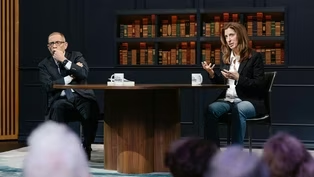
Journalist Pamela Colloff discusses criminal justice and a con man who weaponized it.
Journalist Pamela Colloff is a reporter at ProPublica and a staff writer at The New York Times Magazine. She discusses her book “Catch the Devil," the criminal justice system and a con man in Florida who weaponized it.
Problems playing video? | Closed Captioning Feedback
Problems playing video? | Closed Captioning Feedback
Overheard with Evan Smith is a local public television program presented by Austin PBS
Support for Overheard with Evan Smith is provided by: HillCo Partners, Claire & Carl Stuart, Christine & Philip Dial, Eller Group, Diane Land & Steve Adler, and Karey & Chris...
Pamela Colloff
Season 13 Episode 15 | 26m 46sVideo has Closed Captions
Journalist Pamela Colloff is a reporter at ProPublica and a staff writer at The New York Times Magazine. She discusses her book “Catch the Devil," the criminal justice system and a con man in Florida who weaponized it.
Problems playing video? | Closed Captioning Feedback
How to Watch Overheard with Evan Smith
Overheard with Evan Smith is available to stream on pbs.org and the free PBS App, available on iPhone, Apple TV, Android TV, Android smartphones, Amazon Fire TV, Amazon Fire Tablet, Roku, Samsung Smart TV, LG TV, and Vizio.
Buy Now
Providing Support for PBS.org
Learn Moreabout PBS online sponsorship- [Announcer] Funding for "Overheard with Evan Smith" comes from HillCo Partners, a Texas government affairs consultancy, Claire and Carl Stuart, Christine and Philip Dial, Eller Group, specializing in crisis management, litigation, and public affairs communication, ellergroup.com, Diane Land and Steve Adler, and Karey and Chris Oddo.
- I'm Evan Smith, she's an award-winning journalist for ProPublica and "The New York Times Magazine," whose focus is the criminal justice system's many failures.
Her first book is "Catch the Devil: A True Story of Murder, Deception, and Injustice on the Gulf Coast."
She's Pamela Colloff, this is "Overheard."
(bright music) A platform and a voice is a powerful thing.
(audience cheering) You really turn the conversation around (audience applauding) about what leadership should be about.
Are we blowing this?
Are we doing the thing we shouldn't be doing by giving into the attention junkie?
As an industry, we have an obligation to hold ourselves to the same standards that we hold everybody else.
- [Crew Member] Three, two.
- This is "Overheard."
(audience applauding) (bright music continues) Pam, welcome.
- Thank you so much for having me.
- It's so great to to see you and to be with you, and congratulations on this book.
- Thank you so much.
- It's exciting.
By the time people see this, it will not yet be out, but it will be out soon.
I've had the benefit of reading it, it is an absolutely great book.
- Thank you.
- You must be so excited.
- I'm very excited.
I finally, finally wrote a book after many years of saying I wouldn't, and I'm just really happy to be here.
- And the story is a story that you've wanted to tell at length, right, - yeah.
- For some time.
You've written about this subject, these characters, over the years, but this is an opportunity to tell the story, as you told me the other day, in a form in which it deserves, right?
You couldn't possibly capture the depth and the complexity of this story as a magazine piece.
- Yes, I tried, and when I finished the magazine piece, I was like, "There's so much more here," like, I've barely scratched the surface, but this story, to me, was something I had to go into deeper because it's a story that sort of lays bare all of the deepest problems, in my opinion, of the criminal justice system, but it's one I can tell through a really engaging character with immersive storytelling, and that character is a con artist named Paul Skalnik.
- Right.
- He actually started off in Austin in the early '70s and got caught writing hot checks, and that was the last honest job he ever had.
And then he went on (audience chuckling) to a life of being a professional con artist, came to Florida and amassed this incredible rap sheet, but he had this trick, this sort of get out-of-jail-free card, that he would always play.
- A literal get-out-of-jail card?
- Literal, literal.
- Yeah.
- And what that was, was he would, you know, as a former cop, be able to sort of assess these other people in the jail, you know, who were prosecutors the most hungry to get a conviction from.
- Right.
- In jail, you're mostly pretrial, and you know, you're awaiting trial.
And then he would go to prosecutors or police, and he would say, "That guy just confessed everything to me."
Prosecutors would put him on the stand.
This was done in upwards of 40 cases.
- Right.
- Some in Texas, many in Florida, and he helped send dozens of men to prison and some to death row.
- To death row, and none of these confessions were real?
- No, and prosecutors knew exactly who he was.
- Right.
- He was a professional con artist.
- Right, and he conned them.
- Yes.
- Right, but I think, as you point out in this book, he did what he did, but if the system were not situated to enable his con, none of this would've happened.
This is not all on him, this is on them, too.
- That's exactly.
I think it might be easy to think this is a story about this incredibly talented con artist, and of course, he is very good at what he does.
- Right.
- But he would've just been another guy pulling scams in Florida if not for this institutional buy-in to what he was doing.
- Right.
- He was useful to them.
- Right.
- And so even long after it was time, you know, to realize that this was a professional con artist who should not be trusted, he was being put in these increasingly important trials, and in return, he got his freedom.
So his crime victims, and it started off with petty theft- - Right.
- And it escalated from there.
He had some, what I might call, some Epstein proclivities.
- [Evan] Right.
- Those crimes- - I mean, he abused young girls.
- He did.
- I mean, the thing is he was enabled to do that- - He did.
- By the failure of the system to protect those girls from him.
- Yes.
- Right.
- And because he was so useful to prosecutors in these other, you know, murder cases, - Right.
- That was really swept under the rug.
One of the most powerful and interesting things I did reporting the book was tracking down some of those women, now my age, who were teenagers at the time, who had never been believed or- - But opened up to you?
- Who did, and the process of finding them was very difficult.
- Right.
- And getting them to talk, but it was important.
- So this began as a story that ProPublica and "The Times Magazine" published in 2019?
- The end of 2019.
- End of 2019.
- Yeah.
- At that time, you told me you thought there's more here?
- There's so much more here.
- Right.
- I mean, you always- - I'm always interested when you write the story, do you know at the time you're writing the story that you're also gonna do something else?
You're gonna make it into a movie or it's gonna become a book?
And do you gather material at that time, thinking, "I'm not gonna use this now, but I'm gonna use it later."
You knew at the time?
- I knew, and I had spent a year investigating that magazine piece.
- Right.
- And there was a lot in it, but it just felt like there's so much more here.
How did this happen?
What other things did he do?
- Right.
- And just the, you know, his life itself, I was able to find that he- - [Evan] Well, he's a great character.
- He's incredible, and he was, you know, I spent some time with him while working on the book.
- [Evan] Yeah.
- He was married to nine different women, some of them at the same time.
He was a bigamist.
- Right.
(audience chuckling softly) Well, he was a con man.
- Yes.
- Right.
- He was very, very charming.
- Yeah, yeah, so let's start with the beginning of the book and then go to the end of the book, because I do think these two poles are interesting in terms of how you chose to tell the story.
The first scene in this book, you go see him in federal prison in Texas.
- Federal.
Yes.
- Right.
You meet him for the first time.
- I met him for the first time and he totally hoodwinked me, and I thought that was an important place to start the book.
- Right.
- 'Cause I think there's always the problem when you read about a con man that you think, "Well, you know," (chuckles) these rubes, like, I would never-" - [Evan] "I will see through it."
- You know, I would never fall for that.
- Right.
- And here I am, I'm an investigative journalist, I know he's a con artist.
- Right.
- I'm going to see him in federal prison, there's like, a lot of red flags.
(audience laughing) And we had this just crazy introduction where he began by telling me, "I'm dying," and he, you know, pulled out this bloody rag, and he said, "These are my last days."
And then, you know, he sized me up very quickly, and he said, "But you know, what you've come to talk to me about, that's a story that must be told, and I wanna help you tell it, and if it's the last thing I do before I die," (audience chuckling) and you know, I made this elated phone call to my magazine editor at ProPublica, Tracy Weber, on the way home from Dallas to Austin, and I was like, "We've got it, we've got it."
And I spent months trying to come back to see him, writing him emails, all the things.
You know, there was always something.
He was too sick to meet with me or there was a problem in the mail room, and anyone would've realized long before me, like, "Okay, this is not happening," but I wanted it so badly.
- Yeah, right.
- And that's what he was so good at, like, sizing me up, knowing what I wanted, telling me what I wanted to hear, and then making me believe it.
- Promised you the moon and then didn't deliver.
- Yes.
- And in the end, didn't deliver.
- But that's also the impetus for the book, because it was a challenge.
It was like, "Okay, now, he's not gonna tell me anything."
- Right.
- "So my revenge will be finding out everything."
- Well, and as a good reporter (audience laughing) you sometimes have cooperation.
- Right.
- And sometimes you don't.
Sometimes Glen Powell gives you the interview.
- Yes.
- And sometimes he doesn't, but you have to interview everybody else around him, and you write the story anyway.
- That's exactly- - And in some ways, taking that same thing thing in this case, you did all the reporting around this guy.
- I did.
- Right?
- And in many ways, that ended up being a blessing, because he didn't have a lot of insight into himself, but what that allowed me to do was to focus on all the people left in his wake.
- Right.
- You know, all these women, wives, their daughters, these men, some of whom are still stuck in prison 40 years later.
- Right.
- And to tell the story through them, - Right.
- So they're really the motor of the book.
- Well, let me just acknowledge, also, any con man would not have been worth a book, might not even have been worth a magazine story, but I mean, this guy is an extraordinary character, and what was left in his wake is extraordinary.
And now, let's go to the end, because of the men left behind bars, the most heartbreaking of all is Jim Dailey.
- [Pamela] Yes.
- You begin the book, going to see Paul Skalnik, you end the book with Jim Dailey, effectively now, kind of contemporary.
- Right.
- Say who he is, and how he was impacted by Paul Skalnik along the way.
- So as Skalnik started telling these stories and prosecutors were having so much success with him, they would always get convictions if he was put on the stand or they would get these punishing sentences that they were looking for.
- Right.
- And to be clear, you know, many of these men were guilty, but the difference between a 15-year sentence and a life sentence is pretty significant, and Skalnik was the one who could, you know, make that happen.
And also to be clear, a good case never needs a jailhouse informant.
You need a jailhouse informant when something is wrong with your case.
- Right.
- When you don't have enough.
Jim Dailey ended up being accused of a murder that occurred in 1985 in Pinellas County, Florida.
Very long story short, there's no forensic evidence, there's no motive.
The clear killer appears to be his housemate at the time who tried to pin it on him, and that housemate has since confessed numerous times to the murder, - Right.
- And then recanted the confessions.
But it doesn't matter, because once someone like Skalnik testifies, it's codified.
It's very, very hard to undo that.
Once, you know, you've given live jury testimony and a jury has found someone guilty, it's very, very hard to undo that.
- Right, so Jim Dailey ends up being one of Paul Skalnik's victims.
- Yes.
- As it were.
- And this was back in the day when the electric chair was used in Florida.
- Right.
- That's what he was looking at.
Now, it's lethal injection, but he's been sitting on death row since 1987.
- So Jim Dailey ends up on death row because this con man says he confessed?
- Correct.
- So Jim Dailey is on death row, in fact, he has a date to be executed and then the pandemic happens?
- Yes, so while I was writing the article, Ron DeSantis, signed a death warrant.
He later got a stay, he was stuck on what's called death watch, which is this cell that's 30-feet away from the execution chamber.
- Right, it's like the on-deck circle, right, yeah.
- Exactly.
- Yeah.
- And then the pandemic happened, and he was stuck there for, I wanna say, close to nine months, and it was this strange, as awful as that was, as COVID was ripping through penitentiaries, he actually, strangely, his life was preserved by being on death watch by himself.
- And so I looked on the Florida Department of Corrections, whatever the formal name of that agency is, this morning.
Jim Dailey is still on death row.
- He is.
- If he were executed in Florida, he does not have a date of execution yet, but he would be the oldest person ever executed in the state of Florida.
- Correct, he turns 80 in June.
- Right.
- Has all the health problems you can imagine for someone who's gotten healthcare in prison for 40 years.
- And Paul Skalnik is dead?
- He's dead, but he went free.
I mean, except for that time when I went to see him in federal prison, he spent most of his time out and about.
- Out among us, but I guess I bring up the fact that Paul Skalnik is dead, because theoretically, Paul Skalnik copping to having made this up would be a necessary condition to Jim Dailey getting off death row.
- Yes, yes.
- I mean, the question is, in a state like Florida, which we'll talk about in a second, is rivaling Texas to be the killingest state in the country.
- It has surpassed Texas- - Right, right - In this regard, which is really an achievement.
- I mean, the likelihood of Jim Dailey, who is the victim, again, of this con man who is now dead getting off death row, - Right.
- Like, what's gonna make that happen?
- I went back to see Skalnik shortly before he did die.
- He died in 2020?
- In 2020.
He died at the very beginning of the pandemic.
- Right, right, but not COVID?
- Yes.
Well, it was March of 2020.
It was, like, his last great escape.
Like, he didnt have to go through all that.
- Right, didn't have to go through COVID, right, yeah.
- That we did.
And I went to see him twice and said, "Jim Dailey has a date," and you know, at the time, I was going to be a witness for that.
It was very real.
It was a month of counting down the clock, 'cause it's a very short period there.
Had this really happened, would he consider recanting?
- Yeah.
- And he refused.
- He wouldn't, yeah.
- He refused.
- You have no doubt that Jim Dailey is innocent?
- Correct.
- 100% certain?
- Yes.
- That he's innocent.
- Yes.
- And yet he sits on death row.
- Yes.
- Why is the criminal justice system so screwed up?
(everyone laughing) It is not just jailhouse snitches, it's the unreliability of eyewitness identification, more misidentification.
- Right.
- It's, you know, the forensics around arson are unreliable.
Bite mark testimony is unreliable.
When they do forensics on hair samples, it's unreliable.
You are a certified blood spatter expert.
(Pamela laughing) You went to school for that, right, you did.
- That's true, it's true.
- Blood spatter testimony.
In fact, you wrote the greatest piece of journalism in the history of blood spatter (audience laughing) about a guy named Joe- - There's not a lot of competition for that.
- Well, that's okay, but take the win.
(audience and Pamela laughing) Take the W on that one.
A guy named Joe Bryan, a famous case - Yes.
- Who you got out of jail.
- Well, on parole, he was never exonerated.
- I say you got him out.
(Pamela and audience laughing) My show, you got him out.
- Thank you.
(laughs) - But the point is all of these ways in which crimes are investigated, people are prosecuted to a one, they're all unreliable, not to mention things that are as mundane as the inadequacy of lawyering.
- Yes.
- For some of these folks who are arrested.
- There's so many issues.
- Right.
- And we could talk about that for hours.
- Forever, right.
- But junk science in the courtroom is a big interest of mine, and so bloodstain pattern analysis, for anyone who's seen "Dexter," (audience chuckling) you know, the idea is that you see blood spatters at the crime scene, and then from that, you can sort of reverse engineer the choreography of the crime, which, if it sounds crazy on its face, it is.
And I had seen people testify to this, and just could not figure out how this was considered a science.
So I signed up for a class that everyone has to take to testify about this.
I went to a rural police department in Oklahoma for a week and learned anything and everything about blood spatter, and I am now, you know, you could call me, theoretically, as an expert witness, I suppose.
- Dr.
Colloff, doctor of blood spatter.
(Pamela laughing) - But that was the sole training, a week-long class, that the person in the Joe Bryan case who testified for the prosecution and tied all these things together that made him look guilty, that was the totality of his training, was what I had.
- But surely the criminal justice system, as I'm referring to it, like an institution, of course, it's a lot of things, - Sure.
- But the criminal justice system surely knows how bad it is at all of this.
It's been pointed out over and over and over.
Why isn't it better?
Why can't they learn?
- I mean, that's the great question.
I mean, people have been shouting about junk science for so long- - Yep.
- For all these issues.
Just to quickly bring it back to jailhouse informants, we know that a quarter of death row exonerations, the underlying convictions were based on jailhouse informant testimony.
- Right.
- A quarter.
- 20% of DNA exonerations, so that's, you know, - Right.
- You're 100% sure, those are, in part, based on that kind of testimony, and this has been known for a while.
So I think the criminal justice system really values the concept of finality, and the idea is that a live jury heard testimony, and in real time, they were able to assess the credibility of witnesses and all of the evidence, and that their verdict is this sacrosanct thing.
What's hard is in the criminal justice system, we look back, we look at precedent.
- Yeah.
- In forensic science, we look forward.
And so there's this disconnect between what we know about the unreliability of eyewitness testimony and all these things with what's actually happening in courtrooms.
- Right, but how many people have to be exonerated, people who claim they were innocent from the very first, from the jump?
- Right.
- How many people have to be exonerated for us to stand back from this and say, "Something is wrong here"?
- Right, I mean, last night, there were two men who were- - Two executions, one in Texas, one in Florida, both of them innocent.
- Both, well, what I would say is both of them had innocence claims that were legitimate.
- But in both instances, in the case of the Texas, 599th person executed in Texas since 1973, - Yeah.
- Right?
More than any other state, more than a third of all executions nationwide in the state of Texas.
- Right.
- It's a cousin who confessed?
- I believe that's right, yes.
- It's a cousin who confessed.
In the case of Florida, there was somebody else who had confessed repeatedly to other people.
- The brother, yeah.
- The brother, yeah.
- So in both instances, other people said, "No, no, I did it," right?
- Right.
And just to give you a sense of sort of the recalcitrance of the courts to deal with this, and a lot of this is appellate judges just rubber stamping what comes before them, but Florida has the highest rate right now of executions.
It also has the highest rate of death row exonerations, 30 men.
30 men have been exonerated from Florida's death row.
That suggests a big problem, and I don't wanna be here to suggest that everybody who has these convictions is innocent- - [Evan] Of course.
- But what these cases highlight is it's all the same types of witnesses and evidence in other cases, as well.
- Right, it's what we were talking about.
- Right, we pay more attention to the death row cases.
- Right, I mean, on the death penalty, speaking of finality, so on this question of the death penalty, you know, Texas, as I said, had this reputation, and the data is there to prove it, That it is the killingest state over time, but of late, you know, a record low or near record low number of executions annually, a near record low number of death sentences annually.
Death row, right now, only 160, only 167 people on death row in Texas, which is the smallest number in 41 years.
What's going on?
- So there's a very strange disconnect going on right now, and that is that the number of death sentences that judges and juries are handing down are an all-time low, and it's incredibly dramatic.
So in 1986, so, you know, 40 years ago, I believe it was 325 death sentences were handed down nationwide.
Last year, it was 23.
- Yeah.
- So it's staggering when you think about the change in public opinion about capital punishment.
- [Evan] Right.
- But at the same time, there's been this incredible drop, we are starting to have, especially in the past year, and in part because of the Trump administration and an executive order they handed down, telling prosecutors to double down on the death penalty, we actually have this rise again, so twice as many people were executed last year as were the year before.
- So this may be going back up?
- So it may be going back up, and there are all these political pressures and reasons for that.
- Right.
- And just to give you a sense of the tenor of things, the Justice Department in April announced that they're bringing back firing squads for federal executions.
- Right.
Great.
- So this is not your kinder, gentler approach.
- Just when you think you're in the basement, there's always another basement, right?
- Right, right.
- I mean, that's kind of the world we're living in.
- That's fair.
- We have a couple minutes left.
You grew up in New York, you went to Brown University.
- Yes.
- Why didn't you do something other than journalism?
(Pamela laughing) Why was this your thing?
- I think just honestly telling stories has always been, you know, I was a failed fiction writer.
That's what I wanted to be in high school and realized I was really bad at it, and that if I actually was given the storyline and the characters, the figuring out how to tell that story would be more interesting.
- Right.
- And then just getting out in the world and talking to so many different people, but I was sort of the classic '90s cliche of slacker Austin.
I moved here, I married a musician.
- You waited on tables.
- I waited tables by night and wrote by day, and you know, loved having the community here of artists, and filmmakers, and musicians, and writers, so.
- Yeah, well, what I remember, because we do know each other for a long time, was you writing to me when I was an editor at "Texas Monthly," you were working, I think, writing for "On Patrol"?
- "Texas Highway Patrol Magazine."
- "Texas Highway Patrol."
(audience chuckling) - You have to take what you can get.
- Right, right.
- I was- - The magazine for motorcycle cops?
(Pamela laughing) Well, they need a magazine, right?
- I was ghostwriting a column called "Ask the Officer," (audience chuckling) and when I started talking to Evan, I was living so close to the old airport that when he would call, I would have to, I'd be like, "Hold on, I have another call," and I would put it in the pillow while the plane flew overhead.
- So that I didn't know?
(audience laughing) - Yeah, it was an interesting time.
- Right.
You conned me, actually, (Pamela and audience laughing) it turns out, right.
- Exactly.
- What I've told people for years is you wrote to me the very best pitch for a story that you wanted to write for "Texas Monthly" that I had ever seen before or since.
And you know, the thing about magazine writers, some of them can pitch great stories but can't execute, some of them don't know how to pitch but write great stories.
You're one of the only people I know who was a 10 out of 10 at both.
- Thank you.
- And I feel like back then, when you showed up at "Texas Monthly," at the beginning of what I think of as your magazine career, we all knew that you were gonna be this person one day.
- Thank you, I certainly had no idea, so thank you, (Evan and audience laughing) and I learned so much of what I know from you.
And I remember there was one editing choice I was so mad about in the '90s.
I was like, "He's just wrong," and you let me win it, and I went back recently and read it, and you were right.
- Was I right, actually?
- Yeah.
- It's okay.
(Pamela and audience laughing) Get a mulligan, that's absolutely alright.
(Pamela and audience laughing) Over those years that you've been a magazine writer, and again, you're at ProPublica and "The New York Times Magazine," you're not at "Us Weekly," right?
You could have chosen, with this ability to tell stories, you could have chosen to write about politics.
You could be writing about Susie Wiles now, or you could be writing about Olivia Rodrigo now, and instead you're writing about Paul Skalnik.
Why was this particular subspecialty the thing, as a magazine writer over these years, that you cared about so much?
- I'm sure I need a lot of psychoanalysis to figure that out, (audience chuckling) but I do, I mean, these are just the stories I can't stop thinking about.
These are the stories when I'm brushing my teeth or driving in the car that I can't get out of my head, and I wanna try to figure out why they happened.
And I also just, I've always been interested in what people do in the worst moments of their lives.
You know, whether it's the victims in this, or perpetrators, that sort of tension is narratively really, really interesting and compelling.
And I keep saying that I'm gonna start writing stories, you know, with rainbows and unicorns in them, but the dark side keeps drawing me back, so.
- Right.
(Pamela chuckling) Not unless a rainbow falls from the sky and kills a unicorn (Pamela and audience laughing) will you write that story.
- That would work.
- It could happen one day, all right.
We'll have to stop there.
I think this book is so great.
I think everybody should buy it, I think everybody should read it, and I'm so happy for your success.
- Thank you so much.
- Pamela Colloff.
- Thank you, thank you.
- Give her a big hand.
Thank you so much.
(audience applauding) I'm so glad you came.
- Thank you.
Visit our website at austinpbs.org/overheard to find invitations to interviews, Q&As with our audience and guests, and an archive of past episodes.
- With the price that is paid by these men and by the victim's families who've been sold the wrong story all these years is just so heartbreaking.
And I think also when you hear a clearance rate like that, that he always cracks the case, anyone who's not being skeptical of that, it's too good to be true.
- [Announcer] Funding for "Overheard with Evan Smith" comes from HillCo Partners, a Texas government affairs consultancy, Claire and Carl Stuart, Christine and Philip Dial, Eller Group, specializing in crisis management, litigation, and public affairs communication, ellergroup.com, Diane Land and Steve Adler, and Karey and Chris Oddo.
(bright flute music)
 New
NewVideo has Closed Captions
Clip: S13 Ep15 | 5m 6s | Journalist Pamela Colloff discusses criminal justice and a con man who weaponized it. (5m 6s)
Providing Support for PBS.org
Learn Moreabout PBS online sponsorship
- News and Public Affairs

Top journalists deliver compelling original analysis of the hour's headlines.

- News and Public Affairs

Today's top journalists discuss Washington's current political events and public affairs.












Support for PBS provided by:
Overheard with Evan Smith is a local public television program presented by Austin PBS
Support for Overheard with Evan Smith is provided by: HillCo Partners, Claire & Carl Stuart, Christine & Philip Dial, Eller Group, Diane Land & Steve Adler, and Karey & Chris...