
“Profiles in Cowardice” Author on How Trump Got Powerful Leaders to Back Down
Clip: 9/17/2026 | 17m 48sVideo has Closed Captions
Jacob Weisberg discusses his new book "Profiles in Cowardice."
Jacob Weisberg's new book "Profiles in Cowardice" delivers a twist on JFK's famous "Profiles in Courage." Through portraits of eight public figures, ranging from Jeff Bezos to George W. Bush, the book looks at why powerful people who once resisted President Trump have stayed silent during his second term. Jacob Weisberg discusses what he sees as a broad, collective failure to defend democracy.
Problems playing video? | Closed Captioning Feedback
Problems playing video? | Closed Captioning Feedback
“Profiles in Cowardice” Author on How Trump Got Powerful Leaders to Back Down
Clip: 9/17/2026 | 17m 48sVideo has Closed Captions
Jacob Weisberg's new book "Profiles in Cowardice" delivers a twist on JFK's famous "Profiles in Courage." Through portraits of eight public figures, ranging from Jeff Bezos to George W. Bush, the book looks at why powerful people who once resisted President Trump have stayed silent during his second term. Jacob Weisberg discusses what he sees as a broad, collective failure to defend democracy.
Problems playing video? | Closed Captioning Feedback
Where to Watch Amanpour and Company
Amanpour and Company is available to stream on pbs.org and the PBS app.
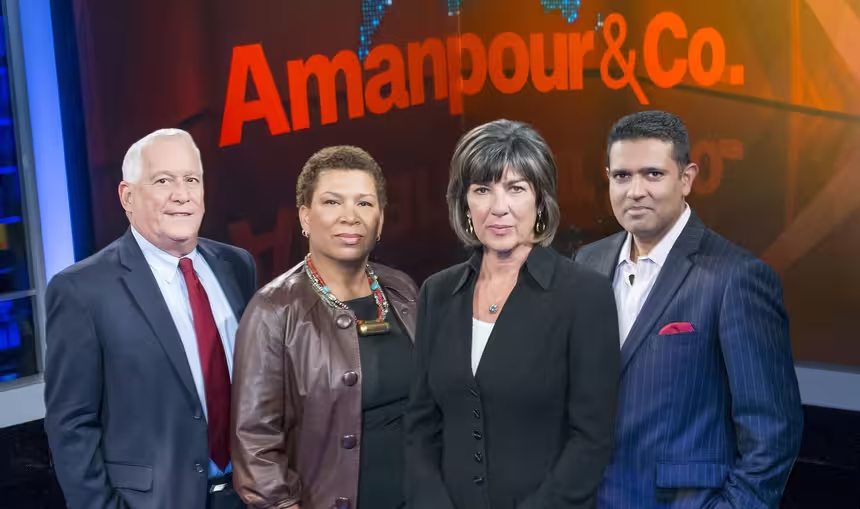
Watch Amanpour and Company on PBS
PBS and WNET, in collaboration with CNN, launched Amanpour and Company in September 2018. The series features wide-ranging, in-depth conversations with global thought leaders and cultural influencers on issues impacting the world each day, from politics, business, technology and arts, to science and sports.Providing Support for PBS.org
Learn Moreabout PBS online sponsorshipJacob Weisberg, thank you so much for talking with us.
Thank you, Michelle.
I'm glad to be here.
So your latest book, Profiles in Cowardice, deliberately turns John F. Kennedy's profiles in courage on its head.
And just to remind people who may not remember this book, Kennedy profiled eight people that he was inspired by who stood up against great odds or some risk to themselves at sort of perilous moments.
And so I was just wondering when you got the idea for this?
Well I got the idea right early in Trump's second term because I was so aware of the difference from his first term.
In the first term I felt the guard rails protecting democracy mostly held.
They were a little shaky but they held.
And the second term, it felt very much like they weren't holding and aren't holding, because institutions and civil society was caving into him against so many of its basic principles.
So I wanted to understand why it was different and to actually look at the pressures on these institutions and on the people who lead them to try to understand what had happened.
So you profile eight powerful figures in different fields, politics, business, law, media, academia, and you say that if public courage is a principal choice made under conditions of pressure, cowardice is the evasion of that choice.
Where courage is a presence, cowardice is an absence, being nowhere to be found at the critical moment.
I was trying to figure out what was the through line for all these—for these eight people—Jeff Bezos, owner of The Washington Post; Mitch McConnell, you know, former Senate leader, currently in the Senate; Chief Justice John Roberts on the Supreme Court; the president of Dartmouth; former president George W. Bush; Megyn Kelly.
And I was trying to figure out what is the through line here?
Is the through line that in the first Trump term they actually did stand up against pressure, illegal acts, violations of the public trust, and in the second term something else?
Yes, to different degrees and in different ways.
But yes, I think these are people I expected more from because at some point they did assert principle and they did in whatever way resist Donald Trump.
Bezos is sort of the perfect example.
I mean, in Trump 1, I thought he was a fantastic owner of the Washington Post.
He really, Trump tried to pressure him, bully him to get the Post to go light in its coverage, and Bezos didn't give an inch, and Bezos was punished for that.
Trump tried to take a ten billion dollar contract away from Amazon just to punish Bezos for what the Washington Post was doing.
And Bezos didn't flinch, but in Trump II, he flinched.
He started the, even before Trump was inaugurated the second time, he went down to Mar-a-Lago on bended knee, paid 40 million dollars for the Melania Trump documentary, which was a price that bears no relation to its value or for anything Amazon Prime had ever paid for rights to a documentary before.
And he'd been a terrible steward of the Washington Post and Trump, too.
So I think it creates a kind of mystery.
This is the same person.
He didn't wake up and turn evil.
What happened?
What did you come up with?
For Bezos, I think it's about space.
I think he has a childhood dream of putting people into outer space.
I think what happened in the second term is his conflict with Trump threatened to derail that.
His company, Blue Origin, was just losing out to Elon Musk's SpaceX.
It was losing out in part because Musk was in with Trump and SpaceX was getting the government contracts from the Pentagon and NASA, which is what the whole business depends upon.
And I think there's nothing more important to Bezos.
I think he sees it as his legacy.
It's what he does instead of philanthropy.
And in that context, I think he's pretty ready to sacrifice the Washington Post and a lot else.
And what about George W. Bush?
I feel that I can say with assurance, as you do in the book, that there are many people around him who are quite puzzled by his silence when, you know, President Trump has not just insulted, you know, him and his family, his father, himself, but also tried to dismantle some of the proudest achievements of his administration, things that he cared deeply about.
What's your take on that?
Yeah.
Well, this is a sin of omission, as you say.
It's that Bush can't bring himself to say Trump's name.
And for someone whose whole idea of the presidency was based on applying a kind of simple right and wrong morality, you know, call evil by its name, he just won't say it.
And this is, as you say, a president who has destroyed PEPFAR, I mean, a thing that Bush did that pretty much everyone in the world agrees was wonderful.
I mean, PEPFAR, the, you know, program that brought antiretroviral drugs to HIV-positive people around the world in Africa and elsewhere, probably saved 25 million lives.
I mean, it's an illustration of the good that good government can do.
And even when Elon Musk was effectively destroying that, Bush wouldn't speak up publicly.
I think there are various reasons for it.
I think the biggest one is that he's trying to restore his post-presidential reputation, and that involves running the library and the foundation and raising a lot of money within a Republican world in which antagonizing Trump supporters and antagonizing Trump will sort of bring this raft down on him.
You know, Trump said, I mean, there's no love lost between Bush and Trump.
Trump said when he first ran for president that Bush was responsible for September 11th.
Not that he'd handled it badly, but that the Twin Towers came down because of him.
I mean, I have to say, as someone who, you know, wasn't in any respect a Bush supporter, that's just an appalling, repulsive thing to say.
But Bush just won't, he won't get into it.
And there are people around him who have been encouraging him to do it and want him to do it.
And, you know, it's not, we don't want our ex-presidents to be political pundits.
He doesn't have to weigh in on everything in the news.
But to make a moral statement, and he could have made a moral statement at a couple of moments when I think he could have really made a difference.
- Okay, so you talk about George W. Bush's Sins of Omission.
So let's talk about Brad Karp.
You call his chapter "existentialist."
So first of all, would you just describe, for people who aren't familiar, what's the history of Paul Weiss as a law firm?
- So it's the outstanding liberal law firm that is also a hugely successful transaction firm, Wall Street firm that represents big companies doing mergers, acquisitions, private equity.
And for a long time, and this, you know, this firm goes back, you know, to the to the late 19th century, it goes back more than 150 years now.
It has always done both of those things.
And it played, it has a kind of storied role in the civil rights movement, it stood up for the rights of immigrants.
In the first term, Brad Karp, who I think was, you know, very sincere about this, provided him himself on sending 75 lawyers from Paul Weiss to the airports in New York when Trump declared the first Muslim ban, subsequently thrown out by the courts, to say, if people who have a right to enter the country are going to be denied entry, we're going to have lawyers there to help them, you know, so that the firm had this liberal identity, at the same time as it's had an identity as a top Wall Street firm.
And so Brad Karp, when Trump returns to office, it's immediately—it's almost kind of an immediate target.
And so what does he do, and what does Brad Karp do in response?
Yeah, so one of the first things Trump did after his re-election was issue an executive order targeting Paul Weiss.
His firm has more than a thousand lawyers, and this executive order said no Paul Weiss lawyer can enter a government building, and those that have security clearances were stripping those security clearances away.
Well, if you're a lawyer, you pretty much have to go into government buildings to represent your clients and do your work.
I mean, this was, Carp called it existential because what he was saying was, we can't survive as a firm if the president is declaring us essentially illegal in the way he was.
Now, that order was totally unconstitutional, and firms that challenged other orders have been completely vindicated.
They've won every ruling in federal courts.
Those rulings haven't been upheld.
But Paul Weiss, instead of filing for an injunction to say, "Mr.
President, you can't do this to us," which I think they unquestionably would have been successful with, started negotiating.
And Karp made, in just five days, he went down to Washington, he went to the White House, and he cut a kind of deal where Paul Weiss agreed to do $40 million in unspecified pro bono work for the government.
They agreed to eliminate their DEI programs, anything to do with affirmative action, and a bunch of other vague stuff that essentially, in one way or another, let Trump say they've admitted that they did terrible, terrible things.
Is it possible that some of the people you profiled here, rather than being cowards, just changed their minds?
None of them are making that case.
None of them are saying they—Jeff Bezos a little bit says he changed his mind, but even he says, you know, Trump is really different this time.
He's matured, he's more stable, he's calmer.
Even he realizes you need to come up with some kind of justification for being such a different person the second time around.
But no, I don't think they really changed their minds.
I don't think, I also don't think they woke up one day and decided, hey, it would be a really good idea to have a dictator instead of a president.
I think they have succumbed to these different kinds of pressures.
I think they've been weak, but I don't think they've made anything like a principled, intellectual, or analytical decision to support someone they used to think was terrible.
You know, it is interesting because the people who have opposed Trump have paid with their careers.
I mean, some of them have found new life and new voice in other arenas.
I'm thinking about Miles Taylor, who is a lifelong Republican, was serving in the Department of Defense, found that the president was eager to engage in conduct that he could not countenance, and has become a prominent voice sort of in opposition, has paid a price for that.
You're thinking about people like Adam Kinzinger.
You're thinking about people like Liz Cheney.
You're thinking about people who sort of had their security clearances withdrawn, people who've been sort of prosecuted.
And people look at that and they go, "It's just not worth it.
It's just not worth it."
Is that cowardice?
But think about what those people have gained.
I mean, the respect of their families, I think of history, of, you know, they can hold their heads high.
I mean, I really admire Liz Cheney exactly for that reason, that she knew what she was going to sacrifice, not just not being able to be in Congress anymore, but, you know, this kind of ostracism.
Wyoming's a pretty right-wing, Trumpy place.
And people who are her friends her whole life don't talk to her.
She's been sort of cast out.
But at the same time, I think if you take a longer view, view of history, but also maybe a future in which we have a normal Republican Party again, you know, if there's a Republican Party that eventually breaks with Trump and repudiates him, who are going to be the people who are going to be clean enough to lead that party?
Liz Cheney, I think, is top of the list.
So you say, once a few prominent actors make the seemingly rational choice of safety, everyone else can say they're merely being prudent.
That's how democracy dies, not by waving a white flag in a final battle with dictatorship, but through a thousand respectable, reasonable retreats.
Each of the eight figures I've chosen to profile embodies a different interplay of these factors and others besides.
When you finished this examination, how did you think about it?
I think there is a sad commentary here about American elites and about their sense of institutional responsibility and the narrow way in which they conceive it.
But something else I took away from the book is actually back to this idea of what is courage, what is cowardice.
I think going in, I thought of it much more as a matter of individual moral choice, and someone who is going to do the right thing or isn't going to do the right thing, and the courageous person makes the harder choice and does the right thing.
And that's absolutely still true.
I mean, you can't take the personal moral choice out of the equation.
The eight people I wrote about are people who made specific bad choices, which is what I'm interested in.
But I also think there is a social dimension to it and a context to it that drives so much of the behavior.
And if you look at what's different between Trump 1 and Trump 2, it's not just that specific people made specific bad choices.
It's that the wind was going in a different direction, and people look around at their peer groups, and they look at what other people are doing.
And I think you see this so strongly with the tech CEOs, the tech leaders, who, you know, in Trump won at a couple crucial points, including after January 6, acted as I would have wanted them to act.
You know, they kicked Trump off all the social media platforms, because they said, we can't let our platforms be used by someone who's trying to overthrow an election or destroy democracy.
Of course, they all let him back on, you know, and the mode in Trump, too, was this guy's president, we have interests, we got to deal with him.
And it's almost as if they act as one.
I think you see something similar with the law firms.
I mean, there was a split in law firms, but most of them, after Paul Weiss made a deal, were rushing to the White House to make their own deals, to offer up, essentially, contributions.
The White House amassed almost a billion dollars in these commitments from all those firms.
But that's my point, though.
If Paul Weiss had made a different choice, like just Harvard made a different choice—I mean, there are ways in which Harvard capitulated in ways that many people are not happy with, but overall, they've taken the stance that they're not going to allow the administration to run their departments.
They fought in the courts.
I mean, there are people to this day who—journalists.
I'm thinking about somebody like Charlie Sykes, who was a longtime conservative journalist, and he's really dedicated the second part of his career to, you know, calling balls and strikes as he sees them.
And he's lost friends.
I mean, there are people who won't have dinner with him now, people who avoid him at the supermarket now, but he still did it and he's still doing it.
So I guess what I'm saying is, does personal courage still matter?
Absolutely.
Look, and I think it makes the examples of the kind you're talking about of the people who have stood up at key moments, all the more precious.
It's not mainly what my book's about, but there are those people who I really admire.
And, you know, Charlie Sykes and a lot of people in journalism, you know, Jay Powell and Lisa Cook at the Fed.
You know, you can go around, you can find examples of people who still resisted.
You can't find many examples among elected Republicans in Congress.
In fact, when Thomas Massey, the Kentucky congressman who was primaried by Trump, candidate Trump was supporting, leaves at the end of this term, there will be exactly zero.
But there are people who have stood up.
And most of all, I think of the ordinary people who, you know, in Minneapolis resisted ICE as an occupying army in that city and drove them out.
And that wasn't coordinated by the top.
I mean, that wasn't, you know, that wasn't driven by the kind of institutional leaders of the country.
That was ordinary people doing the right thing.
So, you know, I don't think courage is dead, but it does respond to these incentives and to these pressures.
What's made me hopeful is that just in the way that the cowardice has been contagious, I think the courage can be contagious in the other direction.
And I think independent institutions like the universities are already showing a lot of signs of doing much better.
There was an initial wave of fear and disarray and disorganization and they didn't know how to kind of work together as well.
And that's all improved a lot.
And I think they, as one example, are less vulnerable.
I think if Trump issued executive orders now against law firms, the story would probably be pretty different.
Jacob Weisberg, thank you so much for talking with us.
Michelle, it's a pleasure.
 New Episode
- News and Public Affairs

Top journalists deliver compelling original analysis of the hour's headlines.
 New Episode
- News and Public Affairs

Today's top journalists discuss Washington's current political events and public affairs.
 New Episode
 New Episode
 New Episode
 New Episode


 New Episode
 New Episode

 New Episode
Support for PBS provided by: