
River Runs and Nightfall Trails
Season 20 Episode 8 | 27m 29sVideo has Closed Captions
Host Willem Lange shows you what happens when kids head out on a Solstice nighttime hike.
We begin with a paddleboard journey along Sandy River. Then host Willem Lange takes you to New England’s only Dark Sky Park in northern Maine. Then tag along with children and their parents on a hike into darkness with a South East Land Trust guide. Learn
Problems playing video? | Closed Captioning Feedback
Problems playing video? | Closed Captioning Feedback
Windows to the Wild is a local public television program presented by NHPBS
River Runs and Nightfall Trails
Season 20 Episode 8 | 27m 29sVideo has Closed Captions
We begin with a paddleboard journey along Sandy River. Then host Willem Lange takes you to New England’s only Dark Sky Park in northern Maine. Then tag along with children and their parents on a hike into darkness with a South East Land Trust guide. Learn
Problems playing video? | Closed Captioning Feedback
Where to Watch Windows to the Wild
Windows to the Wild is available to stream on pbs.org and the PBS app.
Providing Support for PBS.org
Learn Moreabout PBS online sponsorship♪♪ -Welcome to Windows to the Wild, I'm Willem Lange.
Today we take you into the dark.
We're going to take a hike with children and their parents in the dark, armed only with glow sticks.
Then it’s north to Maine, where you'll see what the night sky looks like at AMC’s Dark Sky Park.
First, one of our photographers, Joel Klementovich, takes us on a river run aboard a paddleboard with a group of friends.
They explore the waterway and discover important things about their connection with rivers in New England.
♪♪ ♪♪ [sticks crunch] ♪♪ [raindrops patter] -Five o’clock, first day we're, I don’t know, 5 or 6 miles down.
[raindrops patter] Sandy, just started raining about an hour ago-- [Willem narrates] -Joel Klementovich is a photographer from Conway, New Hampshire.
He loves to climb mountains and paddle rivers right in his own backyard.
[river flows gently] Here he is in Maine, on the Sandy River with a group of paddleboarders.
♪♪ [water rushing] Before we begin the trip downstream, let's, let's meet his travel companions.
[rushing water intensifies] -My name is Eli I'm from Pennsylvania.
-Amy told me about this trip, my friend Amy, and we had these dates set aside for a trip, and she was like, do you want to do this paddleboard expedition and do an entire river from the source to the sea?
And I was like, yeah!
-I’m Clark Tate I am running the river today because I've heard a lot about the Sandy and its unique characteristics, such as really cold water and really dynamic fish passage, so I wanted to come check it out!
-My name is Amy Borch, I live in South Portland, Maine, and I want to spend as much time outside as possible for as many days as possible.
-My name is Matt Palmariello, I'm from Rome, Maine, and, I'm here to paddle the Sandy because I've been driving over it for years and I've always wanted to do it and, so I'm happy to have this group together to make it happen.
-And I'm Joe and, let's see we’re-- a bunch of us are doing this with, Rivers for Change.
[river gurgles] -Rivers for Change is a nonprofit with a mission.
Connect people to rivers through adventures, conservation, and education.
[faintly] -Keep goin, there you go, nice!
We're out here today for the next few days, ♪♪ following the Sandy River down to the Kennebec, which, [water gurgles] the Sandy River has some of the best spawning habitat for Atlantic salmon, and, we're hoping to maybe come across a few salmon on our way down stream.
♪♪ [Willem narrates] -The Sandy river's headwaters are just south of Rangeley, Maine.
From there, the stream winds its way south for about 70 miles and joins the Kennebec River.
♪♪ Joe and his friends will spend the next few days on the river.
Everything they need is strapped to their paddle boards.
♪♪ -So paddling for me, [water rushes faintly] It's been a big part of my life for probably half my life now, and I, and I think, like, you know, people say, like, think of your happy place.
For me, that would be, you know, sitting somewhere near the water near a lake or a river, or ocean.
[water sloshes] -How many days have you been paddleboarding before you came here?
-Like an hour.
[water rushes] I'm starting to learn what things I can go through on the board, and that I can stand up on the board, and I don't fall off it’s pretty stable.
[water splashes] ♪♪ [Willem narrates] -Stand up paddle boards both solid and inflatable, work well on lakes, oceans or rivers.
♪♪ Inflatable boards are easy to transport, and they handle white water better than their solid counterparts.
♪♪ [water rushes] However, there are limitations.
♪♪ [water rushes] ♪♪ -So we portaged around our first class three.
It’s first thing in the morning, our first, [water rushes] first rapid this morning so we’ve done a lot of portaging this morning and now we're loading up and heading downstream.
♪♪ [Willem narrates] -The Sandy River is free of dams the last one was removed in 2007.
However, four dams remain on the Kennebec River, which blocks the migration of Atlantic salmon to this cold water tributary.
♪♪ Despite the hurdles, there has been some success in getting the fish upstream.
♪♪ -Salmon are a symbol, and they're an inspiring symbol, creatively drawing them they're beautiful fish to draw, and they also represent the health of an ecosystem.
If you have salmon in the water, you have [water gurgles] hopefully a healthy ecosystem.
But it gets complicated because are these salmon going from source to sea or are they being carted up?
But-- -Yeah.
[birds sing faintly] -And in this case if we see salmon up here, they would have been moved by truck around dams to get in here.
♪♪ -This would be the end of the highest point the salmon could ever get to on the Sandy River.
[water churns] -I would love to see you know, them come back.
♪♪ As a, you know as a person that gets out in nature and enjoys getting outside, natural environments-- [indiscernable] and, I've never physically seen a dam come down, but I think it would be an incredible thing if these rivers could start flowing free again.
[muffled] -Woo woo!
♪♪ -Oh, I think we made really good time on the river today.
♪♪ ♪♪ [fire crackles] ♪♪ [firewood rustling] [indistinct chatter] [laughter] -It was good until you put that camera in my face.
[chuckling] ♪♪ [fire crackles] ♪♪ [water churns] [Willem narrates] -After three nights and four days on the river.
♪♪ ♪♪ [indistinct chatter] Joel and his companions pack up their boards.
♪♪ [raindrops patter] ♪♪ -Final thoughts?
[water ripples faintly] -Great few days on the river.
[water ripples faintly] -Come back to the Sandy?
-I would definitely come back to the Sandy.
I plan to.
-They'll leave the river without spotting any Atlantic salmon, but they'll take many experiences home with them.
-Made it, what an awesome adventure!
♪♪ -I really love being outside because it allows me to be really in tune with my environment.
[water rushes] I value being outside because it creates a shift in the way that I see the world.
[water churns] On this trip, I've really been enjoying tuning in to the sounds that are out here, so the sound of the river, the sound of the birds in the trees, rain on the tent at night.
[water ripples] [birds singing] Sometimes it keeps you up But also-- -I love it.
-can help you go to sleep if you just shift your perspective, and these ways that I connect with the outdoors, I can bring those things back home with me.
♪♪ When I get to come out here and learn from the place that I'm in, I can take that back home with me and even if it's just go outside for ten minutes and lay down on the ground and close my eyes and explore the neighborhood through sound, that's a really lovely way to reset, ♪♪ and connect with the place that I live in, in a new way it's different every time.
♪♪ [birds singing] -The winter solstice is the shortest day of the year in the Northern Hemisphere.
In Epping, New Hampshire, it's a time of celebration.
That's when the folks at the Southeast Land Trust get families together and head outdoors in the dark.
♪♪ We're under the first snowfall of the season.
♪♪ Volunteers gather at the Southeast Land Trust property in Epping, New Hampshire.
-Hello everybody, thank you for coming!
-They prepare for an unusual event.
-Why are we here tonight?
What's going on tonight?
-Families arrive for what's become a popular two-hour hike.
They'll cross fields, walk along ponds, and then disappear into the darkness.
-Winter solstice!
-Winter solstice, that's right!
-Hi, I'm Lizzie Franceschini.
I'm SELT’s education program manager, and we are here for our 5th Annual Glowstick Solstice Hike tonight.
-Lizzie is a school teacher.
The passion she has for teaching goes beyond the classroom.
She's also an educational guide for the Southeast Land Trust, known as SELT, S-E-L-T.
-Today is technically the day before the winter solstice, but close enough.
We're celebrating the winter solstice today which is the longest night.
So we get to spend some time outside in the darkness celebrating that darkness rather than hiding away from it.
♪♪ [Willem narrates] -Darkness begins to sweep away any remaining daylight from the sky.
Glow sticks and a few headlamps will be the only source of light guiding these young explorers along trails.
♪♪ -So our hike today is a chance to experience something different, use some different senses, have that adventure feeling and just like push a little bit beyond the comfort zone, which is so important for kids’ development.
Who’s been to a glowstick hike here with us before?
-This is my fourth year doing the glow stick hike here at Burley Farm and it's lots of fun, we like to come, my daughter is eight years old and it’s a good way to kind of, slow down at this busy time of year and connect with nature.
♪♪ [Willem narrates] -SELT owns properties throughout Rockingham and Strafford counties.
-Total we have conserved 28,000 acres in the state of New Hampshire-- Southeast New Hampshire.
[Willem narrates] -Land protection, stewardship and encouraging everyone to get outdoors, are key to the SELT mission.
-My name is Justine Morse and I became involved with SELT probably a couple years ago.
♪♪ -Volunteers help make it happen.
♪♪ -I have two little grandchildren that just turned two and four this past week, and they've been part of little SELT-ies program with Miss Lizzie, and they absolutely love it, they still come and look forward to it every single season.
And then I decided to join the volunteers, probably a couple years ago.
♪♪ -So today on our hike, we are gonna stop at different times along the way and do activities like we always do.
If you want to go ahead of me, that's fine.
Make sure you can see me, I can see you and when I blow my whistle, you stop and come back to where I am.
[Willem narrates] -Lizzie’s children are along to help lead the troops.
♪♪ -This is one of them, Hadley you wanna say hi to the camera?
♪♪ They just love being outside they've been outside their whole childhood.
They you know, they're, pandemic babies so outside was the way to be to stay out and socialize with everyone so they're very used to being outside.
They love it.
Are we ready to hike?
-Yes!
-Are we ready to hike?
[children yell] -Yes!
-Okay, let's do it!
-With that enthusiastic confirmation, the hikers are off.
♪♪ -We are gonna play a little game with a parachute and some glow balls.
♪♪ [Willem narrates] -There’ll be stops along the way [whistle blows twice] -Okay, let's see those listening ears on I'm gonna explain the game we're about to play.
It's called Glow Ball Pop It.
-It's Lizzie's chance to show the kids that learning can be active and fun.
♪♪ -Yeah there you go we need some more field players.
♪♪ Yeah along the way we're going to stop for, several different activities that involve light and darkness, and it really helps keep the kids going on a hike to have different stopping points, so we can recollect as a group and have some fun along the way.
And then we'll end with a fire and toasting marshmallows.
[children laugh] We have a good, strategy here with nobody on that side, it just keeps falling right off.
[tarp flaps] [chuckling] ♪♪ -This property which SELT now owns, was conserved in partnership with the Burley family of Epping.
The family's roots run deep here, more than 200 years, living and farming in the community.
♪♪ -This was an ice pond back in the day when this was actually a Burley farms, and they would use this to harvest their ice and then pull it back up and keep their produce cold.
It's a little piece of history right here.
If you do not have a flashlight, you have 10s to start running up the hill.
Go!
One, two-- -Young hikers are released into the darkness.
Glow sticks become beacons for anxious parents.
The point is for everyone to feel comfortable in an environment that for some, might feel uncomfortable -That is the main goal for me.
I'm a science teacher by trade, so I could come out here and talk about the science of the Earth's tilts and why we have the solstice versus an equinox, but they’d get bored pretty quickly.
So the idea is to get them out and having fun and comfortable.
It's those repeated experiences having fun with their friends outdoors that's gonna make them fall in love with the outdoors so that they become the conservationists we need when all of us are gone and we have all this SELT land to take care of.
♪♪ -This is my third solstice hike.
♪♪ Yeah we come out every year and it is my favorite day of the year.
I absolutely love it.
-I love that it, it brings people together and I think that the most important thing is community.
And the fact that we can come and do hard things together just makes it that much sweeter.
[woman cheers] -The more we get the parents out, the more comfortable they are with it.
So you’ve seen when we at the beginning, when we raised hands about who’s come back year after year, a lot of these people have been coming back year after year after year, and I see them out doing things on their own too.
Our next stop is going to be into the woods.
-Yay!
-Who's ready to go into the forest?
-When you give kids more space, it makes them brave.
it makes them brave.
-Mom, let’s go!
-It makes them brave and when you let kids find that inner strength, then it creates something beautiful and they know that they can be strong in all pieces of their life.
♪♪ [Willem narrates] -The evening hike winds down with the last stretch of darkness.
Glow sticks give way to a campfire.
♪♪ -I love it, it's making good memories and, I think it teaches the kids that they can still enjoy the outdoors, even in what other people consider to be bad weather, you can still find your fun and, and get outside and enjoy nature in all, all weathers.
[indistinct chatter] -It's just nice because it's not something I’d probably do on my own every day on a snowy December day.
But when there's a lot of other kids and families, it's nice to bring them together for an event like this.
-Um, it was great, and I got my marshmallow on top completely golden!
-You know I like being outside with friends whether it's daylight or not you know?
And this is so cute to see all the kids out with their, their glow sticks and having fun with each other and enjoying the nature.
-Personally, I really like it.
[indistinct shouting] As long as you have like a small light I think it's fine.
-In today's world of, you know, all the technology and everything, they're outside and they're doing stuff and they're embracing, you know what New Hampshire has to offer.
♪♪ -It is exciting.
I love seeing everybody out here.
It's good vibes, great energy.
It's also a relief every time I run a program and everybody returns uninjured and happy.
So it's been a long day.
We started this morning at an elementary school writing program, and then came back to the office and got ready for this.
So it's, rewarding work, but it's also challenging work.
So it's a mix of relief and happiness.
♪♪ -As development continues to sprawl across the land, light pollution has taken away the joy of the night sky for a lot of people.
We take you to a place in Maine where AMC offers the only international dark sky park in New England.
♪♪ [Willem narrates] This is a small patch of Maine's 100 mile wilderness.
There's a lot of wildlife here and very little light pollution.
♪♪ That’s why these folks have traveled here.
♪♪ -So we are in, the Appalachian Mountain Club's, 100 mile wilderness.
They own 120,000 acres of land here and there are three lodges on the property.
♪♪ My name is John Meader, I am the owner and director of Northern Stars Planetarium.
It's a portable planetarium, I travel to elementary and middle schools across the state of Maine, serving about 15 to 18,000 kids a year teaching astronomy.
♪♪ -My name is Sean Laatsch, I'm the director of the Versant Power Astronomy Center and Jordan Planetarium at the University of Maine.
We're a planetarium and a small observatory.
We serve K-12 schools the university and the general public.
♪♪ -John and Sean are at Little Lyford Lodge.
They're here to help out the Appalachian Mountain Club’s See the Dark Festival.
-We're about 150 miles north of Portland, Maine.
And if you go from Portland south down the east coast, of the United States, if you were in space looking down at nighttime, it's all lit up because you got, you know, every, every 80 to 100 miles you got a pretty major city, and so there's lots of light pollution.
When you come up north of Portland, it starts dropping off pretty quickly.
You get north of Bangor and, and it just gets dark.
And this really is the darkest spot east of the Mississippi River.
♪♪ -So when you go out, it's very hard to find these conditions on the East Coast, east of the Mississippi due to development and, urbanization so here in north western Maine, that is the spot where you can still go out and see the dark skies and see the Milky Way, and, and be able to experience what it would look like without, some of the light pollution you might find in your more suburban or urban areas.
♪♪ -See the two stars that are really close together?
They go around each other.
The Appalachian Mountain Club hosts a series of events where the dark sky shines.
-The dark sky movement has been about preserving these dark areas that are left, and we knew we have quality dark skies above our property and we want to take the extra step to, you know, promote both, promote it, for educational purposes and then also and for people to come visit it and come see it and we also wanted to take the opportunity to protect it.
-It's another thing that we can celebrate and we can invite people here to see, and I think the really neat thing about, you know, a dark sky is that, you know, and so many of our conservation projects that we work on, it's like an effort you're trying to get somewhere or restore a piece of land or, ♪♪ get it back to the way it was, maybe?
And with the dark sky, it's just you shut off the lights and you have the thing that you're conserving.
It's right there.
So inviting people to come here to this place, and enjoy is such a simple thing I think can be really restorative for people.
-So we're starting to get glimpses of the Milky Way.
It's still kind of faint, but, but you can see a lightness through here.
It looks like a thin cloud, that's the Milky Way.
♪♪ -The dark skies are important for viewing the sky if you're an astronomy geek like myself or Sean, who wants to see the Milky Way.
80% of the people in United States have never seen the Milky Way overhead because of light pollution.
So there's that aspect.
It's also good for our own personal health.
-This is a giant cloud of hydrogen gas, ♪♪ which is what stars are made of.
I really enjoy sharing the night sky with people.
I think that's one of one of my passions and telling some of the the different stories and the way different cultures looked at the sky.
All people have used the sky for navigation, timekeeping, knowing when to plant and harvest their crops.
So I think it's something that sort of is universal among all humans and, we all sort of look to it as a sort of I think as something larger than ourselves, and there's a, it's a very peaceful thing to look at the night sky.
♪♪ How many of you were here last night?
Raise your hands, oh I can’t see you nevermind.
[Willem narrates] -John and Sean work as a tag team to help people who visit for the weekend learn about and enjoy the night sky.
-I love cultural astronomy and have some of that, but John is definitely, you know, a really advanced storyteller and has all these really incredible stories, and different from many different stories than I have.
-The brighter one on the left is kind of orange, and the slightly fainter one, just to the right of it is blue, and together they're known as Albireo.
-So we always have a good time and we do sort of play off of each other.
You want it to be fun and enjoyable and, and not something that's, you know, just about the science or just about the dark it's really about having fun and, and hopefully it makes it a special experience that they'll remember and take home with them.
-You got it!
Smaller than Earth and Venus, but bigger than Mercury.
And it's red.
You know why it's red?
-Well, we were looking for a place to go stargazing and, actually, I chose this weekend because I knew it would be a new moon.
And then there only after that, I realized that there was actually a festival at the AMC, so it was perfect.
-He’s flying across the sky like you see a goose or something flying, this is a swan flying.
-Yesterday when we were looking at the telescopes, yeah, they showed me a lot more constellations that I thought were there, and it looked really cool because I had never really looked at the night sky and seen so many things there.
♪♪ -Getting people to go out and see and be in awe and have that experience is so, ♪♪ important and so kind of just human to be able to go out and and see what nature should look like without kind of human interference.
-That's part of what we really want to try and do too, is give that human perspective that this is fun, you know?
And looking at the night sky, yes, it's it's, you know, we're all part of the universe and it's a bigger part of us, but it's also a lot of fun.
-When you look up at Orion in the winter sky, there are a lot more stories about winter stars for some reason.
Just to the right of Orion is a group of stars called the Seven Sisters.
And in today's world, where there’s a lot of contention, I think the Sky is a very calming and peaceful thing and you're not necessarily thinking about some of those contentious issues, it's more about, you know, getting back to peace, sort of using your imagination a little bit and thinking about those things that yeah, that are bigger than than yourself in some cases.
-Can you see the two stars?
♪♪ -Well we’ve come to that place in the show that I’ll-- I've always liked least, when we have to say goodbye, so I shall.
Bye bye.
I'm Willem Lange, and I hope to see you again, on Windows to the Wild.
♪♪ Support for the production of Windows to the Wild is provided by the Alice J. Reen Charitable Trust, the John D. McGonagle Foundation, the Bailey Charitable Foundation, Road Scholar, and viewers like you.
Thank you!
-Make a gift to the wild and support the Willem Lange Endowment Fund, established by a friend of New Hampshire PBS, to learn how you can keep Environmental nature and outdoor programing possible for years to come, call our Development Team at (603) 868-4467.
Thank you!
♪♪ ♪♪ [chime]
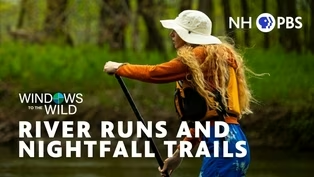
River Runs and Nightfall Trails (Preview)
Preview: S20 Ep8 | 30s | Host Willem Lange shows you what happens when kids head out on a Solstice nighttime hike. (30s)
Providing Support for PBS.org
Learn Moreabout PBS online sponsorship New Episode
 New Episode
- Drama

Lesley Manville and Tim McMullan return in the final installment of the Susan Ryeland mysteries.
 New Episode

 New Episode
 New Episode



Support for PBS provided by:
Windows to the Wild is a local public television program presented by NHPBS