
September 7, 2026 - PBS News Hour full episode
9/7/2026 | 56m 46sVideo has Closed Captions
September 7, 2026 - PBS News Hour full episode
September 7, 2026 - PBS News Hour full episode
Problems playing video? | Closed Captioning Feedback
Problems playing video? | Closed Captioning Feedback
Major corporate funding for the PBS News Hour is provided by BDO, BNSF, Consumer Cellular, American Cruise Lines, and Raymond James. Funding for the PBS NewsHour Weekend is provided by...
September 7, 2026 - PBS News Hour full episode
9/7/2026 | 56m 46sVideo has Closed Captions
September 7, 2026 - PBS News Hour full episode
Problems playing video? | Closed Captioning Feedback
Where to Watch PBS News Hour
PBS News Hour is available to stream on pbs.org and the PBS app.
Providing Support for PBS.org
Learn Moreabout PBS online sponsorshipGEOFF BENNETT: Good evening.
I'm Geoff Bennett.
AMNA NAWAZ: And I'm Amna Nawaz.
On the "NewsHour" tonight: An Amazon cargo jet barrels off the runway at Miami International Airport, killing at least five people.
GEOFF BENNETT: A landslide victory by the German far right sends political shockwaves across Europe.
AMNA NAWAZ: And our exclusive interview with California Governor Gavin Newsom as he rallies voters in the South and weighs his own presidential run.
GOV.
GAVIN NEWSOM (D-CA): I think Democrats need to grow a backbone and we need to stop being self-righteous in terms of just trying to intellectually win arguments because of the ruthlessness on the other side.
(BREAK) AMNA NAWAZ: Welcome to the "News Hour."
Federal officials are investigating why and how an Amazon cargo jet overran a runway at Miami International Airport on Sunday, before striking two vehicles, killing five people and injuring five more.
GEOFF BENNETT: The flight was coming from Puerto Rico, and the landing is going to be a focus of that investigation.
Video posted on social media shows the Boeing 767 jet still airborne far down the runway and that the left rear landing gear did not fully settle on the ground.
Seconds later, the plane barrels across a grassy patch, crashes through a chain-link fence and slams into two vehicles.
The victims have not yet been identified.
Authorities say all were inside a van and an SUV struck by the plane.
National Transportation Safety Board Chair Jennifer Homendy described what investigators encountered at the scene today.
JENNIFER HOMENDY, Chair, National Transportation Safety Board: I would describe it in one word of devastating, utter devastation.
I mean, you can see in the -- on the paved surface tire marks that continues through the grass.
There's debris everywhere.
GEOFF BENNETT: There are many questions being asked about this accident and the landing.
Our aviation correspondent, Miles O'Brien, is here with more.
So, Miles, You've looked closely at the video of this landing.
What stands out to you?
MILES O'BRIEN: Geoff, what I see is a non-stabilized approach in non-stable meteorological conditions.
The wind was gusty.
There was a tailwind, which had a crosswind component.
The aircraft as it came down ended up significantly above what we call the glide slope, which is the imaginary slide which takes you down to the runway.
The crew tried to correct it and dove precipitously toward that altitude they should have been at, picking up speed.
So, by the time we see them in this video, it appears this aircraft is sort of diving for the runway with a tailwind, which makes it faster over the ground and, in addition to that, a crosswind, which is what caused that left wing to go up.
And this is the key point to think about here, Geoff.
They landed at about 185 miles an hour in speed, which is much higher than you would expect, about halfway down a 9,000-foot runway.
And then you see that left wing lift up, and the left landing gear is not on the concrete.
That's crucial, because that's what tells the airplane that it can deploy reverse thrust and the spoilers, the speed breaks on the wing.
Without those wheels on the ground, the crew would not have been able to do that.
And so they left the runway at a very high rate of speed, about 130 miles an hour into the grass.
And that's what we saw.
GEOFF BENNETT: So, Miles, at what point should a crew abandon a landing like that?
MILES O'BRIEN: Well, the textbook says, if you have an unstabilized approach -- and they were about three miles out when they were they were way above that so-called glide slope -- that probably would have been a prudent time to knock it off, as opposed to trying to dive down to catch it and get toward it.
But, certainly, if they just elected to continue and try to correct, which happens, by the time you are floating over the runway and about halfway down it, that would be the time to initiate what we call the go-around.
GEOFF BENNETT: And the plane, as we saw on that video, it goes beyond the runway and through the safety area at the end.
What is that area designed to do?
MILES O'BRIEN: Well, there's about 1,000 feet between the end of that runway to the road.
That is what the FAA requires for a runway that it arrives and departs with large aircraft.
So that is to the book.
However, there are other ways that you can slow down an aircraft in these situations.
GEOFF BENNETT: And that brings us to something called EMAS.
What is that and could it have stopped this plane?
MILES O'BRIEN: engineered material arresting system.
It's basically breakable concrete.
When the wheels of an aircraft get in it, it's like quicksand.
It will slow an aircraft down very quickly.
It's designed to accept and slow down an aircraft coming in at, say, about 80 miles an hour.
This aircraft, as we say, was arriving at the end of the runway at about 130 miles an hour.
So it's unclear what the EMAS might have done in this case, but certainly it would have slowed it down further.
That said, the FAA does not require this sort of engineered material at the end of a runway if there's 1,000 feet of runway safety area, which Miami has in this case.
GEOFF BENNETT: And that's why, one would imagine, Miami did not have this EMAS system.
MILES O'BRIEN: Exactly.
Now, there'll be some questions raised about this.
Should EMAS just be everywhere, just as another layer of safety?
And there'll be some questions, of course, about what the crew was doing.
And, of course, when that cockpit voice recorder is analyzed, as well as the flight data recorder, many of those questions will become much clearer, and a lot of the speeds and footages and distances will become more precise, and we can understand what happened here?
GEOFF BENNETT: Our aviation correspondent, Miles O'Brien.
Miles, thanks as always.
MILES O'BRIEN: You're welcome, Geoff.
AMNA NAWAZ: Germany's far right AfD, or Alternative for Germany party, yesterday won a major parliamentary election victory in the Eastern state of Saxony-Anhalt.
The blow -- the win, rather, is a blow to chancellor Friedrich Merz, mired with record low approval ratings.
And it marks a growing divide in German politics.
The AfD party is anti-immigration.
It's been labeled as xenophobic and as extremist by German intelligence.
Liz Landers reports.
LIZ LANDERS: In Germany, a dawn of a more divisive era of domestic politics.
Germany's far right Alternative for Germany Party, or AfD, won 44 percent of seats yesterday, just three seats short of a majority in the Eastern state of Saxony-Anhalt.
The party has vowed to crack down on immigration and broaden its power to the national level.
ALICE WEIDEL, Leader, AfD Party (through translator): And if we assume responsibility for government in Germany at the national level, we will close the borders, and only those who have a legal right to reside in Germany will be allowed to come here.
We will deport those who commit crimes here and those who are residing in this country illegally.
LIZ LANDERS: And if it is able to successfully form a parliamentary coalition with other parties in order to govern, it would have extensive control over the state's domestic immigration, education, and other policies.
AfD's anti-immigration stance has bled into its leaders' statements, which have been accused of being Islamophobic, antisemitic, and antidemocratic.
Last year, the German intelligence agency labeled AfD extremist.
AfD's win in the state is a turn in the state's politics.
Saxony-Anhalt, once part of East Germany prior to reunification, voted for the ruling Christian Democratic Union, or CDU, in its last parliamentary election.
Yesterday's win also a reflection of Chancellor Friedrich Merz's plunging approval ratings, with an 87 percent disapproval rating in Saxony-Anhalt and just 16 percent approval nationwide as of July.
He faces stiff competition.
Today, he acknowledged his party's loss.
FRIEDRICH MERZ, German Chancellor (through translator): We are all deeply shocked.
We did not expect this to happen in this way.
Yesterday marked a turning point, not only in Saxony-Anhalt, but throughout Germany.
I must admit, this is the most serious election defeat that the CDU has had for years, for decades.
LIZ LANDERS: Germany's political system is positioned that each state is largely autonomous, much more reliant on the state's Parliament than the federal level in Berlin.
The far right party's win also renewed concerns internationally.
Spanish Prime Minister Pedro Sanchez today decried the win as an indicator of Europe's destabilization.
PEDRO SANCHEZ, Spanish Prime Minister (through translator): What we saw yesterday in Saxony is a warning and also a confirmation, a warning that the far right threat, thanks in large part to the surrender of the traditional right, is gaining ground in Europe and in the world.
LIZ LANDERS: Meanwhile, in the United States, President Donald Trump shared the news of the AfD's victory in a social media post.
Last year, Vice President J.D.
Vance shocked many when he appeared alongside AfD's leadership and chastised the German government's decades-old position of refusing to work with parties labeled extremist.
For perspective on the outcome of the election in Germany, we turn to Liana Fix, senior fellow at the Council on Foreign Relations and author of "Germany Rearmed: The Return of War and the End of Illusions."
Liana, thank you for joining the "News Hour."
LIANA FIX, Council on Foreign Relations: Absolutely.
Thank you for the invitation.
LIZ LANDERS: How do you explain why the AfD did so well in the election?
LIANA FIX: So one popular explanation is that in East Germany and East Germans, in particular since unification, have felt economically deprived, that they are not on the same living standards as their West German compatriots.
But that explanation really only goes so far.
It is primarily about the self-perception, about the feeling of being left behind, because East Germany really has caught up in the economic situation.
And at the same time, it is mixed with a profound sense that immigration policies have gone too far in Germany, and a general shock about all the change that is happening in Germany these days, both the Russia shock, also the A.I.
shock, the China shock to Germany's industry.
It's a challenging time to be a chancellor of Germany.
LIZ LANDERS: What are some of the policies that AfD advocates for?
LIANA FIX: So, the federal level, the AfD in general is very anti-immigration.
They want to deport both refugees, but also asylum seekers from other parts of Europe and the world.
They are very much in favor of a very strict rule of law, but they also, especially in education, for example, in Saxony-Anhalt, the AfD has proposed to focus more on the centuries before the Nazi era, and not to place too much emphasis on the Nazi era.
They also have some ideas about kicking out public broadcasters from Saxony-Anhalt.
Overall, it is a very disruptive agenda.
And, at foreign policy, they do want closer ties with Russia and China.
LIZ LANDERS: This news, of course, over the weekend, I think has shocked some people around the world.
But how likely is it that the AfD will actually come to power?
LIANA FIX: So this is Saxony-Anhalt.
It is a small East German state, but it is relevant because, for the first time, the firewall the German parties have built against the AfD, no one should work or enter into a coalition with the AfD, is really crumbling, because in this case you would need all the other five parties, from conservatives to very left-wing parties, to build a coalition only to prevent the AfD getting into power.
So that's why this election is so powerful.
It's such a danger to Chancellor Friedrich Merz, because it is about the future direction of the Conservative Party in Europe and partly also about his own future.
On the federal level, this -- the AfD is polling as the strongest party ahead of Friedrich Merz's Conservative Party, and quite comfortably ahead.
But it's very unlikely that this would translate in the next election into a government responsibility for the AfD.
However, 10 years down the road, that picture might look different.
LIZ LANDERS: Speaking of 10 years down the road, is this election seen as a bellwether and signal for how future elections are likely to go in Germany?
LIANA FIX: It absolutely is.
And the next elections are already coming up at the end of September in two weeks' time.
There will be two more elections in the state of Berlin, but also in another East German region.
They are not as dramatic as in Saxony-Anhalt.
So the AfD is not as far ahead as it has been in this election.
But, still, further setbacks for Friedrich Merz, for Chancellor Friedrich Merz, in these elections might actually raise the leadership question in Germany, and that at a time when Russian hybrid warfare campaigns are escalating against Germany.
So it is really very much a twin threat that Chancellor Merz is facing here.
LIZ LANDERS: The AfD is pro-Russian.
Will this election result have an impact on Germany's support for Ukraine and its efforts to shield itself from these Russian hybrid attacks?
LIANA FIX: No, they will not directly, because foreign policy, security policy are obviously a federal issue that cannot be disrupted by Saxony-Anhalt.
But there are some concerns, for example, that, if the AfD gets into power, Saxony-Anhalt should not be included in sensitive intelligence sharing anymore because of the concern that intelligence might be leaked to extremists or to Russia.
There are also concerns that, what if the AfD gets in power on Saxony-Anhalt and tries to prevent any mobilization efforts of the German army, of the Bundeswehr in that country?
So these are actual considerations.
And then, of course, Germany's European neighbors, from Poland to France, are very concerned.
They welcome Germany's rearmament, Germany's historic rearmament, that it is going through now.
But, as I argue in my book, of course, they don't want to see that military power in the hands of the AfD.
Even if that is only a possibility like 10 years or 15 years down the line, it is still a very scary thought for Germany's neighbors.
LIZ LANDERS: Liana Fix, thank you for your expertise.
LIANA FIX: Thank you.
AMNA NAWAZ: In the day's other headlines: Hurricane Lowell is set to pass just west of Hawaii tonight with winds up to 110 miles an hour.
The Category 2 storm is taking an unusual path, heading north towards Kauai and Ni'ihau before banking west.
The governor has declared a state of emergency for all of Hawaii, with areas as far east as the Big Island facing up to a foot of rain.
Satellite imagery shows a very active Pacific Ocean today.
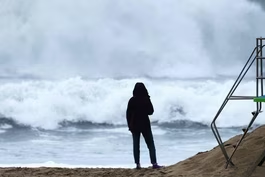
Closer to California's coast, Tropical Storm Marie is whipping up high surf with swells up to 10 feet.
The National Weather Service warned beachgoers about potentially life-threatening waves.
In his latest proposal to rename geographic locations, President Trump posted multiple times online about changing New Mexico to New America.
On social media today, the president published at least seven versions of maps with that name change.
That followed several posts yesterday, including this A.I.
video of him replacing the word Mexico with America on a road sign.
The president has no legal authority to rename any state, and in the case of New Mexico, it's written into their Constitution.
New Mexico's Democratic governor responded by saying the name -- quote -- "isn't up for debate."
The Kremlin said today it's not ruling out future talks between Ukraine, Russia and the United States.
But spokesman Dmitry Peskov said it was too early to say when or where they could take place.
That followed a weekend visit to Moscow by U.S.
negotiators Steve Witkoff and Jared Kushner to meet with Russian President Vladimir Putin.
The pair then traveled to Ukraine for the first time to meet with President Volodymyr Zelenskyy.
No major breakthroughs were announced.
Meantime, in Western Russia, local authorities say a Ukrainian drone slammed into this residential building, killing one person and leaving four others injured.
Nepal held an official day of mourning today to remember those killed in catastrophic floods nearly two weeks ago.
People gathered to sing prayers and hold symbolic funerals, with some burning effigies in place of bodies yet to be found.
Authorities say more than 1,300 people are confirmed dead, and roughly 5,000 remain missing in Nepal and Tibet.
And, meantime, rescue operations continue, with crews using heavy machinery to clear the rubble.
One worker reflected on the scale of loss.
ZHOU ZHIDONG, Rescue Worker (through translator): My heart is very heavy because so many people have died, each one of them a living, breathing soul.
But, sometimes, in the face of nature, we are powerless.
AMNA NAWAZ: Chinese authorities say at least 43 people died and more than 500 remain missing.
But some rights groups say the death toll could be much higher.
Britain's King Charles reconfirmed the status of Prince Harry and his wife, Meghan, today as non-working royals following their return to the U.K.
A letter reportedly sent to government officials on the king's behalf states that their position is -- quote -- "akin to private citizens" when it comes to their work and security arrangements.
The king wanted to -- quote -- "help avoid doubt or confusion" by restating their status.
Harry and Meghan returned to the U.K.
late last month after leaving their royal duties and moving to the U.S.
six years ago.
Financial markets were closed for the Labor Day holiday, but the recent run-up in energy prices meant travelers were paying record gas prices.
AAA says the average price of regular gas is around $4.15.
That's nearly a dollar higher than last year and well above the prior Labor Day record set in 2012.
Still to come on the "News Hour": we sit down with California Governor and likely presidential contender Gavin Newsom; Tamara Keith and Amy Walter break down the latest political headlines; and a look inside Southern Lebanon as Israel ramps up attacks.
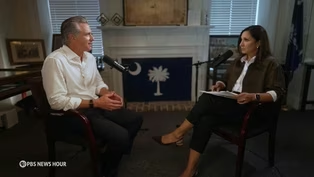
Over his eight years as California governor, Gavin Newsom has become one of the Democratic Party's most vocal critics of President Trump.
As speculation swirls around Newsom's own potential presidential bid, he's been hitting the road and raising money to get more Democrats elected at the state level, where he says his party took their eye off the ball.
Producer Matthew Loffman and I met up with Newsom in North and South Carolina for this report and an exclusive one-on-one interview.
GOV.
GAVIN NEWSOM (D-CA): We're up against an invasive species in the name of Donald Trump.
(APPLAUSE) AMNA NAWAZ: The California governor taking his fiery brand on the road and deep into Republican counties in Alabama and the Carolinas.
GOV.
GAVIN NEWSOM: This 2026, it's all on the line.
We have drawn the line... AMNA NAWAZ: ... states where Republican efforts to redraw congressional maps are helping to motivate Democrats ahead of November's midterm elections, like Ann Elliott.
Do you think it's different this year?
ANN ELLIOTT, South Carolina Democratic voter: I feel a change in the air a little bit.
AMNA NAWAZ: Why?
What do you feel?
ANN ELLIOTT: Well, I think people are miffed and people are beginning to pay more attention.
AMNA NAWAZ: That attention has also turned to 2028 and speculation about whether Governor Newsom hopes to be President Newsom.
GOV.
GAVIN NEWSOM: It's the election that defines all the elections we have had.
AMNA NAWAZ: That's brought the eyes of traditional media, content creators, and, most importantly, voters.
WOMAN: Thank you for being here.
GOV.
GAVIN NEWSOM: My honor.
Thank you.
AMNA NAWAZ: South Carolina for the first time will be first on the Democrats' nominating calendar as they work to pick their party's nominee.
GOV.
GAVIN NEWSOM: Thank you, all of you for what you will do.
AMNA NAWAZ: Voters like Christian Mergner came to hear the governor's message and kick the tires on a potential candidate.
CHRISTIAN MERGNER, South Carolina Democratic Voter: I think he's got a strong understanding and a strong background.
He seems very genuine and sincere.
He's got a laugh.
Humor and empathy go hand in hand, just like communication and trust do.
And he's got that.
AMNA NAWAZ: Yokima Cureton, volunteering for the state Democratic Party for the first time, is already all in for a potential Newsom campaign.
Is this someone you think might run for president or should run for president?
And would you support him?
YOKIMA CURETON, South Carolina Democratic Voter: Absolutely.
I think he should, and I absolutely would support him.
I like that he continues to push the envelope on what's going on in the rural communities.
And I feel like that grassroots effort is really what's going to push us over the top.
(CHEERING) AMNA NAWAZ: But, for now, Newsom says he's focused on showing up to boost turnout for 2026.
GOV.
GAVIN NEWSOM: Remind people what's wrong.
AMNA NAWAZ: This year, he hopes Trump turns up too.
GOV.
GAVIN NEWSOM: His record's hard to defend right now, particularly in states like North Carolina and South Carolina.
So I'd be encouraged if he shows up.
The one thing that we should be sober about is the amount of money he can bring to these races.
And so I think the Democratic Party would be wise to be cautious about overreading the polls at this moment, because those resources could start to shift.
AMNA NAWAZ: You think those races, to tighten... GOV.
GAVIN NEWSOM: I think they legitimately could.
AMNA NAWAZ: Even beyond November, Newsom says Democrats need to build back at the state level, not just in strongholds, but in places like Lancaster County, South Carolina... WOMAN: Thank you so much for coming.
AMNA NAWAZ: ... where, back in 2024, Donald Trump won by 24 points.
That is where we sat down for a longer conversation on his party, his ambitions, and why he says Democrats need to do things differently.
I began by asking him why he's focused on red and rural counties.
GOV.
GAVIN NEWSOM: Well, I get a lot of Democrats say, well, don't waste your resources.
And I think what they really mean is money.
But I -- and I could see that argument.
I can intellectually.
If you have a limited amount of money and it's a scarcity issue, where do you invest those dollars?
But time is free.
Showing up, just having the decency to say you're worth the drive, that's -- there's no excuse not to do that.
And our party hasn't done that for 20-plus years.
I said - - I was in Alabama my first stop.
I remember talking about this in a March 2010 op-ed in The Wall Street Journal that Karl Rove wrote saying our strategy is to spend $30 million on this red map initiative to win back state House and Senate seats, so that we can use those seats to then redistrict to determine the future of Congress.
And he won 675 seats; 2010 was the last time we had a majority in these Southern states.
We had a majority then, but we turned our back after that.
They won almost 1,000 of these state seats, and the Democratic Party was focused on the guy or gal to come save the day.
We were watching cable news.
And we were waiting for the presidential cycle.
We weren't doing the hard work of courthouses and school boards and city council and state races.
And so that's why I'm here focusing on those races and trying to focus the energy of the Democratic Party on a long-term strategy that we have abandoned.
You mentioned redistricting, and we all know you were able to push through new maps in California, other Democratic efforts in Virginia and Maryland and New York weren't as successful, but even your effort expires, right, in 2030.
GOV.
GAVIN NEWSOM: Yes.
AMNA NAWAZ: And I have also heard you say again and again that Democrats keep trying to win arguments, while the other side is consolidating power.
GOV.
GAVIN NEWSOM: Yes.
AMNA NAWAZ: So do you want to see Democrats do more to consolidate power?
If Democrats win majorities in these state legislatures, should they be pushing for more redistricting?
GOV.
GAVIN NEWSOM: Well, we got to win.
The right is ruthless.
The right is ruthless.
They are.
They're not screwing around.
AMNA NAWAZ: So you're saying yes to more Democratic redistricting?
GOV.
GAVIN NEWSOM: I'm saying -- I'm saying -- well, I'm saying what the voters of California said, and I was proud to write that initiative, and that is we need national independent redistricting.
So we did two things.
By the way, we did the first thing, which was we allowed the voters for the first time in American history to decide for themselves.
We didn't do that to them.
We did that on their behalf.
And so the voters decided those maps.
But they also on that same ballot had another question: Should we have national independent redistricting?
AMNA NAWAZ: Yes.
GOV.
GAVIN NEWSOM: And that was affirmative.
And so we need to do that.
AMNA NAWAZ: But short of a national system at the state level, do you think more states should be doing that?
GOV.
GAVIN NEWSOM: Well, we -- then we got to fight fire with fire.
I'm done.
I'm done.
I'm done with watching women's rights roll back, LGBTQ rights.
I'm done with seeing the Voting Rights Act being vandalized.
I'm done seeing our inheritance, this country and this nation being completely squandered by short-termism.
So, absolutely.
You know what?
Until we can level that playing field, yes, I'm going to -- I believe in fighting fire with fire.
I think Democrats need to grow a backbone and we need to stop being a little self-righteous and a little highbrow in terms of just trying to intellectually win arguments, because of the ruthlessness of the other side.
I just can't watch people suffer because we're just -- we're playing by an old set of rules.
We are.
We have been.
AMNA NAWAZ: So let me ask you about how Democrats can win back control of Congress, because it's been a pretty revealing primary season for the party, right, a reckoning, some have called it too.
You saw how many wins DSA candidates, Democratic Socialist candidates, were able to win, Donavan McKinney in Michigan, Chris Rabb in Pennsylvania, Abdul El-Sayed in Michigan.
He doesn't identify as DSA, but was sort of aligned with them.
AMNA NAWAZ: If you have these candidates and this platform that is clearly animating the base, energizing turnout, should more of those ideas be worked into the broader Democratic platform?
GOV.
GAVIN NEWSOM: I think they are.
I mean, we want money out of politics.
I have been supporting clean money campaigns for decades.
We have a public finance... AMNA NAWAZ: But there seems to be a little distance between some leadership and those DSA candidates.
GOV.
GAVIN NEWSOM: But not the ideas.
We want Medicare.
I mean, I believe in universal health care, and I believe in Medicare for all.
the party does overwhelmingly, I mean, you poll people in the party.
I mean, so if it's about more money in your pocket, lowering costs, it's about getting money out of politics, and it's about Medicare for all, I think we're pretty aligned.
It's about recognizing that we have got a planet that is getting hotter and drier, and that we have got to address the issue of climate change, and we want energy security, and we want to move off fossil fuels.
That's a DSA position.
That's a mainstream position within the Democratic Party.
So I think, in many ways, it's just a label.
And it's a familiar -- forgive me.
You're talking the wrong person.
It's such a familiar label to me.
AMNA NAWAZ: Yes.
GOV.
GAVIN NEWSOM: We called them progressives.
It was the Green Party.
I ran against the Green Party.
It's on the exact same platform 20 years ago.
Maybe it's because I'm from the Bay Area.
Maybe it's because from California.
And I think it's healthy.
I just think it's - - I'm not consumed by this.
I don't think there's a great -- I just -- I think it's the natural -- it's how -- it's reflected Kucinich and just aspects and component parts of our party that we have always had, and it's a healthy dialectic within the party.
AMNA NAWAZ: I want to ask you about some of the Democratic messaging when it comes to taking on the president and talking about President Trump.
AMNA NAWAZ: You saw House Minority Leader Hakeem Jeffries took a lot of flack for a meeting that he took with Jared Kushner, your fellow Californian.
Congressman Ro Khanna said he shouldn't have done it.
He said it undermined the party's base.
GOV.
GAVIN NEWSOM: Yes.
AMNA NAWAZ: Do you agree with that?
GOV.
GAVIN NEWSOM: No, no.
I'm not as offended by it.
Come on.
So he met with him.
I care about -- I met with Trump for 90 minutes.
AMNA NAWAZ: Did anything come of that meeting, of Jeffries' meeting?
GOV.
GAVIN NEWSOM: I don't know.
You got to ask Jeffries.
I mean, but you know what?
I met with Trump 90 minutes.
AMNA NAWAZ: Yes.
GOV.
GAVIN NEWSOM: I meet with my father-in-law all the time, big Republican.
Come on.
(CROSSTALK) AMNA NAWAZ: ... your meeting with the president.
GOV.
GAVIN NEWSOM: I sit down on my podcast.
I have been rightfully criticized by people like him that don't like meeting with people they disagree with.
But divorce is not an option in this country.
And so the idea that they met did not offend me.
I understand it offended the base, and I'm not naive to the concern about that, but I'm personally not concerned about Speaker Jeffries doing appropriate oversight.
So that will be the determination.
I will criticize him if he doesn't unleash the oversight committees.
I want to see real accountability.
And, by the way, I think you know enough about what I have been saying.
I'm not messing around when it comes to accountability.
AMNA NAWAZ: What does that mean?
GOV.
GAVIN NEWSOM: This great grift, the corruption, if any of that's illegal, we run every single one of that down.
I mean, all these sole source contracts, the crony capitalism, the state capitalism, I mean, we run all of them down.
AMNA NAWAZ: And you would go after President Trump in that case as well?
GOV.
GAVIN NEWSOM: I think you go after -- if there are -- if things have been done illegally, you hold these folks accountable.
If we don't, shame on us.
And so that's the job of the speaker.
And knowing Speaker Jeffries, I'm not concerned about that at all.
So I don't get offended by who people meet.
I care about their actions, not the fact that they're meeting and engaging folks they may disagree with.
And, by the way, why am I here in a red county?
I want to meet people I disagree with.
We all want to be loved.
We need to be loved.
We want to be connected, respected, and protected.
But I get the atmospherics of that and what Kushner represents and all the Saudi money and all the conflicts and the Board of Peace, which is all about him getting a piece of the Middle East.
That is about action, not about a meeting, and that will be judged on the basis of Speaker Jeffries' performance.
AMNA NAWAZ: On the accountability front, do you want to see Democrats impeach the president if they win back the majority?
GOV.
GAVIN NEWSOM: If the facts -- wherever the facts lead.
And I'm not naive about the politics of that, because it will be a sideshow and distraction.
What I don't want to do is see another impeachment that amounts to nothing except a virtue signal.
And that's important.
I mean, I just don't want a sideshow, and we, again, should be focused as we have in California on $11 insulin, which is the only state in the country that does that, focusing more on getting those diapers in the hands of newborns and doing more on paid sick leave and family leave, doing more on universal health care.
No other state's done more than us and in childcare, and having that positive alternative and affirmative agenda.
And I think that, we would be better off, but accountability across the board.
And it's not just Trump.
It's all the folks that are complicit in this great grift.
It's all the folks that are complicit in the rank corruption that is going on in this administration.
AMNA NAWAZ: You want to see the president held accountable, his Cabinet members?
GOV.
GAVIN NEWSOM: I want to see all - - anyone that has broken the law.
AMNA NAWAZ: You want to see his family?
GOV.
GAVIN NEWSOM: Anyone that's broken the law.
Anyone that's taken advantage of the American people, picked their pocket illegally should be held to account, period, full stop.
It's not complicated.
AMNA NAWAZ: South Carolina is also going to be the first primary state.
GOV.
GAVIN NEWSOM: Oh, there's that.
AMNA NAWAZ: You have been to New Hampshire, you have been to Nevada, you have been to Michigan.
They're all early states.
Look, the assumption is that you are running for president in 2028.
What would lead you not to run?
GOV.
GAVIN NEWSOM: Big enough why to endure, as Nietzsche said, any how, not being able to look you in the eye and say I have a compelling vision that I think is better than the people that are standing next to me left and right, that I meet the moment and that I'm not wasting your time or anyone else's time, that we can actually be successful.
I'm not naive about people's perception of me or California and the California derangement syndrome that rages 24/7 on FOX, for all those reasons.
And also, sorry, but it's true.
I got four young kids, and two of them were fighting last night, and I was just getting home from a fund-raiser, and I was -- dinner was called in the hotel room at 10:30, and Hunter and Dutch were screaming and yelling at each other.
And I just -- like, I didn't know what to -- I was like, I'm a horrible parent.
AMNA NAWAZ: Do your kids want you to run?
GOV.
GAVIN NEWSOM: Two of them do.
Two of them absolutely don't.
AMNA NAWAZ: It's a house divided.
GOV.
GAVIN NEWSOM: Don't ruin us, Dad.
Don't do this to us.
Don't do this to me, Dad.
Don't do this.
Literally, explicit.
AMNA NAWAZ: You won't run unless all of them agree?
GOV.
GAVIN NEWSOM: You talk about a focus group.
I don't care what the Kalshi says or your Polymarket says, or what the DSA says about me, because I'm some, what -- that's what matters is what they say, and obviously my rock star wife.
AMNA NAWAZ: Governor Newsom, you're very comfortable in this format, I should say.
It's almost like you have your own podcast show.
GOV.
GAVIN NEWSOM: Podcast.
I know, but not everyone loves my guests.
AMNA NAWAZ: Would you keep the podcast if you were president?
GOV.
GAVIN NEWSOM: I -- oh, that's interesting.
As president, a presidential podcast, that's kind of a little different, a little different than a fireside chat.
It's kind of a modern version.
AMNA NAWAZ: It is.
Is that a good idea?
GOV.
GAVIN NEWSOM: I'm sitting back.
I'm thinking.
I'm thinking about what I would what I wear.
Is it a sweater?
Is it more a relaxing, approachable look?
AMNA NAWAZ: Depends on the season, I think.
GOV.
GAVIN NEWSOM: I don't know.
I just -- I feel my physiology changed when you said that.
AMNA NAWAZ: But it's a powerful messaging tool, right?
Is it a good idea for a president to have his own podcast?
GOV.
GAVIN NEWSOM: I think it's a fantastic one.
I think you have to meet people where they are, and the reason I'm doing a podcast is I'm trying to iterate.
AMNA NAWAZ: Yes.
GOV.
GAVIN NEWSOM: And after we got shellacked last year, I just felt like we needed to do different things.
That's exactly why I changed my social media.
Continue to do it.
Done.
Get what you got.
That's why I did the Patriot SOT.
That's why I'm selling these kneepads to university presidents that are selling out and law firms that are selling out.
I'm sorry.
I just try new things.
I think we need to try new things.
Iterate.
Take risks.
AMNA NAWAZ: To watch our full 50-minute interview, including more on A.I.
data centers, transgender rights, and Newsom's final months as California governor, check out the latest episode of "Settle In" available tomorrow morning on our YouTube channel or wherever you get your podcasts.
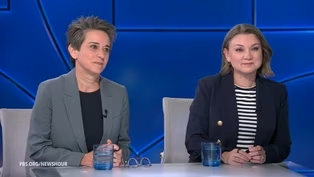
GEOFF BENNETT: And now for some perspective on California Governor Gavin Newsom's apparent efforts to get a jump on 2028 and the unofficial kickoff to the midterms that starts today, we are joined by our Politics Monday duo.
That's Amy Walter of The Cook Political Report With Amy Walter and Tamara Keith of NPR.
It's good to have you both here on this Labor Day.
AMY WALTER, The Cook Political Report: Good to be here.
GEOFF BENNETT: So, Amy, we will start with you.
We watched on his interview with Gavin Newsom.
He's in South Carolina, a state that, as you both know, played a pivotal role in the Democratic primary calendar last time around.
What did you hear in what he said?
AMY WALTER: I thought it was notable that he talked about his successes in being a foe to Donald Trump.
Obviously, he was one of the only Democratic governors who was able to get a map passed that, let's face it, if Democrats do win control of the House next year, they can point to Gavin Newsom's success in passing that redistricting referendum in getting them there.
And he also talked about what he wants to do to sort of keep Donald Trump in check as we get into the next two years.
I think the challenge for Newsom, and, quite frankly, it's for all of the Democratic candidates who want to run in 2028, is, what is the message of what life looks like beyond Donald Trump?
What is the positive, what is the forward-looking message?
GEOFF BENNETT: And, Tam, what do you take away from the fact that Newsom is in South Carolina, of all places, at all?
TAMARA KEITH, National Public Radio: Well, South Carolina picks presidents.
Or certainly it did in the 2020 cycle.
I mean, Governor Newsom is doing everything someone who is running for president would do.
He had a podcast.
He explored more moderate views and took his message to FOX News and some broey podcasts.
He really got his social media account, put it on steroids, and has been mocking President Trump's style through that social media account in a way that's gotten a lot of attention from Democratic voters.
South Carolina is going to matter.
South Carolina is a state with a very large African American electorate, and that is a group of voters that any Democrat who wants a chance to be president of the United States needs to find a way to get those voters excited.
So, of course he was there.
GEOFF BENNETT: And, Amy, here we are less than two months away from the midterms.
Hard to believe.
Where do Republicans stand?
AMY WALTER: Well, Republicans, no, they're in a defensive crouch right now.
The president's approval rating right now sits at about 38 percent nationally.
That's lower than he was at this point in 2018.
It's about on par where George W. Bush was in 2006, which, by the way, I have been saying this for a while.
Others have also been making the comparison between what was going on in 2006 and what was going on now.
In 2006, Democrats won both the House and the Senate.
Democrats are trying to win both the House and the Senate.
This time, Democrats won in some of the more rural parts of America.
At that time, it was a deep frustration over the president's handling of war.
We obviously have an unpopular around war at this point.
And, of course, frustration around issues like corruption.
And that is something we're seeing in 2026.
I think the big question for these next few weeks is whether Republicans in these individual races are going to be able to change the focus from one that is on Donald Trump to one that is focused on the individual Democratic candidates.
That is a tall -- taller order for some candidates than others.
GEOFF BENNETT: And, Tam, Republicans are doing something unusual this week.
They're holding a national midterm convention in Dallas.
You have been reporting on it.
You will be there.
What should we know?
TAMARA KEITH: Yes, so this is something that Republicans have never done before.
Midterm conventions are not a thing, just to be clear.
And the chairman of the Republican National Committee, Joe Gruters, has said repeatedly that this is going to be a Trumpapalooza.
Not my word, his word.
And the president will be headlining the convention both nights of the convention.
It is only two nights.
I have gone through the list of announced speakers and found that fewer than half of the candidates in competitive races are actually speaking at this convention.
Some share of them won't even be there.
They won't be with -- they want as much distance from this as possible.
But the theory of the case as expressed by President Trump is that he thinks that his voters aren't going to turn out unless he's on the ballot, so they have to make it like he's on the ballot.
And so, please, please, please vote as if Donald Trump is on the ballot is the message that he has had and that we expect him to continue to have.
GEOFF BENNETT: Is there something to that?
I mean, they're calling this Trumpapalooza.
The president himself is telling Republican candidates to embrace him and his agenda.
History shows that most presidents don't want the midterms to be a referendum on their presidencies.
AMY WALTER: Right.
GEOFF BENNETT: Past presidents have always said it's not a referendum, it's a choice.
This is a choice election.
AMY WALTER: That's right.
GEOFF BENNETT: What's the calculation behind making Donald Trump the center of it?
AMY WALTER: Well, his calculation is that his candidates win when he is on the ballot.
When it is a choice election between Donald Trump and a Democrat, Republicans do really well.
The difference, of course, this year is that not only is Donald Trump not on the ballot, but there's no contrast with a Democratic candidate.
He can't bounce this off of a Hillary Clinton or Kamala Harris or Joe Biden.
This is really about who's in charge in Washington.
It's why so many Democrats are eager to highlight the ways in which the Republican opponents are attached to decisions made by the president.
GEOFF BENNETT: And the president's going to spend some real money from his campaign coffers in support of Republicans?
I see you saying no.
TAMARA KEITH: I don't see it.
AMY WALTER: It's the biggest parlor game in Washington right now.
GEOFF BENNETT: So he may not spend the money?
TAMARA KEITH: Well, we don't know how much he's going to spend.
All we know for sure right now is that MAGA Inc., which is the super PAC that is connected to him, has dropped in the last few days $10 million on ads attacking James Talarico in Texas.
That is a state where Ken Paxton, the Republican nominee, has had lackluster fund-raising, to say the least.
He has not had a great campaign.
And so this is this is a candidate President Trump endorsed.
And so his super PAC had better spend some money trying to prop up a Republican who the president endorsed who a lot of people were warning may not be the best candidate.
We don't know yet how much they're going to spend.
GEOFF BENNETT: Yes.
So, $10 million in Texas out of how much?
(CROSSTALK) AMY WALTER: Exactly.
TAMARA KEITH: Out of 400.
GEOFF BENNETT: Four hundred million dollars.
TAMARA KEITH: And then there's another allied group that just started an ad campaign.
It's only a million dollars.
It's not the full enchilada.
TAMARA KEITH: But it is two ads all about Donald Trump, no mention of candidates running in the midterms, a lot of slow-motion footage of Donald Trump.
GEOFF BENNETT: More to come.
Tamara Keith, Amy Walter.
Thank you both.
AMY WALTER: You're welcome.
TAMARA KEITH: You're welcome.
AMNA NAWAZ: An Israeli strike in Southern Lebanon today killed 12 people, including two children.
The IDF said a weapons transfer was under way in the targeted building.
Farther south, the IDF has destroyed dozens of villages in its occupied territory, many of them home to Shia Muslims.
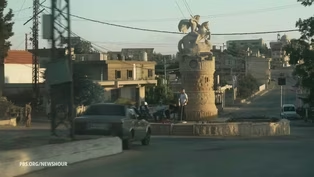
Special correspondent Simona Foltyn and videographer Adrian Hartrick report from three villages near Israel's occupation zone demarcated by the so-called Yellow Line.
SIMONA FOLTYN: From her backyard, Ashwak looks out on neighboring villages the Israeli army has destroyed, emptied and still occupies.
ASHWAK DABAGHI, Marjayoun, Lebanon, Resident: There is no stability.
There is no relaxing.
Always stress out.
Always keep this bag.
Maybe, after one hour, hey, we need to go.
If I don't have children, I swear to God, never live Marjayoun.
SIMONA FOLTYN: Marjayoun is a Christian town in Southern Lebanon.
Most villages in this border region, however, are Shia Muslim and have historically supported Hezbollah, a Shia militant group that emerged with Iranian backing in response to Israel's 1982 invasion of Lebanon.
Israel's latest military campaign has inflicted unprecedented devastation on those Shia communities.
In stark contrast, Christian villages like Marjayoun have been left largely intact.
Despite the war around them, Ashwak, her husband, Victor, and their two children, Georges and Giselle, try to lead a normal life.
But nothing about this is normal.
ASHWAK DABAGHI: Sorry, guys.
SIMONA FOLTYN: Ashwak feels they are caught between Israel and Hezbollah.
ASHWAK DABAGHI: Leave us.
We want to stay here.
We want to live in peace.
I'm not with Israel.
I'm not with Hezbollah.
I'm not with anybody.
I'm with my family.
SIMONA FOLTYN: A family of dual Lebanese-American citizens who could have returned to the United States long ago.
But this is their home, and they dread what might happen to it unattended.
Beyond their fence lies a stern warning.
The Shia village of Dibbin has been largely destroyed, in what many here see as collective punishment of the Shia community who support Hezbollah.
ASHWAK DABAGHI: They don't deserve this.
Even if them with Hezbollah, nobody deserves to lose her house, her family, her dreams.
Even if you stay here, you look.
We don't want to live like that.
SIMONA FOLTYN: During previous bouts of fighting in this area, the family did leave for the Lebanese capital for a few weeks.
Victor put up surveillance cameras to keep an eye on the property.
This is down there?
VICTOR DABAGHI, Marjayoun, Lebanon, Resident: That's down there, yes.
SIMONA FOLTYN: And what he saw shook the family.
VICTOR DABAGHI: All right, here's the guy.
One of them is waiting by my pickup truck where the main door is, and the other one coming up towards the camera running with his mask on.
This is the guy's face.
SIMONA FOLTYN: Victor is an Iraq War U.S.
Army veteran.
He believes that man was a Hezbollah fighter who tried to use their house to launch attacks on Israel.
VICTOR DABAGHI: What intentions could they have breaking a camera, a security camera inside my own private property?
SIMONA FOLTYN: Are you worried that your house could have become a target for Israeli strikes?
VICTOR DABAGHI: Of course.
Israel is watching their moves, and their mission is to finish them here in Lebanon.
SIMONA FOLTYN: As part of this mission, dozens of Shia villages where Hezbollah used to be present have been completely razed by the Israeli Army.
Israel's defense minister has said this is a replica of his Gaza strategy following the October 7 Hamas attacks on Israel.
And speaking to Israel's Channel 14, Israel Katz referred to Lebanon's Shia population as enemies.
ISRAEL KATZ, Israeli Defense Minister (through translator): Twenty-four Lebanese villages that were hundreds of years old were Shiite residents who acted as enemies on behalf of Hezbollah and threatened our borders and our residents and constantly provoked.
We destroyed all of the buildings.
Not one house -- they have got not one house.
The criminalization of all these villages is complete.
SIMONA FOLTYN: A recent U.N.
report expressed alarm over such remarks and urged Israeli officials to seize rhetoric that dehumanizes the population of Lebanon and that legitimizes collective punishment on grounds of ethnic origin.
The IDF rejects that characterization, despite the defense minister's statement, telling the "News Hour" that: "The IDF operates in accordance with international law and directs a strike solely against Hezbollah and not against the Lebanese state or its civilians" and that it "categorically rejects claims of collective punishment and ethnic cleansing."
But the reality on the ground remains that the south has been emptied of Shia Muslims.
We drive onwards to the adjacent village of Qlayaa.
Like in Marjayoun, the Israeli Army has allowed the Christians here to stay on certain conditions.
One of those conditions is that filming around Qlayaa, where the Israeli military operates, is strictly forbidden.
AMIN SAEED, Qlayaa Village Chief (through translator): People have become so panicked.
As soon as they see a camera, they panic more.
Just now, several people called me: "Amin, you have a camera in the car."
SIMONA FOLTYN: Amin Saeed is the village chief and among the enforcers of the Israel Defense Force's new rules.
Since we can't interview him out on the street, we decided to go for a ride along the main road.
AMIN SAEED (through translator): They are controlling us from all sides.
Here in the heart of the village, we can move, but we can't go towards the olive groves on one side, and we also can't go to the river on the other side.
SIMONA FOLTYN: The IDF regularly sends voice notes to the municipality.
In one of these voice notes obtained by the "News Hour," the Israeli Army instructed Qlayaa's municipality to not shelter residents from neighboring Shia villages.
IDF VOICE NOTE (through translator): You need to pull yourselves together and prevent the return of strangers and Hezbollah elements to your lands.
If you do not do this, we cannot guarantee your lives in the town.
SIMONA FOLTYN: The villagers set up informal checkpoints like this one to implement Israel's directives.
Turned away by their Christian neighbors, some displaced Shia civilians have found refuge in this school further away from the border.
Zeinab previously rented a house in Qlayaa, but was asked to leave by its Christian residents in line with Israel's instructions.
ZEINAB AHMED, Displaced from Khiyam (through translator): They kicked us out because Israel threatened them.
When they threatened them, they kicked us out, because we are Shia.
SIMONA FOLTYN: Zeinab and Samira have helplessly watched the destruction of their community on their phones.
SAMIRA JARMAKI, Displaced from Khiyam (through translator): There isn't a single house left.
I even saw the photo.
There's just wiped out land and the Israeli tanks and armed vehicles are parked there.
All my family, my brothers, their houses are gone.
If we return, where would we go?
Where?
SIMONA FOLTYN: Their village, Khiyam, is occupied by Israeli forces, but we managed to film it from a distance.
Only piles of rubble are visible through our zoom lens.
While Shia villages have been demolished, Sunni and Christian villages are subject to tightening Israeli control.
We're driving towards the Yellow Line, right up to the occupation zone the Israeli army has established across vast swathes of Southern Lebanon, similar to the model they have implemented in Gaza.
Our destination is Kfarchouba, a Sunni Muslim village surrounded by Israeli positions.
To see just how difficult life has become here, we joined the municipality on a maintenance trip to the water pumping station.
The facility is a 10-minute ride from the center of town.
It's the only source of water for the residents.
Mohammed Hassan Al-Hajj is in charge of maintenance.
MOHAMMED HASSAN AL-HAJJ: We brought diesel to run the generator so we can pump the water for the people of Kfarchouba.
SIMONA FOLTYN: Every time they come here, they risk encounters with the Israeli Army, which has taken the hill right across the water station.
Traces of Israeli tanks mark the road.
Bullets from Israeli machine guns dot the water station's walls.
Mohammed was already arrested once.
MOHAMMED HASSAN AL-HAJJ (through translator): About 15 soldiers arrived here and immediately got out with weapons.
They surrounded us and grabbed us.
He started pushing me from here to this corner.
SIMONA FOLTYN: He says he was blindfolded, taken to an Israeli base, tied up on the floor for several hours and interrogated.
MOHAMMED HASSAN AL-HAJJ (through translator): He said: "What were you doing there?"
I told him: "We are pumping water for the town."
He said: "Didn't we know it's forbidden to go there?"
SIMONA FOLTYN: In response to questions by the "News Hour," the IDF said that Mohammed repeatedly approached an area in which IDF operations were taking place, and that the detention was carried out due to security concerns.
What would happen if you were not able to come here to this well and maintain the infrastructure here?
MOHAMMED HASSAN AL-HAJJ (through translator): If we don't come here to pump water, the people won't be able to survive without water.
And they will be forced to leave.
SIMONA FOLTYN: The municipality is trying to prevent just that, but the civilians who've remained here risk their lives every day, be it to secure water, farm their fields, or simply drive back home.
Back in the Christian village of Qlayaa, a memorial was under way for three Israeli strike victims.
Tea (ph) D'aibes, her brother Tony and their father, James, were killed in an Israeli strike in June.
They were returning from Beirut, where the two students had gone to take their university exams.
They left behind their mother, now without children and without a husband.
She interrupted the sermon, desperately demanding answers that nobody here could give.
Her brother-in-law agreed to speak in her place.
YOUSSIF D'AIBES, Relative of Israeli Strike Victim (through translator): Why is a young man in the prime of his life and his sister in the prime of hers, university students about to finish their specialties, one of them a doctor, why are they killed on the road in cold blood?
They didn't pose a threat to anyone.
SIMONA FOLTYN: The IDF did not answer the "News Hour"'s questions about the killings.
Though the family blames the IDF for the deadly strikes, they agree with Israel on one thing: Hezbollah must be disarmed.
YOUSSIF D'AIBES (through translator): Everyone has a right to their home and land and they must return.
But under the umbrella of the state and a clear, strong law, we can no longer tolerate chaos.
SIMONA FOLTYN: Israel and Lebanon have been through intermittent conflict for decades.
Next door in Marjayoun, Ashwak believes there's only one solution.
ASHWAK DABAGHI: Let's do peace with Israel.
SIMONA FOLTYN: And if you were to say this, let's do peace with Israel, how would it be perceived by your Shia neighbors?
ASHWAK DABAGHI: If you are not with them, they said you're -- are you working with Israel?
No, I'm not working with anybody.
Just I want to stay here.
I want to stay in my home.
SIMONA FOLTYN: But staying is becoming harder every day, as Israeli troops show no signs of leaving.
For the "PBS News Hour," I'm Simona Foltyn in Southern Lebanon.
GEOFF BENNETT: Join us again here tomorrow night, when a fighter pilot who was ordered to take down Flight 93 on September 11 reflects on the attacks 25 years later.
And that's the "News Hour" for tonight.
I'm Geoff Bennett.
AMNA NAWAZ: And I'm Amna Nawaz.
On behalf of the entire "News Hour" team, thank you for joining us.
 New
NewFar-right AfD win signals shift in Germany, alarms Europe
Video has Closed Captions
Far-right AfD win signals shift in Germany, raises alarm in Europe (8m 56s)
 New
NewGavin Newsom on Democrats finding new ways to beat GOP
Video has Closed Captions
Gavin Newsom on how to beat the GOP: 'Democrats need to grow a backbone' (15m 8s)
 New
NewInside southern Lebanon villages as Israel ramps up attacks
Video has Closed Captions
Inside southern Lebanon's villages where Israeli occupation has upended daily life (10m 56s)
 New
NewNews Wrap: Marie brings dangerous surf to California coast
Video has Closed Captions
News Wrap: Tropical Storm Marie brings dangerous surf to California coast (4m 15s)
 New
NewTamara Keith and Amy Walter on GOP's midterm challenges
Video has Closed Captions
Tamara Keith and Amy Walter on GOP's midterm challenges (7m 19s)
 New
NewWhat went wrong before an Amazon jet barreled off the runway
Video has Closed Captions
What went wrong before an Amazon cargo jet barreled off the runway in Miami (5m 33s)
Providing Support for PBS.org
Learn Moreabout PBS online sponsorship New Episode
- News and Public Affairs

Today's top journalists discuss Washington's current political events and public affairs.

- News and Public Affairs

FRONTLINE is investigative journalism that questions, explains and changes our world.
 New Episode
 New Episode
 New Episode
 New Episode
 New Episode
 New Episode

 New Episode
 New Episode
 New Episode
 New Episode
Support for PBS provided by:
Major corporate funding for the PBS News Hour is provided by BDO, BNSF, Consumer Cellular, American Cruise Lines, and Raymond James. Funding for the PBS NewsHour Weekend is provided by...