
Tanzania: Hero Rats
Clip: Season 2007 | 10m 51sVideo has Closed Captions
Go inside an effort to train giant rats to sniff out deadly unexploded land mines — and save lives.
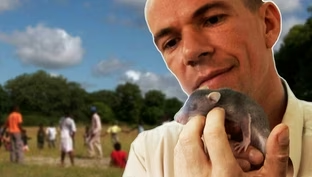
Bart Weetjens founded a unique lab in Tanzania dedicated to training rats to sniff out deadly unexploded land mines — the legacy of countless bloody conflicts. Although dogs had traditionally been used to help humans detect mines, Weetjens, who had long felt a special bond with rodents, realized that African giant pouched rats were lighter, cheaper to care for, and less susceptible to disease.
Problems playing video? | Closed Captioning Feedback
Problems playing video? | Closed Captioning Feedback
Funding for FRONTLINE is provided through the support of PBS viewers and by the Corporation for Public Broadcasting. Major funding for FRONTLINE is provided by the Ford Foundation. Additional funding...
Tanzania: Hero Rats
Clip: Season 2007 | 10m 51sVideo has Closed Captions
Bart Weetjens founded a unique lab in Tanzania dedicated to training rats to sniff out deadly unexploded land mines — the legacy of countless bloody conflicts. Although dogs had traditionally been used to help humans detect mines, Weetjens, who had long felt a special bond with rodents, realized that African giant pouched rats were lighter, cheaper to care for, and less susceptible to disease.
Problems playing video? | Closed Captioning Feedback
Where to Watch FRONTLINE
FRONTLINE is available to stream on pbs.org and the PBS app.
Inside the Scam
Follow scams as they unfold — and examine tactics used to manipulate victims. A collaboration between FRONTLINE and The Associated Press.Providing Support for PBS.org
Learn Moreabout PBS online sponsorship♪ ♪ ♪ ♪ >> ALEXIS BLOOM: Here in the southern highlands of Tanzania, an intriguing new research project is underway.
>> And he's, he's really about to opening his eyes, huh?
He's, just small splits, so this how it, how it starts.
>> BLOOM: Bart Weetjens runs this unique laboratory.
>> But if you see how the whiskers already move, like he has already pretty high frequency in their movement, so it's already perceiving.
>> BLOOM: These baby rats already have an incredible sense of smell.
In Bart's lab, they're being trained for a new and critical task that may save human lives.
It all started when Bart was a boy in Belgium.
>> I had a passion for rodents.
One day, I was given a hamster, and I was so fond of this hamster that I gave it another hamster as a playmate, and soon, I had a lot of hamsters.
I've always felt a very strong bonding with rodents.
Don't ask me why, but it's just like that.
Something extra here.
>> (chuckles) >> BLOOM: Bart's rats are not your average gutter rat.
This is the African giant pouched rat.
It lives up to eight years in captivity, is sociable and easy to train.
>> (speaking indistinctly) >> BLOOM: And this is just what Bart and his team have been doing in Tanzania for the last seven years: training rats to help solve one of Africa's deadliest problems by sniffing out land mines.
(explosion roars) Every hour somewhere in the world, a person is maimed or killed by a land mine.
(explosion roars) And there are more mines in Africa than anywhere else.
(insects buzzing) But finding and removing land mines can be expensive and extremely dangerous.
And that's where Bart's rats come in.
The principle here is simple.
Bart uses the Pavlovian method.
When a rat stops to sniff an explosive scent, the trainer signals with a loud click... (clicks) ...and rewards the rat with food.
After months of training, they find the explosives with lightning speed.
They indicate the spot by scratching.
The progress of each rat is carefully documented.
Over 300 rats are being trained here, each with its own personality and its own name.
>> You will find Mozambican names.
You will find Swahili names: Utomi, Ufamba.
There is a Hutu and Tutsi together peacefully in one cage.
(rat squeaks) >> BLOOM: The training begins at dawn.
They're nocturnal, so they wear sunscreen to protect their sensitive ears.
We head down the road to a training field run by the Hero Rat program.
(engine idling) Here, trainers have created a hazardous treasure hunt, burying land mines and canisters of TNT.
All the detonators have been removed, but the explosive material is still inside.
Strapped into a harness, the rats run on a cord between two trainers.
>> Whenever they trace an explosive scent, you may see they become a bit more nervous, they start looking where the highest concentration is, and on that spot, they will scratch as an indication.
>> BLOOM: So, that sort of scratching indicates, like, "Okay, I've found something"?
>> Yes.
>> BLOOM: Yeah.
Dogs have traditionally been used to detect land mines, but Bart realized that rats are less likely to set off a mine and less susceptible to tropical disease.
And once trained, rats work obediently with humans.
Do you know when you've got a good one?
>> Yes, example, me, I got good one, yeah.
Named is Ararat.
>> BLOOM: Ararat?
>> Yes.
(chuckles) That rat got two times jackpot, you know.
>> Ararat is a star.
He worked through the whole curriculum without any error.
We're sure Ararat has a bright future in the mine fields.
>> BLOOM: After nearly a year in training, Bart is sending Ararat and seven others on their first mission.
♪ ♪ Mozambique, on the east coast of Africa.
A beautiful country with a terrible history of war.
They're slowly rebuilding.
But 30 years of conflict continues to take its toll here.
Since the end of the civil war, thousands of Mozambicans have been killed or injured by unexploded land mines.
>> (speaking Portuguese): >> BLOOM: Ramos spent two years recovering in the hospital, but he lost both his legs beneath the knee.
He now walks with prosthetics.
>> (speaking Portuguese) (man responds on radio) >> BLOOM: A few years ago, the Hero Rat program hired Ramos as a radio operator.
>> (speaking Portuguese) >> BLOOM: Ramos changed his mind about the rats after seeing them in action.
He welcomes the reinforcements, which have just arrived from Tanzania.
Over the next few weeks, Ararat and the other new rats will be put through rigorous licensing tests.
Meanwhile, Bart's brother Frank has set up a base camp where he shows us how the demining works.
>> There we go.
>> BLOOM: We suit up in protective gear and join a team heading out.
>> Yeah, you're going to be looking very... You're going to be feeling very elegant in this thing, you know?
(both laugh) Never go beyond any of the red marked poles.
>> BLOOM: Mm-hmm.
>> Never step over any tape.
>> BLOOM: After clearing dense vegetation, the deminers use metal detectors.
It's a dangerous and painstaking process that moves inch by inch.
(detector sounds) And the detectors are triggered by even the smallest metal object.
This is where Bart's rats have the advantage, zeroing in on just the explosives.
Since the rats first began working here four years ago, they've found a hand grenade, unexploded ammunition, and 22 land mines.
For Bart, after so many years of preparation, each trip into the minefields is a moment of truth.
When the rats begin to scratch, the deminers are called in.
(detector sounding) Uncovered, just where the rats indicated, a land mine, which is carefully defused.
The rats are rarely wrong.
(children calling) Bart's Hero Rats are now demining the land around this school.
They've cleared 100 acres.
Children now play here unafraid.
(children calling) It's another success for a program that many doubted.
>> In the beginning, it was really tough.
Everywhere I went to apply for funding, we were just laughed at.
Institutions were actually very, very reluctant towards such an approach.
>> BLOOM: In that initial stage, did you ever think to yourself, "What am I doing this for?"
>> Um, well, the reason why was clear, obvious.
(stammers) I dreamt of a better world.
As long as these mines are there, people just cannot build a normal life.
(door creaking) >> BLOOM: Back in his laboratory, Bart thinks he's found yet another way for his rats to help save lives.
(rat squeaks) Bart and his wife, Maureen, have discovered that rats can help doctors diagnose tuberculosis by smelling it.
In Africa, TB is a leading cause of death.
A lab technician can only test around 20 samples a day.
One rat can test up to 2,000.
You could pretty much put any scent in?
>> Indeed-- this is a generic technology.
In the end, the animals are trained to pinpoint a specific target scent.
What's the target scent?
This can be anything.
>> BLOOM: Bart says the possibilities for his rats are limitless.
>> They, they save human lives and... Yes, they are, they are heroes, actually.
>> BLOOM: Inspired by a boyhood passion, Bart took a chance.
And so far, his rats keep paying off.
♪ ♪ ♪ ♪
 Now Playing
Video has Closed Captions
Clip: S2007 | 10m 51s | Go inside an effort to train giant rats to sniff out deadly unexploded land mines — and save lives. (10m 51s)
Preview: S2007 Ep13 | 30s | Airs Tuesday, December 11, 2012 at 10:00 p.m. ET/PT. Check your local listings. (30s)
Preview: S2007 Ep13 | 30s | Airs Tuesday, December 27, 2011 at 10:00 p.m. ET/PT. Check your local listings. (30s)
Preview: S2007 Ep14 | 54m 34s | The crisis in Sudan reaches the U.N. but struggles to find just attention. (54m 34s)

"Showdown With Iran" - Preview
Preview: S2007 Ep12 | 32s | Iran is on the rise as both a threat and puzzling foreign policy challenges for the U.S. (32s)

Preview: S2007 Ep11 | 33s | Inside the battles within the Bush administration. (33s)
Preview: S2007 Ep10 | 33s | FRONTLINE investigates how strategic and tactical mistakes brought Iraq to civil war. (33s)
The NSA's Eavesdropping at AT&T
Clip: S2007 Ep5 | 8m 54s | How the NSA got access to AT&T data centers across the U.S. to monitor communications. (8m 54s)
"Spying on the Home Front" - Preview
Preview: S2007 Ep5 | 33s | In the war against terrorism, what’s the sacrifice Americans must make? Privacy? (33s)
"When Kids Get Life" - Preview
Preview: S2007 Ep9 | 33s | When a child is convicted of murder, how unforgiving should society be? (33s)
Preview: S2007 Ep6 | 33s | How bipartisan forces halted action on global warming for three U.S. administrations. (33s)
"News War: What's Happening to the News?" - Preview
Preview: S2007 Ep3 | 33s | Examining the dramatic new challenges facing mainstream media in the 21st century. (33s)
"News War: Secrets, Sources, & Spin, Part II" - Preview
Preview: S2007 Ep2 | 31s | Examining the dramatic new challenges facing mainstream media in the 21st century. (31s)
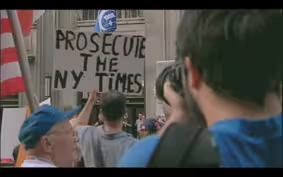
"News War: Secrets, Sources, & Spin, Part I" - Preview
Preview: S2007 Ep1 | 33s | Examining the dramatic new challenges facing mainstream media in the 21st century. (33s)
Providing Support for PBS.org
Learn Moreabout PBS online sponsorship New Episode
- News and Public Affairs

Top journalists deliver compelling original analysis of the hour's headlines.

- News and Public Affairs

Today's top journalists discuss Washington's current political events and public affairs.



 New Episode





 New Episode
 New Episode
Support for PBS provided by:
Funding for FRONTLINE is provided through the support of PBS viewers and by the Corporation for Public Broadcasting. Major funding for FRONTLINE is provided by the Ford Foundation. Additional funding...