
Tim Miller
Season 13 Episode 13 | 26m 46sVideo has Closed Captions
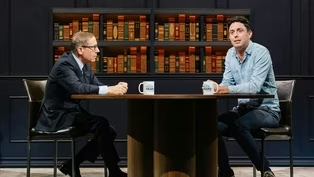
Political commentator Tim Miller talks about the current political climate in the U.S.
Political commentator and writer at The Bulwark, Tim Miller, talks about the current political climate in the U.S. and current events.
Problems playing video? | Closed Captioning Feedback
Problems playing video? | Closed Captioning Feedback
Overheard with Evan Smith is a local public television program presented by Austin PBS
Support for Overheard with Evan Smith is provided by: HillCo Partners, Claire & Carl Stuart, Christine & Philip Dial, Eller Group, Diane Land & Steve Adler, and Karey & Chris...
Tim Miller
Season 13 Episode 13 | 26m 46sVideo has Closed Captions
Political commentator and writer at The Bulwark, Tim Miller, talks about the current political climate in the U.S. and current events.
Problems playing video? | Closed Captioning Feedback
Where to Watch Overheard with Evan Smith
Overheard with Evan Smith is available to stream on pbs.org and the PBS app.
Buy Now
Providing Support for PBS.org
Learn Moreabout PBS online sponsorship- [Announcer] Funding for "Overheard with Evan Smith" comes from: HillCo Partners, a Texas government affairs consultancy; Claire and Carl Stuart; Christine and Philip Dial; Eller Group, specializing in crisis management, litigation, and public affairs communication, Ellergroup.com; Diane Land and Steve Adler; and Karey and Chris Oddo.
- I'm Evan Smith, he's the it-boy of resistance media, a writer at large at The Bulwark and the host of the Bulwark podcast, and the author of the bestselling memoir, "Why We Did It: A Travelog from the Republican Road to Hell."
He's Tim Miller, this is "Overheard."
(audience applauding) A platform and a voice is a powerful thing.
You've really turned the conversation around about what leadership should be about.
Are we blowing this?
Are we doing the thing we shouldn't be doing by giving in to the attention junkie?
As an industry, we have an obligation to hold ourselves to the same standards that we hold everybody else to.
This is "Overheard."
(audience applauding) (upbeat music) Tim Miller, welcome.
- Good to be with you, man.
- Thank you, it's good to see you again here in Austin, Texas.
- I love an excuse to be in Austin, get some La Barbecue, you know, have a good time.
- That may have been an ad.
That's fine.
But that's okay.
- It was not (laughs).
- It's cool.
- Free endorsement.
- Let Brendan Carr come after us, that's actually fine.
(Tim laughs) So we're sitting here on March 20th.
It is 14 months to the day that Donald Trump was inaugurated.
In your wildest dreams, would you have expected, over these 14 months, for us to be where we are today?
- I think that the last two weeks, my answer's different than it would've been.
- Say more.
- because look, I had what I thought was a pretty negative, some might say deranged, view of what the Trump administration would look like in the second term.
The details and particulars, could I have predicted that he might try to invade Greenland, or, you know, all of the various specifics?
No.
But just in general strokes, I thought that the first year was kind of about what I expected from the Trump administration.
I knew- - It's not that they didn't tell us.
I mean, they told us.
- Right, yeah.
The signs said mass deportation now.
I knew that there were going to be very aggressive deportation efforts, that people's human rights were gonna be violated, I knew they'd be lawless, I knew the cabinet would be clownish.
We figured he'd try to do tariffs and that would hurt the economy.
Like, a lot of what we saw in that first year was basically what I expected.
and in some ways, actually, it was just slightly better, 'cause I was pretty worried that they'd be more effective at going after the people on their enemies list than they were, the DOJ and the FBI.
- Right, James Comey is still walking among us.
- Exactly, so's Tish James, and Barack Obama (chuckles), and you know, Mayor Frey, and all the other people they've come for, so in that sense, it was not good, but I expected it to be not good.
The Iran war just has been such a catastrophe, and it is the first time that even somebody that had as low a bar as I did for expectations has felt, like, I think it's even worse than I thought it was gonna be, and I really think that this Iran decision is gonna end up being the worst and most catastrophic decision of either of his terms thus far, and that's a pretty high bar.
- Yeah, well, there are two components of it.
They're related, but they're separate.
One is the security conversation, and one is the economic conversation.
The security conversation's sort of TBD, - Yeah.
- Right?
We don't know.
I mean, there've been a couple of incidents, including one here in Austin, where we think sort of, maybe, kind of, sort of, there's a relationship to what's going on.
The economic thing seems immediately like a problem.
- Yeah, well, just briefly on the security thing, it's not really TBD in the sense that Iran was not a threat to us, right?
Like I- - Well, but TBD in the sense of whether it's gonna blow back on us.
- Blow back on us, for sure.
And look, obviously Iran was a state sponsor of terror and there was stuff happening to our assets in the region, and that's been going on for a half century, but there was no acute security concern, so anything that happens to cause more deaths of US troops, or to you know, create back home, potentially, terror threats, you know, is something that was a totally unnecessary consequence of the decision.
- Predictable, predictable.
- Yeah, predictable, but unnecessary.
It just wasn't, this was not necessary.
This was not, like, you know, it wasn't like the response to 9/11, right?
It wasn't as if they were attacked and we felt like we should do something, and we made some mistakes, and you know, went overboard, made some misjudgments, like that.
This was totally a war of his choosing, like, we did this for no reason, and it was the opposite of what he promised people we'd do.
So in that sense, the security thing, I think, is already a negative.
The economics, like, I'm not an economist, I don't wanna play one on PBS, but I've been, you know, dorking out on podcasts and articles from people who have expertise in various verticals, and I just think it's, it's gonna be worse than what the conventional wisdom is.
I think that there's a lot of people out there who feel like, Donald Trump, they thought the end was near for Donald Trump for 10 years now, so they don't wanna be the person out there now saying, "The end is near again.
This is gonna be the thing that kills Donald Trump," but I just look at, you know, whether it be the oil prices, commodity prices, fertilizer, or helium, the relationship with our partners, people moving off of the dollar.
I think that there's just a lot of really potential catastrophic consequences.
And we all learned this in 2022, it's not recent history.
You know, when supply chains get disrupted, just as Joe Biden and his economic team, you know, if they'd predicted all of the potential consequences that came out of that.
Even if Donald Trump quit this war today, and it's already been over by the time this airs, it is still going to be months upon months of disruptions that is gonna harm people here and all over the world.
- Right, and of course, those are serious consequences.
The more mundane consequence may be political - Yeah.
- for him, right?
You and I were in New Orleans the last couple of weeks at the New Orleans Book Festival, we saw our friend James Carville.
One must always remember what James Carville said: "It's the economy, stupid."
Heading into an election, what will this election be litigated on?
Probably the same thing that it was litigated on last time, - Yeah.
- right, which is the economy.
- Costs.
- Right.
- And everything he has done is self-inflicted to make costs worse.
- I mean, the Biden thing, you know, you could say, and I think accurately, that they spent too much on stimulus, and that juiced the economy a little bit too much on the margins, but, like, they were dealing with the fallout from COVID, which was this external shock, and they made some you know, decisions that in retrospect were, you know, probably exacerbated the problem a little bit.
Trump wasn't dealing with that.
The economy was recovering, and he made a series of choices with the tariffs, that makes things more expensive, the crackdown in immigration makes things more expensive.
You know, fewer workers, that's gonna, it's gonna increase, like, building supplies, and, like, think about the folks that are, you know, building houses, that exacerbates the housing problem.
And then this war is gonna dramatically exacerbate it.
So I think that the political consequences are gonna be real serious.
You see a lot of polls going around now where, like, MAGA Republicans are sticking with him, and that's true, and I think they, who knows, you know, whether that will ever be cracked.
But Trump's election in 2024, the reason why he won a popular vote, which he hadn't in either of the other two, was he added a big part to his coalition of independents, and, you know, that was the manosphere type independents, it was younger Black and Hispanic men, in particular.
All of those folks are off the boat.
Like, they got on- - The data has them going all the way back over.
- Yeah, of course, - In every case.
- because of course they are, 'cause they signed up for him because they believed, wrongly, that he was gonna be the anti-war candidate, and they were lied to about that, but here we are, and they thought that the economy was better.
They had a memory of the 2019 economy, that it was better and cheaper, and it was better for them than the Joe Biden economy was, thinking back to the pre-COVID economy when Trump was president.
He's betrayed them on both of those promises with the Iran war and the costs, and so, you know, some of those folks just won't vote in the midterms.
Some of them, like, you said, have gone completely to the other side.
The Democratic base is gonna be mobilized and excited to go turn out and vote.
The Republican base is gonna be depressed.
They've always struggled in the Trump era.
- It's a midterm election, which is always bad for the president's party, except for rare cases.
- Yeah, and in particular, during the Trump era, the Republicans have done bad when he's not on the ballot 'cause there are some people out there who are just Trump-only voters.
- Except, except, I know he says, "I'm not on the ballot this time," He is absolutely on the ballot this time.
- This is a referendum about him - Well, for people voting against him.
- Don't you think?
- Yeah, for people voting against him, for sure.
- Whether his name's the ballot or not, he's on the ballot.
- But you're, you know, we'll see who wins the Texas primary, so we can talk about that, but if you're in Ohio, and you're a MAGA Republican who's not a frequent midterm voter, and you look at the ballot, and it's some guy, John Husten - Husted.
- that you don't know at all, that is not, that does not seem very MAGA and you're, like, "We're in a war, everything's costing more for me.
Why am I gonna go out and vote in a midterm for John Husted?"
Like, Trump isn't on the ballot for that person.
And so I do think that it's gonna hurt Republicans in the midterms.
We'll see how much.
For it to really hurt, for, like, the damage to be real, the Democrats need to win the Senate.
- Well, this is the point I'm gonna make.
If only the Democrats were alive, right?
- Yeah, right, so- - Like, in some ways, the precondition for the outcome you're talking about is there has to be an alternative that people are comfortable with, and yet the Democrats haven't been able to find their behinds with a map and a flashlight for the last two years.
- Yeah, I think that that is true, particularly in red states.
I do think the Democrats have found their backbone a little bit, in the last year, and I think that the people of Minneapolis were a big, steeled a lot of the backbone for Democrats.
I think you've seen more, just a couple of people are coming to mind.
Mark Kelly, for example, or Ruben Gallego.
- Jon Ossoff.
- Jon Ossoff in Georgia.
Like, we're seeing more Democrats step up and, you know, that whole first year, like, when they were sending immigrants to El Salvador, you know, I was screaming on the podcast, I was, like, "Why aren't the Democrats fighting this harder?"
And it's because, I think, they were scared.
They thought they lost the election on immigration, they didn't wanna fight him on that.
I think that what happened to Renee Good and Alex Pretti which was obviously this horrible tragedy, and then what we saw in the streets of Minneapolis, like, made a lot of Democrats realize, "Oh, wait, we can fight him on this, we can also," and I talked to Talarico about this this week, you know, you know, change maybe some of our border policies, and feel a little differently about the border, but we can also fight what is wrong, what they are doing in this country, whether it be on immigration or with the Iran war.
So I do think the Democrats are finding their sea legs a little bit.
My concern for the Democrats is, are they doing it in red America?
because this, just the nature of the Senate.
You can complain about the Senate and say it's unfair the way that the, you know, it's not proportional, it's not representative, but the Senate is what it is, and it's not gonna change in the next few years, and for the Democrats to win the Senate, they've got to win here in Texas, or Iowa, or Ohio, or Alaska.
- North Carolina.
- North Carolina is just a- - No, that's a given.
- That might happen, yeah.
- If Roy Cooper loses in North Carolina, - There's no chance.
- There's no way the math works - There's no chance, right, and so to get there, they've got to win two out of these other states that Trump won by 10 or more points, - Right.
- you know, so that means you gotta go win Trump voters.
And so I think we'll see how Democrats do there.
Talarico is an interesting case here in Texas, but you know, that, I think is gonna be the big question is does the political environment gets so bad for Trump that the Democrats can win in these places where they haven't won since the early Obama era?
- So these are the literal tangible things in front of us as it relates to this election cycle.
The existential things that maybe you and I talk about, maybe some other people talk about, but I wonder if the average person talks about, are things like norms, guardrails, the values that we all took for granted.
I mean, I understand, it's like, "Aren't you adorable?
Pat, pat, pat.
(Tim laughs) You're worried about our democracy," but the reality is, this is really an extraordinary time.
I mean, I'll give you an example.
Today, the Washington Post, one of their early newsletters showed up and it had two things back-to-back, just presented flatly, with no commentary.
One was, apparently, you may have seen this, the president was in the Oval yesterday with the Prime Minister of Japan, and he was asked, "Why didn't you give our allies in Europe a heads-up about bombing Iran," and with the prime minister of Japan next to him, he said, "Well, Japan didn't warn us about bombing Pearl Harbor."
- Yeah, and the interesting thing about that is, - And The Post- - did Pearl Harbor work out well for Japan?
How did that end up - No, no, no.
working out?
- I mean, it makes no sense if you actually look at it on paper, but then the Post says "the Prime Minister was not amused."
Oh, I bet - Yeah, you don't say.
she was not amused.
And then the next thing, right after that, again with no commentary, is a panel picked by Trump voted to put his face on a gold coin, and I was like, this is the new abnormal, this is the abnormality that we've all become desensitized to.
Does anybody out in America care about this, or is it just us?
- Some people care about it, for sure, maybe not as many as we would like, and I think that... Look, here's the thing.
You know, electing Donald Trump the second time is gonna create some permanent consequences and changes in how things go in this country.
I mean- - The after will not be different from, will not be the same party as the before.
- It will have to be.
You know, sometimes when you make a choice in your life, a bad choice, or when a country makes a choice, like, the door shuts behind you.
Like you can fix your life, you know, if you're drunk driving and, you know, you get into an accident, you injure yourself, like, okay, you know, you can go to rehab, you know, you can improve yourself, but, like, that decision is still gonna have ramifications and consequences for you.
I think that's where we're at in this country.
Like we can get rid of Donald Trump, and hopefully, we'll get rid of Donald Trump sometime soon, and we can get rid of his cronies and the folks that wanna imitate him, but some of this stuff, like, you know... Look, if he puts his name or he puts his face on a coin, and he remodels the ballroom, and we have an Arc de Trump, and we start renaming airports after Trump, and he puts his name and he puts his face on Mount Rushmore, I don't know- - Kennedy Center.
- Kennedy Center.
- Right.
- Like, I don't know, the next president, sure, could come there and say, "My job is gonna be to tear down all this stuff.
We're gonna take a bulldozer to the East Wing, we're gonna smelt the coin, you know, we're gonna fire everybody that he hired that are all of these hacks that are all over the administration, that Cash Patel has hired."
Okay, but that president will also face a lot of real, like, problems that are more acute in people's lives.
- This is the point.
Putting Humpty Dumpty back together at some point, assuming that that's the goal here, right, the undismantling is gonna be really hard.
- It's gonna be really hard.
- It's gonna be really hard.
- And I think that there's gonna be a lot of people out there that say, just, like, they said to Joe Biden, that if, God willing, you know, a pro-democracy president we have in 2029, they'll just say to him, "You know what you should really focus on is healthcare and kitchen table issues.
- Don't look back.
- Don't worry about all the stuff, don't look back, and I don't, that's not gonna be possible.
There's gonna have to be some looking back, there's gonna have to be some reforms to the way we do things.
We're gonna have to figure out how to prevent a future president from having a crypto scam where people can buy off his family with fake digital currency, right?
So there are gonna have to be reforms, but they're also gonna have to care, it's gonna be a juggling act, and I think that there is, the next person in charge is gonna also have to just kind of try to break some stuff, and do things, and not feel constrained.
You know, I think that Joe Biden and Merrick Garland, God love them, I think their intentions were right but were very constrained by traditional norms, and we saw where that got us, and so I'm not saying that, you know, we have to, we want, you know, a Democratic Trump, or I'm not saying that the next person needs to also, you know, be, like, putting their face on coins, but I do think that they can't be victim of, like, death by committee, and death by norms and jurisdictions.
- And you can't go back in the time machine - You gotta fix it.
- to 2018 - You can't.
- and pretend that it's all, - You gotta create new things, - it's all the same.
- you gotta build.
Something I wanna ask you about that that is kinda the through line, narratively, in your book is the enabling of this aberrational behavior by people who know better.
Even if you don't agree with them politically, you know that there are people in Washington who know better privately.
They won't say it publicly.
We were reminded this week that sometimes there are bridges too far.
The Markwayne Mullen hearing when Rand Paul just went absolutely off on this guy, I mean, it got my attention, in part because you never hear anybody in the party of the president do that at a, I mean, I know it was very personal, for him, - Yes (laughs) that's right.
- but Markwayne Mullen basically said, you know, the neighbor that beat up Rand Paul, Rand Paul deserved it.
- Yeah, he nailed it.
- he nailed it.
- He nailed it, - So- kind of an exception.
- But, still the idea that there's a Republican vote against a nominee, it's not unique, but it's rare.
The fact is that the enabling of this stuff is another thing that we're gonna be reckoning with.
- Yeah.
- Right?
- Absolutely we are.
And look, let's just look at the war, for example.
We've had the first resignation of anybody in this administration, which is Joe Kent, which is kind of a special case, 'cause he has a big history of, you know, associations with white nationalists, too.
- Well, he went right on Tucker Carlson's podcast.
- Then he goes immediately to Tucker.
- The minute he resigns.
- and advances some conspiracy theories, right, so it's a special case, but he said, "Hey, I had a red line.
I said I'd signed up for this 'cause I thought we weren't gonna get into war with Iran.
We have gotten into this war.
I think it's, you know, Israel is implicated in that.
I'm quitting."
That was the first time we've seen this, and it's noteworthy because think about all the horrible stuff and think about all of the law-breaking that we've seen.
I mean, our government killed two American citizens.
Like, we sent a bunch of Venezuelans- - At least two.
- At least two, yeah.
We sent a bunch of Venezuelans who had done nothing, who'd done literally nothing, and didn't even come illegally, came using the CBP1 app and the asylum process, and we sent them to a foreign gulag, and nobody quit.
And if you look back to the recent past, you know, even the Bush administration, a lot of mistakes, you look at Abu Ghraib, there were whistleblowers internally.
You know, Scott McClellan, who was the Caroline Leavitt of the Bush administration, quit, you know, and said that "I can't, I don't, I can't spin for what is happening here."
That's how processes work in democracies.
It's not that the leaders are, you know, perfect, it's that when a leader acts unlawfully or unethically, there are other norms and functions, people around them hold them in check, whether it be their staff or whether it be Congress.
That is the unique thing about this Trump second term.
There is none of that.
- Well, that's the whole point about it, guardrails have just basically been obliterated.
- Yeah, yeah.
- Congress has quit doing its job.
Congress basically doesn't exist.
They're like the Duma, just going along with whatever Trump wants, and internally, he's surrounded himself by total sycophants.
And this is what I wrote about in the book.
Like, we saw how this came to be from 2016 to 2020, where people slowly convinced themselves and rationalized you know, how to go along with something like this.
but this second term, it is exponentially worse than that first term.
And people were at least grappling with this in the first term.
That's what the book was about.
I was asking people, "How do you grapple with these questions where you know that he's flawed or you know some of the stuff that he has done is wrong, but you still wanna be a Republican?"
And people grappled with it in different ways, and there was a lot of cowardice.
This time there's no grappling, it's just, and we've got three more years left of it, so buckle up.
- It's gonna be something else.
- Let's talk about The Bulwark.
You joined The Bulwark in 2020, am I right about that?
- Oh, boy.
What year is it now?
- It's 2026.
- That sounds about right, yeah.
- You look good.
You're Benjamin Buttoning.
(Tim laughs) It's fine actually.
The Bulwark has been in business a little bit longer than that as a news organization, not as a Substack and as a, you know, kind of distributed content in the way that it is now, but basically, it's been around for, you know, six to eight years.
- Yeah.
- It has taken off like a rocket as a business.
Why?
- So the core group of The Bulwark, for people who don't know, was a bunch of never-Trump Republicans, you know, people who had been Republicans- - Bill Crystal, Charlie Sykes, and Sarah Longwell.
- Jonathan Last, myself.
- Jonathan Last at the beginning.
- Yeah.
And so it was a bunch of us who had no home, right, and so we had left the Republican Party, we weren't interested in becoming, in going to the Democratic Party.
The Bulwark was kind of a side hustle for almost all of us, except Jonathan Last, like, he did it full-time, but everybody else was doing other stuff, and so we were like, let's see what happens with this.
You know, it is, we want a home for people who had come from the Republican side who feel like, this is wrong, and they wanna express themselves candidly, and not have corporate owners or donors putting limits on us, which is what had happened to The Weekly Standard, which was the kind of precursor magazine.
- Which Bill Kristol.
- Which Bill Kristol founded, right, and so I think there was something about that that just gave us a freedom.
I would have Democratic friends come up to me and say, "I'm kind of jealous of you," back, like, in those early days of 2020, 2021, and I was, like, "Why?"
and it was, like, "You can just let it rip."
- You have freedom.
- And, you know, even if I think that I just wanna be a pundit or a journalist for life, there's something in the back of my head that's like, maybe the next Democratic president will call me, and I will be their spokesperson, and I won't want this clip of me on TV calling somebody whatever.
And so they pulled their punches.
And so I think there was just something about the fact that we did not have any associations or aspirations to be traditional, like, we're going up the ladder to have The New York Times hire us, that let us just let it rip, and I think people appreciated that.
In this moment, people had a lot of frustration, and they appreciated our candor.
and I think as we've brought in more people who don't come from that background, like Sam Stein and others, traditional journalists, the ethos was already there, and I think that a lot of people just really want folks that are not gonna BS them, not pull punches, not fueling, not worry about their access to, you know, one politician or the other, and I think that it showed also a little bit, really, another inflection point for when our audience grew, when we took off more, was during the Joe Biden saga in 2024, and I think that we were a lot more willing, to some people in our audience's dismay, to just say bluntly that, like, after the Joe Biden debate, that he has to get out of the race, he has to get out and, and not dance around that question, and I think there were a lot of folks out there who were just tuning into politics (laughs), who were, like, "Oh, my god, Trump is gonna win again?
And I just watched this debate, and it's the most horrifying thing I've ever seen," and, like, you know, they had people send him, like, "You should watch these guys.
They're at least speaking the truth about what's happening."
And so I think it's just that ethos of just kind of freedom that has allowed us to resonate with people.
- Authenticity is still a thing.
- Yes.
- Still matters.
You said that the group of you at the beginning were Republicans who were not happy with the state of the party but did not want to become Democrats.
- Yeah.
- Has that changed-ish - I think that... I mean, look, I get this question a lot and people are, like, "What party?
Have you joined the Democratic Party?"
And I'm, like, "This is..." I mean, I haven't voted for- "I'm not gonna ask you to show me your card.
- Yeah, I was like, I was like, I haven't voted for, I voted for a single Republican in, like, a jungle primary in Louisiana who was the hopeless normal Republican running for governor against Jeff Landry.
It's the only time I've voted for Republicans since 2014.
It's 2026 (laughs).
Like, call me whatever you want.
Call me Shirley.
I'm a Democrat, functionally, you know.
Like it just is what it is.
- Since 2014, but of course, you worked for Jeb Bush during the 2016 cycle.
- 2016, right.
but then Trump ended up winning, and so by the time we got down to Florida.
So I guess I, technically speaking, I guess I did, but I can't even remember.
Who did I vote for?
Maybe Kasich, or Rubio, or somebody, in that primary, so maybe it was 2016, in the primary.
But I think that now, after, basically between the insurrection and Trump getting renominated, I think various members of The Bulwark went on this journey at different times, and for me, it was actually before January 6th, was I said after the election, when no one stood up to him, Liz Cheney and Adam Kinzinger, you know, when seven people - Effectively, no one.
- in the party, - when effectively, nobody in the party stood up to him when he tried to steal the election and stay in power against the will of the people, and end the world's longest-running consistent democracy, I was, like, "I am not part of this party.
I'm not part of this group, I can't be.
I have to be on the other side that fights this.
Like, you guys have left me no choice.
There's no point in staying in the Republican party to fight, to fight with who?"
Everybody just was part of a coup attempt.
So that was my view between, you know, basically, the 2020 election and January 6th.
And then I think that other members of The Bulwark kind of came around to this during this primary in 2024.
It's like the guy tried a coup.
There are other qualified people that are being put forth, like former governors, current governors, Secretary of State, Chris Christie.
Like, there are a lot of people out there, that would have at least been, even if you disagree with them on some policies, like, viable, legitimate - But you'd be open, pro-democracy presidents.
In the last minute we have, you'd be open to supporting what you would describe just now as a normal Republican?
- Who?
There aren't any.
I'm sorry.
I'm sorry.
Here's the thing, Evan.
I have Trump derangement syndrome.
I am gonna be- - You admit it?
- I'm gonna be an old man in a home, and I'm going to be 84 years old, okay, and I'm gonna get wheeled in by my daughter.
We're gonna go into the cafeteria, and she's gonna try to sit me down next to somebody, and I'm gonna be like, "They were for Trump!"
But it's like, I just, I cannot.
So anybody that was ever for this, like, once he tried January 6th and ran again, if you were for him, - That was it.
- that shows such bad judgment, I can never be for you again.
So what Republicans could I be for?
- Yeah, I mean, you just answered the question.
- None, yeah.
- You're having fun doing this.
- I'm having so much fun, man.
I mean, look, there are some days that it's hard, there's some days I wish I could just put my phone in the toilet, and, you know, go sit outside and read a fiction book, and you know, have a rose.
Like, I would love to do that.
I can't do that, and so that's not, you know, a lot of people have worse jobs than me.
I'm not, you know, I'm not cleaning toilets or whatever.
So some days it's hard to wake up and care about the stupidest people that you've ever met running the country and running the world to hell, but if we're gonna have to be stuck in here, if I'm stuck in there with them, and they have to be stuck in here with me (laughs), and I might as well at least have some fun with it, and laugh at them, and scream when I need to, and cry every once in a while, and that's what we're trying to do.
And I am enjoying that, and it's fulfilling to be able to just, after a career of being a flack, where you're spinning for people and spinning for other people, it's really kind of fulfilling and nice to just get to say whatever the heck I want and just, and be true to myself, and that part I really like, as well.
- Good.
Well, keep enjoying yourself.
(audience applauding) - Thank you, man.
Tim Miller, give him a big hand!
Thank you very much, man.
That was great.
Good, all right, great.
- Thanks.
(audience applauding) We'd love to have you join us in the studio.
Visit our website at austinpbs.org/overheard to find invitations to interviews, Q&As with our audience and guests, and an archive of past episodes.
- This Iran thing is going so badly that I do wonder if there is a little bit of second thoughts on that.
I think they're obviously gonna continue to put pressure on.
I think that they would like for the Cuban regime to collapse under its own weight, and I think that they probably wanna do it, but I think it's a little bit Iran contingent right now.
- [Announcer] Funding for "Overheard with Evan Smith" comes from: HillCo Partners, a Texas government affairs consultancy; Claire and Carl Stuart; Christine and Philip Dial; Eller Group, specializing in crisis management, litigation, and public affairs communication, Ellergroup.com; Diane Land and Steve Adler; and Karey and Chris Oddo.
(perky music)
Video has Closed Captions
Clip: S13 Ep13 | 9m 34s | Political commentator Tim Miller talks about the current political climate in the U.S. (9m 34s)
Providing Support for PBS.org
Learn Moreabout PBS online sponsorship New Episode
- News and Public Affairs

Top journalists deliver compelling original analysis of the hour's headlines.
 New Episode
- News and Public Affairs

FRONTLINE is investigative journalism that questions, explains and changes our world.
 New Episode
 New Episode
 New Episode
 New Episode
 New Episode
 New Episode
 New Episode
 New Episode
Support for PBS provided by:
Overheard with Evan Smith is a local public television program presented by Austin PBS
Support for Overheard with Evan Smith is provided by: HillCo Partners, Claire & Carl Stuart, Christine & Philip Dial, Eller Group, Diane Land & Steve Adler, and Karey & Chris...