
European countries face Russian sabotage and shadow warfare
Clip: 9/3/2026 | 7m 53sVideo has Closed Captions
European countries confront Russian sabotage and shadow warfare
German police arrested two people suspected of attacking a weapons manufacturer in Munich. The incident comes after Germany officially blamed the Russian government for an attack involving drones that came close to downing an aircraft as it landed. Nick Schifrin discussed the Russian attacks against Europe with David Cattler.
Problems playing video? | Closed Captioning Feedback
Problems playing video? | Closed Captioning Feedback
Major corporate funding for the PBS News Hour is provided by BDO, BNSF, Consumer Cellular, American Cruise Lines, and Raymond James. Funding for the PBS NewsHour Weekend is provided by...
European countries face Russian sabotage and shadow warfare
Clip: 9/3/2026 | 7m 53sVideo has Closed Captions
German police arrested two people suspected of attacking a weapons manufacturer in Munich. The incident comes after Germany officially blamed the Russian government for an attack involving drones that came close to downing an aircraft as it landed. Nick Schifrin discussed the Russian attacks against Europe with David Cattler.
Problems playing video? | Closed Captioning Feedback
Where to Watch PBS News Hour
PBS News Hour is available to stream on pbs.org and the PBS app.
Providing Support for PBS.org
Learn Moreabout PBS online sponsorshipAMNA NAWAZ: Today, German police arrested two people suspected of attacking a weapons manufacturer in Munich.
The incident comes after Germany officially blamed the Russian government for another kind of sabotage attack last month, when armed drones came close to downing an aircraft as it landed in Leipzig.
GEOFF BENNETT: European officials say these so-called hybrid attacks are part of a wave of sabotage by Russia targeting members of NATO.
Here's Nick Schifrin.
NICK SCHIFRIN: In the distance, an electricity substation explosion and what German officials fear is another Russian provocation.
A swarm of police descend on the scene.
A phalanx of officers comb fields for evidence and find 10 other bombs.
It's the second such incident in two days, and German officials say it was no accident.
HERBERT REUL, (through translator): Let me be clear.
This was not a faulty switch.
It was deliberate.
It is a criminal offense, sabotage directed by a foreign state or left-wing extremism.
We cannot rule out either possibility.
NICK SCHIFRIN: The apparent Russian sabotage threat became very real early last month, when, in the Leipzig Airport, a bomb squad found drones with military-grade explosives, the suspected target, a Ukrainian cargo plane.
But authorities also said another drone exploded next to a plane as it landed.
This week, Germany cast blame officially.
ALEXANDER DOBRINDT, German Interior Minister (through translator): We assume that Germany is the target of further hybrid attacks by Russia.
Let me make one thing clear.
We are not at war.
But we are a daily target of hybrid warfare.
NICK SCHIFRIN: European officials accuse Russia of years of hybrid warfare, from attempted arson outside the British prime minister's home, to firebombing warehouses in Latvia storing aid for Ukraine, to an assassination plot against a German weapons manufacturer, as well as drones that cross into NATO territory and have destroyed property.
But Russian President Vladimir Putin calls all the accusations fiction.
VLADIMIR PUTIN, Russian President (through translator): It is unclear why all these accusations are being made.
Yet there is one explanation, the need to counter an aggressive Russia.
But where is the evidence?
Well, they have planted the evidence.
NICK SCHIFRIN: Germany is Ukraine's largest European benefactor.
European officials say it's no coincidence Moscow's reported sabotage targets Kyiv supporters.
Germany vows it will close a Russian consulate and seek more sanctions.
But collective European punishment is still under debate.
KAJA KALLAS, High Representative, European Union: It is clear that it has all the hallmarks of state-sponsored terrorism.
The question is, what do we do about this?
NICK SCHIFRIN: Also today, Denmark's National Security and Intelligence Service accused Russia of recruiting Danish citizens for sabotage against Danish defense firms with ties to Ukraine.
For perspective on all this, we turn to David Cattler, a former senior member of the U.S.
intelligence community and former assistant secretary-general for intelligence and security at NATO from 2019 to 2023.
He's now a senior fellow at the Center for European Policy Analysis.
Thanks very much, David.
Welcome back to the "News Hour."
DAVID CATTLER, Former U.S.
Intelligence Official: Well, thanks.
It's great to be here.
NICK SCHIFRIN: It is very rare that Germany actually calls Russia out on one of these sabotage attempts.
How significant is the calling out and what does it say about the seriousness of the Leipzig Airport incident?
DAVID CATTLER: Well, I think it's very significant that the German government has taken this step now to publicly attribute a broader campaign, not just the attack on Leipzig, to Moscow, saying that they are orchestrating and directing these sorts of hybrid attacks.
I think it also matters because a hybrid attack doesn't mean that the attack is harmless.
And just because the attack failed doesn't mean that there aren't and shouldn't be consequences for it.
There's almost certainly a lot of intelligence in the background here.
But the fact that they have taken this step is a -- it's a big deal.
What we need to wait and see now, though, is what consequences come.
And does that actually provide the deterrent effect that Berlin and NATO and other allies wish to have happen?
NICK SCHIFRIN: Before I ask about the consequences, let's talk about the attacks themselves.
Are they increasing in number?
Are they increasing in location?
And does the Leipzig attack especially indicate that Russia is willing to take more risks when it comes to the sabotage?
DAVID CATTLER: So, yes to all of those things.
I think where you end it is exactly the key point for people to understand, that what you're seeing is an increase in the pace.
You're seeing an increase in the scope and in the range of activities.
You have the Leipzig attack.
You have arson, sabotage, murder, attacks on critical infrastructure also.
And Russia has more than one service likely engaged in this campaign.
You have military intelligence in the GRU, and you have the FSB that's sort of a combination of the CIA and the FBI.
And if they're not checked, if they're not deterred, you should expect to see some tests of what the risk tolerance is of the victim also.
DAVID CATTLER: How far can they push before they provoke a response?
NICK SCHIFRIN: European officials tell me Putin is trying to test what he can get away with.
He's trying to test NATO resilience.
He's trying to undermine support for Ukraine, perhaps all three.
Why do you think Russia is apparently launching these attacks?
DAVID CATTLER: Well, all of those reasons, and I think, at the strategic level, he's really trying to accomplish two things.
One is to break support for Ukraine.
So let's go and try to conduct an arson attack at a weapons depot, or let's try to assassinate the CEO of a major German arms company that's made statements and is investing not just in increased arms production, but direct cooperation with Ukraine.
And, at the same time, that can support an even broader goal, which is to break solidarity within Europe and within NATO, to try to change the security architecture for Europe as a whole.
And if he can accomplish those two things through these activities without a direct conventional attack on NATO, all the better, I think, from Moscow's perspective.
NICK SCHIFRIN: And I should mark, of course, Russian authorities deny any involvement in this, and we heard Vladimir Putin himself saying this is all fiction.
The German response, as you brought up before, to Leipzig was to close the Russian consulate in Bonn, terminate its agreement with the Russian House cultural center in Berlin, and summon Russia's ambassador.
Is that sufficient to create that deterrence that you described before?
DAVID CATTLER: Well, we will see, right?
Because, again, that's -- those are the steps that Germany says publicly they're prepared to take.
They may be taking other steps in private also.
And other nations likely will take actions in solidarity with Berlin.
But I think it's too -- important for people to understand, when you hear things like we're going to close a consulate, we're going to close a cultural center, you think, OK, it's no big deal.
But there have been longstanding allegations about Russian activities conducted from those facilities, signals intelligence, human intelligence collection, influence operations.
NICK SCHIFRIN: But even does - - forgive me for interrupting.
NICK SCHIFRIN: But does kicking out some intelligence agents really deter Russia?
DAVID CATTLER: It might not deter them, but it makes them -- it makes the operations more difficult to conduct.
They have to do them remotely, might have to use the Internet, communications, that sort of thing.
NICK SCHIFRIN: I had the Latvian foreign minister, Baiba Braze, on the show last week, someone you worked with at NATO.
And she said that while European intelligence services are indeed concerned about these sabotage attacks, and the attacks themselves might escalate, there's no immediate military threat to NATO, because Russia is bogged down in Ukraine.
Do you think that's right?
DAVID CATTLER: I think it's right that we don't see signs, I don't see signs of Russian preparation for a conventional attack on a NATO ally.
I think, in that case, the deterrence and the defensive capabilities that NATO has arrayed are sufficient to convince Moscow that the cost of that attack would be too high.
But they're doing this hybrid campaign.
And they are trying through the hybrid campaign to achieve the same results that they might have sought through a conventional attack.
The risk there is too high.
So they have decided to go in a different direction.
NICK SCHIFRIN: David Cattler, thank you very much.
DAVID CATTLER: Yes, thanks, Nick.
 New
NewGloria Steinem and her trailblazing fight for women’s rights
Video has Closed Captions
Remembering Gloria Steinem and her trailblazing fight for women’s rights (7m 12s)
 New
NewNBA hits Clippers with a record fine for evading salary cap
Video has Closed Captions
NBA hits LA Clippers with a record fine for circumventing salary cap (6m)
 New
NewNews Wrap: Trump asks court to lift mail ballot order block
Video has Closed Captions
News Wrap: Trump asks Supreme Court to lift block on mail ballot order (6m 31s)
 New
NewRozina Ali joins Amna Nawaz on 'Settle In'
Video has Closed Captions
Rozina Ali and Amna Nawaz discuss Islamophobia in America on 'Settle In' (4m 9s)
 New
NewRussia may force more men to fight in Ukraine amid losses
Video has Closed Captions
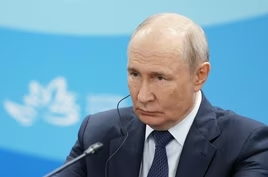
Russia may force more men to fight in Ukraine as military faces heavy losses (7m 59s)
 New
NewShiyazh Pete on the speech that made him a viral sensation
Video has Closed Captions
Shiyazh Pete on inspiring Navajo Nation and the speech that made him a viral sensation (5m 5s)
 New
NewSteinem stayed true to herself despite pressure, Taymor says
Video has Closed Captions
Steinem stayed true to herself despite intense pressure, Julie Taymor says (7m 17s)
Providing Support for PBS.org
Learn Moreabout PBS online sponsorship
- News and Public Affairs

Today's top journalists discuss Washington's current political events and public affairs.

- News and Public Affairs

FRONTLINE is investigative journalism that questions, explains and changes our world.


 New Episode
 New Episode



 New Episode
 New Episode
 New Episode
Support for PBS provided by:
Major corporate funding for the PBS News Hour is provided by BDO, BNSF, Consumer Cellular, American Cruise Lines, and Raymond James. Funding for the PBS NewsHour Weekend is provided by...