
Urban Wildlife: Promote a Little Wildlife
Clip: Special | 1m 4sVideo has Closed Captions
What should you do and not do to promote Urban Wildlife in your backyard?
Not every backyard is a welcoming place for animals and beneficial insects. Find out what you can do and should never do to promote Urban Wildlife in your area.
Problems playing video? | Closed Captioning Feedback
Problems playing video? | Closed Captioning Feedback
Science Trek is a local public television program presented by IdahoPTV
Major Funding by the Laura Moore Cunningham Foundation and the Idaho National Laboratory. Additional Funding by the Friends of Idaho Public Television and the Corporation for Public Broadcasting.
Urban Wildlife: Promote a Little Wildlife
Clip: Special | 1m 4sVideo has Closed Captions
Not every backyard is a welcoming place for animals and beneficial insects. Find out what you can do and should never do to promote Urban Wildlife in your area.
Problems playing video? | Closed Captioning Feedback
How to Watch Science Trek
Science Trek is available to stream on pbs.org and the free PBS App, available on iPhone, Apple TV, Android TV, Android smartphones, Amazon Fire TV, Amazon Fire Tablet, Roku, Samsung Smart TV, and Vizio.
Science Trek
Science Trek is a place where parents, kids, and educators can watch short, educational videos on a variety of science topics. Every Monday Science Trek releases a new video that introduces children to math, science, technology, engineering, and math (STEM) career potentials in a fun, informative way.[MUSIC] Joan Cartan-Hansen, Host: How can wild creatures and people live together in the same space?
Well, there are things you can do to encourage a little wildlife in your backyard.
If you have a flower garden, plant it with wildlife in mind.
Things like sunflowers, and cornflowers and black-eye susans help attract song birds.
Other plants attract butterflies and other pollinators.
Nesting boxes give birds a place to live.
And native trees and hedges provide a home for birds, insects and small mammals.
You can hang a bird feeder, or a bat house.
So, those are some ideas about what you can do to promote wildlife, but there are something things you should never do.
Never disturb animals in their habitat.
Watch them at a distance.
Don't feed wild animals.
And leave baby animals alone.
Their parents may be away gathering food and they won't come back until you leave.
If you think an animal is hurt, don't touch.
Call an adult or someone from your local wildlife services for help.
For more information about urban wildlife, check out the science trek website.
You'll find it at science trek dot org
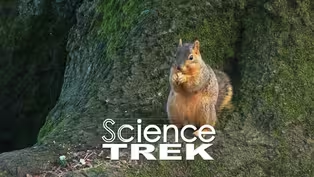
Urban Wildlife: Living Wild in the City
Video has Closed Captions
Clip: Special | 1m 4s | What kind of animals live in an urban environment? (1m 4s)
Providing Support for PBS.org
Learn Moreabout PBS online sponsorship
- Science and Nature

Explore scientific discoveries on television's most acclaimed science documentary series.

- Science and Nature

Capturing the splendor of the natural world, from the African plains to the Antarctic ice.











Support for PBS provided by:
Science Trek is a local public television program presented by IdahoPTV
Major Funding by the Laura Moore Cunningham Foundation and the Idaho National Laboratory. Additional Funding by the Friends of Idaho Public Television and the Corporation for Public Broadcasting.