
Water access becomes top election issue for Arizona voters
Clip: 10/12/2026 | 4m 51sVideo has Closed Captions
Water access becomes a top election concern for Arizona voters
For many Arizona voters, the top concern heading into the midterms isn't inflation, immigration or education. It's water. With the state gripped by prolonged drought, candidates are facing growing questions about how to secure its water future. Stephanie Sy reports for our series, Tipping Point.
Problems playing video? | Closed Captioning Feedback
Problems playing video? | Closed Captioning Feedback
Major corporate funding for the PBS News Hour is provided by BDO, BNSF, Consumer Cellular, American Cruise Lines, and Raymond James. Funding for the PBS NewsHour Weekend is provided by...
Water access becomes top election issue for Arizona voters
Clip: 10/12/2026 | 4m 51sVideo has Closed Captions
For many Arizona voters, the top concern heading into the midterms isn't inflation, immigration or education. It's water. With the state gripped by prolonged drought, candidates are facing growing questions about how to secure its water future. Stephanie Sy reports for our series, Tipping Point.
Problems playing video? | Closed Captioning Feedback
Where to Watch PBS News Hour
PBS News Hour is available to stream on pbs.org and the PBS app.
Providing Support for PBS.org
Learn Moreabout PBS online sponsorshipGEOFF BENNETT: For many Arizona voters, the top concern heading into the midterms isn't inflation, immigration, or education.
It's water.
With the state gripped by prolonged drought, candidates are facing growing questions about how to secure the state's water future.
Our Stephanie Sy reports now for our ongoing climate series, Tipping Point.
STEPHANIE SY: Canals like this one, which winds through the heart of Phoenix, carry water to this desert metropolis.
But the water is becoming scarcer.
MATT BEIDLER, Arizona Voter: It's obviously a really big concern.
In fact, our family is considering moving, variety of factors, but sustainability overall, and water is obviously a huge factor.
STEPHANIE SY: Matt Beidler, a father who works in I.T.
sales here, is not the only Arizona starting to fear the worst.
For the first time ever, worries about water are the top concern for this swing state's voters, even overtaking immigration and affordability, according to a recent survey from the Center for the Future of Arizona.
SYBIL FRANCIS, Center for the Future of Arizona: Water's certainly been in the political conversation in the past, but this is very new.
I don't think I have seen candidates running for governor talking about water issues in the past.
STEPHANIE SY: At least not to this degree.
The shift follows deep federal cuts this summer to Colorado River water allocated to Arizona cities.
GOV.
KATIE HOBBS (D-AZ): And those before me didn't protect our water, so I tackled the problem.
STEPHANIE SY: Now water issues are dominating the airwaves and the political debate for governor.
MAN: Everybody's concerned about water.
STEPHANIE SY: Reaching into the competitive race for the open U.S.
House seat in Arizona's First District.
Democrat Amish Shah: AMISH SHAH (D), Arizona Congressional Candidate: This is the state of Arizona.
We live in a desert and we're running out of water.
So, obviously, our voters are really scared and upset about this.
We have a precious resource that we absolutely need to conserve.
STEPHANIE SY: Shah says the state should conserve water, fight for fair allocation and stop using water for data centers.
His Republican opponent, Jay Feely, says the economy and affordability are still the district's top issue, but water is a big concern too.
JAY FEELY (R), Arizona Congressional Candidate: People are concerned about that.
And it does impact so many different areas, when we're talking about data centers, we're talking about building more homes to bring down the cost, we're talking about bringing industry here.
Those are all impacted.
STEPHANIE SY: As Arizona voter Victoria Richardson plays with her young son in the park, she has data centers and his future on her mind.
VICTORIA RICHARDSON, Arizona Voter: I'm more concerned with the amount of data centers that are going in Arizona because of the amount of resources that they're taking and the amount of water that they're going through, especially in a desert climate.
It's about making sure that there's resources not just for us, but for the generations that follow.
STEPHANIE SY: According to one analysis, data centers use a small fraction of water in Arizona, with agriculture consuming 75 percent of the state's water.
Sarah Porter, who directs the Kyl Center for Water Policy at Arizona State University, says the state has invested heavily to avoid a water crisis.
But headlines have scared many residents.
SARAH PORTER, Arizona State University: People imagine -- the worst case that they imagine is waking up and turning on the tap and no water running from the tap.
And that simply isn't in the cards.
STEPHANIE SY: That doesn't mean there won't be changes coming for residents in the state, whether that's restrictions on water use or higher rates due to the cost of expensive water infrastructure.
Phoenix is building an advanced water purification plant meant, the city says, to supplement the Colorado River supply, not replace it.
Nazario Prieto is the city's assistant water services director.
NAZARIO PRIETO, Phoenix, Arizona, Assistant Water Services Director: How much does it cost to not have enough water, right?
What is the cost of that?
And then, when we start looking at the shortages on the Colorado, the water -- any water source is going to get more and more expensive.
STEPHANIE SY: The Center for the Future of Arizona's Sybil Francis says every community faces different degrees of water shortage, which candidates would be wise to address.
SYBIL FRANCIS: It's not like there's one answer to this, but I think every politician should be communicating with their communities about what they are doing, how they see the issue and what they're doing.
STEPHANIE SY: For voter MATT BEIDLER, it comes down to the long-term economics.
MATT BEIDLER: If you want to live here, if you want your home to still have valuation, there needs to be a sustainability plan to proactively get in front of the changing climate here.
STEPHANIE SY: With early voting already under way, Arizona voters are asking candidates for exactly that, a plan.
For the "PBS News Hour," I'm Stephanie Sy in Phoenix.
 New
New'Blockers' highlights government workers who resisted DOGE
Video has Closed Captions
In 'Blockers,' Michael Lewis highlights government workers who resisted DOGE (7m 58s)
 New
NewA Brief But Spectacular take on giving veterans a chance
Video has Closed Captions
A Brief But Spectacular take on translating military service into civilian life (3m 1s)
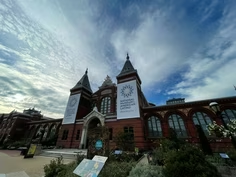 New
NewSmithsonian's American Latino museum finds permanent home
Video has Closed Captions
Smithsonian's American Latino museum finds permanent home on National Mall (5m 50s)
 New
NewTamara Keith and Amy Walter on GOP's midterm vulnerability
Video has Closed Captions
Tamara Keith and Amy Walter on the GOP's vulnerability in the midterms (8m 21s)
 New
NewUkraine disputes ceasefire as Trump's diesel deal draws fire
Video has Closed Captions
Ukraine disputes Trump's claim of energy ceasefire as Russian diesel deal draws fire (10m 42s)
Providing Support for PBS.org
Learn Moreabout PBS online sponsorship
- News and Public Affairs

FRONTLINE is investigative journalism that questions, explains and changes our world.
 New Episode
- News and Public Affairs

Today's top journalists discuss Washington's current political events and public affairs.
 New Episode
 New Episode
 New Episode
 New Episode
 New Episode
 New Episode
 New Episode
 New Episode
 New Episode
Support for PBS provided by:
Major corporate funding for the PBS News Hour is provided by BDO, BNSF, Consumer Cellular, American Cruise Lines, and Raymond James. Funding for the PBS NewsHour Weekend is provided by...