
Middle East experts assess prospects for U.S.-Iran deal
Clip: 6/11/2026 | 8m 40sVideo has Closed Captions
Middle East experts assess prospects for U.S.-Iran deal
To discuss the latest developments in the conflict between the U.S. and Iran, Amna Nawaz spoke with Joel Rayburn and Suzanne Maloney. Rayburn is a retired Army colonel and is now at the Hudson Institute. Maloney served in the State Department during the George W. Bush administration and is now at the Brookings Institution.
Problems playing video? | Closed Captioning Feedback
Problems playing video? | Closed Captioning Feedback
Major corporate funding for the PBS News Hour is provided by BDO, BNSF, Consumer Cellular, American Cruise Lines, and Raymond James. Funding for the PBS NewsHour Weekend is provided by...
Middle East experts assess prospects for U.S.-Iran deal
Clip: 6/11/2026 | 8m 40sVideo has Closed Captions
To discuss the latest developments in the conflict between the U.S. and Iran, Amna Nawaz spoke with Joel Rayburn and Suzanne Maloney. Rayburn is a retired Army colonel and is now at the Hudson Institute. Maloney served in the State Department during the George W. Bush administration and is now at the Brookings Institution.
Problems playing video? | Closed Captioning Feedback
Where to Watch PBS News Hour
PBS News Hour is available to stream on pbs.org and the PBS app.
Providing Support for PBS.org
Learn Moreabout PBS online sponsorshipAMNA NAWAZ: For perspective on all these developments, we get two views.
Retired Army Colonel Joel Rayburn served in the first Trump administration on the national security staff with a focus on Iran.
He's now at the Hudson Institute.
And Suzanne Maloney served on the State Department's policy planning staff during the George W. Bush administration.
She's now director of the foreign policy program at the Brookings Institution and focuses on Iran and the Gulf energy economy.
Welcome to you both.
And, Suzanne, kick us off here.
You saw the president cancel strikes on Iran just hours after threatening more.
He now says a deal is approved.
Do you believe him?
SUZANNE MALONEY, Brookings Institution: Well, thanks so much.
I don't know what to believe at this point.
It's been a pretty wild week.
And I think that what we have seen is that there have been negotiations under way for some time.
There has been much public talk, particularly by the president, that a deal is near.
But I think both sides also believe that the use of force can accelerate the negotiations or amplify their own position in those negotiations.
So I would expect that, even if we get to a first phase of any agreement, we're likely to see continued unrest and turmoil and potentially sporadic tit-for-tat exchanges like we have seen over the course of the past week.
AMNA NAWAZ: Joel, what about you?
What's your reaction?
Do you believe the president, when he says a deal has been approved?
COL.
JOEL RAYBURN (RET.
), Former Trump National Security Council Staff: Well, I believe that -- first of all, I believe he's an eternal optimist and he's going to cast things in a positive light.
And I think, from the U.S.
perspective, they feel probably and via Pakistani interlocutors and Qatari interlocutors that they have got the Iranian interlocutors in a place that's very close.
The problem is that the Iranian regime, of course, their pattern is to move the goalposts when they get into that zone.
Their pattern also is to appear accommodating when they're under severe military and economic pressure and then, as soon as that pressure is relieved, then to try to erase the red lines, soften the red lines.
So I think the devil's in the details here.
I also think that Lebanon is the issue on which the IRGC in particular might try to thwart a deal, move the goalposts, and try to hold on to Lebanese Hezbollah as an instrument.
AMNA NAWAZ: I want to get to Lebanon in just a moment.
But, Joel, to stick with you, to be very close to a deal is not what the president is saying.
He's saying a deal has been approved.
If you don't think we're there yet, what do you think it would take for the U.S.
to get Iran to a deal?
COL.
JOEL RAYBURN (RET.
): Look, if they are - - if the Iranians are ready to accept a deal that's acceptable to President Trump, then it can only be because last night he demonstrated something that I think they didn't believe before last night, which is that he's willing to return to the use of force.
So he reestablished, I think, the credibility of the threat of force.
There was also another very important revelation that he made yesterday, which is that essentially Project Freedom, which we all thought had been called off at the behest of the Gulf, and in anticipation that Iranians might retaliate a few weeks ago, that actually something like it has been continuing clandestinely.
And there's been some leakage of the Iranian blockade of the Strait of Hormuz, which also explains, I think, which if -- the Iranians have to take that into account.
They have to realize that their timetable, their pressure on trying to generate economic pressure in the global economy may be leaky.
So that could affect their calculus as well.
AMNA NAWAZ: Suzanne, you agree with that premise there that it would take additional U.S.
military force to push Iran to a deal, a final deal?
SUZANNE MALONEY: Look, I think the Iranians need and want to deal, but they want to deal on their terms, and they want to be able to set a new strategic equation across the region that includes their own hegemonic role.
And here we see, as Joel referenced, their efforts to try to insulate their proxies, to use their power to insulate their proxies, rather than using their proxies to extend their influence.
I think that tells you about their mind-set.
I don't think that whatever limited success Project Freedom might have had has really changed the extent to which Iran is capable of truly harming the global economy and creating ripple effects for the American economy.
We saw something like statistics of perhaps 200 ships that may have transited under some U.S.
guidance without their transponders on, and so there has been a bit of leakage.
But contrast that with 130 to 160 ships that were transiting the Strait of Hormuz prior to President Trump's decision to try to promote regime change through the use of military force on February 28 in Iran.
I think the reality is that economic pain is much tougher on the United States and the international economy.
The Iranians believe that they can be resilient because they have built an economy that has been structured to evade U.S.
sanctions and economic pressure over the course of the past 47 years.
AMNA NAWAZ: Joel, to that point of what Iran could agree to and what they are pressured to agree to right now, you mentioned Lebanon.
We reported earlier Prime Minister Netanyahu of Israel said they're not part of the deal.
If we take that to mean Israel's war in Lebanon continues, why would Iran agree to that after they have repeatedly tied the ending of that war to any deal with the U.S.?
COL.
JOEL RAYBURN (RET.
): I think what the Iranians will try to do is to reach a deal that basically is a trading of their blockade for our blockade, so that the Strait of Hormuz opens up, they get relieved of economic pressure and the blockade, but then they try to kick the can down the road on disposition of their nuclear program and certainly on things like their missile and drone capacity and, then most of all, Hezbollah.
I wouldn't say the rest of the proxies.
I think Hezbollah is so qualitatively different from the rest of the proxies.
Hezbollah is so important to the Revolutionary Guards, especially to someone like Ahmad Vahidi, who's the new commander of the Revolutionary Guards.
I think they will go very far, almost to the end, almost to collapse, in the service of trying to preserve Hezbollah, because Hezbollah is so important to their ideology, Islamic Revolution and their projection of power.
AMNA NAWAZ: Suzanne, is that kind of deal, one that would essentially reopen the Strait of Hormuz, but does not include specifications about the nuclear program, is that one worth the U.S.
signing?
SUZANNE MALONEY: Well, look, I think that's not the deal that President Trump would prefer to sign.
It's not the deal that any American president would prefer to sign.
But it is likely the deal that is on offer right now.
And we are coming to a point at which the physical disruption of energy supplies from the Gulf is going to begin to hit the entire global economy, not just Asia and Europe and jet fuel, but really here in the United States.
We have already seen the impact on gasoline prices, on inflation rates.
The president has a larger agenda that he's trying to advance.
And it is -- unfortunately, the miscalculations that informed the military campaign are ones that really can't be undone at this point.
The challenge you will have is moving from a reopening of the strait, however modest and incremental it may be, to a meaningful nuclear agreement that constrains Iran's capacity to move toward weapons capability.
It took two years to negotiate the 2015 deal.
That was 159 pages of very dense text.
I don't think that this administration necessarily has the patience to engage in something that detailed, and we're going to have to see what the Iranians are prepared to really put on the table with respect to the nuclear program.
AMNA NAWAZ: Joel, I will give you the last word here in less than a minute or so we have left.
On that miscalculations point, the U.S.
has miscalculated before on how long this would take, on how much economic and military pressure Iran could sustain, on whether or not there would be infighting in the regime.
Could they be miscalculating again?
COL.
JOEL RAYBURN (RET.
): Well, listen, I think actually of the two parties, the one that's more prone to miscalculation, misjudgment and overreach is the Iranian regime.
They're very insular.
I don't think they understand the world beyond their borders very well.
They certainly don't understand the U.S.
And they have misjudged President Trump over and over again.
Look at back at the time, for example, of the Qasem Soleimani raid.
Qasem Soleimani and the supreme leader didn't think the President Trump was going to use military force in that case.
I think last night he tried to dispel them of that miscalculation in order to set the table for the deal.
So I would look more of miscalculation on their side than on ours.
AMNA NAWAZ: Joel Rayburn, Suzanne Maloney, thanks so much to both of you for joining us tonight.
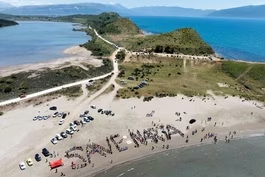
Kushner-Trump resort plan sparks protests in Albania
Video has Closed Captions
A look at the Albanian island where a Kushner-Trump resort plan has sparked protests (7m 25s)
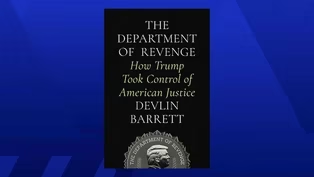
New book explores Trump's use of DOJ to settle scores
Video has Closed Captions
'The Department of Revenge' explores Trump's use of DOJ to settle political scores (8m 6s)
Spy program set to expire as Congress rejects FISA extension
Video has Closed Captions
Surveillance program set to expire as Congress rejects FISA extension (5m 41s)
Trump calls off strikes, says deal with Iran is close
Video has Closed Captions
Trump calls off threatened strikes, says deal with Iran is close (5m 20s)
Why SpaceX is rocketing toward largest IPO in history
Video has Closed Captions
Why SpaceX is rocketing toward largest IPO in stock market history (6m 13s)

World Cup players challenged by dangerously hot weather
Video has Closed Captions
World Cup players challenged by dangerously hot weather (5m 22s)
Providing Support for PBS.org
Learn Moreabout PBS online sponsorship
- News and Public Affairs

FRONTLINE is investigative journalism that questions, explains and changes our world.
 New Episode
- News and Public Affairs

Today's top journalists discuss Washington's current political events and public affairs.
 New Episode
 New Episode
 New Episode
 New Episode
 New Episode
 New Episode
 New Episode
 New Episode
Support for PBS provided by:
Major corporate funding for the PBS News Hour is provided by BDO, BNSF, Consumer Cellular, American Cruise Lines, and Raymond James. Funding for the PBS NewsHour Weekend is provided by...