
Washington Week with The Atlantic full episode, 6/26/26
6/26/2026 | 26m 46sVideo has Closed Captions
Full Washington Week with the Atlantic broadcast from June 26, 2026.
Full Washington Week with the Atlantic broadcast from June 26, 2026.
Problems playing video? | Closed Captioning Feedback
Problems playing video? | Closed Captioning Feedback
Major funding for “Washington Week with The Atlantic” is provided by Consumer Cellular, Otsuka, Kaiser Permanente, the Yuen Foundation, and the Corporation for Public Broadcasting.
Washington Week with The Atlantic full episode, 6/26/26
6/26/2026 | 26m 46sVideo has Closed Captions
Full Washington Week with the Atlantic broadcast from June 26, 2026.
Problems playing video? | Closed Captioning Feedback
Where to Watch Washington Week with The Atlantic
Washington Week with The Atlantic is available to stream on pbs.org and the PBS app.
Buy Now
10 big stories Washington Week covered
Washington Week came on the air February 23, 1967. In the 50 years that followed, we covered a lot of history-making events. Read up on 10 of the biggest stories Washington Week covered in its first 50 years.Providing Support for PBS.org
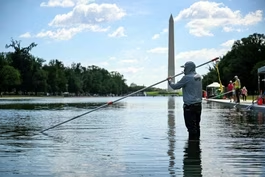
Learn Moreabout PBS online sponsorshipJEFFREY GOLDBERG: The Reflecting Pool between the Lincoln Memorial and the Washington Monument, ordinarily an admired and generally undiscussed feature of the nation's capital, has a new role.
It's the place where metaphor goes to die.
President Trump's renovation turned it into an actual swamp in desperate need of draining.
Tonight, we'll look at the ways in which the White House's chaotic approach to redesigning Washington is representative of the broader chaos in foreign and domestic policy, next.
Good evening, and welcome to Washington Week.
It isn't only metaphors that go to die in the Reflecting Pool.
Apparently, some ducks might have died there as well.
The Reflecting Pool episode is not, in itself, important, unless you're one of those ducks, but compared to matters related to the economy, energy prices, and housing, of course, war in the Middle East and Europe, Trump's efforts to remake Washington don't matter all that much.
But they tell us a lot about the current chaos and about his approach to leadership and governance.
Here to make sense of the week, Leigh Ann Caldwell, the chief Washington correspondent at Puck, Stephen Hayes is the editor and CEO of The Dispatch, Michael Scherer is a staff writer and White House correspondent at The Atlantic, and Nancy Youssef is a staff writer and Pentagon correspondent at The Atlantic.
Thank you all for -- I just want to stand up for ducks.
Stand up for ducks.
That's our new motto at Washington Week.
But, Steve, let's just jump right into the Reflecting Pool.
What does it all mean?
What is the obsession with the Reflecting Pool, both the political obsession and the president's original obsession?
STEPHEN HAYES, Editor, The Dispatch: Yes.
I mean, look, I've spent the better part of three weeks trying to ignore this story as much as I possibly could.
JEFFREY GOLDBERG: Not me.
STEPHEN HAYES: Precisely because it wasn't - - when you look around, it's like we're really focused on the Reflecting Pool.
I think the president wanted to boast about what he's done to clean up Washington.
They cleaned up a fountain near Union Station.
This was part of a broader sort of refurbishment.
And his fans were out on social media boosting the president.
And immediately, or almost immediately, it was clear that this wasn't working.
Whatever had happened elsewhere, this one wasn't working.
And so you have the president trying to find somebody to blame for what has gone wrong.
Is it possible that there was a -- JEFFREY GOLDBERG: The international algae conspiracy.
STEPHEN HAYES: Yes the international algae conspiracy, the vandals that have cut this reinforced rubber that he said a couple months ago couldn't be cut.
I think it's possible that that happened.
I mean, you've had left wing types try to assassinate the president several times.
So, sure, maybe they wanted to embarrass him here.
But we can say that the way that the White House has reacted is inconsistent with the way the White House reacts when something like this happens.
Remember Kash Patel jumped the gun on the UFC plot.
He outed people in previous attempts on the president's life.
You've got the president himself who tweeted out a picture of the White House Correspondents' Dinner shooter right as it happened, before anything happened.
They've told us nothing about these potential vandals so far.
JEFFREY GOLDBERG: Right.
Michael, we reported this week, The Atlantic reported this week that in a meeting with Lonnie Bunch, the head of the Smithsonian, last year, President Trump spent most of the time talking about chandelier color.
MICHAEL SCHERER, Staff Writer, The Atlantic: Yes.
JEFFREY GOLDBERG: And also talking about his deep desire to knock down Dulles Airport and rename it after himself, rebuild it.
It's not really a joke at all to suggest that President Trump cares more about architecture, design, interior decorating than he cares about almost anything.
MICHAEL SCHERER: Yes, he's a hobbyist who happens to be president, and he's getting to do his hobby with public taxpayer dollars at what -- to whatever extent he wants.
Part of this is also that he conflates national greatness with what he can do.
And that's sort of part of his identity, it's part of his politics.
We saw him on the National Mall this week launching the Great American State Fair, patriotic event, supposed to be a unifying moment.
It was all about how great he has been as president.
That was his speech.
That was the speech he delivered.
And he is -- like, these projects are not going to end.
I reported this week that you know, he had said months ago that he was repaving the colonnade outside the Oval Office with black African granite.
JEFFREY GOLDBERG: It was Tennessee flagstone, but that was not good enough.
MICHAEL SCHERER: That was not good enough.
And he said he'd pay for it, but he isn't paying for it.
You know, the Park Service documents show that that the Park Service was billed for it.
And he keeps going to Congress.
He went there initially for $10 billion for D.C.
beautification.
They said no.
He said he wanted a billion dollars in the summer supplemental for White House security enhancements.
They said no.
He just put up a supplemental for the Iran war, and he asked for another $500 million for the Park Service, including he wants to rebuild the retaining wall, I think, around the golf course that he wants to redo, the sea wall there on the Potomac River.
So he's not done.
He's just getting going.
I mean, we're going to have project after project after project, because it is really the thing that captures his imagination, gets him excited.
JEFFREY GOLDBERG: Is this because he's a hotel guy?
MICHAEL SCHERER: His whole life has been this, yes, from the beginning.
I mean, like, go back to the earliest quotes you can find of Donald Trump in 1983 or '84.
It's about what he knows about real estate and how to make buildings beautiful.
So, that's his whole identity.
JEFFREY GOLDBERG: Right.
Leigh Ann, let's move to things that happen inside government buildings, not the paint jobs and the marble.
There was this burst of bipartisanship this week, that was then burst.
The burst was burst by Donald Trump at the last minute not participating, deciding not to participate in this bipartisan effort.
Give us the backdrop of this.
Give us the background.
LEIGH ANN CALDWELL, Chief Washington Correspondent, Puck: Yes.
So, you're talking about a bipartisan housing bill that passed overwhelmingly from the House and the Senate.
It was like old school legislating, something that is really a lost art on Capitol Hill, something especially that's a lost art on the Trump administration, who Trump cares about things that can pass with Republicans only.
And it defied -- despite the president, it moved forward.
The president decided that he was not going to sign it into law.
There was a podium set up at the Capitol.
All the chairs were ready to go.
There was flowers and the ropes, everything, you know, in a production-like way.
This was going to be legislation that both parties actually could tout on the affordability crisis.
And -- JEFFREY GOLDBERG: Its goal was to -- its goal is to make it easier to build housing.
LEIGH ANN CALDWELL: Yes.
It incentivizes more building.
It talks about the low stock in housing, trying to cut through that.
So, the president decided an hour before he was supposed to sign it that he is not going to sign it.
The reason is because of the Save America Act.
This is legislation that the president has been obsessed with.
It's about requires a voter I.D.
to vote.
It requires proof of citizenship.
He keeps adding things he wants on this, including prohibiting mail-in ballots, banning women or trans men from playing in women's sports.
And he has really paralyzed Washington over this.
The House of Representatives didn't do any work this week because one Republican member was holding everything up because the Senate has not passed the Save America Act.
The Senate is completely paralyzed as well.
The president won't sign foreign intelligence surveillance legislation because of it, won't sign the bipartisan housing bill.
You know, he went to Capitol Hill to yell at Republican senators about this very issue this week.
JEFFREY GOLDBERG: And they yelled back, some of them at least.
LEIGH ANN CALDWELL: One, one person, Senator Bill Cassidy, yelled back.
This was their opportunity to have a discussion with the president about why it's impossible for this legislation to pass the Senate.
There are not 60 votes.
You need Democrats in order to do it.
The president wants them to change the Senate rules, get rid of the filibuster, do whatever it takes, like the president is doing whatever he wants with the Reflecting Pool, building everything.
He is extremely frustrated with the Senate.
Senate Majority Leader John Thune won't change the Senate rules for this.
It is dividing the conference.
It is dividing the Republican base.
People are worried about the impact this is going to have on the midterm elections.
And I'm going to report on Sunday that -- and my column on Sunday, that one of the things that the president told the Republican senators in this closed-door lunch is, no one cares about housing.
At my rallies, no one cheers about housing.
What they do cheer for is the SAVE Act, is this voting legislation.
And so that really encapsulates how he's thinking about this and what his priorities are.
And, again, getting back to like the big picture here, Congress is completely paralyzed.
JEFFREY GOLDBERG: Right.
Nancy, staying on the subject of things that divide the Republican Party, things that divide the Republican base, Iran.
Iran just fired on a tanker because the tanker apparently wasn't following the rules of the road, or the rules of the Strait of Hormuz that Iran believes are now in place.
How did we get to this point now where Iran is regularly asserting its control over the Strait of Hormuz, even after this preliminary agreement?
It just seems as if you melt away everything else, before the war started in February, the strait was open, and now Iran believes that it's theirs, and the Trump administration isn't doing very much about that.
NANCY YOUSSSEF, Staff Writer, The Atlantic: So, the way it started was the U.S., in February, when it launched its war on Iran, said that it was going after its leadership, that this was a threat to Iran's existence itself.
And so Iran said, if that's the case, we're going to use the most important card we have, the one that we've held for this situation, which is threatening passage through the Strait of Hormuz, knowing that it's critical to the world economy because one-fifth of oil went through there, as well as key resources traveled through that strait.
And so it brought the strait into the war.
The U.S.
then was unable to make the regime fall.
But what the regime learned was that by using that leverage, it gave itself a strategic advantage in not only the war, but then subsequently the talks.
We heard it from Trump himself.
Why did he want to end the war now?
He said, in France, because of the threat to the economy, not because of Iran's missile strikes on Gulf partners.
The primary issue is that stockpiles were running low, and we had to reopen the strait.
So, that's how we got here.
Then they signed a memorandum of understanding.
A memorandum of understanding doesn't deal with the core issues around this, and, in some ways, we all were waiting for this moment when Iran would try to leverage again its power over the strait because, by doing so, what Iran is saying is, you can agree on whatever you want, we can make any kind of deal we want, there can also be unofficial ways that we control the strait.
In the days leading up to this, there was a lot of chatter to ships traveling through, you need to check with us first.
You need our approval first.
You need to pay first, potentially going down the road.
So, they're trying to set the conditions on how the strait's going to operate going forward.
Outside of these what could be months-long talks about key issues, like proxies, ballistic missiles and eventually the strait.
So, that's how we got to the point that they are now using their drones to create enough intimidation such that they continue to have a say over how the strait operates despite what the president says.
JEFFREY GOLDBERG: Steve, that does not sound like winning, does it?
STEPHEN HAYES: No, it's definitely not winning.
And to add to Nancy's list, I mean, we haven't settled the big things.
And the memorandum of understanding is a punt, and it's unclear whether there will actually be a deal, in part because Iran got a lot of the things that Iran was seeking through the memorandum of understanding.
JEFFREY GOLDBERG: Explain why it's a punt, just for a moment.
STEPHEN HAYES: Well, it's a punt because the Iranians knew what they wanted to get, and they got a lot of those things.
I mean, the first paragraph says, no more fighting in Lebanon.
Lebanon is mentioned three times.
They wanted to protect Hezbollah.
The Trump administration effectively shrugged their shoulders and said, okay, we'll do that.
They've gotten free flow of oil, of goods.
They're getting more money.
We're talking about a $300 billion recovery fund that the administration sort of, in the memorandum of understanding itself, suggests that they're going to help with, but then when they're asked about it, they sort of shrugged their shoulders and say, we haven't made any commitments.
But Iran is now going to be getting this money that they've long sought one way or the other, whether it's the relief of sanctions, whether it's through a recovery fund.
And the administration's basically tied its own hands to negotiate further.
JEFFREY GOLDBERG: Yes.
Go ahead.
NANCY YOUSSEF: Can I just add quickly?
Because I think those are all important points.
If nothing happens, Iran now has the capability to sell their oil at market value.
There are tankers in the water right now that they can start selling to China.
There are silos in China filled with oil that they can start making hundreds of billions of dollars off of right now if nothing else changes.
JEFFREY GOLDBERG: And replenish their weapons stores with that money.
NANCY YOUSSEF: They replenish their weapons stores.
They could rebuild their proxy network.
There's all sorts of funding that, that, that comes into play even if nothing else happens because of just the memorandum of understanding.
So, you can imagine what's at stake for the United States and for Iran as we go through the details of things like proxy groups, their ballistic missile capability and other factors.
STEPHEN HAYES: Hezbollah's also gotten more than a billion dollars by the Institute for Study of War analysis, more than a billion dollars since 2024.
And Iran has already signaled that it will be replenishing its funds and increasing those based on what they're getting here.
MICHAEL SCHERER: And I think the other issue here is, as we get closer to the midterm elections, Iran's ability to affect the U.S.
economy again and affect the political standing of the president grows, and they've shown that there was never a settlement.
There's not a flip switch that says, okay, we're now in agreement, peace is at hand.
And so I fully expect, I don't, you know, know their thinking, I don't report on it, but that Trump remains vulnerable.
If we go into September and there's another 10 percent spike in oil prices, that's a news cycle.
Everyone knows what the oil, the price of gasoline is.
That hurts Trump.
And he doesn't have -- JEFFREY GOLDBERG: So, he who controls the price of gas at the pump two months before a midterm has extraordinary power over an American election?
NANCY YOUSSEF: Because Trump has said, I don't want to go back to military action, he has signaled that.
And so if the Iranians know that the president is reluctant to use military force again, they have incentive to sort of challenge the control of the strait and by extension the price of oil.
JEFFREY GOLDBERG: What is notable about that obviously is that President Trump, among other Republicans, was highly critical of President Obama for signaling in Afghanistan and elsewhere, we're going to do X, but we're not going to do Y. Telling the enemy ahead of time, this is what we're not going to do, and now they seem to be doing the same exact thing.
Steve, you mentioned something that struck me, and I want to ask the broader question about the debate inside Republican Party, inside the administration.
But you basically alluded to the fact that in this last round, the United States, the Trump administration more or less took the side of Iran on the Lebanon question, and not Israel, its partner in the war that was launched in February.
That seems like a plot twist.
STEPHEN HAYES: Yes.
I mean, it's what -- look, I think you can say without hyperbole, without exaggeration, that this is a pro-terrorism deal that -- the memorandum of understanding, as it stands right now, because it makes clear that the IRGC the Iranian regime, is going to be flush with cash, the same thing that Republicans, as you pointed out, objected to in the most strenuous terms under Barack Obama, I think, correctly.
That's now going to happen at scale, in orders of magnitude more money we're talking about.
Money's fungible.
This is one of the things Republicans went nuts on.
And that means that Hezbollah's going to be stronger.
JEFFREY GOLDBERG: So, Leigh Ann, you have a lot of people on the Hill, Republican senators on the Hill, who are hawkish on these Middle East questions, in the style of their former colleague, Marco Rubio, the secretary of state, who runs one branch of American foreign policy.
J.D.
Vance seems to run another.
What are you hearing among that sort of national security crowd, among Republicans, about these not completely coherent twists and turns in Trump's policy?
LEIGH ANN CALDWELL: The national security Republicans are -- many of them are mostly privately beside themselves what this MOU does.
They don't like it but they're not willing to do much about it.
We saw that for the first time at the beginning of the week that four Republicans joined with Democrats and to vote in favor to end the war, essentially, a war powers resolution.
You know, it had passed really because two Republican senators were gone.
There was an attendance issue, but still it passed.
Donald Trump comes to the Senate, has his lunch about the voting rights bill, or the voting bill, but also is furious about this Iran vote.
Even though it's symbolic, it doesn't sign it into law, it doesn't have any binding properties, he understands that this is a bad message that is being sent to Iran.
And then, you know, later in the day, Senator Bill Cassidy, the same senator who got into a shouting match with the president over Iran, flips his vote in a new version of this bill, and votes to side with the president.
He says it's because he finally got a briefing from -- on the issue.
He went to the vice president's house, talked to the vice president and Steve Witkoff.
Great, maybe he has a better understanding now of what the intentions are, but he really got bullied into this.
And the reality is what's happening on the Hill, Pete Hegseth has given a briefing to conservative members of the House of Representatives about this MOU.
A select few number of Republican senators got a briefing from J.D.
Vance and Steve Witkoff on the MOU.
There's been some, you know, national security smaller group briefings, but there has not been any sort of all-member understanding of what's happening there.
And so half the Congress is being left out of these discussions.
JEFFREY GOLDBERG: Right.
NANCY YOUSSEF: Can I quickly add, I think of the war in Iran splitting the Republican Party between MAGA and neoconservatives the way the war in Gaza split progressive and centrists on the Democratic side.
JEFFREY GOLDBERG: Right.
I want to get to that in, in a minute.
Before we do, I want to talk about J.D.
Vance.
He's had an interesting week.
Here's something -- just watch this for a second.
Here's something that he said about Richard Nixon just the other day.
J.D.
VANCE, U.S.
Vice President: I think that his historical legacy is enjoying a bit of a renaissance, but I think deservedly so.
As I joked with Robert backstage, if Watergate happened tomorrow, it would be like a 12-hour news story, like the idea that it would've taken down a presidency is crazy.
JEFFREY GOLDBERG: I'm perplexed why someone would -- someone who works for Donald Trump say that.
Michael, you just broke another story about a corruption-related issue today.
What is Vance doing there?
MICHAEL SCHERER: I think, I mean, if you talk to White House advisers and other Trump world advisers about Vance, they'll mention he's just really green.
He hasn't been in politics very long.
He was only just elected to the Senate before he became vice president.
He just doesn't have a lot of experience.
And I think he's too online.
I mean, the idea that Republicans defend Nixon is one thing.
It's pretty normal at this point.
Trump has been very favorable about Nixon.
The idea that the Watergate scandal, which basically destroyed the Republican Party for five years in the 1970s, is somehow something you should embrace now only works on social media.
That's not a political argument.
JEFFREY GOLDBERG: Right.
And then to say that, oh, compared to what we see today, it's nothing, it's like you're not an online commenter.
You're the vice president of the United States in an administration that you seem to be accusing of committing corruption.
I just found this whole week a little bit incoherent for my taste.
But we'll move on from that.
I want to ask about Democratic politics, New York City Democratic socialists on the rise, Mayor Mamdani showing his muscle.
The question is, is this going to lead to a split in the party the way that, as Nancy was alluding, you see different kinds of splits in the Republican Party?
LEIGH ANN CALDWELL: It's causing a lot of heartburn among Democrats.
This could -- if Democrats take control of the House of Representatives, and if it's a slim majority, this could cause a lot of problems for Hakeem Jeffries and his ability to govern.
No, this -- they're less concerned with -- Democrats are less concerned with Republicans trying to tie the entire party to these Democratic socialists.
And they point to, look, yes, this happens.
This was in a blue seat.
The seat we care about more is the one in upstate New York where we got our candidate, and that's a majority Democratic seat.
JEFFREY GOLDBERG: It's New York City.
So, all bets are off.
LEIGH ANN CALDWELL: But it matters.
JEFFREY GOLDBERG: Right.
I mean, Steve, let me ask you this.
One of the candidates coming into Congress, because she won a Democratic primary in an overwhelmingly Democratic district, Darializa Chevalier said all kinds of things.
This is the sort of thing that apart from being ridiculous and appalling this kind of quote could be an albatross around the necks of the Democrats.
She tweeted once, I forgot to get napkins, so I just wiped my hand on the American flag behind me.
Leigh Ann is making the case that this doesn't really matter nationally, but I would have to imagine the Republicans are going to try to attach that to the reputation.
STEPHEN HAYES: No doubt.
Look, one of the reasons that Donald Trump was elected was because he would say, look at how crazy they are.
And, you know, there was grounds for him to say some of that.
But this is Donald Trump's dream.
If he can point to those kind of quotes, and they can make ads about this, broadcast them all over the country, and it is concerning enough to other Democrats that as you're seeing moderate and centrist Democrats step up and say, nothing to do with this.
JEFFREY GOLDBERG: That's not us.
Nancy, in the last minute that we have, you and Missy Ryan broke a story this week about General C.D.
Donahue, one of the most esteemed Army leaders of this generation, former Delta, former everything, would be retiring prematurely after running into opposition in Pete Hegseth's Pentagon.
What does it mean?
NANCY YOUSSEF: So, he's at least the 20th general or admiral to be pushed out of office.
And the fact is, we don't know why the secretary's going this way.
But I think what young officers are taking from this is that disagreeing under Pete Hegseth's Pentagon is a form of disrespect.
And so what it portends is a military officer unwilling to give their candid military advice because they fear it will be career-ending, and that's why it's having such a big effect inside the Pentagon this week.
JEFFREY GOLDBERG: Right.
And we've seen a lot of generals, ex-generals and admirals now push back against this particular firing.
I'm sure we'll talk about this more as we continue.
But for now, we're going to have to leave it there.
I want to thank our guests for joining me.
I want to thank you at home for watching us.
I'm Jeffrey Goldberg.
Good night from Washington.

Iran asserts control of Strait of Hormuz despite U.S. deal
Video has Closed Captions
Iran asserts control of Strait of Hormuz despite U.S. agreement (14m 48s)
Trump's effort to remake Washington reflects governing style
Video has Closed Captions
How Trump's effort to remake Washington reflects his governing style (8m 50s)
Providing Support for PBS.org
Learn Moreabout PBS online sponsorship New Episode
- News and Public Affairs

Top journalists deliver compelling original analysis of the hour's headlines.

- News and Public Affairs

FRONTLINE is investigative journalism that questions, explains and changes our world.

 New Episode
 New Episode
 New Episode
 New Episode
 New Episode
 New Episode
 New Episode
 New Episode
Support for PBS provided by:
Major funding for “Washington Week with The Atlantic” is provided by Consumer Cellular, Otsuka, Kaiser Permanente, the Yuen Foundation, and the Corporation for Public Broadcasting.