
Washington Week with The Atlantic full episode, 1/16/26
1/16/2026 | 26m 46sVideo has Closed Captions
Washington Week with The Atlantic full episode, 1/16/26
If you have the feeling that we’re all just living in Trump’s world, you’re not alone. No president in our lifetimes has made himself the center of everything the way that Trump has. Join moderator Jeffrey Goldberg, Jonathan Karl of ABC News, David Sanger of The New York Times, Nancy Youssef of The Atlantic and Nick Schifrin of PBS News to discuss this and more.
Problems playing video? | Closed Captioning Feedback
Problems playing video? | Closed Captioning Feedback
Major funding for “Washington Week with The Atlantic” is provided by Consumer Cellular, Otsuka, Kaiser Permanente, the Yuen Foundation, and the Corporation for Public Broadcasting.
Washington Week with The Atlantic full episode, 1/16/26
1/16/2026 | 26m 46sVideo has Closed Captions
If you have the feeling that we’re all just living in Trump’s world, you’re not alone. No president in our lifetimes has made himself the center of everything the way that Trump has. Join moderator Jeffrey Goldberg, Jonathan Karl of ABC News, David Sanger of The New York Times, Nancy Youssef of The Atlantic and Nick Schifrin of PBS News to discuss this and more.
Problems playing video? | Closed Captioning Feedback
How to Watch Washington Week with The Atlantic
Washington Week with The Atlantic is available to stream on pbs.org and the free PBS App, available on iPhone, Apple TV, Android TV, Android smartphones, Amazon Fire TV, Amazon Fire Tablet, Roku, Samsung Smart TV, and Vizio.
Buy Now
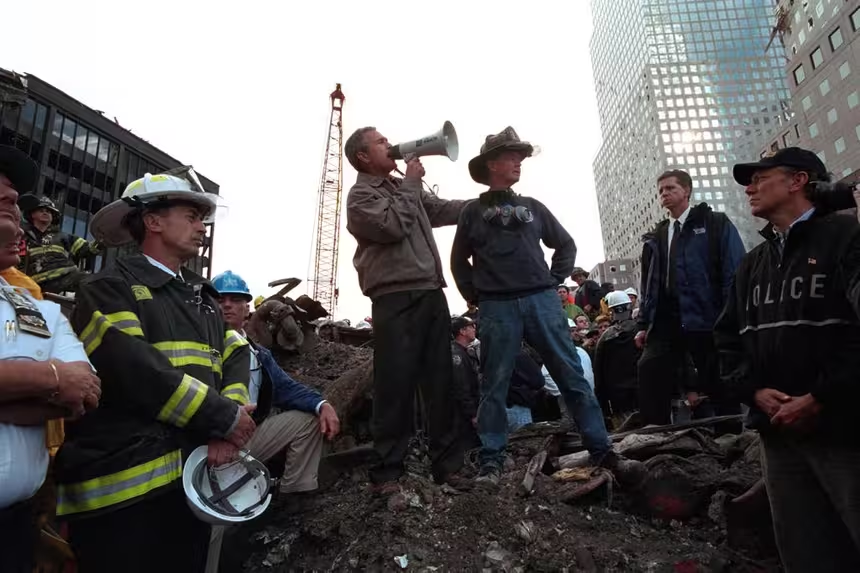
10 big stories Washington Week covered
Washington Week came on the air February 23, 1967. In the 50 years that followed, we covered a lot of history-making events. Read up on 10 of the biggest stories Washington Week covered in its first 50 years.Providing Support for PBS.org
Learn Moreabout PBS online sponsorshipJeffrey Goldberg: Maybe President Trump will order strikes against Iran, or maybe he won't.
Maybe he'll invoke the Insurrection Act against anti-ICE protesters in Minnesota, or maybe he won't.
Maybe he'll try to buy or conquer Greenland, or not.
If you have the feeling that we're all just living in Trump's world, you're not alone.
No president in our lifetimes has made himself the center of everything the way that Trump has, next.
Good evening and welcome to Washington Week.
It seemed inevitable earlier this week that President Trump would be ordering military strikes on Iran, but then he pulled back after getting pressure from Israel and America's Arab allies to hold off.
But that doesn't mean he won't attack Iran next week or tomorrow, or right now for that matter.
Very often, unpredictability is a useful leadership tool, but we're in a whole other reality now.
President Trump doesn't recognize the guardrails that were visible to previous presidents, and self-restraint isn't his specialty, which is why Denmark is preparing for the defense of Greenland.
Joining me tonight at the table to discuss all of this, Jonathan Karl, the chief Washington correspondent for ABC News, David Sanger, the White House and national security correspondent at The New York Times, Nancy Youssef is a staff writer at The Atlantic, Nick Schifrin is the foreign affairs and defense correspondent for PBS NewsHour and the moderator of the new program, Compass Points, that debuts this weekend on PBS.
Welcome all of you.
Thank you.
Nick, big weekend, big weekend here at PBS everybody.
The juggernaut, new juggernaut is coming your way.
We'll talk a little bit about what you'd be talking about on Sunday.
But let me just start, David, with you and get a little -- get a sense of what this current state of play in Iran is.
David Sanger, White House Correspondent, The New York Times: Well, Jeff, two completely separate dynamics underway here.
One, a rotting regime, increasing frequency of these protests.
We've all been through this before the protesters come out this time in much larger numbers.
It wasn't just students.
It was the middle class.
It was people protesting the devaluation of the riyal, and so this sense of heightened crisis.
But some things are the same, the protesters still have no guns, no arms, and the Iranian regime does.
Jeffrey Goldberg: And they use them at ferocious pace.
David Sanger: And they did use them at a much more ferocious pace here.
And you've got to think that any regime that's got to try to shoot its way out of this isn't going to last forever, but may last for a while.
And then the other side of this, as you were suggesting in your opening, Jeff, is the president who said, we're going to come to the rescue of these protesters.
But, you know, this is not an operation like taking out three nuclear sites, as he did in June.
There, you had defined targets.
You could go in, you could bomb, you could bury the uranium, and you could leave.
If you are in a situation where you're trying to support protesters, you need to know what it is you're trying to do, regime change, trying to promote democracy, trying to just stop the killing, and we never heard that from this White House.
Jeffrey Goldberg: Right.
Let me read you something.
This is an extraordinary Truth Social post by Donald Trump, even by the extraordinary standards that we're getting used to.
I greatly respect the fact that all scheduled hangings, which were to take place yesterday, over 800 of them, have been canceled by the leadership of Iran.
Thank you, exclamation point.
Donald J. Trump, president of the United States of America.
I mean, it has this kind of very dark, almost Monty Pythonesque, all the hangings are off.
The truth is that they didn't stop the hangings.
But, Nick, talk about this for a minute.
The - - is this just evidence that Trump is trying to find himself an off-ramp from this and is using what might be bad data as an excuse?
Nick Schifrin, Foreign Affairs and Defense Correspondent, PBS NewsHour: Well, the U.S.
military officials who I talked to earlier in the week did predict that the president was going to attack Iran and then -- Jeffrey Goldberg: We were all.
By Wednesday, it seemed like we were all, this is the night it's going to happen.
Nick Schifrin: Right, exactly.
And then by the afternoon, or whatever it was, suddenly it wasn't.
And one official told me, yes, he's looking for an off-ramp.
So, what's the explanation?
Well, perhaps there was this idea that, oh, maybe if they don't hang a protester, and there was one specific protester who the activists were all saying going to be hang tomorrow, if they don't hang that protester, then, okay, they're moderating somehow.
But I think, clearly, that, as you said, right, Israel and the Arab states were not into a U.S.
strike.
You know, Nancy's been reporting, and we'll talk more about the idea that the U.S.
military didn't have the assets that he wanted.
And all of that meant that the president was looking for an off-ramp to award that, frankly, all of his advisers said wasn't an easy win, right?
You didn't have a Caracas option in Tehran.
You didn't have a way to take all these protesters and let them, or create an extra momentum so that they could overthrow the regime.
And given that was the answer and given that the pressure that he was on diplomatically, there was no easy way to choose any option and actually get what he wanted, assuming that we actually even knew what he wanted.
Jeffrey Goldberg: Nancy, let me ask you two questions.
One is jumping off something of that nature.
You said you wrote earlier this week, until last fall, commanders in the Middle East could count on having an aircraft carrier strike group nearby, that was either in the Persian Gulf or could reach it quickly.
Not this time.
The USS Gerald R. Ford, which had been closest to the Middle East, left the shores of Europe last fall for the U.S.
pressure Campaign on Venezuela.
It would take at least two weeks for the Ford to move back within range of the Middle East.
You've been writing about the overstretched quality of the military.
Is that the reason that we didn't have the strike that they had been promising on Monday and Tuesday?
Nancy Youssef, Staff Writer, The Atlantic: I think it's certainly a factor.
And one evidence of that was that the USS Abraham Lincoln, one of two carriers operating now, is moving from the Western Pacific to the Middle East, which would signal that they needed the presence there.
Remember that the carrier gives the military a lot of options in terms of its defense of its forces there.
It also allows them to launch strikes from there in a region where allies were saying, we don't want you to launch strikes from our country.
We fear that.
The other thing that moved out of the Middle East was drones.
And so you lost a lot of the capability -- Jeffrey Goldberg: What do you mean, moved out of the Middle East?
Nancy Youssef: So, those drones that were in the Middle East went through the Western Hemisphere as well, and so we lost the carrier, we lost air capabilities.
And so when you're talking about striking a regime on its last gasp that's already threatening the U.S., threatening its allies, you want the most defenses you can in the region, and a lot of the ones that they're used to having weren't there.
Jeffrey Goldberg: Jon, was it a mistake then, from a strategic standpoint, to focus on Venezuela, which does not pose as much of a threat to American interest as Iran clearly does?
Jonathan Karl, Chief Washington Correspondent, ABC News: I mean now you have what moved into Venezuela and you're now moving assets out of the South China Sea to the Middle East, which is counter to what we've been told that they're trying to do, which is focus on the real threat.
They see ultimately long-term threat from China.
But, look, in terms of how this all turned around, you have a couple of factors.
By the way, one, the Iranian foreign minister went on Fox News, which was a very interesting move.
And it was the Iranian foreign minister who announced -- I mean, in announced, it was with Q&A with Bret Baier, that there were going to be no hangings.
We're not -- there are no hanging scheduled.
So, Donald Trump learned that by watching Fox News at 6:00 on Wednesday -- Jeffrey Goldberg: Well, the Iranians know and has to know how to communicate directly to the president.
Jonathan Karl: And there's another thing.
Tucker Carlson has been at the White House twice over the past week.
And we know what Tucker Carlson, you know, feels generally about not getting involved in the Middle East and not doing anything that would remotely something that the Israelis would favor.
I mean, Bibi Netanyahu was at Mar-a-Lago in mid-December encouraging Trump to take another military strike at Iran this time over the ballistic missile program.
And, you know, it did look like he was moving in that direction.
And now I think there's this whole -- you know, Trump is not particularly strategic on this stuff.
It's very much in the moment.
Jeffrey Goldberg: I want to go to David in a minute to talk about the Israelis who were telling him this week, please don't have a strike on Iran, but in December, we're talking about something else.
But, Jon, you've hinted at maybe the largest question.
Can you make it all make sense?
Jonathan Karl: Well, look, he went and said, help is on the way, to the Iranian protesters.
Time after time, over the last -- mostly over the last ten days or so, he has been encouraging the Iranian protesters.
And at the same time, the ayatollah has come out and the ayatollah called him a tyrant.
I mean, that's really something.
The ayatollah called him a tyrant and called for him to be overthrown.
So, it's -- I mean, you can kind of see that.
Trump's got all of these factors going on.
He's feeling strong.
He's feeling like he's the most powerful president ever.
He's just taken Maduro out of Venezuela.
He's pushing around Denmark over Greenland.
He feels he has the power, but he truly -- I think he still does not want to get dragged into something.
Jeffrey Goldberg: But, look, I'm asking you as my friends.
I'm just on the hunt for coherence.
And the way you're describing just the movement of aircraft carriers, I have to imagine that there are people in the United States Navy who said, oh, we're not going to be near China.
We're going to the Middle East.
Oh, sorry, we're going to the Caribbean.
Nope, we're going back over.
David Sanger: If you're in the hunt for coherence, you're covering the wrong administration, okay?
But -- Jeffrey Goldberg: But this is the only administration we got.
David Sanger: It's the one you got.
Jeffrey Goldberg: It's what we got, right?
Jonathan Karl: You cover the administration you have.
Jeffrey Goldberg: Yes.
You go to war with the administration you have.
David Sanger: You read the National security strategy that they turned out back in November and it talks about -- Jeffrey Goldberg: In which the main enemy is England, I think, if you read it carefully.
David Sanger: Well, there's a lot of discussion of Europe.
But the main focus suddenly is the Western Hemisphere.
So, yes, we could fit Maduro into that and we could fit the run for the resources there.
But all of a sudden he's getting involved in an uprising in Iran, setting out red lines.
Imagine for a moment that Barack Obama had said, we are coming to the aid.
Jonthan Karl: Help is on the way.
David Sanger: Help is on the way.
You will remember that in -- Jeffrey Goldberg: Well, he did, in effect, issue a red line, said to the Syrians.
David Sanger: For Syria -- Jeffrey Goldberg: Yes.
David Sanger: -- and which became one of the rallying calls of what he did wrong in foreign policy, right?
He doesn't believe that.
He believes to this day that that was a fine moment.
I think he said that to you in one of your interviews.
But it was certainly part of the Trump critique of that administration.
And so the president is feeling emboldened, but you'll notice that he pulls back when it looks like he could be in a confrontation with a nuclear-armed country, China or Russia, or get involved in something on the ground that he can't control.
And that's what these uprisings were.
Jonthan Karl: The critique of Obama was you set the red line and then they crossed it and you did nothing.
David Sanger: That's right.
Jonthan Karl: And that's where you're in the position.
You're seeing Trump do it.
He set a red line.
It's clearly been crossed.
What's he going to do?
Jeffrey Goldberg: And there's a -- go ahead, Nancy.
Nancy Youssef: I was just saying, can I add to that list?
He doesn't want anything protracted either.
I mean, since Christmas, which was less than a month ago, the U.S.
has conducted strikes in Nigeria, Somalia, Syria, Venezuela.
Jeffrey Goldberg: But one and done.
Nancy Youssef: That's right, all one and done.
Jeffrey Goldberg: Right.
And the bombing of the Iranian nuclear program was literally take off from America, fly halfway around the world, drop your payload, come back to there, never touch ground.
Nancy Youssef: The only exception was Yemen, which went on for several weeks and was inconclusive at best in terms of outcomes.
So -- Jeffrey Goldberg: But they declared victory anyway, right?
Nick Schifrin: I think with Iran, we also have to remember if we're going to give the benefit of the doubt here that, you know, at the bare minimum, right, he was given three options.
You can help the protesters by giving them a signal, by hitting the people who have been killing the protesters, so, hey, we know who's killing you.
Second option was, we're going to go wider, take out the IRGC, take out the besiege forces, try and destabilize the regime.
Jeffrey Goldberg: IRGC, the Revolutionary Guard, that's the core of the -- Nick Schifrin: Right.
Or, three, go after the missiles that we do expect Israel at some point this year to try and go after again.
But neither of the -- all three of them did not really achieve any one goal, right, did not achieve any one victory, as he put it, you know, to CBS.
David Sanger: Because most of the weapons he was looking at were weapons.
And it was only when they were discussing dropping Starlink in, you had something that made sense, or broadcasting in Persian language back in something that they were dismantled.
Jeffrey Goldberg: Well, we dismantled that.
I want to keep moving a around the world a bit but, David, answer that one quick question about what the Israelis want and what the Arabs want right now, because that's going to give us a fairly big clue about what's going to happen next week or the week after on Iran.
David Sanger: So, the Arabs want some stability out there.
And while the Israelis ultimately, as Nick said, want to go after those missiles and so forth, they are not in the position right now to go do anything to which the Iranians might respond with missile attacks of their own.
Jeffrey Goldberg: Got it.
Nick Schifrin: And there was a U.S.
assessment this week that the Iranians would launch a larger strike against a U.S.
strike.
Jeffrey Goldberg: Right.
David Sanger: That's right.
Jeffrey Goldberg: Nick, so, on your show this week, the upcoming show, you're going to be talking about splits in the Republican Party on these ideological questions.
And, you know, I do find it hard to believe that J.D.
Vance is looking to have yet another foreign military intervention.
I forgot until you mentioned, you know, Nigeria and Somalia.
We just sort of dismissed those.
Take us inside the Republican fight.
Nick Schifrin: It's not even a Republican fight.
It's a White House fight, right?
I mean, to me, the core foreign policy debate, and I'd like to think that, you know, on Compass Points, we're going to reflect this, is -- Jeffrey Goldberg: That was a nice plug.
Nick Schifrin: Oh, thank you.
Jeffrey Goldberg: Yes, that was nice.
Nancy Youssef: It's well done.
Nick Schifrin: You know, on one side you get a traditional -- well, let's call it a traditional Republican approach, what Marco Rubio was perhaps, right?
Jeffrey Goldberg: Muscular interventions.
Nick Schifrin: Right.
And Corey Shockey from the American Enterprise Institute kind of represents that on our show.
And so we want to help the Iranian protesters, especially if we've created a moral red line.
We want our friends in Europe to be our allies and our friends and not threaten them, right?
Then you've got, if you will, the J.D.
Vance, as Steve Witkoff has been on this side, certainly in the argument, the restrainer, let's call it, right?
Why are we focused on Latin America?
Why are we bombing Iran?
Our focus should be China.
Donald Trump was elected in 2016 to be a restrainer president.
What happened to that?
Defense priorities, a think tank in D.C.
has Jen Kavanaugh as their representative and she's on the show.
And then somewhere in the middle, as we've been, you know, basically acknowledging, the president goes either way or not, and that's Heritage Foundation.
Jeffrey Goldberg: That's Heritage.
Nancy, this is an interesting question because it's not that Trump might have all of these thoughts at different points in the day.
Is that a fair statement that he encompasses all of this, which is why there's so much confusion?
Nancy Youssef: I think that's absolutely fair.
And so I think what's astonishing is he came in as an America first president, that he wasn't going to get involved in international affairs.
I think the shock is not that he has so many different ideas, but that it's so at odds with what he promised the administration would be.
Remember, he campaigned on fixing the economy, bringing -- removing illegal immigrants from the country.
And now at this start of 2026, we're focused so much on foreign policy and intervention and the U.S.
military might overseas.
Jeffrey Goldberg: Right.
David, I want to turn to you.
You spent a very large number of hours with the president just last week, you and three colleagues.
I'm going to ask you this question because you were just in the gold showroom that the Oval Office now is.
I'm going to ask you a gold-related question.
So, Machado, the Venezuelan Nobel Peace Prize laureate, the Venezuelan opposition figure, literally gave her physical Nobel Prize to Trump as a way of saying thank you, and also encouraging him to help her become president of Venezuela, one assumes.
Tell us about that episode and why he took it.
David Sanger: So, strange episode.
He has made no secret of his desire for the Nobel Prize.
He's made no secret of his anger that President Obama got one, as he said, you know, after just being here a few weeks, right?
And there was some element of, you know, embarrassment that he had not even done anything yet when he got that.
But along the way, something strange happened, where the president seemed to mix up having the medal itself with being named a laureate.
And at some point the Nobel Committee came out and said, once Nobel Prizes are awarded, they're awarded.
That's it.
They are not -- Jonthan Karl: They can't be given away.
They can't (INAUDIBLE) for all time.
David Sanger: People have given away, some have sold the actual medal, but that doesn't mean that the person who buys the medal or receives it as a gift is the Nobel laureate.
Jeffrey Goldberg: Wait, are you telling me that if I eat lunch in Pulitzer Hall at Columbia University, that does not make me a Pulitzer winner?
David Sanger: It may not.
Jeffrey Goldberg: This is a very disturbing turn of events.
Jonthan Karl: Vladimir Putin stole Bob Kraft's Super Bowl ring.
I mean, he's got a Super Bowl ring.
Jeffrey Goldberg: What does that say to you about a type of person?
Jonthan Karl: Well, it tells me that he's not a Super Bowl champion, though, you know?
Jeffrey Goldberg: But go to your interview.
Yes, well -- yes.
David Sanger: Yes.
So, you know, in the interview, the interview is remarkable for a couple of reasons.
I mean, first, when we asked him, why do you feel you need to own Greenland since under the treaty that we have with Denmark, you can open up the 15 or 16 bases that the U.S.
used to have and closed down.
And he said, you know, it's psychological.
I just feel like I need to own it.
This was the New York real estate guy in the president basically saying, I know the difference between -- Jeffrey Goldberg: He looks at a building and says, I want that building.
David Sanger: And to some degree, I think there's a bit of that going on with the Nobel Peace Prize here as well, right?
He wanted to show off and own the medal.
Now, he does have a medal down the hall.
It was won by Teddy Roosevelt in 1906.
But that doesn't seem to -- it doesn't seem to quite do it.
The amazing thing when we also did the interview was that was the moment where he said, nothing can stop me, even international law, depends on how I interpret international law.
Jonthan Karl: No.
But he also said his morality.
His morality -- Jeffrey Goldberg: The only thing to keep restraint is his own morality.
Yes, that was an interesting statement.
Jon, I want to -- speaking of which, let's pivot to some domestic issues.
The president is threatening to invoke the Insurrection Act in Minneapolis.
We just saw today that they're -- the Justice Department is investigating the mayor of Minneapolis and the governor of Minnesota now for maybe obstruction of justice.
Tell us what it means to invoke the specter of the Insurrection Act.
Jonthan Karl: Well, look, he came very close to doing this in 2020.
He wanted to invoke the Insurrection Act to crack down on the George Floyd protests in 2020.
And he was largely stopped from doing so by his defense secretary at the time and his attorney general, who both tried to convince him and also tried to kind of do a little bit of, you know, distracting him from actually going through with something that he really did want to do.
There's nobody around to make that argument now.
Look, it's a perilous situation because there are absolutely provocations on all sides in Minneapolis.
And if it gets violent again, I don't think that he would hesitate to send in active duty U.S.
military, which he would have to invoke the Insurrection Act to do.
Jeffrey Goldberg: Nancy, you're a Pentagon correspondent.
Is there any sign to you that anyone in the civilian or military leadership in the Pentagon right now would argue against this, if the president said the 82nd Airborne is going to Minneapolis?
Nancy Youssef: I think they would be objections to it.
I don't know how aggressively they would make the argument.
But what you're talking about then potentially, you know, the Insurrection Act allows the military to detain people, to do conduct arrests.
I think if you look at ICE, many people see it as a political force on behalf of the Trump administration.
What happens when you have members of the 82nd smashing windows, detaining Americans alongside those forces?
So, I don't know how aggressively they'll make the case inside the Pentagon, but I know that it goes against the very ethos of the military that is so desperate to not be politicized.
That would be the most demonstrative display of the politicization in the military if it happens.
Nick Schifrin: Yes.
I mean, Nancy, I'm sure maybe you agree with this, but I don't know a single service member, whether enlisted or an officer, senior, junior, who wants this to happen, right?
Civilian leadership, fine, you know, maybe they'll have debates with the president, but no soldier, no Marine, no airman, no sailor wants to be seen as a political arm.
They took their oath, they take their job seriously, and there is, at least among the people I talk to, a great fear and reluctance to take that step.
Jonthan Karl: But, again, the secretary of defense.
And one of the other key things here is you have seen the top ranks of this administration make it clear they believe that ICE officers have, in the words of the vice president, absolute immunity.
Jeffrey Goldberg: Right.
You know, there's this criticism we've heard again and again of government officials, former, current members of Congress, leaders of Congress, that they don't call out what many people would see as this administration's excesses.
But here's Jerome Powell, chairman of the Federal Reserve, pushing back on his own threat, the threat of criminal investigation.
Just watch this for one second.
Jerome Powell, Chair, Federal Reserve: The threat of criminal charges is a consequence of the Federal Reserve setting interest rates based on our best assessment of what will serve the public rather than following the preferences of the president.
Jeffrey Goldberg: Nancy, you talk to a lot of ex-military leaders, ex-defense secretaries.
You're familiar with all these people.
Jerome Powell, very frankly, comes out and says, this is nonsense what they're doing.
I've been struck, going back to what Nick said.
I've been struck by the fact that there's very little said in public by people who obviously feel as if the military should not be used in various ways that Trump is thinking of using them.
What is the breaking point for them?
Nancy Youssef: You hope if they're asked to do something illegal.
I would note that Senator Mark Kelly has been charged.
That has a chilling effect.
Their service members are being threatened to be dropped in rank, that they lose their retirement.
There are real tangible threats that they can make.
I'm not justifying silence, but when you talk to people and ask them, why haven't you said more?
They come back to you with real fears that they could experience.
David Sanger: And you see that -- Jeffrey Goldberg: Yes.
I'm sorry to -- I have to wrap it up, but it's a -- we'll have you back to -- David Sanger: It's a good point.
Jeffrey Goldberg: -- to make the next point.
This is not a four-hour Trump interview.
We're going to have to leave it there.
I'm sorry.
But I want to thank our guests for joining me, and I want to thank you at home for watching us.
And you could read Nancy Youssef's story on the overstretched military by visiting theatlantic.com.
And this weekend, you should watch Nick's show.
I'm Jeffrey Goldberg.
Goodnight from Washington.
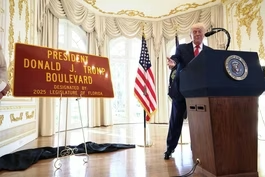
How Trump ignores the guardrails of the presidency
Video has Closed Captions
How Trump ignores the guardrails of the presidency (10m 22s)
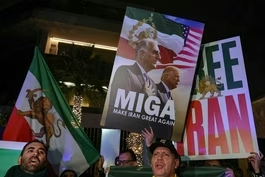
Trump's mixed messages and unpredictability on Iran
Video has Closed Captions
Trump's mixed messages and unpredictability on Iran (13m 26s)
Providing Support for PBS.org
Learn Moreabout PBS online sponsorship
- News and Public Affairs

Top journalists deliver compelling original analysis of the hour's headlines.

- News and Public Affairs

FRONTLINE is investigative journalism that questions, explains and changes our world.












Support for PBS provided by:
Major funding for “Washington Week with The Atlantic” is provided by Consumer Cellular, Otsuka, Kaiser Permanente, the Yuen Foundation, and the Corporation for Public Broadcasting.