
Washington Week with The Atlantic full episode,1/9/26
1/9/2026 | 26m 46sVideo has Closed Captions
Washington Week with The Atlantic full episode,1/9/26
Donald Trump often says he’s not a neoconservative and not a nation-builder, but he seems to be trying to remake the world. And at home, he’s unleashed ICE to remake America’s demographic reality. Join moderator Jeffrey Goldberg, Peter Baker of The New York Times, Susan Glasser of The New Yorker, Stephen Hayes of The Dispatch and Vivian Salama of The Atlantic to discuss this and more.
Problems playing video? | Closed Captioning Feedback
Problems playing video? | Closed Captioning Feedback
Major funding for “Washington Week with The Atlantic” is provided by Consumer Cellular, Otsuka, Kaiser Permanente, the Yuen Foundation, and the Corporation for Public Broadcasting.
Washington Week with The Atlantic full episode,1/9/26
1/9/2026 | 26m 46sVideo has Closed Captions
Donald Trump often says he’s not a neoconservative and not a nation-builder, but he seems to be trying to remake the world. And at home, he’s unleashed ICE to remake America’s demographic reality. Join moderator Jeffrey Goldberg, Peter Baker of The New York Times, Susan Glasser of The New Yorker, Stephen Hayes of The Dispatch and Vivian Salama of The Atlantic to discuss this and more.
Problems playing video? | Closed Captioning Feedback
How to Watch Washington Week with The Atlantic
Washington Week with The Atlantic is available to stream on pbs.org and the free PBS App, available on iPhone, Apple TV, Android TV, Android smartphones, Amazon Fire TV, Amazon Fire Tablet, Roku, Samsung Smart TV, and Vizio.
Buy Now
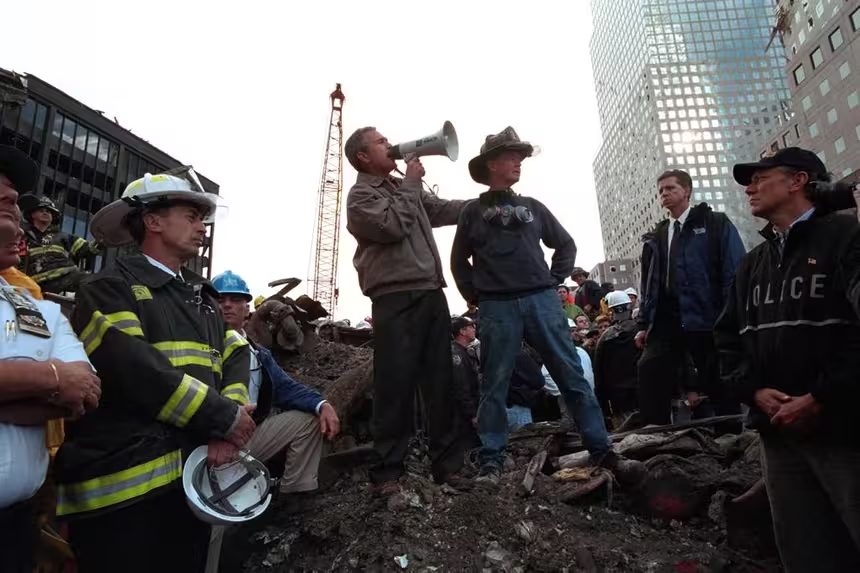
10 big stories Washington Week covered
Washington Week came on the air February 23, 1967. In the 50 years that followed, we covered a lot of history-making events. Read up on 10 of the biggest stories Washington Week covered in its first 50 years.Providing Support for PBS.org
Learn Moreabout PBS online sponsorshipJEFFREY GOLDBERG: Donald Trump often says he's not a neo-conservative, not an interventionist, and not a nation builder, but he seems to be trying to remake the world to conform to his vision.
And at home, he's enabled ICE to now fatal effect to remake America's demographic reality.
Tonight, Trump unleashed, next.
Good evening and welcome to Washington Week.
So, it's been another tumultuous week for America and for America's allies and adversaries.
It's been one of those weeks that feels like a month.
It was only a week ago that Delta Force operators snatched Nicolas Maduro from his home in Venezuela and was only a few days ago that we all realized, and by all of us, I mean NATO, that Trump was completely serious about seizing Greenland.
And then there's ICE, death in Minneapolis, shooting in Portland, and an overwhelming sense that Stephen Miller and company are playing for keeps.
Joining me tonight to discuss all this, Peter Baker, the chief White House correspondent at The New York Times, Susan Glasser is a staff writer at the New Yorker, Stephen Hayes is the editor of the Dispatch, and Vivian Salama is a staff writer at The Atlantic.
Thank you all very much.
We'll have the debate later if this was the most intense week of all of Trump presidency.
But right now, let's just start with foreign policy issues.
Peter, start us off.
How would you characterize the Trump foreign policy doctrine this week?
PETER BAKER, Chief White House Correspondent, The New York Times: Well, I think you're right to say this week, because, in fact, it does change.
But one thing we've learned, I think, is that our assumption about the first term that he was some sort of a neo-isolationist is wrong.
That's not the way to put it.
Now, he's looking more like a neo-imperialist.
But I think it also presupposes that ideology and a philosophy that may or may not be in his mind, it may be in the minds of people around him.
I think with Trump is a lot more reactive, is a lot more transactional, and it's a lot more -- JEFFREY GOLDBERG: No, opportunistic.
PETER BAKER: Yes, opportunistic.
And I think the two quotes this week that define it most, really important quotes this week, Stephen Miller on CNN on Monday saying, the world is governed by power.
He's not necessarily wrong, but usually American officials at least give voice to the idea that the world is actually governed by laws and standards and principles and so forth.
But by saying that, he's saying, we could do what we want because we have power.
And if unless you thought he might have misspoke, that he wasn't speaking for the president, the president then said it basically himself to my colleagues at The New York Times during interview this week, he said that he was asked, is there anything that you think is a restraint on your power globally, he says, the only thing would be my own morality, what's in my own mind.
JEFFREY GOLDBERG: Right.
Let's watch President Trump talk about this issue that's become, in a way, as big as Venezuela, although it's entirely theoretical at this moment, and let's just watch President Trump, DONALD TRUMP, U.S.
President: we are going to do something on Greenland, whether they like it or not, but we're going to be doing something with Greenland, either the nice way or the more difficult way.
JEFFREY GOLDBERG: Susan, Greenland belongs to Denmark.
It's part of Denmark.
Denmark is a United States ally, a treaty ally in NATO.
I feel like we are down the rabbit hole with this discourse.
Is that fair?
SUSAN GLASSER, Staff Writer, The New Yorker: Yes.
I mean, I think it's not discourse, you know, there will be an argument.
We don't know how history will look here, but there is a strong case to be made that by threatening the use of the American military against our NATO ally, Denmark, and saying, demanding that they turn over this territory, literally a statement being cheered in Moscow right now because it's so reminiscent of what Vladimir Putin said to Ukraine before he invaded it, you could say this marks, in a way, the effective end of NATO as we knew it, Jeff.
Underpinning NATO is the Article 5 guarantee of mutual defense.
Is there anyone really at the end of this week who can convincingly claim to be sure that the United States will unequivocally come to the aid of its allies when it is threatening military force?
You had the prime minister of Denmark, in fact, making this point this week, saying that Donald Trump's military threats against Denmark, were he to move forward at all, you know, would be the end of NATO.
And I think, again, it's a great example of the difference between Trump 1.0 and Trump 2.0.
Donald Trump, according to the reporting Peter and I did for our book about his first term, spent years privately talking about this.
Many of his own advisers thought he was literally delusional when he spoke of taking over Greenland in the first term.
Here we are in the second term, that quote from Stephen Miller, it was in response to a question about why should the United States be threatening to take over Greenland, and Stephen Miller said, we can do anything we want specifically about Greenland.
JEFFREY GOLDBERG: Stay on the book for one minute.
He told you, Donald Trump told you in 2021 when you were interviewing him, the both of you for the book, that, basically, he looked at a map, said Greenland's really big, look good as part of America, so let's do it.
I mean, that's the bottom of the ideology is that it looked good on a map.
Like give us the -- set the scene for that interview and that extraordinary moment when you realized, oh, he just is imagining this land mass five times the size of France just being part of America because it -- the United States because it looks good.
SUSAN GLASSER: Well, we were an hour and a half into the interview and his aide moved to end the interview, she was like, last question.
And so we said, well, wait a minute, one more thing.
And the reason that we asked about Greenland, that is because our sources had been telling us that it wasn't just this sort of punch line of late night comedians, that it wasn't the passing whim of Donald Trump in the summer of 2019 when we all found out about it, but that for years he'd been asking people about it.
So we wanted to ask him.
And I think that is a very revealing quote that helps us to understand what's happening today.
He said, quote, it's like a real estate deal, except it's a lot, lot bigger, obviously.
JEFFREY GOLDBERG: Right.
SUSAN GLASSER: And he said, I looked on a map.
I love maps.
I'm a real estate guy.
It's just like a corner store.
JEFFREY GOLDBERG: So, I mean, real estate, I look at a corner, I say, I got to get that store for the building that I'm building, et cetera.
You know, it's not that different.
Steve, it's different.
STEPHEN HAYES, EDITOR, THE DISPATCH: Yes.
I would say -- JEFFREY GOLDBERG: It's pretty different.
STEPHEN HAYES: It's very different.
The thing that struck me as I was listening to the protests from European leaders this week, including the leaders of Denmark and others, was that they were saying this could be the effective end of NATO, as if that might be a deterrent to Donald Trump.
SUSAN GLASSER: Yes.
STEPHEN HAYES: I don't think that will necessarily stop him, because I think that may be part of what he wants.
JEFFREY GOLDBERG: But wait, come back to this, because Peter makes the point that there is no real ideology operating here.
So, why would Donald Trump be interested in ending NATO as a defense treaty?
STEPHEN HAYES: So, I agree with Peter entirely that there's no ideology.
I also think that there's no Trump doctrine by definition.
If we're saying what the Trump doctrine is this week, it's not a doctrine.
But if you look at what Donald Trump does, he -- this is in the national security strategy.
You can see it in his rhetoric.
You can see it in the rhetoric of people from Marco Rubio to J.D.
Vance, to Stephen Miller.
He wants to dominate this hemisphere.
It matters to him more than anything.
And in that sense, maybe it is more like real estate than we are allowing.
But the unstated corollary to that is that our adversaries in other parts of the world can also dominate their backyards.
Leave us alone.
We'll have this.
JEFFREY GOLDBERG: It's an old fashioned spheres of influence kind of view of the world.
You know, you mentioned that Stephen Miller has said some very interesting things this week.
Maybe this -- to me, this might be the most interesting.
He said, what is their basis of having Greenland as a colony of Denmark?
The United States is the power of NATO, for the United States to secure the Arctic region to protect and defend NATO and NATO interests.
Obviously, Greenland should be part of the United States.
Vivian, you know, if you carry this theory through to its logical conclusion, in his mind, any part of a NATO country's territory that's important for U.S.
security should be part of the U.S., which is to say, if you want to make the argument that Poland is important for American security, then he's sort of arguing that we should be in charge of Poland because it can't be left to the Poles.
I mean, what is he saying and where do these thoughts emanate from?
What corner of the Republican Party is this coming from?
Because I'm not familiar with this kind of thinking in this century.
VIVIAN SALAMA, Staff Writer, The Atlantic: So, I mean, one of the things that has driven President Trump's interest now in having this corollary to the Monroe Doctrine, as they called it in the national security strategy, is this concept that 40 years ago President Reagan was a champion of Western Hemisphere dominance, you know?
He was trying to end the Cold War and reinforcing American position in the Western Hemisphere, but also kind of bridging tensions with then Moscow, the Soviet Union before its collapsed.
And he believes that President Reagan was a strong president on the Western Hemisphere.
And so for the sake of his legacy, he needs to do this too.
I mean, is there a little bit of a desire for, you know, a Riviera of the Arctic in President Trump's mind?
Possibly, but, you know, he keeps talking about it in real estate terms.
But at the end of the day, he sees this as part of his legacy.
He's thinking about his legacy.
Presumably, we are in his last term of office.
JEFFREY GOLDBERG: But stay on this Miller idea.
It sounds like they're completely unilateral in their approach, that they have contempt for NATO.
And I guess what the big question on the table is, what is the future of NATO if this is the current attitude of the president and his most trusted advisers?
VIVIAN SALAMA: They've never hidden the fact that they have contempt for NATO.
President Trump has said all along that he believes that they are -- that the U.S.
is treated unfairly and that the U.S.
does more for NATO than NATO ever does for it.
He has repeatedly said that he prefers bilateral defense agreements and trade agreements to any kind of multilateral.
And so NATO is the culmination of that.
He's hammered allies for failing to put in enough defense spending, and to an extent, it was successful.
JEFFREY GOLDBERG: I always thought that the -- or sometimes I would think because the doctrine shifts from week to week.
On occasion, I've thought that his talk about NATO paying its fair share or we're going to leave, we're not going to defend you unless you pay, that was just the businessman, Donald Trump, trying to squeeze more money out of their allies.
I don't have -- as an American taxpayer, I don't have a particular problem with that.
But I think what we're getting now is a larger disdain for the existence of the alliance itself.
VIVIAN SALAMA: And yet he stopped short.
This week, we heard him come out and say, you know, I will still -- the United States will still support NATO even if NATO doesn't support the United States.
He constantly pulls back from these threats.
SUSAN GLASSER: Although he was asked actually by Peter's colleagues at the Times, specifically on Greenland.
They said to him, sorry, it may come down to a choice between Greenland or NATO, and he stopped short of saying, well, of course, NATO, he said, I'd have to think about that.
JEFFREY GOLDBERG: Well, he's not going to give away his negotiating -- SUSAN GLASSER: Look, Jeff, I actually -- I think that the record is pretty clear that Donald Trump has a long-term contempt for NATO.
Going back to his first campaign, he said it was obsolete.
He has had a consistent predilection for essentially denigrating the -- even the concept of alliances looking to treat, you know, as a one-on-one equal with our adversaries.
When it comes to this idea, by the way, of treaties Donald Trump has a bilateral treaty with Denmark.
It's not a multilateral treaty.
He has a 1951 defense treaty signed by Harry Truman that already gives the United States military essentially the untrammeled right to do as it pleases.
JEFFREY GOLDBERG: The U.S.
could move a hundred thousand troops in a NATO framework onto Greenland.
SUSAN GLASSER: So, it's not about that.
PETER BAKER: He said in the interview, I need it for psychological reasons.
Psychological is his quote.
I need it for psychological reasons to actually own it.
It's different if you own it rather than lease it, again, the real estate thing.
JEFFREY GOLDBERG: So, the renting versus buying?
PETER BAKER: But the other thing I would -- JEFFREY GOLDBERG: Is that what we're talking about?
PETER BAKER: Yes, a little bit.
I would - - in fact, by the way, there was a rent lease back option they looked at in the first term.
We discovered when we were doing our reporting.
But take the next step, okay?
Who else hates NATO?
Vladimir Putin hates NATO.
Let's now then take the consequence of what we're talking about the next step, all right?
If Article 5 no longer has any meaning, if Article 5 cannot be a mutual defense thing, because we're about to actually -- by the way, when Harry Truman set up NATO, I don't think he thought that the only country that ever actually attacked NATO in order to take territory might be the United States.
JEFFREY GOLDBERG: Right.
PETER BAKER: And that's the scenario you're talking about.
JEFFREY GOLDBERG: The only time Article 5 has ever been invoked right is after 9/11.
PETER BAKER: Right.
And not -- JEFFREY GOLDBERG: To help protect the -- PETER BAKER: And not a territorial conquest.
The only territorial conquest that may actually take place out of a NATO country would be by the United States, as he's talking about.
Now, does he really got to do it?
Who knows?
But the consequence of this is at the same time we're trying to negotiate a peace deal in Ukraine, we're saying we're going to give security guarantees, Article 5, like security guarantees to Ukraine.
Why on earth would that be a meaningful thing if the United States can't be counted on for the Article 5 security guarantees it already has?
JEFFREY GOLDBERG: Okay.
Crazy question, could Denmark -- if this gets more dramatic, could Denmark go to NATO and say, I am -- we are invoking Article 5, you must rise to the defense of Denmark against the threat from the United States?
STEPHEN HAYES: I mean, it's suggested as much, right?
I mean, I think that's -- JEFFREY GOLDBERG: And that is feasible.
STEPHEN HAYES: Right.
I mean, I think that's -- it's -- that would seem like a crazy thing to do.
JEFFREY GOLDBERG: No.
I feel like we're playing Risk on ketamine right now, actually.
STEPHEN HAYES: So many of the things that we've seen -- JEFFREY GOLDBERG: I mean, I don't know if you've ever done that, but, yes.
SUSAN GLASSER: That was a little too specific.
JEFFREY GOLDBERG: Yes.
Yes.
I have never played Risk on ketamine.
STEPHEN HAYES: Okay.
JEFFREY GOLDBERG: Thank you very much.
STEPHEN HAYES: There is, there was another line from Steven Miller's interview with Jake Tapper earlier this week that hasn't gotten nearly the attention I have to get ought to of, and he was describing the post World War rules-based international order, of which the United States is the primary author, and he called it a period when we were groveling and asking for favors.
That is not really anybody's understanding of what's happened in the building of that order in the furtherance of U.S.
interests.
But Stephen Miller, we keep talking about Stephen Miller, he's the deputy White House chief of staff, incredibly important and influential adviser to Donald Trump, maybe more influential than just about anybody else.
JEFFREY GOLDBERG: With a coherent ideology, or set of video ideologies?
STEPHEN HAYES: Yes, evolving, but more so, but coherent.
VIVAN SALAMA: But even someone that the president himself has joked is more hard line than most in his administration, he has acknowledged that repeatedly.
SUSAN GLASSER: But now it connects the dots, I think, between what's happening internationally with Trump's disruption and what's happening at home.
Remember that the big picture context here, Jeff, is a world where Trump is not only trying to pivot the international order to make the U.S.
sort of on a par with Russia and China, sort of the great powers who will decide the fate of the world, but he's also talked even in the campaign and certainly since then that the greatest threat really to the United States is the enemy within.
And Stephen Miller is the architect of Donald Trump's campaign to essentially militarize domestic policy as well.
So, we have the Western Hemisphere and we have what's happening -- JEFFREY GOLDBERG: And I do want to come to ICE in a minute.
I just have two more questions on this.
Well, Steve, tie this together, tie this Greenland discourse to what just happened in Venezuela or what's happening in Venezuela.
STEPHEN HAYES: Yes.
Well, I think actually Peter got it right earlier.
I do think that there was this sense from Donald Trump and from sort of MAGA more broadly that when we were talking about America first, that meant sort of neo-isolationism.
And it turns out that it, at least in its current context, it means imperialism.
And that's what I thought was so extraordinary about the president's press conference last Saturday after the Maduro operation, is he went out and, you know, he basically announced that we're going to be an imperial.
But, yes, we took it for the damn oil.
You know, you're damn right we did.
JEFFREY GOLDBERG: Right.
STEPHEN HAYES: And it really is.
I think, you know, if you've been covering this, you've been paying close attention to this, you kind of understood that that was there.
But to have him say it the way that he said it, to have Karoline Leavitt, the White House spokeswoman, say it the way she said it -- JEFFREY GOLDBERG: By the way, that's one of his superpowers.
He just says the thing that you suspect may be it's true.
But, Vivian, I want to go to another part of this puzzle, Iran.
About a week ago, president posted on Truth Social that, quote, if Iran violently kills peaceful protestors, which is their custom, the United States of America will come to their rescue.
We are locked and loaded and ready to go.
He said it again.
What gives?
Is he really going to do anything?
Because that could be the big enchilada here, I mean, if he starts in involving the United States directly in this Iranian uprising.
VIVIAN SALAMA: The big enchilada that would make the heads of even some of his Republican supporters explode probably, because they did not even support a limited operation that he did last year in the defense of Israel when he went on after nuclear sites in Iran last year.
JEFFREY GOLDBERG: Right.
VIVIAN SALAMA: Now, he's doing it in the name allegedly of pro-democracy protesters in Iran, which every -- you know, I think people of both parties certainly would support.
But to involve the United States in yet another overseas issue, another overseas matter, to involve the U.S.
military, to -- if it comes to it, to bypass Congress again, which is one of the issues that we saw here with Venezuela, one of the things that, by the way, European allies are taking notice of the fact that he bypassed Congress to do the Venezuela operation, why wouldn't he do it to go after Greenland or to go after Iran?
JEFFREY GOLDBERG: Steve, one of the head-spinning aspects of this, and Vivian stated it directly, to support democracy protesters.
STEPHEN HAYES: Yes.
JEFFREY GOLDBERG: If there's one thing we understand about Trumpism is that it's a reaction to the Bush period when we were trying to remake the Middle East as a system of democratic states, which didn't work.
So, what are the chances that Trump and the people around him would actually embrace full-on neo-conservatism?
STEPHEN HAYES: Slim, zero.
I mean, I think Marco Rubio still believes in sort of a democracy-focused or a democracy-led foreign policy, even as he is often the chief articulator of this new MAGA foreign policy, but I don't think Donald Trump believes (ph) that at all.
JEFFREY GOLDBERG: Do you think they're going to do something in Iran?
STEPHEN HAYES: I mean, I don't have any idea.
We see the president lending his name to it rhetorically, but look at what he said about democracy and the will of the voters in Venezuela.
I mean, he threw Machado right under the bus.
There's no real talk.
There's not even really pretense that that's part of what the American project is there.
VIVIAN SALAMA: And if that Mar-a-Lago press conference was a blueprint for his foreign operations, then what's to say that he's also not wanting to get involved in Iran also for oil?
SUSAN GLASSER: Yes.
VIVIAN SALAMA: He made that very clear about Venezuela.
SUSAN GLASSER: I think being wary of the idea of a blueprint also to the point about it's not a doctrine, it's not an ism unless you call a sort of narcissistic unilateralism to be the case, Donald Trump -- JEFFREY GOLDBERG: Every day is zero.
It's like a reset.
I want to move -- PETER BAKER: (INAUDIBLE) speeches that I - - we don't care, he said to the Arabs, about your internal repression.
You can do whatever you want.
We're not going to lecture you about human rights.
And now we're talking about using the military to defend human rights in a Middle East country.
It's very confusing in that sense.
I mean, one may be consistent -- the other may be consistent, but they're not consistent with each other.
JEFFREY GOLDBERG: It gets us talking about it.
Susan, I want to switch to ICE and the domestic issues.
There's no sign that the opposition in cities like Minneapolis, Portland, and so on is doing anything but making Trump and J.D.
Vance and Stephen Miller double down on aggressive enforcement.
Where is this heading?
SUSAN GLASSER: Yes.
I think that's an important point to make, Jeff, is that it seems that this is, in some ways what they wanted, or a political goal of theirs, was to incite, you know, conflict inside the country division, rancor, escalation.
There are, of course, many mayors, not just the mayor of Minneapolis, who believe that the presence in their cities of this enhanced ICE presence, these immigration crackdowns is designed, in fact, to provoke civil conflict.
You do hear Miller and Trump muttering all the time about the possibility of invoking something like the Insurrection Act, especially as courts rule against them in terms of troops.
And you have this horrific incident in Minneapolis, which would be terrible under any circumstance.
But what I've noticed, and we've all seen it obviously, is the specific, calculated decision in particular by Vice President Vance to inflame the situation.
He has spent the last several days constantly on social media vilifying the woman who was killed after dropping off her child at school in the morning rather than doing what any other politician would have done in our lifetime, simply saying, this is a tragedy, it should be investigated.
Vance has made it a strategy to escalate this and to pit Americans against each other.
And, yes, maybe he's trying to distract from the fact that Donald Trump is not the America first isolationist that J.D.
Vance thought he was, or that he campaigned on.
I don't know.
But it's very divisive and very painful to us (ph).
JEFFREY GOLDBERG: I think one of the novel aspects of this that you're referring to is that, ordinarily in an incident like this, federal officials all the way up to the president would say, let's see, the FBI is investigating, you're going to look at everything, hear all the audio and investigate and interrogate everyone.
And here, the administration has made a decision that she' -- the woman who was killed is practically Antifa.
This is genuinely new and troubling from the perspective of due process.
STEPHEN HAYES: I mean beyond Antifa, right?
He called her -- they called her a domestic terrorist.
JEFFREY GOLDBERG: Domestic terrorist, yes.
STEPHEN HAYES: So literally Antifa.
JEFFREY GOLDBERG: Right.
STEPHEN HAYES: Plus, look, I think, yes, we should be troubled by the incident itself, which was tragic for all the reasons everybody has already talked about.
The fact that the president and virtually everybody in his administration has doubled and tripled down on making these attacks on this woman by saying things that they can't possibly know, they can't possibly prove, some of them demonstrably untrue, it's hard to come to a conclusion other than the one that Susan comes to, which is that this is part of the goal that they would like to have this situation inflamed.
JEFFREY GOLDBERG: Yes.
Vivian in just a minute that we have left, J.D.
Vance has said that the ICE officers operating in these cities are operating with absolute immunity.
You're a lawyer.
Explain where that idea might come from.
VIVIAN SALAMA: So, possibly from the office of the vice president, where they -- JEFFREY GOLDBERG: Not necessarily from American law.
VIVIAN SALAMA: It is not from American law.
It is challenging for -- it is hard to prosecute in a state court these types of matters.
It would be very hard to prosecute, but whether or not they were protected by immunity, that doesn't seem to be the case.
And I think one of the underlying themes of everything we've spoken about today is that the White House is now trying to test the limits of executive power.
And we've seen that in everything we've discussed over the course of the past week.
We've seen that from Stephen Miller's rhetoric and the vice president's as well, and it's extraordinary that they've managed to take it this far on all of these issues.
JEFFREY GOLDBERG: That might be the common theme here, the endless pushing out of the boundaries of executive power.
I think it's going to be a continuing subject for us, but I'm sorry to say that we have to leave it there.
I want to thank my guests for joining me and thank you at home for watching.
For more on Stephen Miller's influence over President Trump's foreign and domestic policies, please visit theatlantic.com.
I'm Jeffrey Goldberg.
Goodnight from Washington.
Trump’s Greenland threats and imperialist ambitions
Video has Closed Captions
Trump’s Greenland threats and imperialist ambitions (19m 32s)

What is the goal of Trump's immigration crackdown?
Video has Closed Captions
What is the goal of Trump's aggressive immigration crackdown? (4m 14s)
Providing Support for PBS.org
Learn Moreabout PBS online sponsorship
- News and Public Affairs

Top journalists deliver compelling original analysis of the hour's headlines.

- News and Public Affairs

FRONTLINE is investigative journalism that questions, explains and changes our world.












Support for PBS provided by:
Major funding for “Washington Week with The Atlantic” is provided by Consumer Cellular, Otsuka, Kaiser Permanente, the Yuen Foundation, and the Corporation for Public Broadcasting.